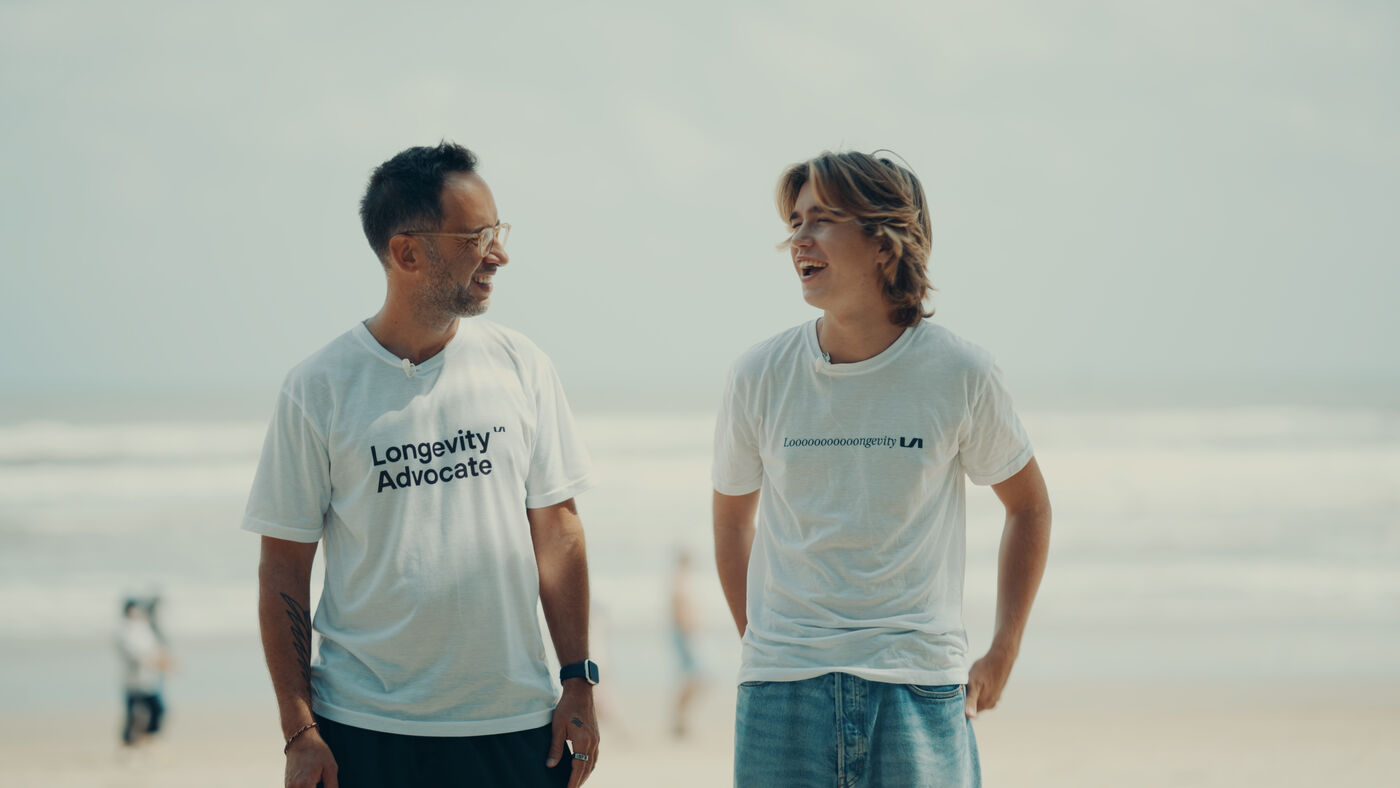
We met him in San Diego, at Human Longevity, for an afternoon that is still on this page in
his own words. He led the first sequencing of the human genome, built the first synthetic cell,
and founded both the institute that carries his name and the company that put deep screening
into the hands of people who were not yet ill.
Nothing here has been taken down. His interview stays, his sentences stay as he said them,
and his place among the people we met stays where it is. Nothing he told us
has stopped being true.
Who is Craig Venter
The man who read the genome
J. Craig Venter is one of the most influential scientists in the history of genomics. He led the private effort that first sequenced the human genome, later built the first cell controlled entirely by a synthetic genome, and mapped the microbial life of the world's oceans.
He founded the J. Craig Venter Institute, where he was founder, CEO and chair, and co-founded Human Longevity Inc. (HLI) to bring deep genomic sequencing and whole-body imaging to individuals, turning the tools of big science into a personal health check.
His longevity message is prevention. Testing, he argues, replaces uncertainty with knowledge: bloodwork, genetic risk scores and advanced MRI can reveal what the body hides long before symptoms arrive. Feeling fine, he reminds us, is not the same as being healthy, and a disease caught early is a fundamentally different fate than one found too late.
At HLI's screening, a striking share of seemingly healthy people learn they are carrying something serious they never suspected, the clearest possible argument for looking before you have to.
J. Craig Venter Institute · He was its founder & CEOHuman Longevity Inc. · Co-founderFirst human genomeFirst synthetic cell
San Diego · California
Where we met
An afternoon in San Diego
We met Craig in San Diego, at Human Longevity, an outdoor conversation about reading the genome, whole-body imaging, and why the real frontier of medicine is catching disease before it ever announces itself.
San Diego
Human Longevity
An outdoor interview on genomics, prevention and the future of personalised health.
The full scan
The HLI approach
Genome, bloodwork and advanced imaging together, seeing what symptoms keep hidden.
One number
53%
The share of people screened who learn they carry a serious disease they never suspected.
"On average now it's 53% of people, we find a major disease that they were unaware that they had."
Craig Venter · Human Longevity, San Diego
In his own words
Straight from the interview
From our San Diego conversation with Craig, why prevention beats cure, how HLI reads your health, and the standard he wants longevity science to hold itself to.
His view: prevention over cure
Testing replaces uncertainty with knowledge. Bloodwork, genetic risk scores and imaging can flag danger years before symptoms, because feeling fine is not the same as being healthy.
If we can prevent you dying from cancer or heart disease, the two major causes of death, you will live a much longer, healthier life.
San Diego · from the interview
How HLI reads your health
Genome, bloodwork and advanced MRI, read together. With today's algorithms, a hidden tumour becomes almost impossible to miss, diagnostics that were unthinkable a generation ago.
A 12-year-old kid can interpret the MRI images, 'cause tumours just literally light up.
San Diego · from the interview
His wish for the journey
For all his ambition, Craig is a stickler for evidence. His hope for the whole field is that it stays honest, grounded in data, never drifting into wishful thinking.
The key tenet of science is evidence-based decision making, which is very different than fantasy or philosophy or people selling hope and hype.
The video interview is coming. Recorded interviews go live after the launch of the film & series Live Beyond.
Our San Diego conversation with Craig ranged across genomics, whole-body screening and the case for prevention.
Not a longevity researcher
Marek Piotrowski“Hi, Craig. We are super happy that we have a chance to meet you and talk to you in San Diego. … So if you could tell us briefly your story.”
Craig Venter“Well, I’m not a longevity researcher. I’m a genome scientist. Starting in 1995, my team sequenced the first genome in history … The goal’s been to understand the genome and how it leads to life with the human genome, how your genome codes for everything about you. It’s very deterministic, but we are at the earliest stages still of trying to read that code.”
Craig Venter“Scientists and governments around the world thought what they needed to do to understand it was just sequence a lot of genomes, and that’s been pretty useless. It’s great for tracking populations and migrations, but if you want to understand your genome and how it codes for you, you need to understand all of your physiology, and that’s how Human Longevity came to happen.”
Healthy people who weren’t
Marek Piotrowski“But what was it called from the beginning, Human Longevity? Or was it even named?”
Craig Venter“It didn’t really have a name because it was a science project. But we figured that interpreting the genome and predicting from the genome would have an impact on longevity. And because the field really hadn’t started yet, we figured it’d be an interesting name, so I called it Human Longevity. … I’m trying to predict the future by understanding the genome. And we set it up just to have normal people who thought that they were healthy come in to get a complete phenotype analysis so they’d just understand their bodies better. And almost from the very first individual on, we started discovering that these healthy people weren’t so healthy.”
Craig Venter“We had a physician come through … A 12-year-old kid can interpret the MRI images, ’cause tumours just literally light up. We discovered this physician had a tumour underneath his breastbone, and he was just totally shocked ’cause he had no symptoms. And that was the first hint that we were gonna start to find things. … On average now it’s 53% of people, we find a major disease that they were unaware that they had.”
A very simple philosophy
Marek Piotrowski“You probably know Peter Attia. He just wrote a book, Outlive … And my biggest learning from his book was that most of the illnesses that we have, like heart disease, diabetes, cancer, they all start 20, 30 years before.”
Craig Venter“They don’t just miraculously appear. And so you could have a tumour for a very long time. You don’t become aware of it until it gets big and impinges on something or metastasizes … And so I developed a new philosophy for longevity, that it’s very simple. If we can prevent you dying from cancer or heart disease, the two major causes of death, you will live a much longer, healthier life. So my personal goal isn’t to make people live to 200 or 1,000. … We’re trying to extend the health span versus the lifespan.”
Craig Venter“My father died at age 59 from sudden cardiac death. Something we could have easily prevented here with the clinic, had he lived long enough to go through it.”
Feeling healthy, being healthy
Marek Piotrowski“This number is staggering.”
Craig Venter“So most people want to do something to control their health, but they’re limited in what they can do. So what can they do? You can try and control your diet. You can make decisions to smoke or not smoke. And you can do exercise. … But I tell people now that you can’t tell me if you’re healthy. You can tell me you feel healthy. We can tell you in fact whether you’re healthy or not.”
Muscle, brain and no retirement
Marek Piotrowski“I have three questions. So the first one is, what are you doing for your own longevity, apart from regular testing and Human Longevity?”
Craig Venter“Well, there’s two key things, three, that contribute to longevity. Number one, as I said, is good genetics. And no matter what you do, you can’t overcome it. … But it’s shown that muscle tone and exercise is the single most important thing other than good genetics. … So strength training at every age is critical.”
Craig Venter“And the third area is your brain. Your brain is like a muscle. It’s use it or lose it. … Most men die within five years of retirement because they lose their identity … they lose their purpose and goal and drive. So I will never retire. … During COVID, I learned to fly and got my pilot’s licence at age 72.”
For the young generation
Marek Piotrowski“The second question is, what would be your message to the young generation, to people like my son who is 18, for their longevity?”
Craig Venter“Quit smoking pot. Don’t start smoking cigarettes. Vaping is just as dangerous as cigarettes. And start a healthy lifestyle that you keep going. … Early athletic programmes are probably one of the most important things at school.”
Marek Piotrowski“So start early taking care of your health.”
Craig Venter“And develop healthy habits. And pick a sport that you can do for a lifetime. Swimming, tennis, things that are generally both social and constant physical activity, and forced mental activity as well.”
His wish for the quest
Marek Piotrowski“Usually at the end of an interview, we ask this question to our guests. What would you wish us for the rest of our quest for longevity around the world, me and my son?”
Craig Venter“So the key tenet of science is evidence-based decision making, which is very different than fantasy or philosophy or people selling hope and hype. And so I would hope very much that what you can do with your show, and what happens in this broader field, is that you shed light on the real basic science fundamentals in what’s real, what’s realistic hope, and what’s bullshit. Because people rely on documentaries to educate them and separate reality from fantasy, and reality can save people’s lives today.”
Craig Venter“Basic science, evidence-based decision making is the most important thing people can learn today, whether it’s in politics, whether it’s in making documentaries, or just making life decisions.”
Continue the quest
More minds on the quest
Craig stands on the Prevention bridge of the Longevity Map, here are others on the quest, and the full cast of 100+.