
The board
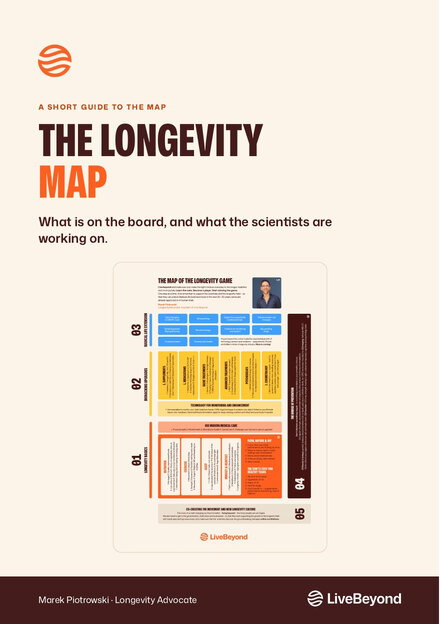
5 levels, 1 map
3 progressive levels, the Bridge of Prevention running across all of them, and a final move. It is the same shape as the map in the book. Open any level to see what is inside it.


Where ageing itself becomes the target
Everything up to here is about playing your own biology well. This level asks a different question: what if the ageing itself can be reset? Gene therapies change the instructions; partial epigenetic reprogramming changes how those instructions are read. Organs are being printed, grown and engineered, and at the far edge some people are buying time in the cold on a bet that medicine catches up. Most of it is still being tested — and none of it is science fiction any more, with biotech, medicine and AI now compounding on each other.
Open any part of this level to see what is in it.
01Gene & cell therapies
4 things
Changing the instructions themselves — correcting what is broken, adding what protects, and growing replacements for what has worn out.
- Gene therapies — still in research, and already being tested: telomerase, klotho, follistatin, PGC‑1α and many more
- CRISPR-Cas9
- Advanced stem-cell therapies
- Organs from genetically modified animals
Telomeres
The plastic tips on a shoelace. When they fray past a point, the cell retires.
Also one of the 12 hallmarks of ageing — 02 · Telomere attritionKlotho
A thread being spun. How much of it there is seems to set how long, and how evenly, the spinning goes on.
Also one of the 12 hallmarks of ageing — 10 · Altered intercellular communication
The one thing nobody would give me was a date. Not whether — when. George Church is the person you ask, and the answer is never really a fact about biology: it is a fact about how much money, attention and permission the field is given. So I put it to him straight — within fifteen years, will we be rejuvenating our organs, the whole body and not one piece of it?
It depends on who we are. The people that will be starting clinical trials next year might start rejuvenating their organs next year. Right. But I don’t expect the average person to be seeing this for at least 15 years.
02Partial epigenetic reprogramming
3 things
Not rewriting the code but resetting how it is read, so a cell behaves like a younger version of itself without forgetting what it is.
- Partial epigenetic reprogramming
- Resetting cellular age
- Rejuvenating drugs
Epigenetics
Switches on top of your genes. The sequence is fixed; which parts are switched on is not, and that is where lifestyle actually reaches your biology.
Also one of the 12 hallmarks of ageing — 03 · Epigenetic alterationsPartial epigenetic reprogramming
A conservator cleaning an old photograph. Go carefully and the picture comes back. Go too far and the picture comes off with the dirt.
Biological age and the epigenetic clocks
2 watches on a table. One counts birthdays and cannot be argued with. The other counts wear, and it can be running fast or slow.

The blood comes from the bone marrow. And if you make the bone marrow young again, it will produce young blood. And young blood is known to rejuvenate tissues.
That is the logic of this whole level in three sentences: do not chase the symptom, go back up the chain to the thing that produces it. Make the factory young and it starts turning out young parts again. Dave has been funding work like this for twenty years, long before anybody called it an industry.
03Engineering resilience
6 things
Building the spare parts: printed tissue, engineered organs, and machines small enough to work one cell at a time.
- 3D bioprinting
- Nanotechnology
- Growing new bodies
- Growing new organs
- Implants that monitor
- Implants that support
Stem cell exhaustion
A workshop keeps a rack of good blank timber for repairs. Every year the rack holds a little less, and what is left is harder to work. Nothing looks wrong until something needs mending.
Also one of the 12 hallmarks of ageing — 09 · Stem cell exhaustion04Frozen time
2 things
The far edge of the map. Buying time on the chance that medicine arrives later — and held honestly as a bet, never as a promise.
- Cryopreservation
- Biostasis — the far edge, 20 or 30 years out