The largest longitudinal ageing study in the world
7–10×
How much faster dogs age than we do
Five
The number of things he takes
0.5%
Share of the NIH budget for ageing biology
Who is Matt Kaeberlein
Nine of the top ten causes of death
Matt Kaeberlein is a biologist of ageing, and the founder of the Dog Aging Project: which has grown into the largest longitudinal study of ageing in the world, following more than 50,000 companion dogs and their owners.
The choice of dogs is not sentimental, it is arithmetic. Dogs age seven to ten times faster than we do, they share our homes, our air and our water, and they get the same diseases, including a canine dementia that looks like ours at both the behavioural and molecular level. His rapamycin trial is designed to detect a 9% change in lifespan in three years. The same experiment in people would take three decades and thousands of participants.
What the longitudinal data has already turned up is genuinely surprising. Dogs fed once a day rather than more often were less likely to have been diagnosed with every one of ten different age-related diseases. Nobody yet knows the mechanism, fasting, time-restricted feeding, or simply less obesity.
He is also, usefully, the most sceptical voice we met. He takes five things: creatine, vitamin D, omega-3, a B vitamin and rapamycin. His reasoning is mechanical rather than moral, the body is the most complicated machine you can imagine, and if you go in and start changing things at random, you are far more likely to break it than improve it.
And he makes an argument about money that deserves to travel further than it has. Half of one per cent of the NIH budget goes to the biology of ageing, roughly $350 million, against $3 billion for Alzheimer’s and $6 billion for cancer, despite ageing being the greatest risk factor for nine of the top ten causes of death.
Dog Aging ProjectRapamycinBiomarkers of ageingResearch funding
Seattle · June 2024
Seattle, June 2024
Where we met
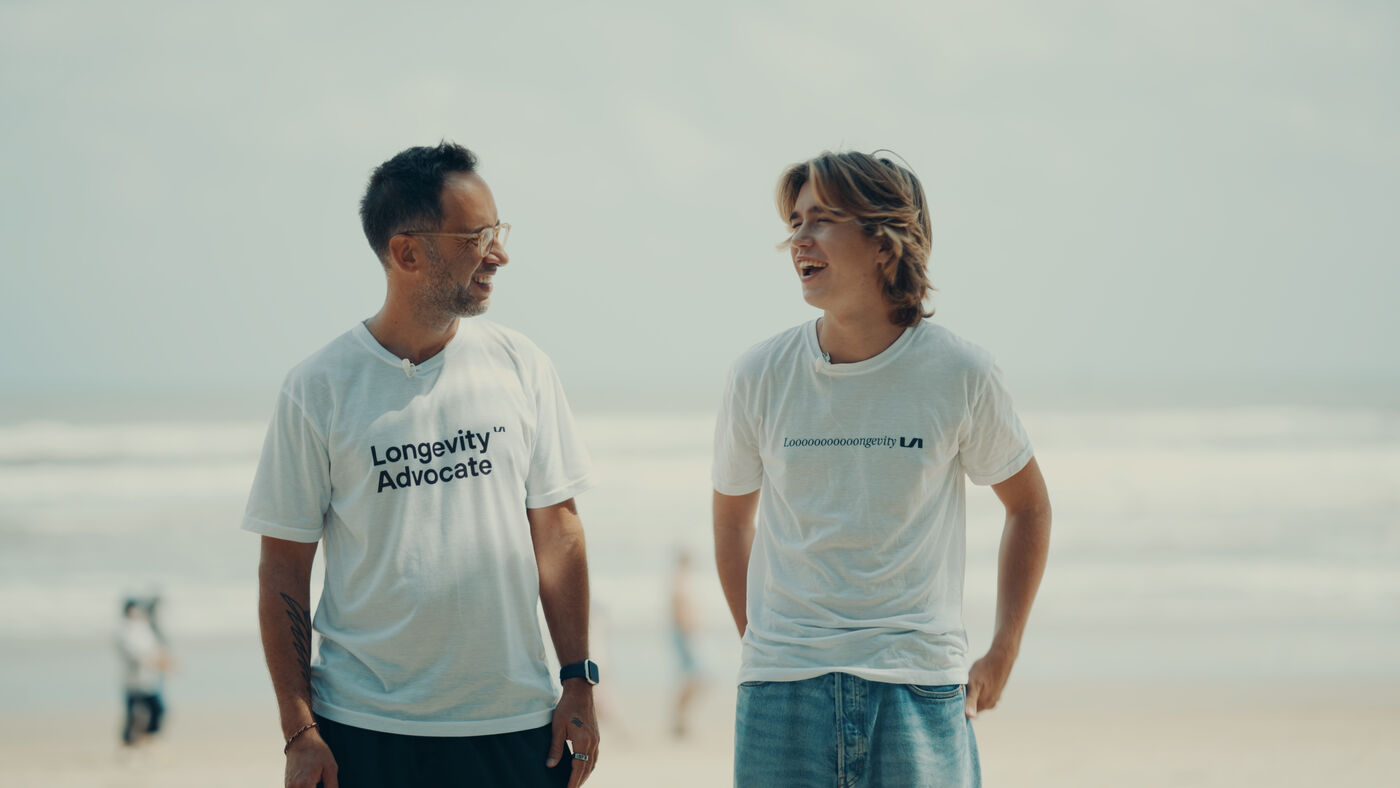
We had met briefly in Dublin at the start of the quest without really talking. Ten months later, staying nearby on Liz Parrish’s island, we came into Seattle on the ferry with Mount Rainier out, and finally had the conversation. It is one of the most level-headed hours of the whole journey, and it closes on something that had nothing to do with science.
Dublin
Early in the quest
A brief first meeting at the conference, no time to talk.
Seattle
June 2024
The full conversation, rapamycin, dogs, supplements and funding.
The Dog Aging Project
Ongoing
50,000 dogs; a rapamycin trial powered to read out in three years.
“I think joy is probably the underappreciated aspect of health span. So I think you guys are doing it right.”
Seattle, June 2024. We had met once in Dublin near the start of the quest; this was the first real conversation, ten months later.
In his words
Be pretty sure before you change anything
“Our bodies are extremely complicated machines, probably the most complicated machines you can imagine. And if you think about any machine, and you just go in and start randomly changing things, the likelihood you’re going to make it better is much less than the likelihood you’re going to make it worse.”
Matt Kaeberlein · Seattle, June 2024
Rule number one of longevity: don’t die.
Matt Kaeberlein
Most billionaires didn’t get to be billionaires by being stupid. They can recognise when somebody’s selling them something that’s BS.
Matt Kaeberlein
We’ve been very good at showing that we can modulate the ageing process, increase lifespan and healthspan in laboratory animals. But what we haven’t yet done is actually be able to show that we can do that in human beings.
Matt Kaeberlein
You only get one body.
Matt Kaeberlein
In his own words
Straight from the interview
From the conversation in Seattle, what he actually takes, what the dogs have taught him, and the argument he wants policymakers to hear.
What he actually takes
Five things: creatine (for lean mass, alongside resistance training), vitamin D (he is deficient without it, like most of the Pacific Northwest), omega-3, a B vitamin, and rapamycin. He is pointed about the alternative, people taking twenty, fifty, a hundred compounds, with almost no laboratory data on how any of them combine.
“I want to only take things that I’m pretty confident are much more likely to have a benefit than do harm.”
Seattle · from the interview
Why dogs
They age seven to ten times faster than we do, in our houses, breathing our air. That compresses a three-decade human trial into three years. His study is powered to detect a 9% change in lifespan, and the longitudinal arm has already found that dogs fed once a day were less likely to have been diagnosed with all ten age-related diseases examined.
“I think the one thing that’s clear is the biological ageing process in dogs is very, very similar to the biological ageing process in people.”
Seattle · from the interview
The funding argument
Roughly $350 million of NIH money goes to the biology of ageing each year, against $3 billion for Alzheimer’s and $6 billion for cancer. Reallocating half of the disease-specific funding would grow the field ten to twenty fold. His view is that the case has simply never been made properly to legislators.
“I don’t think anybody would disagree that it’s better to keep people healthy than keep them sick. I think the message is the science of ageing has gotten to the point where this is reality.”
The video interview is coming. Recorded interviews go live after the launch of the film & series Live Beyond.
From the conversation in Seattle, June 2024. Lightly edited for readability.
On what the field still cannot do
Matt Kaeberlein“I think we need, on the industry side, a clear path to evaluating whether interventions, those could be drugs, they could be lifestyle changes, are actually impacting longevity in people. I think we’ve been very good at showing that we can modulate the ageing process, increase lifespan and healthspan in laboratory animals. But what we haven’t yet done is actually be able to show that we can do that in human beings. So we need a path, and I think there are lots of smart people working on that, but so far nobody’s done it.”
On why lifestyle is not a lesser answer
Matt Kaeberlein“I think when we talk about the role of lifestyle factors in healthspan, it’s the most important thing. … They think they already know what they should do: eat a healthy diet, exercise regularly, sleep, avoid stress, right? Those are all true. The reason why those things have an impact on health and multiple age-related diseases is precisely because they modulate the biology of ageing. So you’re right. I think what we don’t have yet are proven ways that we can go beyond those lifestyle factors to further enhance healthspan and/or increase lifespan in people.”
On taking fifty supplements
Matt Kaeberlein“Even in laboratory studies, we have very little data on combinations, right? Which is actually important because most people who take supplements that they think are going to help improve their healthspan or lifespan, they’re not just taking one thing, they’re taking five, ten, twenty. Some people are taking fifty at a time, which in my view is actually pretty risky because we really have no idea how these things are going to interact. … Our bodies are extremely complicated machines, probably the most complicated machines you can imagine. And if you think about any machine, and you just go in and start randomly changing things, the likelihood you’re going to make it better is much less than the likelihood you’re going to make it worse.”
Marek Piotrowski“So tell me, what are you taking then?”
Matt Kaeberlein“I’m pretty tame mostly. … I do take creatine. And I think the data there is clear. That’s not necessarily a longevity drug. … It’s more for body composition. So I very much am a strong proponent of resistance training. … I supplement with vitamin D because like most people in the Pacific Northwest, I am very deficient if I don’t supplement with vitamin D. I take omega-3. Again, the literature there I think is compelling. I take a B vitamin. And then I take rapamycin. That’s it.”
On the Dog Aging Project
Matt Kaeberlein“The Dog Aging Project is what we call a longitudinal study of ageing, mostly. So what that means is we are following dogs throughout their lives, collecting information on that dog’s genetics and environment, and environment captures pretty much everything else. So what’s their home life like? Are they around other dogs? How many people? What do they eat? How much do they exercise? What’s the quality of the air they breathe, the water they drink? … It has grown into the largest longitudinal study of ageing in the world. More than 50,000 dogs and 50,000 owners participating in this study to understand ageing in dogs.”
Matt Kaeberlein“One of the things that surprised me was that dogs that are fed once a day compared to dogs that are fed more than once a day are less likely to have developed a whole bunch of different age-related diseases, and so we looked at 10 different age-related diseases, and in all of them, the dogs fed once a day were less likely to have been previously diagnosed than the dogs fed more than once a day. Now, is that an intermittent fasting effect? Is it a time-restricted feeding effect? Is it an anti-obesity effect? We don’t know the mechanism yet, but there’s clearly this very, very strong correlation.”
On why the timescale matters
Matt Kaeberlein“The biological ageing process in dogs is very, very similar to the biological ageing process in people. It just happens about seven to 10 times faster. … Dogs are ageing biologically faster than we are, which means we can actually study the ageing process in dogs about seven to 10 times faster than we can in people. … So our clinical trial is designed to detect a 9% change in lifespan in three years. That would take you three decades in people, and you’d need thousands of people in that clinical trial.”
On the money
Matt Kaeberlein“Right now, one half of 1% of the NIH budget is going to research on the biology of ageing, despite the fact that the biology of ageing is the single greatest risk factor for almost every major cause of death and disability in the United States. So $350 million, approximately, goes to biology of ageing research. $3 billion or so goes to Alzheimer’s disease. $6 billion or so a year, this is the yearly budget, goes to cancer. If we reallocated half of the disease-specific funding to the biology of ageing, that would increase the total funding for the field in the United States by 10 to 20 fold.”
Matt Kaeberlein“I think if you look at the top 10 causes of death in the United States, nine of them have ageing as their greatest risk factor. So targeting the biology of ageing is a far more efficient and effective approach to keeping people healthy, free of disease, free of disability, than what we have done, which is to wait until people are sick and then try to treat their disease.”
His message to Aleksander’s generation
Matt Kaeberlein“First of all, it’s a great time to be a young person. … If I could go back and start over in this field, I would. … So one of the things you want to do is stay alive. So that’s rule number one of longevity, don’t die. And the other is, I think the earlier you can actually start to focus on your own health, the better. … They need to recognize, first of all, you only get one body. There’s this, I think it’s Warren Buffett who said: what if you could have any car you wanted? Could be a Ferrari, Lamborghini, whatever. You could have any car you wanted. It’s the last car you can have for the rest of your life. How are you going to take care of it? … The same thing is true with our bodies.”
His wish for the quest
Matt Kaeberlein“What I would say at a personal level, right, is human connection, and I think joy is probably the underappreciated aspect of health span. So I think you guys are doing it right. You’re spending time with your son, travelling the world, meeting new people, seeing new places. So I would simply wish you the best opportunity to engage more deeply with each other and do it in a joyful way.”
Continue the quest
More minds on the quest
Matt Kaeberlein sits in Biohacking Upgrades (rapamycin, biomarkers) with a strong second life in Creating the Movement: his funding argument is an advocacy case, not a laboratory one.