On the cell as a language
Marek Piotrowski"What is partial epigenetic reprogramming — the basis of the science?"
Vittorio Sebastiano"A cell works like a language. DNA is the alphabet, the bases come together to form genes — the words. But the epigenetic program is the grammar that decides which genes are switched on or off. With age, that set of rules becomes dysfunctional. We showed, for the first time in human cells, that by expressing a cocktail of factors we can reset those rules back to a youthful, functional state."
On systemic rejuvenation, one tissue at a time
Vittorio Sebastiano"I don't believe in reprogramming every single cell in the body — that gives me goosebumps; it has safety implications, and safety is always our top priority. But if a tissue is a master regulator of aging, targeting it could have a systemic effect. The immune system is one. The ovary is another — there's a clear connection between ovarian aging and systemic aging in women."
On doing it the right way
Vittorio Sebastiano"There are ways to accelerate science dramatically — but it has to go through a rigorous process. My issue with the pioneer, non-standardized studies is that they only report the good things; there's nothing on complications or adverse effects, and that's the most important information. As a friend, I'd ask you not to do it now — but as part of a clinical trial done the right way? Absolutely, why not."
His message to the next generation
Aleksander Piotrowski"What's your message to the younger generation about longevity?"
Vittorio Sebastiano"Aging is a clock ticking from the very first day — so from the get-go we should think about our health. And what's the point of super-duper, science-fiction technology if we let child obesity skyrocket? It's a shame that, at least in the States, sodas are cheaper than water. There's already a lot we can do today — and we're not doing it."
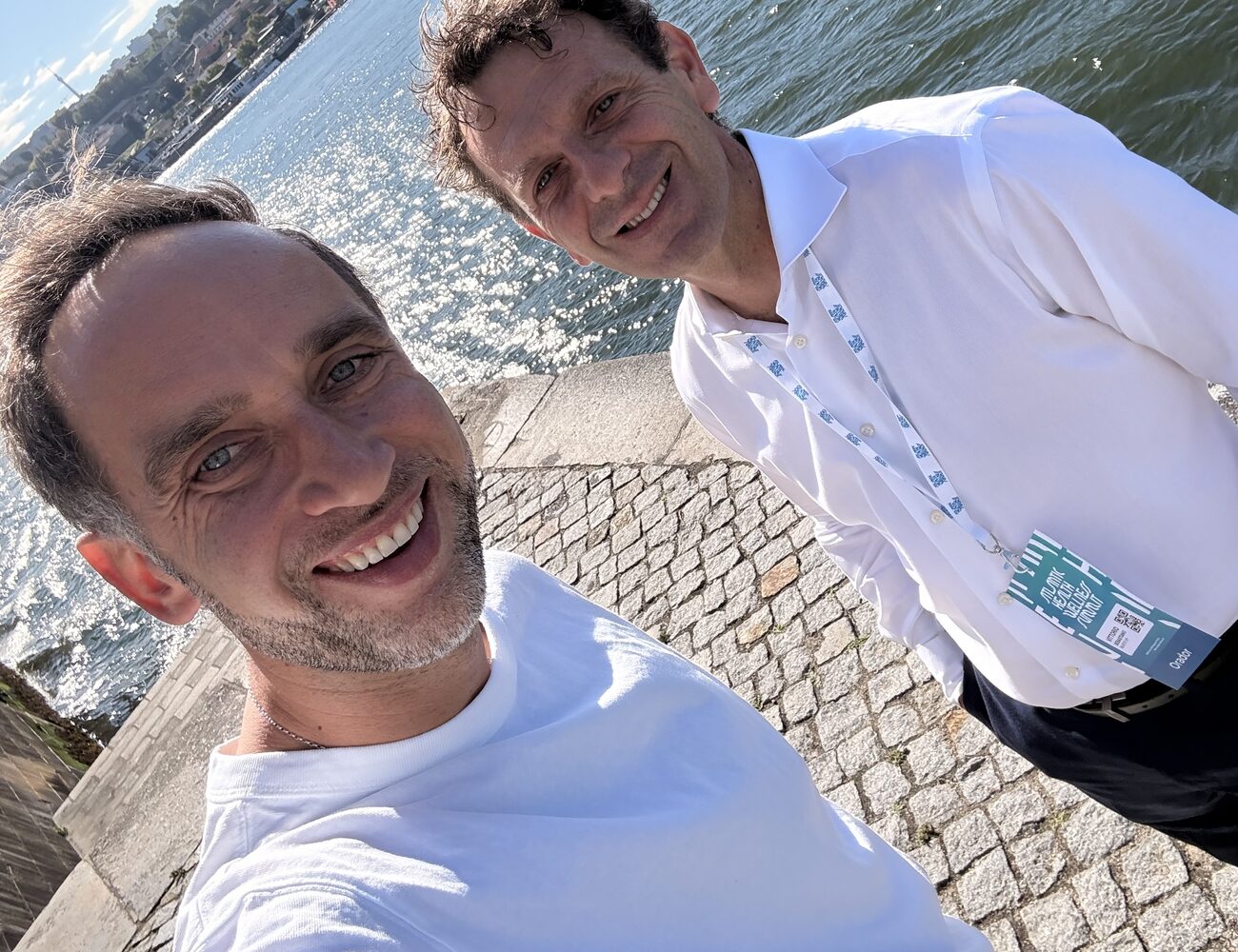
And from the second conversation — on the cliff above the sea at Irvine, California, in December 2025.
On what the reset actually does
Vittorio Sebastiano"It is indeed reversing the biological clock of the cells, and it's doing it across all the so-called hallmarks of aging, which are these manifestations of aging at the cellular level. The factors that we are delivering inside the cells, the mRNAs that we're delivering, they make proteins, and these proteins go into the nucleus of the cells and they reset, they rewire, they reorganize the epigenetic program of the cells. Keep in mind that the epigenetic program is the program that fundamentally tells a cell what to do. With time, it becomes dysfunctional. What we are doing is resetting that program to a functional state… You are empowering the cells, your own cells, again, to do the good job they're supposed to do when they're youthful."
On the cliff, and staying above it
Marek Piotrowski"Maybe not tomorrow, but in 5 or 10 or 15 years, I will go to the doctor, to a longevity clinic, and I'll say: I'd like to turn back the clock of my cells by 15 years. Do it for me. So is it going to work like that?"
Vittorio Sebastiano"I cannot tell you exactly that you're going to choose the age that you're going to end up with. It could be one year, it could be 10 years, it could be 15. Who knows? But actually, think bigger than that. Imagine a future where instead of reversing something that has already been heavily damaged, you prevent something from being heavily damaged… We are here in this beautiful place. You just keep it just above the cliff so that you don't fall from the cliff."
On promises, and facts
Vittorio Sebastiano"Right now it's something that maybe sounds science fiction, but in my opinion, we're going to get there. There could be a future where you can choose: now I'm going to say, I want to have 10 years back. And once you get there, aging at that point is going to start kicking again — you could, at that point, keep yourself at that verge. Still a ton of work to do, obviously. I don't want to sell promises. I want to sell facts."
On organs that age at different speeds
Vittorio Sebastiano"The organs in your body are not aging at the same pace. The organs in your body are not all chronologically the same as your chronological age. Some are younger, some are older. And depending also on your genetics, this is going to drive the way you're going to age over time. If we understand why this happens, how this happens, the synchronicity of this, maybe you can even think about not rejuvenating the whole body. You can target the first organ that ages and prevent it from aging, and then you target the second, and then the third, and then the fourth."
On why one organ is enough to start with
Vittorio Sebastiano"The implications of rejuvenating one organ go beyond that organ itself, because that organ speaks to every other organ in the body. Rejuvenating one organ could actually be the key to rejuvenating maybe not everything, but a lot… The ovary doesn't go everywhere, it's in one location, but the implication of the aging of the ovary is so broad that rejuvenating that could actually rejuvenate the bone, the muscle, the cognitive functions… The hypothalamus is definitely a key organ that we have to look at. It really regulates systemically the way the body ages, because it communicates through hormones and through other molecules with the rest of the body."
On where the science actually is
Marek Piotrowski"Where are we most advanced now with partial epigenetic reprogramming, which organ? Is it an eye, is it skin, is it blood?"
Vittorio Sebastiano"I can tell you for sure the work that I'm most familiar with, which is mine — we are very advanced in the immune system. We have very strong data showing that you can rejuvenate the T cells, which are the cells that are going everywhere and fighting cancer and pathogens. We have strong data in skin. We have strong data in the eye, in the front of the eye. And then other people are working very efficiently, for example, in liver rejuvenation, the back of the eye, the retina and the retinal ganglion, which is basically the nerve that allows us to see."
On the eye, and the nerve that grew back
Vittorio Sebastiano"What was done was to induce a damage in the eye, both in young and in old mice. This damage, which is basically increasing the pressure in the eye, which happens to many people, by the way — it leads to glaucoma. The pressure that builds in the eye damages the back, which is where these retinal cells are. As a function of that, the cells lose their connectivity with the brain, to put it in simple words. What has been shown is that if you come in now and you inject some viral vectors that encode for these factors, rejuvenating factors, those factors go into those back cells and they start rejuvenating the retinal cells to the point that they can regrow that nerve that was damaged."
More passages from the full interview will be published here.