
The Live Beyond article series · 01
The most important thing I learned on the Quest, I didn’t learn from the scientists
A year on the road with my son and more than a hundred longevity scientists. The most important thing I learned came from the teenager in the passenger seat — and from Srikumar Rao, who told me he had never thought about longevity until my email arrived.

In June 2024 my son and I travelled out to Long Island, to the house of a teacher who had once changed my life with a single sentence.
His name is Srikumar Rao. In 1994 he built a course called Creativity and Personal Mastery — at Long Island University first, then Columbia, then London Business School — and it became the rare business-school elective that asks people what they actually want out of a life. When I wrote and asked him for an interview he answered warmly, and with a warning: “I’m not a longevity guy.”
I told him he was. He teaches people how to hold their mind, their heart and their body as one thing. If that is not longevity, I do not know what is.
He and his wife met us at the door like grandparents. We set up two cameras in the front room and sat there for hours. And somewhere in the middle of it he asked me what I had actually learned so far — not what the scientists had told me. What I had learned.
I heard myself start talking about my son.

Resilience. But not the kind I went looking for.
I love longevity science. I believe in it, and I will do everything in my power to help it grow. I do not want to be a bystander, cheering the scientists on from the side. If we really want to stay as long as possible in this beautiful world, then helping the science along feels like a sacred duty.
But when people ask me what the most important thing I learned on the Quest was, I always answer the same way: it was not something I learned from all those brilliant scientists. It was something I learned from my son.
It is resilience. Resilience in a relationship.
The first six months of travelling together were sometimes hard. We were seeing the world, which was wonderful, and we had a great many tensions and disagreements too. Two people in each other’s company every hour of every day, in cars, in airports, in other people’s houses.
When a disagreement happened, I was devastated, and I wanted it solved immediately. In the evening — sit down together, discuss it, resolve it. Or first thing the next morning at the latest.
And in the meantime I was blaming myself and tormenting myself, thinking: it is my fault. My son is my mirror. He must have learned this behaviour from me.
Then I noticed something.
Alek, fifteen minutes after a fight, was often behaving as though nothing had happened. As though everything was fine. Because to him, it was.
At first that irritated me. Then it confused me. And then I decided to try doing the same.
Here is what I told Srikumar:
“And at the beginning, it was hard for me to get that, but then I tried to do it. And then, you know, we had a tension, and then we were just after fifty minutes just talking to each other like nothing has happened.”
“And that was amazing.”
What I understood is this, and it took me forty-eight years and thirty-nine countries and states to understand it:
If two people love each other, and they want the best for each other, that is more than enough.
We are all a bit different. We look at the world differently and disagreements will happen — that is a natural thing, and it is not a sign that anything is broken. But it does not follow that we have to analyse and solve every single one of them.
Twenty per cent of them, yes. Sit down, resolve it, learn something.
The other eighty per cent we can simply skip, and live on, and enjoy the relationship and the life we actually have.
The most important thing is that we love each other, and that we have each other.
I said something close to that to Srikumar, in his living room, about the Quest itself — that the science would be wonderful if we found it, but that this was already the thing we had.
Me: “And if we achieve it, amazing. But on the way, we have so many other beautiful experiences — and one of them is our father-son, son-father relationship. Even only having that from the journey, we already succeeded.”
Srikumar Rao: “Exactly.”
Me: “If we get more from that—”
Srikumar Rao: “That’s a bonus. Absolutely. Yes. Right on, Marek.”
I have thought about that word ever since. A bonus. Everything I had flown around the world to find, put in its right place in four seconds.
And his way of looking at things did not stay in that room. For the rest of the year, whenever something went wrong or was lost — a missed flight, an interview that fell through, a bad day between the two of us — Alek and I got into the habit of asking each other what good was going to come out of it, and what it was going to teach us. That habit is Srikumar’s. We are both still doing it.

Why that belongs in an article about longevity
Because that is longevity. It is not the soft bit at the end of it.
Our mindset, our heartset, our relationships — that is the ground everything else is built on. There is no supplement that survives a life you are not happy inside. There is no protocol that outruns loneliness. Every serious researcher we met said some version of this, usually about ten minutes after they had finished explaining their actual science.
I had asked Srikumar, plainly, how he would inspire more people to live better and healthier lives. He began by telling me that he had never once given longevity a thought until my email arrived. Then he gave the best answer anybody gave me all year.
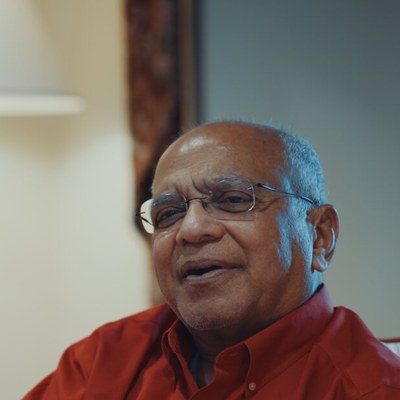
— Srikumar Rao“My take always has been that life is altogether too short, and each day that you spend where you’re not radiantly alive, if not all the time, at least for a portion of the day, if your blood is not singing at the thought of being who you are and doing what you do, then your life is wasted.”
“I frequently say that each day is your life in miniature. You are born when you wake up in the morning, you die when you go to bed at night, and in between is your entire life in miniature. So make the most of each day. And if you make the most of each day, you don’t have to bother about the rest of your life. It’ll be fine.”
A man who had never given longevity a thought, saying the truest thing about it I heard in a year among people who think about nothing else.
So: start there. And then, together with the wonderful scientists, doctors, coaches and healers, let’s add more resilience to our cells too. And ultimately — let’s rejuvenate.
Resilience in the relationship, then resilience in the cell. That is the order I would now recommend to anybody, and I got it the wrong way round for most of my life.
What we actually did
For one year, my son Aleksander and I travelled to meet the people who are changing how long and how well human beings live.
Thirty-nine countries and states. Over a hundred experts — geneticists at Harvard and healers in the Andes, doctors, monks, biohackers, nutritionists, a woman who has injected herself with four experimental gene therapies. Five hundred hours of footage. One camera that my son taught himself to use, because he hated being in front of it. A great deal of cheap food.
People assume I went to collect the science. I did collect it, and there is a film and a book coming out of it.
But that is not why I went.
I went because my son was seventeen and about to leave, and I could already see the shape of the rest of my life: a call on Sundays, a summer visit, a slow and perfectly polite drift. I wanted one more year with him before that started.
The longevity was the excuse.

The thing I did not expect
Doors opened for us that would never have opened for me alone.
I am fairly sure that many of the scientists, doctors, healers and everyday biohackers we met let us in because we arrived as a father and a son. Not as a crew. As two people who were obviously in the middle of something. They invited us into their homes — evenings at Amy Killen’s kitchen table with her family, a forest walk with Liz Parrish, dinner with Anna Campbell in New Zealand.
If you asked the longevity world whether they know Marek Piotrowski, some would say no. If you asked about the guy travelling the world with his son on a quest for longevity, most would smile.
That is not a mission. That is a story. And I have come to believe the story is the whole thing.
What longevity actually means, in the words I use
Most of the argument in this field comes from people meaning different things by one word, so let me put mine down plainly.
lon·gev·i·ty /lɒnˈdʒɛvɪti/ noun
Longevity is the art and science of living longer, healthier and more fulfilling lives.
Science, because the science is real and moving faster than the public has any idea.
Art, because knowing what to do has never once been the hard part. You already know about sleep. The art is the part where a human being actually changes.
And fulfilling, which is not a softener on the end of the sentence. It is the point. A guide in Sardinia told me she would happily live a thousand years if she were happy, and would not want tomorrow if she were not. A prince I interviewed in Warsaw, asked what our societies most need, did not say medicine. He said more joy — and then said joy is itself a contributor to health.
More years without more life is not a prize. It is a longer wait.

What happens now
This is the first of a few pieces, and then something better than pieces.
Every week from here I want to introduce you to one of them. One person we met, and their story — mostly the parts that fitted into neither the film nor the book, because there was never room. The scientist who ran up two flights of stairs rather than take the lift. The healer whose grandfather prayed to trade his own life for his grandson’s, and died three days later. The man who runs the longest study of happiness ever conducted, and asked to be interviewed in a cemetery.
What I am giving you here is simple, and it is everything I have: the room. The people we met, the way they actually talk, and the things they said once the camera had been running long enough that they forgot it was there.
I want to put you in that room, because that room changed me, and I think it might do something for you too.
One last moment from a tape. Last December we spent a day in Los Angeles with Peter Diamandis, who has built a life out of getting people to believe the future is worth arriving at. Near the end, after an hour with the two of us, he turned to my son and said:
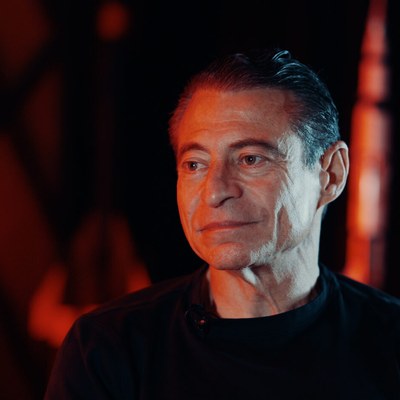
— Peter Diamandis“I can’t wait to do a journey like what you did with your dad.”
“I’m, I’m so, so excited about that opportunity.”
He has two children of his own. He was not being kind to us. He wanted it.
So do it. Not for a year — nobody has a year. For a summer. For a week. Take someone you love somewhere neither of you knows, and ask strangers what they have learned about being alive.
That is where I would start, and I have been to thirty-nine countries and states looking for a better answer.
Next week: what my son found when he came home, and why it is the reason I am writing any of this at all.
Marek and Aleksander running, New Zealand, February 2024. · Live Beyond