
The Live Beyond article series · 05
Aging is a disease. So let’s treat it.
One of the world’s leading longevity doctors, Andrea Maier, on why aging is a disease we can treat, on being optimal, and on my friends who don’t want to know.

The first time I sat down with Andrea Maier, at Longevity Summit Dublin in August 2023, she was one of the first people I asked for an interview, and she wasn’t sure about me at all. I wasn’t sure about her either. I had seen her lecture in Cascais, and in my head she was the strictest person in longevity: data first, nothing allowed until it is proven. Then, just before the camera started rolling, she told me that her own medical colleagues see her as the crazy one. So that became my very first question: are you crazy, or down to earth? Her answer:
“If you put me in that system and the context, I’m very, very innovative, and people perceive me as crazy. Why should we change the healthcare system? Because we are doing so well. Why should we call aging a disease? I think I’m very provocative to say:”
“Yes, of course, aging is a disease because we understand it, so let’s treat it.”
One of the most respected longevity physicians in the world, a doctor who advises the World Health Organization, saying out loud what most doctors won’t: aging is a disease, and we can treat it. She has been saying it for fifteen years. And she can, because she never says it without the science behind her:
“I wouldn’t call it crazy, but provocative, because if you do that with science and you have in your backyard, you have that research, and people know you because you’re a good scientist, I think you can be quite provocative, and that’s what I like.”
That sentence can change how we think about our own health. If aging is a disease, you don’t wait until it shows up. You look for it early, you measure it, and you treat it while there is still time. Which is exactly what some of my friends refuse to do.
Before our quest, I was stupid about my health. I knew diagnostics were important, but I didn’t feel it. I eat well, I exercise, I meditate, I take care of myself, so why should I get tested? I’ll do it tomorrow. Next month. Next year.
Then, on the quest with my son, I was lucky enough to do thorough diagnostics at some of the top longevity clinics in the world: first, and most thoroughly of all, at Chi Longevity in Singapore, co-founded by Andrea, then at Human Longevity in California and the Longevity Center in Warsaw. Since then I have added YEARS in Berlin. And I became a missionary to my friends. Do it, I told them. Do the full check-up, learn what’s there, then fix it or prevent it.
Some of them looked at me and said: I don’t want to know.
That surprised me. Not because I had always been brave. Before the quest I had been putting it off too: tomorrow, next month, next year. (And let’s be honest: thorough diagnostics at a good longevity clinic are expensive, too.) But my friends weren’t putting it off. They had gone to another level. They were afraid of hearing that something was wrong with them. So afraid that they would rather live without knowing, even if it meant dying earlier.
I understand that fear. But I think it is wrong, and I think people need to hear why. With today’s medicine and technology we can find so many things at stage 1, when they can still be fixed or healed, instead of meeting them at stage 3 or 4, when it is much harder, and sometimes impossible. For me, one of the rules of longevity is simple: don’t die from something stupid. And if you die from something preventable, that is stupid.
A few months later, at ARDD in Copenhagen, the big conference on ageing research, I told this story to Andrea. She and Dr Naras Lapsys from her team were going through my results with me. Her answer surprised me more than my friends had.
If you don’t know her yet: Andrea is a Professor of Medicine at the National University of Singapore, where she co-directs the Centre for Healthy Longevity, and a Professor of Gerontology at Vrije Universiteit Amsterdam. She co-founded Chi Longevity, the first longevity medicine clinic in Singapore, and was the founding president of the Healthy Longevity Medicine Society. She advises the World Health Organization on the UN Decade of Healthy Ageing, and she is one of the most sought-after speakers in the world on longevity and precision medicine. In short, she is not just studying the future of medicine. She is building it.
Not sick is not the same as optimal
Andrea didn’t argue about who is brave and who is afraid. She went past the whole question of what is wrong with you:
“… even if you’re just normal, everything looks okay and looks good, how to make you optimal. So how to really push you into a situation where you have the lowest chance of having something abnormal in the future.”
So I told her the truth: I feel amazing. In my mind, my heart and my body. I hadn’t been sick in six years. She smiled and didn’t let me hide behind it:
“… but are you optimal? That’s I think the question.”
A year earlier, at our very first interview in Dublin, she had already explained why “nothing printed in red” isn’t good enough:
“So normal is not enough. So if you just have normal scores in school, like parents most of the times are not very excited. You want to be the best in class, and the same holds for our body.”
And then the question nobody had ever asked me:
“Why should we just deteriorate in the function, and why is normal just enough in terms of our bodily functions? Why is nobody asking you, is your body optimal? And that’s what we have to achieve.”
And she wants it for everybody, not only for people who can afford a private clinic:
“I am really advocating, not fighting, but advocating for a framework that it can be implemented in the end into normal hospital systems or into the healthcare systems, because I think that’s what we need to democratize health in the end.”

She understands the fear
What I liked most is that she didn’t laugh at my friends. In her own living room in Singapore, she had told me she gets it:
“But sometimes it’s also scary to know you, and I absolutely get my patients and my clients sometimes saying, ‘Maybe I should not know it.’ What I learned in the past out of geriatrics, that I feel it’s nearly unethical to measure without having a solution in mind.”
That changed how I talk to my friends. A good test is not a verdict. In Copenhagen she put it in one line:
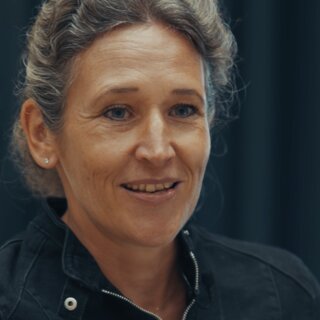
— Andrea Maier, ARDD, Copenhagen, August 2024“… it’s a test, so don’t worry about it because we wouldn’t test if we couldn’t change it.”
Then she explained it with a car:
“So we have to test because we need to know what to do. If you have a car, so you only have to fix the engine, not something else in the car if there is a problem with the engine.”
“But you can change your body. It’s a beautifully, crazingly nice thing which you can manage. So you can grow muscle, which you should do.”
Room for improvement
Even the results that sting can be funny. I told them that I already eat pretty well. Andrea started laughing before anyone said a word, because their dietitian, Denise, had looked at what I eat:
Dr Naras Lapsys: “Denise said there’s room for improvement.”
Andrea Maier: “Sorry. Sorry, I didn’t want to say it.”
Marek: “Okay. But that is good news … because if there was no room for improvement, that would be bad.”
Dr Naras Lapsys: “There is room for improvement. It’s actionable.”

I still think I eat like a saint compared to my friends. But that is exactly the point. Compared to my friends is not the same as optimal.
22 years older than my passport
One number didn’t make anyone laugh. GlycanAge is a test that reads the sugar molecules, the glycans, attached to your antibodies. Their pattern shows how much chronic, low-grade inflammation is going on in your body, the slow kind that ages you from the inside without making you feel sick. In March 2024 my GlycanAge was 15 years older than my real age. A few months later I tested again: plus 22.
After that second result I talked to Nikolina Lauc, who leads GlycanAge. She learned my story and told me that research shows people who lived through major trauma often carry 15, 20 or even more extra years on their GlycanAge. The trauma I lived through as a child could be one of the reasons. Trauma keeps us in a constant, subconscious state of fear and stress, in the body, the mind and the heart, and that stress feeds chronic inflammation. That is why healing trauma, starting with the mind and the heart, matters so much.
I healed my trauma years ago, with MDMA-assisted therapy, which I will write about in one of the next articles. But by then it had already taken its toll. That is a lesson too: the sooner we take care of our traumas, depression and stress, the better, for us and for the people around us. I am so lucky that I dealt with mine. Without that, I probably would never have set off on this quest around the world with my son, and I will be forever grateful for that decision, even though I am still healing what the trauma did to me.
In Copenhagen, Andrea looked at the same number as a doctor:
“And the GlycanAge is of course one very, I think, a tiny part of the immune system and inflammatory system. So and that is very high. It’s not good. It’s abnormal.”
Another measure of inflammation in my blood was very low, so one number is never the whole story:
“… you have to check so many different things to really pinpoint the ones … we can target and you should change.”
When I said that the glycans didn’t like me, Andrea laughed: “I can tell you they don’t like me too.” Joke aside, GlycanAge is just one point on my dashboard. When I did other ageing clocks, including my metabolic age, I came out 20 years younger than my passport. So it is one of many numbers, and it shows me what I should concentrate on and what I still need to heal. That GlycanAge test was two years ago. I have just done a new one. I hope the number has come down, and I will tell you when I know.
Now or never

Testing healthy people and pushing them from normal to optimal sounds obvious when you sit in her clinic. It wasn’t obvious to medicine. She has been fighting for it for almost twenty years:
“So I started in Amsterdam 18 years ago in the Netherlands to advocate for a preventative outpatient clinic, and it was just a no-go because nobody would understand me what I wanted to do.”
“Then I moved to Australia, tried it, and really did not succeed because the system was not ready.”
And then something I didn’t expect from one of the most respected people in the field:
“… very honestly, three years ago, I thought I will leave this field. … five years ago. Absolutely. Because I couldn’t feel the energy …”
She didn’t leave. She moved to Singapore, where the system was ready:
“Since I’m in Singapore, I now say, okay, now or never.”
Life is too short to die
I’m a fan of radical life extension. I want much more than 10 or 20 extra years, and I told her so in Dublin. She didn’t pretend to share my dream:
“My mission is to optimize health to be longer on Earth in a much, much better physical state.”
So I asked her: what if, in ten or twenty years, gene therapies are proven to work? Would she jump on them? She didn’t hesitate:
“Let’s do it. Absolutely. Absolutely. Life is too short to die. … Because this is medicine. I studied medicine to prevent people to die. That’s what we physicians do.”
That’s Andrea. Careful with every claim, and wide open to the future once the science is there.
Longevity starts before you’re born
In Dublin I told her that Alek and I want to show that longevity isn’t only for people over 40. It’s for teenagers like him too. She went a step further:
“I would even go a step further. I’m very interested, and we are starting projects of how can we make sure that the next generation, which is unborn, gets the best basis to be healthier … So how can we now treat individuals who want to become parents and optimize them to give their unborn children the best opportunity of having the best epigenetic makeup, et cetera, et cetera, and the environment.”
Longevity starts before you’re born: in the bodies of the parents, before a child even exists. Andrea is honest that this science is young. Her clinics only see adults, so, in her words, “of course we are lacking hugely the evidence of what’s good and what’s not good”. But that is where she is looking next. And it is a story I want to tell one day, for every parent who wants to give a child the best possible start.
A longevity family
We started with one interview in a conference room in Dublin. It became much more than that. Andrea invited us to speak at her conference in Singapore, and during that conference my son was invited to live with her and her husband, Hans Meij, Professor at the National University of Singapore and director of its Academy for Healthy Longevity, for a whole week. They were amazing with him. Since then we have met again and again, all around the world: Singapore, Copenhagen, Boston, Shanghai, and very soon Poland, at two longevity conferences in Warsaw. Every meeting is better than the one before.


One day I hope we will go on a real adventure together. We almost did. We planned a trip to Rapa Nui, Easter Island, with Andrea, Brian Kennedy and a few other scientists, because it is ground zero for rapamycin: the molecule was first found in a soil sample from that island. Everybody said yes, let’s go! Then I told them the dates, they checked the flights, and they saw how far it is, at the very end of the world. Okay, they said, maybe another time. I am still waiting. I want to come back to Rapa Nui, and this time with my longevity family. The island has an amazing energy, and energy is what drives us forward. That story deserves its own article, and it’s coming.

Today Andrea feels like family, to me and to my son. That is what this quest turned out to be. We didn’t travel as journalists collecting interviews. We were a family meeting a longevity family. I am lucky that I keep meeting her, and you will see much more of her in our film, Live Beyond. Father and Son on a Quest for Longevity, coming next year.

What I tell my friends now
Andrea is not a guru selling perfection. In Copenhagen she admitted it straight away:
“But many … including myself, are struggling sometimes.”
And when Alek asked her for a wish for our quest, she ended on the thing we talk about more than anything:
“Of course, without joy, you can have a beautiful body, and you can have beautiful genes, and your epigenomic age is very, very low, but you have to really enjoy the interaction with humans and with people because there needs to be purpose in life.”
So I don’t tell my friends to be brave any more. I tell them what Andrea told me. You don’t test to find out how bad it is. You test to find out what you can change. Not sick is not the same as optimal, and you only find the difference if you look.
And a question for you. If one test could tell you what to change to live longer and healthier, would you want to know? Yes or no is enough.
More from the quest
Earlier stories
- 04Alone for months, never lonely
- 03Book burning on a massive scale
- 02My son came home and nobody believed him
Next week: the doctor we flew to Australia to meet, and found by a swimming pool in Singapore.
Andrea Maier and Marek, Biomarkers of Aging conference, Boston, 2024. · Live Beyond
Where each quotation comes from. Andrea Maier and Dr Naras Lapsys, ARDD, Copenhagen, August 2024. Andrea Maier, at her home in Singapore, March 2024. Andrea Maier, Longevity Summit Dublin, August 2023.