
The Live Beyond article series · 11
We were nervous too: what my son and I learned inside a longevity clinic
Before our check-ups on the quest, we were scared of what the doctors might find. In Singapore, a team of longevity doctors showed us that a test is not a verdict. It's the start of a plan.

Here's something I don't say often: before our check-ups on the quest, my son Alek and I were nervous. Really nervous.
We were in the middle of a year on the road, a father and a son going around the world to learn how to live longer and healthier. And now some of the best longevity doctors in the world were about to look inside us. What if they found something? What if one of us had to stop, and we had to pack our bags and fly home?
If you've ever put off a check-up because you were scared of what it might show, I get it. I did it for years. I lived healthy, I exercised, I felt great, so I kept moving my own tests: next month, next year.
This is the first of three stories about longevity clinics: what really happens inside them, what they can see, and how they could one day be for everybody. It starts in Singapore, at Chi Longevity.
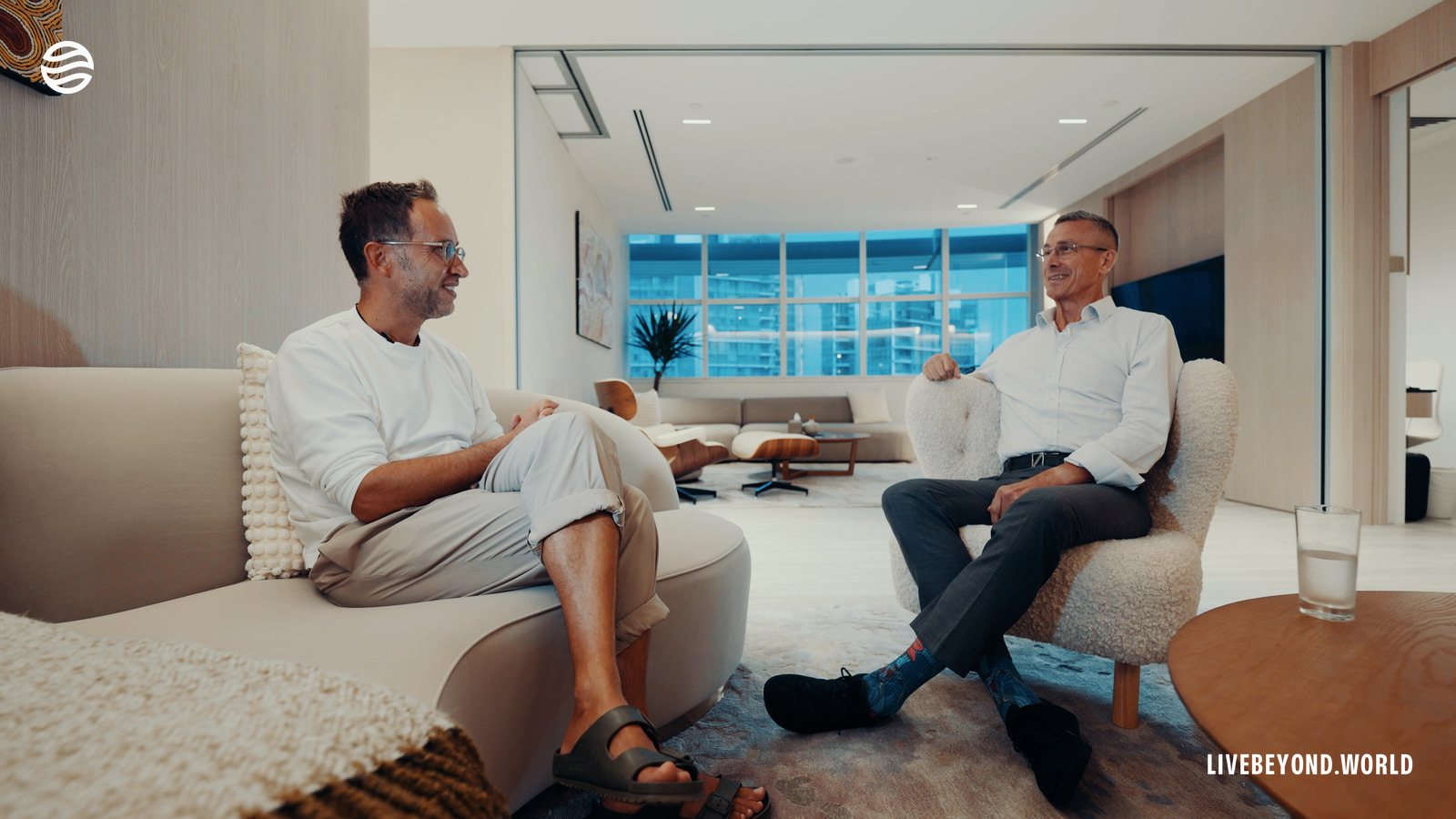
A beautiful, cozy place, and one test after another
Andrea B. Maier invited us. She is one of the world's leading longevity doctors, she feels like family to us by now, and she co-founded Chi Longevity. Come, she said, do the whole examination, and meet the team.
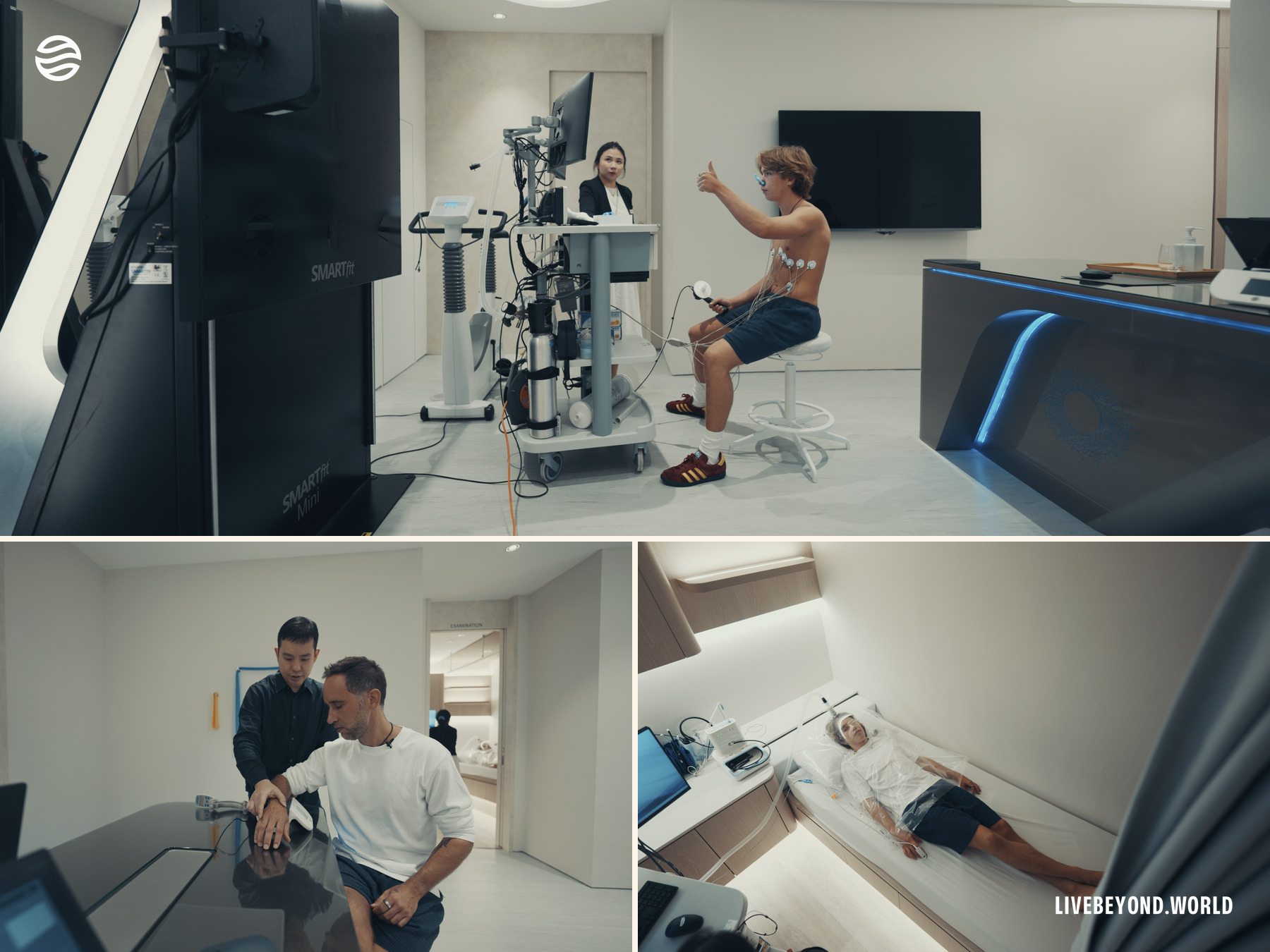
So we did. The first surprise was the place itself: beautiful, and very cozy. Not what I expected from a clinic. Then it was one diagnostic after another: blood, urine, saliva, fitness, body composition, a talk with Denise, the dietitian, who told me there was room for improvement. We laughed. There always is.
The doctor who sat down with us to go through the first results was Dr Oh Eu Leong, today the Medical Director of The Longevity Suite Asia. Very professional, very focused, and smiling the whole time. I couldn't wait, and the recording starts with me laughing:
“So what about my results?”
The blood tests weren't back yet, but the fitness tests were, and Dr Oh started there:
“You did very well in terms of grip strength. You are easily in the top 10% for your age group. … In terms of your VO2 max per kilogram, you nearly hit 50. … This, again, is an excellent result that puts you in the top 10% of your age group.”
(VO2 max is how much oxygen your body can use when you push it hard. It's one of the strongest signs of a long, healthy life.)
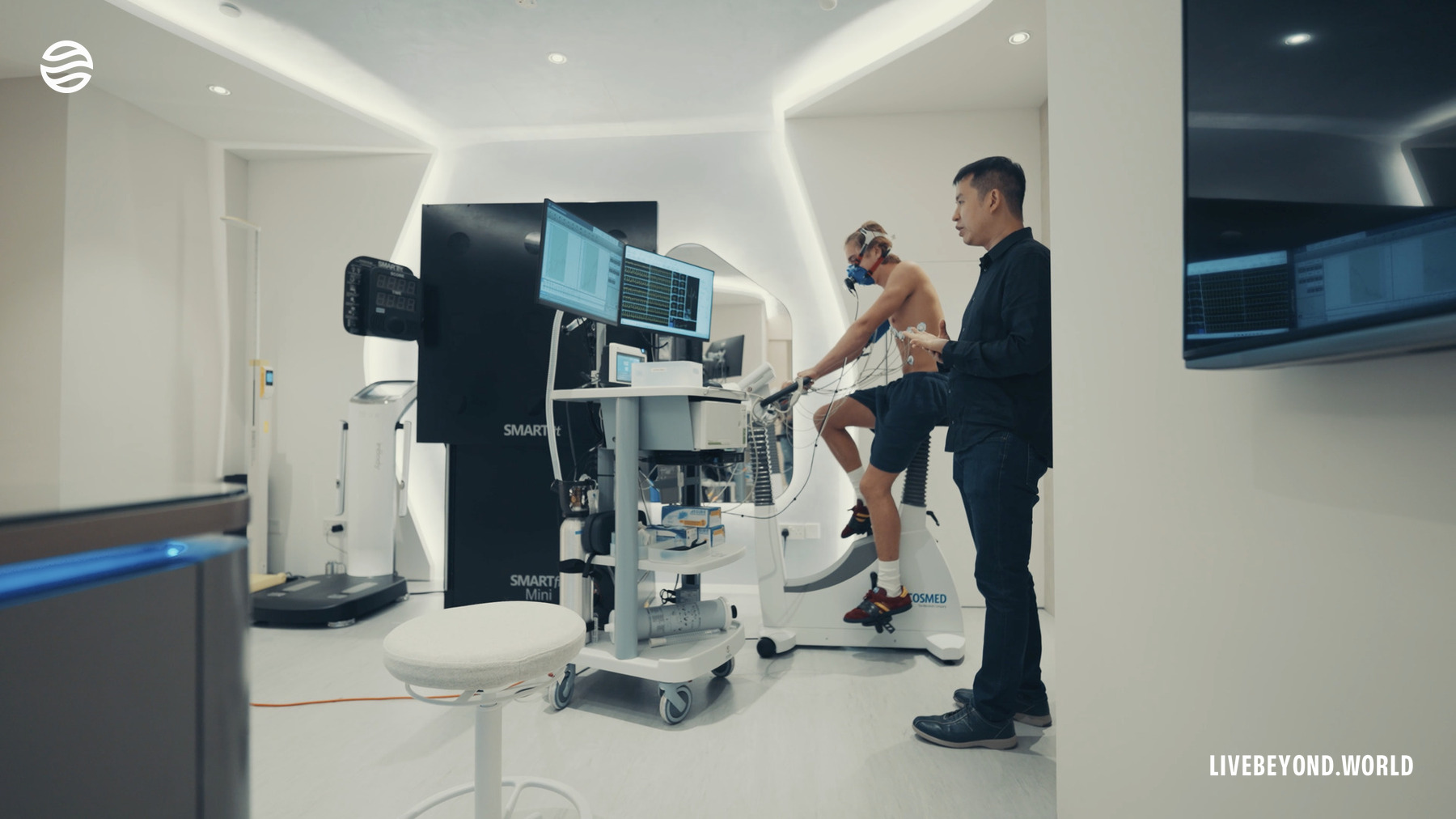
For everything else, he told us exactly what would happen next:
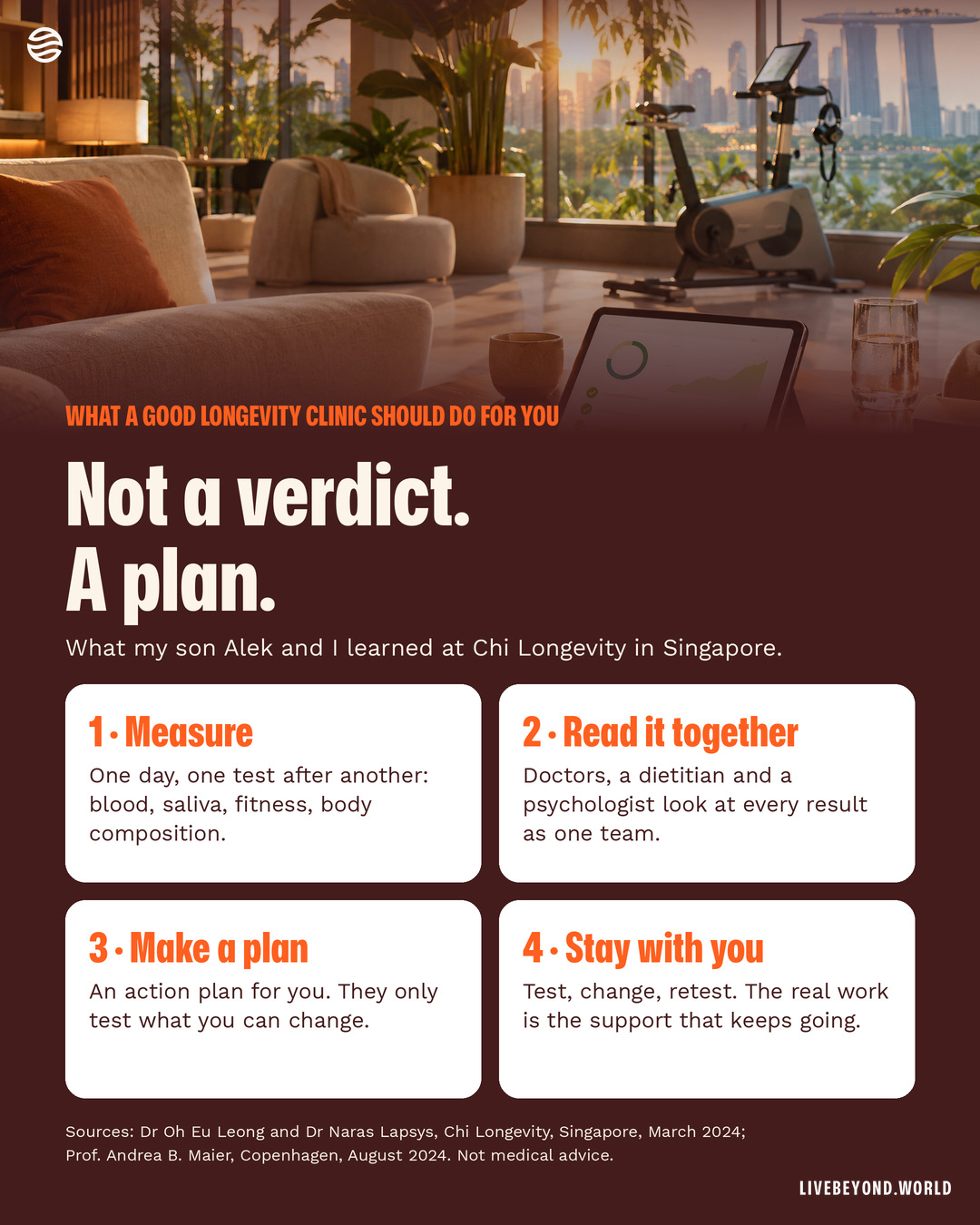
“Once we have all your results, we'll compile everything together. … We have a multidisciplinary team to discuss every client of ours, and then we'll come up with an intervention plan, an action plan for you.”
An action plan. Not a grade, not a verdict. A plan. And a whole team behind it. I said what I felt: perfect, can't wait.
Later in the same conversation I told him something honest, and his answer is the moment I started to relax:
Marek: “I think I know quite a lot already about myself, about how to optimize things, and yet still, when I talk to you, I feel like I have so much to learn.”
Dr Oh Eu Leong: “I feel I have a lot to learn too. … The more you know, the more you realize how little you know.”
The person across the table wasn't a judge. He was curious, just like me. That changes how a check-up feels.
A good doctor doesn't measure you to give you a verdict. She measures you to give you a plan.
The doctor who wanted to be a fit, healthy dad
Then we met Dr Naras Lapsys, the Chief Clinical Officer, the man responsible for the whole committee that reads every result. At first he looked very serious, very distinguished. Then he smiled, and it's one of the most cheerful smiles we met on the whole quest.
I asked him how he ended up in longevity. He told me about his own father:
“I remember him saying to me, "Son, you're gonna need to have children soon because you're gonna be a very old dad." And I thought to myself, "Well, actually, no, what I need to be is a very fit and healthy older dad, and so I'd better get on to doing that soon."”
A father, thinking about the years he'll have with his children. That's the whole quest in one sentence.
Then I asked him what matters most for a longevity clinic. His answer is the thing I wish every clinic had written on the wall:
“Ultimately the success of a clinic is gonna come down to their clients or their patients being able to make change. … We know that changing people's habits and behaviors takes time and is actually very, very difficult. It's very easy to take a pill. … People have to do the work, and I think that is where the successes and fails will be, because you need to be able to provide that ongoing support.”
When I wrote to Dr Oh this November and asked what a good longevity clinic does that a regular check-up doesn't, he said the same thing, from the other side of the desk:
“A regular check-up mostly asks, ‘Are you sick yet?’, and checks your numbers against population ‘normal’ ranges. A good longevity clinic asks, ‘Where are you heading, and how do we change that trajectory?’ … Measuring is the easy part. Good clinics stay with you through the interventions and re-measure to show it’s working.”
I couldn't agree more. Today's clinics are great at diagnostics, and diagnostics are only the start. What most of them still miss is staying with you afterwards, week after week, while you build the new habits. (If you're thinking about it, here's what to look for in a longevity clinic, and how to build habits that last.)
Lead by example
A few days earlier, we had given our talk at the intensive longevity course in Singapore. Dr Oh asked me the question every doctor knows: only about 3 in 100 patients really change their lifestyle, so what can doctors do to help more of them? My answer:
“You have to lead by example. You have to show that you do everything for your longevity, then make friends with your clients and patients, and they will follow.”
“You need to practice what you preach, without a doubt, because otherwise, how is anybody going to respect you and to know what you do unless you walk the walk yourself?”
And then he talked about why Alek was traveling with me:
“What you're doing is setting an example for your son so that he ends up embedding healthy habits right from the start, and he doesn't pick them up when he's 30 or 40.”
Prevention is the queen of longevity
This is the biggest thing I learned on the quest, and I say it at every conference now: prevention is the queen of longevity.
Most of us won't die of something mysterious. A few big diseases take most of the years we lose: heart disease, cancer, diabetes and the other metabolic diseases, and the diseases of the brain like dementia. They don't arrive overnight. They start working on us years, often decades, before we feel anything. Catching them early saves lives, and it saves money, for families and for the whole health system.
So I asked Dr Oh what he would tell everybody who is scared of what a check-up might find. He wrote back:
“What the test finds is already there. Testing gives a person the chance to do something about it whilst the most options are on the table. Almost everything we find early is far more manageable than what we find late. And the most common result I see isn’t bad news, it’s a clear list of the few things that will make the biggest difference for that person.”
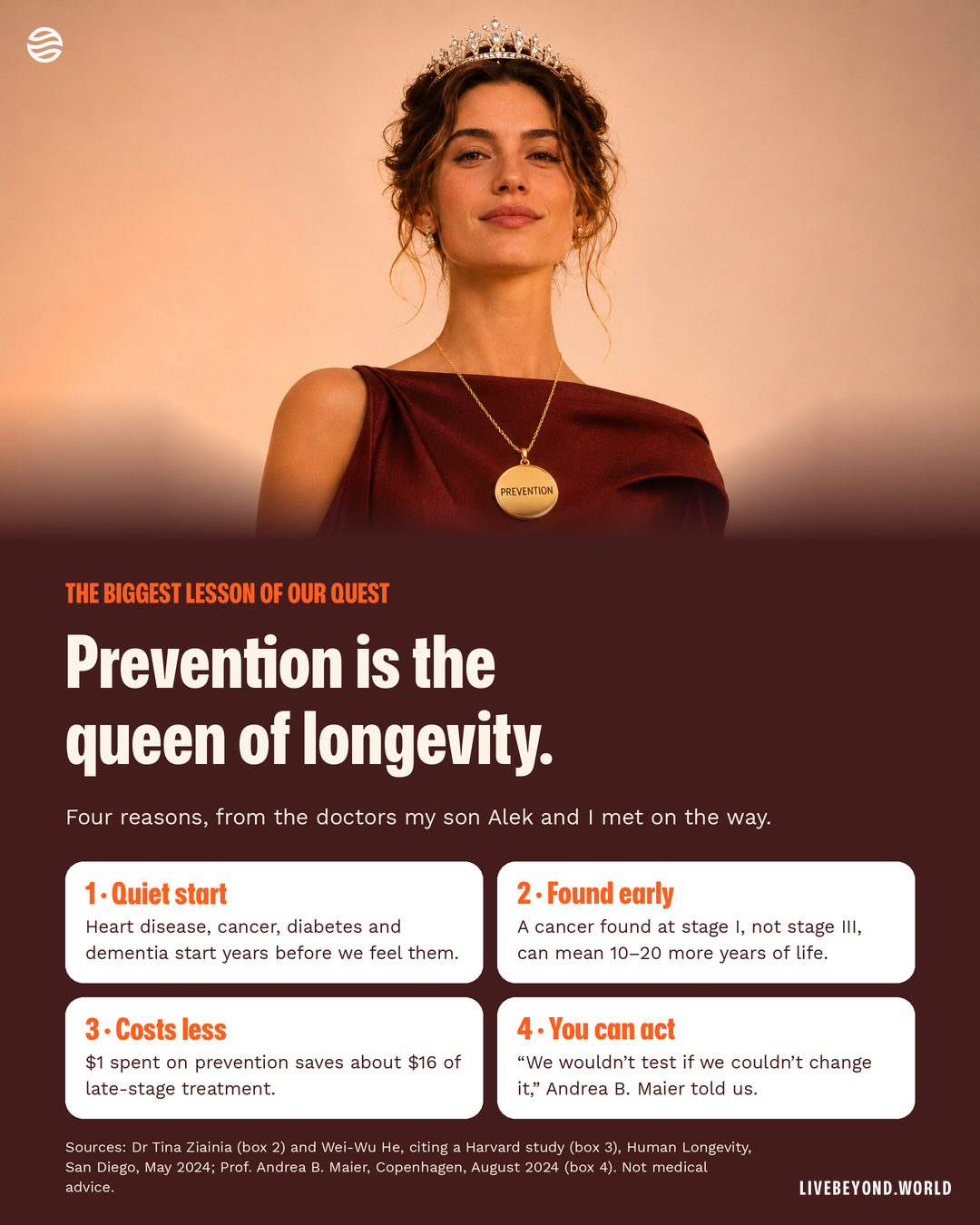
That's why the fear of a check-up is so expensive. The test can't hurt you. Not knowing can.
Copenhagen: you can be happy
Months later, at ARDD in Copenhagen, the big conference on aging research, Andrea and Naras sat down with us together, to talk about clinics, prevention and what to do next. We laughed a lot. And Andrea said the sentence I now repeat to every friend who's afraid of a check-up:
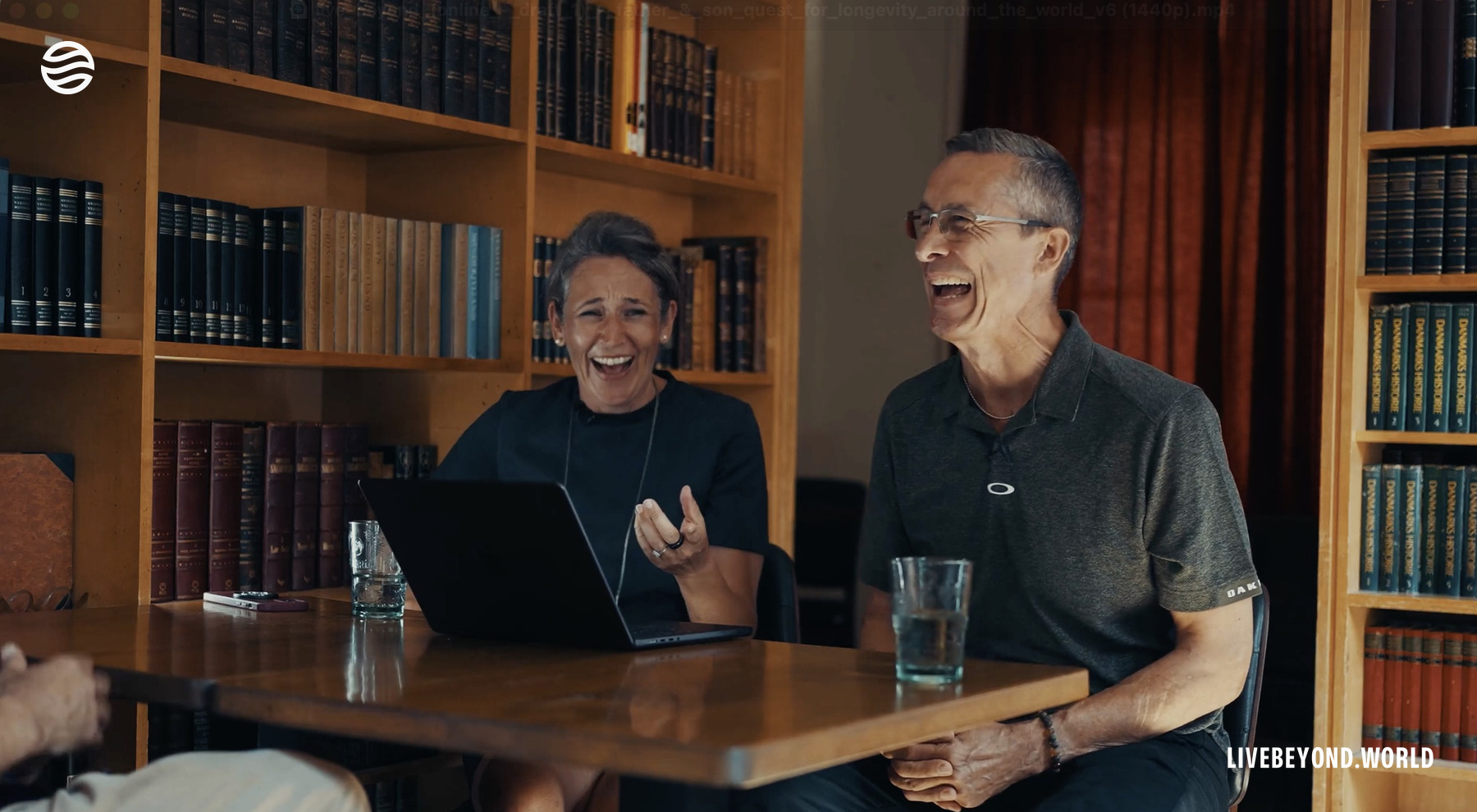
“It's a test, so don't worry about it, because we wouldn't test if we couldn't change it. … You can change your body. … So you can grow muscle, which you should do.”
(Here's why muscle matters so much.) Naras put the whole method in eight words:
“You can test, you can make changes, you can retest.”
I wrote about this in my article about Andrea, and I'll say it again, because it's hugely important. Back in Singapore, she told me why she never measures just for the sake of measuring:
“But sometimes it's also scary to know, and I absolutely get my patients and my clients sometimes saying, ‘Maybe I should not know it.’ What I learned in the past out of geriatrics is that I feel it's nearly unethical to measure without having a solution in mind.”
So a good test never comes alone. It comes with a plan for what you can change.
And then, in Copenhagen, Andrea looked at me and smiled:
Andrea B. Maier: “But you can be happy.”
Marek: “I am happy. I'm happy every day.”
Not just a one-year mission
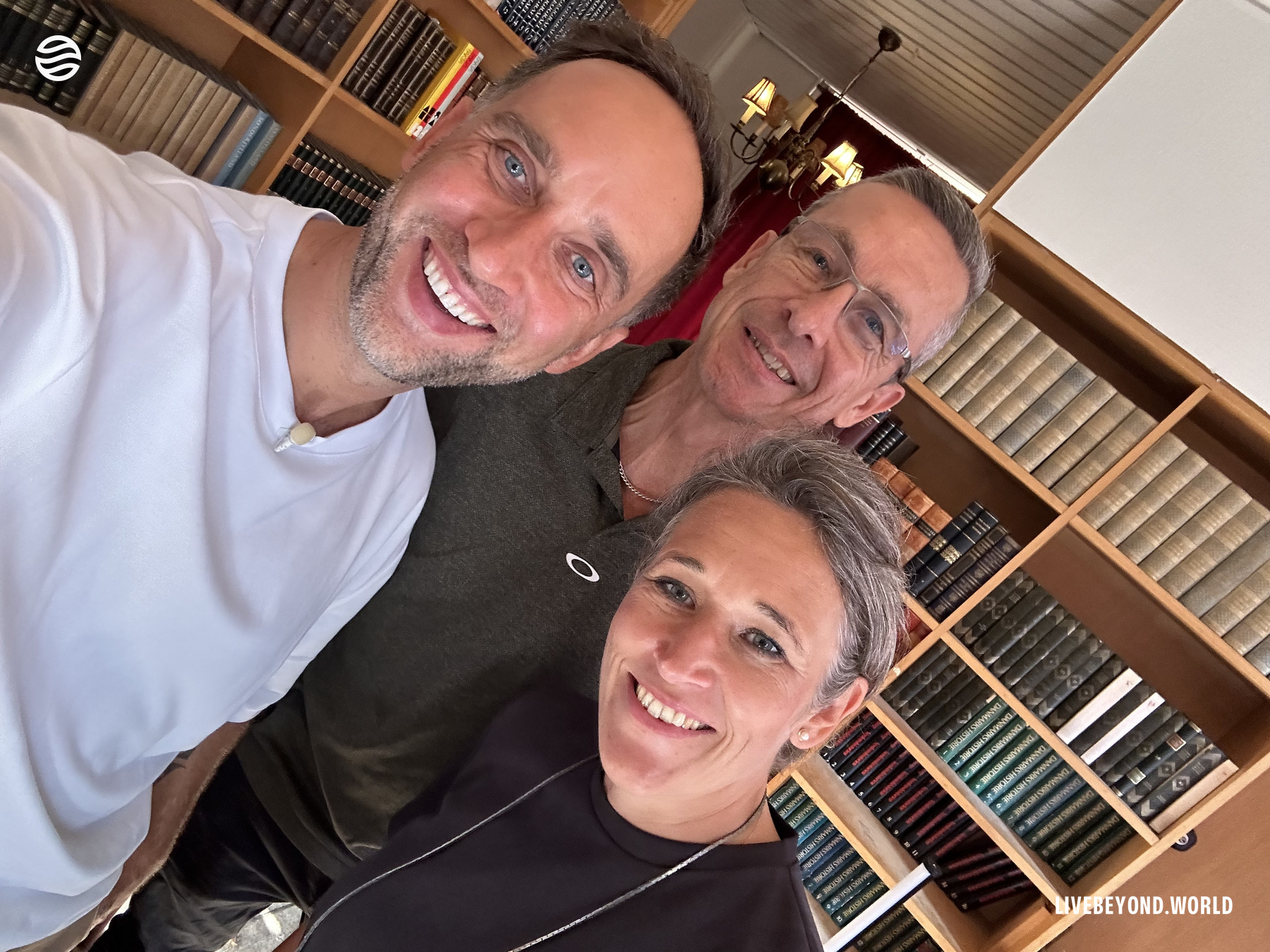
On our last day at Chi, I asked Naras what he'd wish us for the rest of the quest. He said the real test comes later: one day we would go back to normal life, with jobs and families, and the question is whether we take all of this with us or let it become a nice memory. I tried to say it back to him in one line:
Marek: “So, to learn how to make it a part of our lives and not just a one-year mission.”
Dr Naras Lapsys: “Correct.”
We filmed all of this for our film, Live Beyond. Father and Son on a Quest for Longevity, for the series, and for the book we're making. Everyone in this story has a page on the Live Beyond Hub, and so does every longevity clinic we visited on the quest.
Next week, Part 2: the crystal ball. We go to Human Longevity in San Diego, where a whole-body scan, a team of top experts and one very warm doctor showed us what can be seen years before you'd ever feel it.
Hey, and I'd like to ask you one question at the end. Have you ever put off a check-up because you were a little scared of what it might find? And if you went in the end, what made you go?
Send me your answer on Instagram or LinkedIn.
More from the quest
Answers on this topic
Earlier stories
Dr Oh Eu Leong guiding Marek Piotrowski through a test at Chi Longevity, Singapore, March 2024. · Live Beyond
Where each quotation comes from. Dr Oh Eu Leong and Dr Naras Lapsys, Chi Longevity, Singapore, March 2024. Prof. Andrea B. Maier, Singapore, March 2024. Prof. Andrea B. Maier and Dr Naras Lapsys, Copenhagen, August 2024. Dr Oh Eu Leong, in writing, November 2026.