
The Live Beyond article series · 02
My son came home and nobody believed him
A year meeting the people trying to extend human life, and then he came home to Warsaw and nobody believed him. Three numbers, and what actually moves people.

My son spent a year meeting the people who are trying to extend human life. He sat across from geneticists at Harvard. He asked his own questions and wrote them himself. He held the camera in a cryonics facility in Arizona, in a Sardinian village, in a lab in Shanghai.
Then he came home to Warsaw and told his friends about it.
A few weeks later, I told Prince Michael von Liechtenstein what had happened:
“When my son came back home and started talking to friends or neighbors, he was just saying that people just don’t get it. Like, I tell them how to live longer and healthier and better, and then they just say, oh, whatever. It’s like, when I have to die, I have to die.”
A year after that, in Los Angeles, Peter Diamandis asked Alek how it was going with the people closest to him. My son did not dress it up:
“But right now it’s tricky with really everybody from my family, all of my friends there.”
“Everybody’s reluctant, unfortunately.”
Sit with that for a second, because I had to.
An 18-year-old crossed the world, met 100 of the best minds on this subject alive, came home with everything — and could not move his own mother.
If he could not, what exactly did I think a press release was going to do?

For 4,000 years, it was the right answer.
The first thing I want to say is that every one of them was doing what people have always done — and what was, until very recently, the wisest thing to do.
Nathan Cheng, who co-founded the Longevity Biotech Fellowship, put it to us at Harvard like this. The oldest recorded work of literature we have is the Epic of Gilgamesh, and it is a story about a man trying to solve the problem of ageing and death — “and then he loses,” he said, laughing. “That’s kind of the moral of the story.”
That is our first story. It is 4,000 years old, and it ends the same way every time it has ever been told.
Aubrey de Grey said the sharper version of it to us in California:
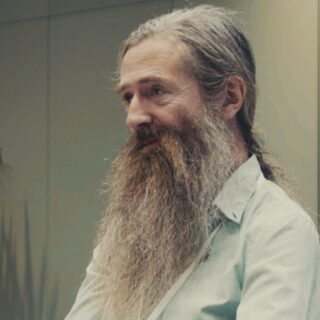
— Aubrey de Grey“People have been making excuses for aging, for not doing anything about aging, since the dawn of civilization, because that’s the only way that we could put aging out of our minds and walk away from the fact that there was nothing we could do about aging then.”
Read that last clause again. There was nothing we could do about it then. For the whole of human history, refusing to think about ageing was mental hygiene. It was the correct, healthy, load-bearing response to a fact you could not change.
Aubrey’s point is that this stopped being true inside the span of one career — his. Ageing turned into something we can begin to do something about, and almost nobody outside the laboratories was ever told. So a species with 4,000 years of well-earned practice at not looking is being asked, quite suddenly, to look.
Of course we say whatever. We were all raised on the same story.

3 numbers that changed my mind
The first: the world is exactly split.
In April and May 2024 the Oxford Longevity Project and Roundglass asked 14,000 adults across 25 markets whether they would want to live forever. 37.4% said yes. 37.4% said no. 25.2% were undecided.
A dead heat, to one decimal place, with a quarter of the world still standing in the middle of the road.
What surprised me was the appetite. More than a third of the planet, unprompted, saying yes. This field talks as though it has to create the desire. It does not.
The second: they do not lack the desire. They lack the word.
Professor Andrea Maier and her team at the NUS Academy for Healthy Longevity ran the HELO survey — more than 3,000 Singapore residents. 82% correctly understood what lifespan means. Only 43% knew the word healthspan — the years you spend in good health rather than merely alive. And 55.5% said they would be interested in attending a healthy longevity clinic.
Fewer than half knew the word, in one of the most health-literate countries on earth.
More than half of them want the thing. Fewer than half have a word for it.
That gap is not science and it is not money. It is language.
Announcing the survey, Professor Maier said the results were “both a wake-up call and an opportunity. Singaporeans want to live not just longer, but better, and we now have the science to support that vision.”
Not just longer, but better. That is the whole thing, and most people have never been told it has a name.
The third: what happens when nobody asks.
Nathan Cheng again. Roughly 0.5% of the budget of the US National Institutes of Health goes to research on the fundamental biology of ageing — against ageing being responsible for something like 80% of deaths.
I am not going to build a conspiracy out of that. It is simpler and more fixable than a conspiracy:
Budgets follow demand. And demand is made of culture.

And before anyone blames the scientists
They already did it themselves, and it is the most surprising thing anybody said to us all year.
This is Aubrey de Grey, the man who has spent 25 years shouting about this, asked why the money is not there:
“Big Pharma are not the bad guys. The FDA are not the bad guys. Even the government are not the bad guys. The bad guys really are us, the scientists, not making a sufficiently strong case for preventative provision.”
I have thought about that sentence for a year.
The scientists we met are, almost without exception, brilliant and generous and few. There are not many of them, they are talking largely to each other, and they are astonishingly bad at the one thing that would change their situation, which is making an ordinary person feel something.
Meanwhile the loudest longevity signal reaching the public is one very wealthy man turning his own daily regimen into a spectacle — down to publishing the measurements of his night-time erections. He has done a superb job of generating attention. But it is the kind of attention that makes people flinch. It looks like a warning rather than an invitation.
We are not in a fight with that. It is simply never going to move the many. It reaches the people who already want the extreme version, and it quietly teaches everybody else that this is for somebody with a different life from theirs.
If you want ordinary people to move, you have to show them something they can see themselves inside. Nobody wants to be the odd one. People want to belong.

The gap is not desire. It is permission.
Here is the thing that confused me for a long time.
If 37.4% of the world already says it would want to live forever, and only 37.4% says no, then the desire is not missing. A third of the planet already wants this. Longevity is not short of people who want it.
So why does nothing move?
Allison Duettmann, who runs the Foresight Institute, gave me the answer at Harvard, and she used a term I had never heard before:

— Allison Duettmann“This dynamic of falsified preferences. Like, if no one ever speaks out about something, then you’re the odd one out. But now that people are starting to speak out, and more and more people are finding each other, it becomes a bit of a safer option for people to speak out.”
The odd one out. There it is again.
Falsified preferences: the gap between what people privately want and what they are willing to say out loud. That is the actual bottleneck, and once you see it you cannot unsee it. The wanting is at 37%. The saying is close to nothing — because saying it out loud still makes you the strange one at dinner.
And it is why the words matter so much. You cannot say a thing you have no word for.
The job is to make one sentence sayable
The wanting is already there, sitting quietly in a third of the world. Nobody has to create it.
What is missing is permission.
For 4,000 years, saying it out loud got you laughed at — because it could not be done. Gilgamesh loses. That is the part that has changed, and it changed inside one lifetime. Wanting to live long and well is not a fantasy any more. It is a plan, with real laboratories and real trials behind it, and some of it is already in clinics.
So here is the sentence.
I want to live way past 100, 150 (or put your own number), in great health and shape. And I’ll do everything to make that possible.
Not as long as I can — 60 is as long as you can, if you are unlucky. And if what you want is not to die at all, say that. Softening it is exactly the habit we are breaking.
Notice the second half of that sentence. It is not a prediction, and it is not a hope. It is a promise about what you are going to do — which is the only part of any of this that has ever been in your hands.
Say the true number. Then act like you mean it.
Say it at a dinner table today and somebody will change the subject. That is the only thing standing between where we are and where we could be.
You are allowed to want to watch your grandchildren grow up and to still be strong enough to keep up with them. You are allowed to say so in front of people who will look at you strangely — because the strange position now is not wanting it. The strange position is pretending you do not.
And every time one person says it out loud, the next person finds it a little easier. That is not a metaphor. That is the mechanism, and it is the one Allison was describing.
That is what a story does, and it is the only thing I know that does it. A story does not win the argument. It gives you permission, and it hands you the words.
Which is, incidentally, the one part of this whole problem that a person reading an article can do something about this afternoon. You cannot fund a laboratory today. You can say one true sentence out loud, to one person, this week.
That is how a culture moves. It has never moved any other way.
Which brings me to the thing I could not work out for a whole year, and only understood on a forest path on an island near Seattle:
If information does not move people — and it did not move the people who love my son — then what does?
Next week: the answer. It was given to me by a woman who has injected herself with 4 experimental gene therapies, and she gave it while we were walking past the place where she buried her cats.
→ Book burning on a massive scale. And it is waiting for all of us.
Aleksander with Peter Diamandis, Los Angeles, December 2025. · Live Beyond
Where each quotation comes from. Marek Piotrowski, in the interview with Prince Michael von Liechtenstein, September 2024. Aleksander Piotrowski, walking with Peter Diamandis, Los Angeles, December 2025. Nathan Cheng, Harvard, November 2024. Aubrey de Grey, California, April 2024. Allison Duettmann, Harvard, November 2024. Professor Andrea Maier is quoted from the NUS Yong Loo Lin School of Medicine announcement of the HELO survey, 31 July 2025, not from an interview. The survey figures are from the Oxford Longevity Project and Roundglass Global Longevity Survey (14,000 adults, 25 markets, April–May 2024) and from the Singapore HEalthy LOngevity survey, NUS Academy for Healthy Longevity.