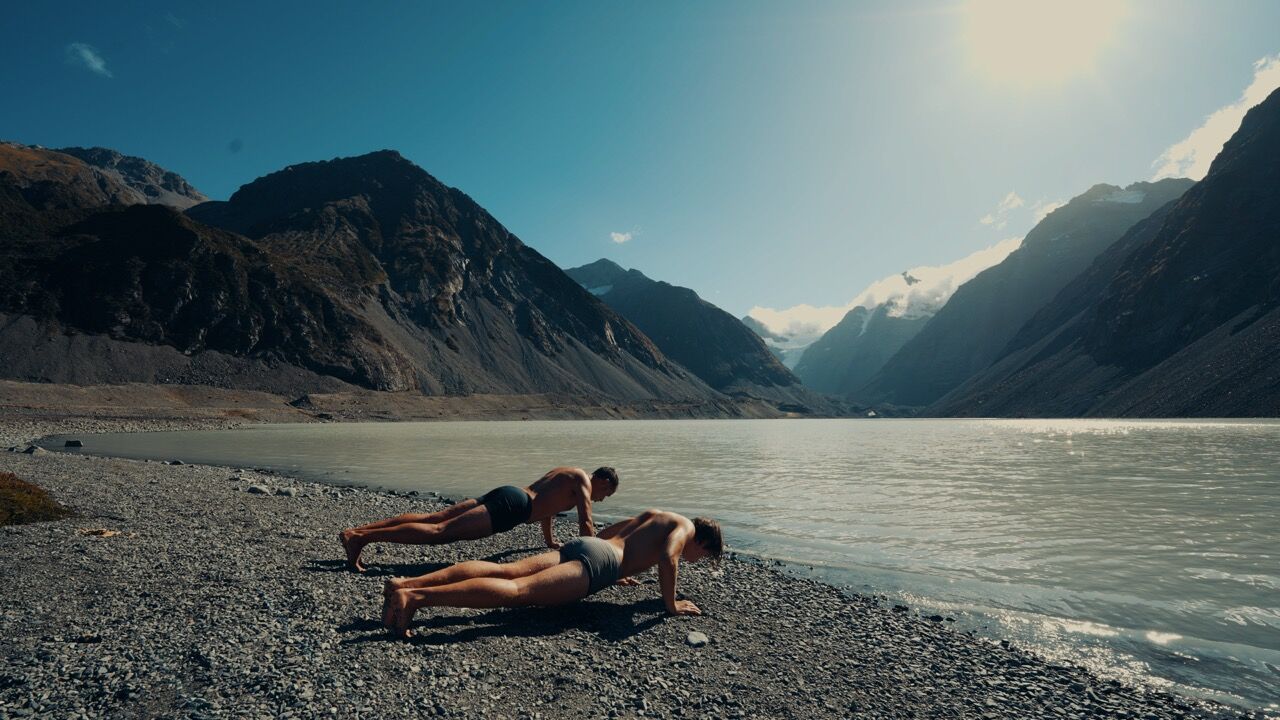
A year around the world with my son. This is the part that isn't in the science — the decision, the fears, the fights, and what I actually carry now. In Marek's own words.
This is a diary of the Quest I took with my son — the quest for longevity around the world that started in August 2023. We finished the official journey in September 2024, but we kept going: to scientists in Boston, New York and London, to friends in Portugal, to long talks in Amsterdam. So really it began almost two years ago and it's still ongoing — the film, the book, the podcasts, and the dream of guiding millions of people onto their own longevity quests.
The exact moment I said: I'm doing this with my son
I wanted to work in longevity a long time ago. I'd spent years as a marketing director, a brand strategist, a CEO of an advertising agency — helping the big corporations, Coca-Cola, Pizza Hut, KFC, alcohol, even tobacco at one point. I never want to go back to that. Six or seven years ago, at a future-technologies conference in San Francisco, I watched people pouring their lives and money into things that would change the world for the better, and I decided: from now on I build a better world, and I start with longevity — so we all have enough time to enjoy this amazing planet.
The moment with Alek came at the end of 2022. He walked up to me — I think it was November — and said, “Hey, Daddy, I'm ready for a gap year.” Years earlier I'd offered him exactly that and he wasn't ready; he still needed his friends and his mom. Now he was. We were in a cafe and I just lit up: “Amazing. Let's do it — and let's build it around longevity, so I can show you the world and my friends around the world, and you can consciously choose what you want to do with your life.”
I took a napkin and started drawing — the biggest centres of longevity research, connected into a route around the world. That napkin was our first map. Alek told his mother and the rest of the family, who were not happy at all; they said he'd fall out of the system. He came back to me worried. I said: “Yes — that's exactly the point. You have to get out of the system and create your own path.”
Father and son — the two heroes of the story.
Longevity Advocate & the documentary
How a social-media video turned into a film
I'm not a professor, not a doctor, and I didn't want to pretend to be one. I'm a guy who wants to advocate for the whole field and help it grow — so Longevity Advocate was the name I fell in love with. I built the brand, a manifesto, a series of short videos about who I am and what I believe.
Then, two months before we left, I asked my friend Kamil — a film producer — to help me shoot some professional social content. He said, “Buy Netflix-approved equipment.” I asked why. He said, “Maybe you'll decide to make a documentary.” I'm not a filmmaker, so I laughed it off — but I spent three nights thinking, and on the fourth morning I woke up and started writing a document: what would I have to do to make a documentary about this Quest?
Two weeks before we flew, I told Alek: “We're going to shoot a documentary.” He said, “No, Dad — I didn't sign up for that. You're the Longevity Advocate. I'm not.” So I asked him: do you take care of your body? Yes. Your health, your nutrition? Yes. “Then you're a biohacker. And if you share what you learn on this journey, you'll be a longevity advocate too.” He went quiet, and he didn't push back again. One day after we landed in Dublin, he was interviewing top scientists. He wasn't part of the crew — he was one of the main heroes of the story.
How did we even get into Longevity Summit Dublin? I saw George Church, David Sinclair, Aubrey de Grey and Steve Horvath were speaking, so I wrote to the organisers: “I'm going around the world with my son making a documentary — maybe you'd like to invite me,” and sent them the Longevity Advocate site. They jumped on a call, gave us a room to record in, and that's how the magic started.
More equipment than talent, at first — then it flipped.
The Longevity Map
Where the Map came from — the helicopter view
As I researched, I saw that the knowledge of longevity is fragmented. There are experts in a hundred separate fields, but nobody had drawn the helicopter view — one picture of the whole thing. And it's not just the science of ageing or of therapies or diagnostics or nutrition. It's also the healers with thousands of years of tribal knowledge. It's the biohackers who sometimes cross the limits but are still important. It's the people who'd never call themselves longevity — the psychedelic therapists, the cosmetologists, the plastic surgeons, the meditation teachers.
So I said: I need to draw a Longevity Map. I put the basics first — everything you can do now, without big money, just by prioritising wellness over convenience. Then biohacking upgrades — where you invest more time and resources: supplements, medications, psychedelics, saunas, cold plunges, red light, clinics. Then the branch that excites me most, radical life extension — gene therapies, partial epigenetic reprogramming, bioprinting, digital doppelgangers. And over all of it I built a bridge: prevention.
Don't die from something stupid.
That's what prevention means. Most of what kills us — cancer, heart disease, diabetes, neurodegeneration, the four horsemen — develops in us for twenty or thirty years. If someone says their uncle “suddenly” died of cancer, it's almost never true: he had it for decades and didn't know. If we don't do regular diagnostics, we're choosing to die of these diseases unconsciously. So on the Quest I decided I'd fill in the blanks of the Map with the best experts in the world — and inspire people to do everything they can from it, survive another twenty or thirty years, and give the scientists time to move the needle fifty years forward.
Drawing the map that became the whole framework — and the map itself.
Father & son
The biggest lesson of the whole year
I thought our relationship was perfect. We'd always had an amazing time — gym, wakeboarding, skateboarding, volleyball, climbing, weekends and holidays. Then we started the journey and I was shocked: where is my son? Our relationship went from simply joyful to — let us call it colourful.
We travelled together almost every hour of every day — the same rooms. Of course we clashed. Half a year in we had the hardest one, and I was ready to give us both a break. He was the one who said no: “You need space; I don't. And you have to understand — life together won't always be pretty.” He was eighteen.
Then I noticed something. After a tension, Alek forgot it in fifteen minutes — like nothing happened. I was the one digging in, blaming myself, needing a big conversation. So I decided to do what he did: after ten or fifteen minutes, just behave like nothing happened. That was the miracle that changed everything.
One: we love each other. Two: we want the best for each other. Everything else is just a misunderstanding.
Arizona — two of us, one road, and a lot of time to talk.
Imagine it: twenty-four hours a day, seven days a week, a whole year, usually in one room, sometimes the car. It's not easy to have your own space. And yet that's exactly how you connect.
A year in one room — and somehow, closer than ever.
The scientists
The people who changed how I see it all
The most important encounter for me was George Church, the father of genetics. We tried to reach him for months through Aubrey, through Liz, through everyone, and only got him after the main Quest, in Boston. He was like Santa Claus and a rockstar at once. I told him I'd always promised Alek that in his thirties we'd look and feel like brothers — and I asked, when? He said: “In twenty years the science should be there. I can't answer for the markets or the governments, but the science will be there.” And when I worried that the gene therapies would cost millions, he was clear that he does not want to work in a field where only rich people can reach the medicine — ageing will kill most of us, so whatever works has to be affordable.
Liz Parrish I love for being a pioneer, brave enough to test gene therapy on herself. Andrea Maier wasn't fond of me at first — “Who are you? Why should I talk to you?” — she assumed we'd shoot on an iPhone in a corridor, then walked into a room full of cameras and lights and said, “Oh, this is for real.” We became real friends. Srikumar Rao insisted he wasn't “longevity”; I told him he heals people's minds and hearts, so he's a longevity master. And Amy Killen — pure energy, a doctor and biohacker who calls herself a “bio-slacker,” because you don't have to do everything perfectly.
What made it all unique is that they welcomed us as a family — because we were one. Steve Horvath, so serious on stage, walked into our interview smiling like a favourite uncle and said he might drop everything and drive around the world after seeing our film. Katia Dowling saw on LinkedIn that we were heading to Australia and wrote, “Come, I'll host you for a week.” No journalist gets that. A father and son do.
With George Church in Boston — the interview we chased for a year — and the labs of the future.
The takeaways
What I actually live by now
First, the rule I say to everyone: treat your mind, heart and body as a temple — not as a trash bin. Most people already know how to eat, move and sleep better. They just don't do it; they prioritise convenience over their own longevity.
Second, use the Map. Do everything you can, little by little — you don't have to do it all at once. Anything you do will change your life and buy you the twenty or thirty years the scientists need.
Third, prevention is king. I used to postpone it — “I feel great, I'll do the diagnostics next year.” But the diseases that kill us start twenty or thirty years early. Now I test, and I want you to test too. And fourth — gym, gym, gym. I loved every sport except the gym, because it wasn't fun. It turns out strength training is one of the most important things you can do. As Gary LeBlanc says, muscle is an organ you have to take care of.
Prevention, movement, and the tests that changed how we live.
What changed my mind
The beliefs the journey overturned
I underestimated prevention — I knew it mattered, not how much. I thought any sport was enough; in fact it's specific: strength training first, then yoga for the synchronisation of mind, heart and body, then pilates for balance and stretch — everything else is a wonderful extra. And I underestimated skin. I thought it was about beauty; it's the shield of every organ, and I hadn't taken care of it. The one belief that only grew stronger: I was a believer in longevity before, and I'm a bigger believer now. People say it's science fiction, not in our lifetimes. I believe that if we engage hundreds of millions of people and start a real movement, we speed it all up — and it becomes available in our lifetimes.
The technology that made me think this changes everything is partial epigenetic reprogramming. Gene therapy up- or down-regulates one gene; reprogramming is the whole symphony — you can dial the state of a cell back toward youth. One day I hope you'll go to a doctor and say, “I'd like twenty years back,” and get a series of injections that do exactly that.
Alek's transformation
From behind the camera to the voice of the film
At the start Alek didn't like being filmed. So I made him the main videographer — not me. Kids need something they're clearly better at than their parents, and he took the challenge and ran with it, watching endless tutorials. He became better than film-school graduates, then a photographer, then a speaker, then an interviewer who stole my questions and invented his own.
The turning point was Shanghai. I told him, “I'm going on stage — film it, or come up with me if you like.” At the last second he came up, said a few words, then went back behind the camera. But when I finished, the whole audience queued up to him — asking about his feelings, his mission, why he was doing this. He felt important. Something shifted. In Singapore he spoke for five minutes to a full house and thousands online. By Copenhagen he was on stage with me the whole time — eighteen years old. Watching him narrate the film now, at university, making his own life — I'm so proud I can barely describe it.
Courage. Inspiration. Love.
Those are the three words for who he's become. My son isn't just my son. He's my friend, my partner in crime, my best videographer, my inspiration.
From behind the camera to the voice of the film — Singapore, then the ARDD stage in Copenhagen.
The legacy
What I hope this inspires
I hope people see themselves in us — that we're explorers charting this world of longevity for them, that we're genuine, that we're not selling anything. So far nobody has really spoken to the masses. People don't want to be robots living by a spreadsheet; they don't want to be biohackers, they want to be bio-slackers. They want to live fully — to live beyond. And underneath the science, we're a father and son like so many in the world, a parent and a child looking for connection, learning from each other.
When we spoke at conferences, scientists kept coming up to say, “You inspired me — I want to do this with my daughter, with my son.” Liz Parrish wished that this would be just the first of many journeys. And Alek told me, “Dad, it would be so amazing to do it again — but this time without cameras. Just us, and a couple of friends.”
If I knew in advance how many things had to line up — the quest, the scientists, the film, the relationship, the money, the platform — I might never have started. So many things could have gone wrong, and somehow they went right. Whenever something bad happened, we asked Srikumar's question: what good will come out of this? That was our attitude the whole way. So my wish for you is simple: be bold. Change the way you look at the world, and the world around you changes. Find your purpose, and fight for it.
Eric Verdin at his racetrack, Alek beside us — the friendships and the joy that carried the whole journey.