
The Live Beyond article series · 10
My son and I saw the lifeboat we hope we’ll never need
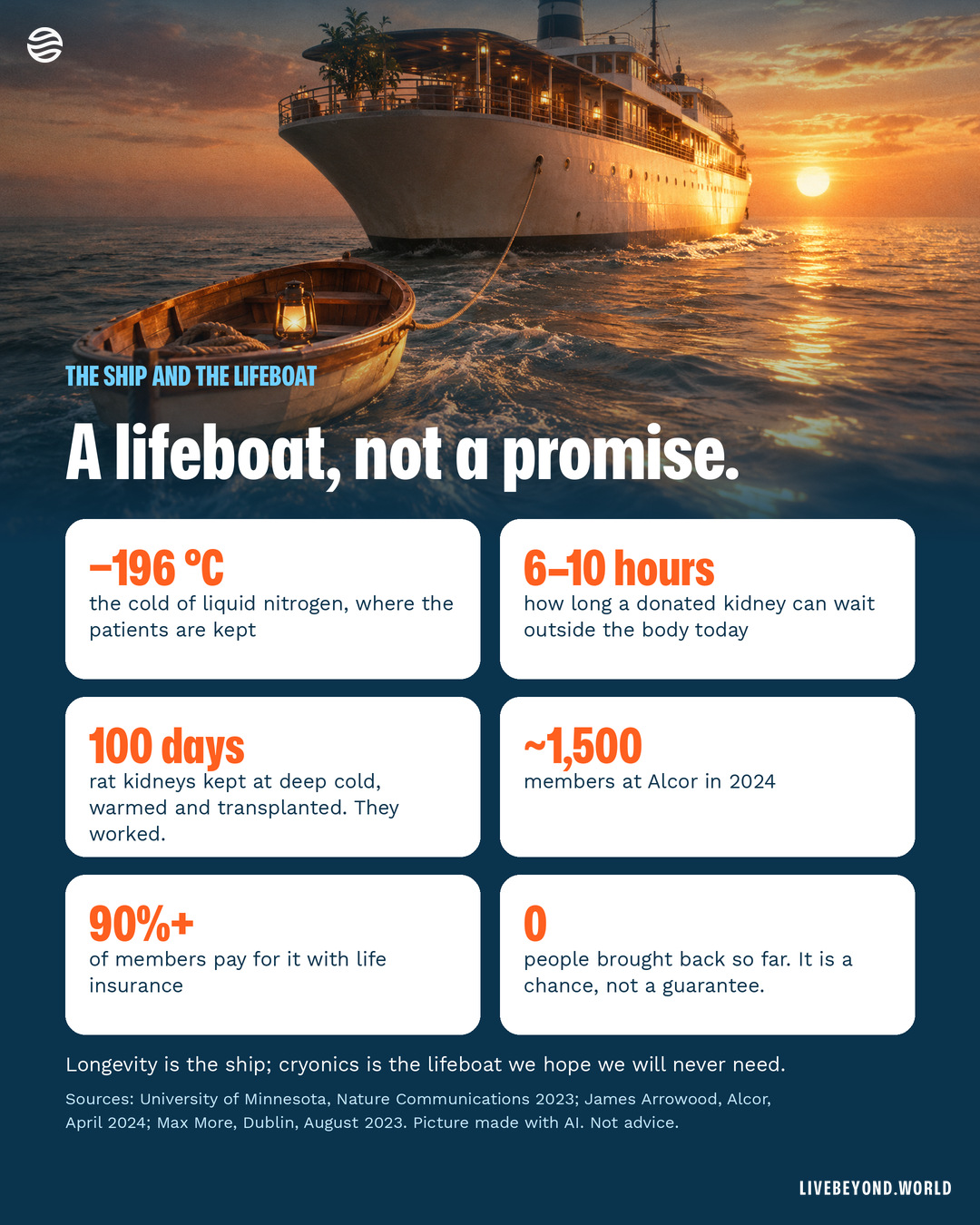
Longevity and cryonics are the ship and the lifeboat. Let’s hope the ship carries us all the way, young and healthy. But let’s keep the lifeboat close, just in case.

Outside, Arizona was burning hot. A few hours’ drive away are some of the most beautiful places my son Alek and I saw on the whole quest: the Grand Canyon, Horseshoe Bend, red rock glowing in the sun.
Then we opened a door in Scottsdale and walked into the coldest room of our journey. Big steel tanks, blue light, cold all around. Inside those tanks are people. Some whole bodies, some only the brain, kept at minus 196 degrees, waiting.
You don’t feel joy in a room like that. You feel that it is needed, and that it is the future. It is a lifeboat, not a party.
On the walls hang photos of the people inside, starting with the very first one. Each of them wanted a chance, and that warmed my heart. And then, on one of the tanks, I saw the photo of a little girl, only two years old. Her parents had brought her here to give her a chance at another life.
I wanted to cry. And I wished, with everything I had, that one day she will wake up and live her whole life.
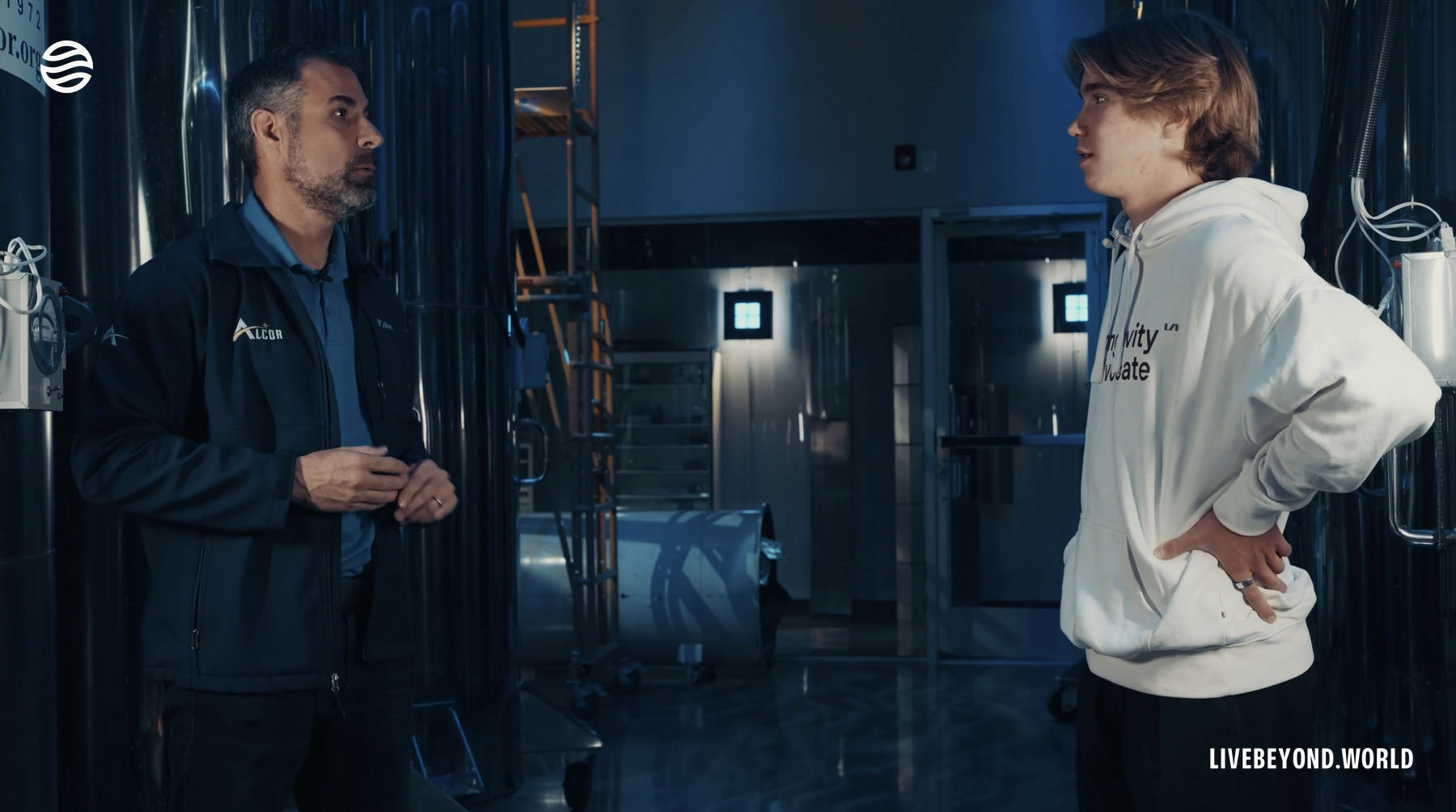
This is the story of that room, and of the people who opened its door to us: the hopeful part, and the honest part.
I came to cryonics before longevity
Years before our quest, at a small conference about future technologies in San Francisco, I heard people talk about mining asteroids, building solar plants in orbit, and freezing people to bring them back one day. Someone in the audience asked what guarantee they could give. The speaker answered with a picture I have never forgotten: you are on the Titanic and it is sinking. You can stay on board, or you can jump into a lifeboat. You might survive, or not. But you have a chance.
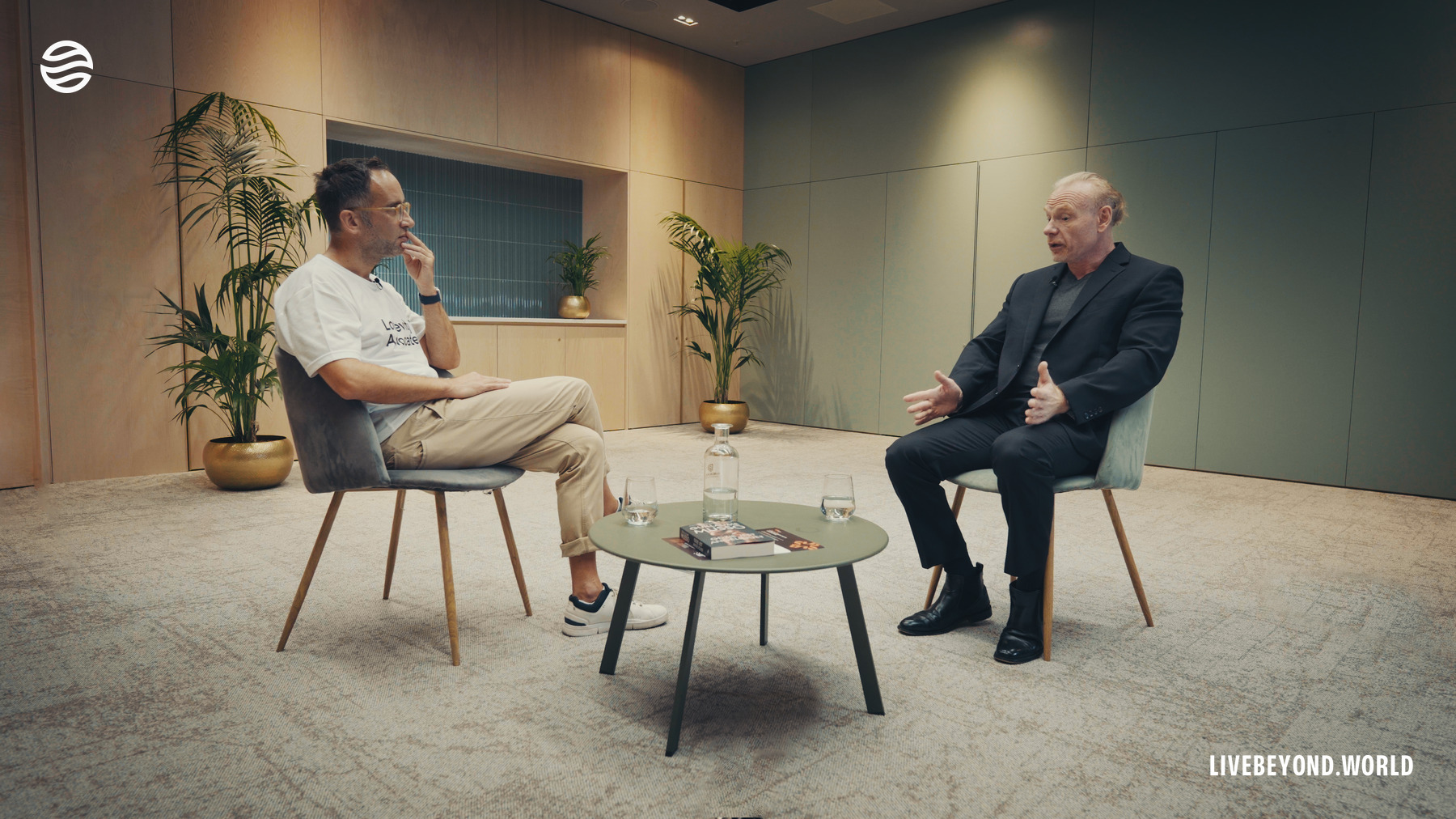
So when we met Max More at the Longevity Summit in Dublin, in August 2023, the very first stop of our quest, I told him that story. He has been signed up for cryonics since he was 22, and he led Alcor for years. He smiled and gave me his own version:
“Or it’s like you’re on a plane and it’s gonna crash, and you can take the parachute or you can sit on the plane till it crashes. Well, it’s a pretty obvious choice to me.”
And then he said the thing that surprised me most:
“My goal is certainly not to die in the first place. That’s number one priority. … Nobody wants to die. Nobody wants to be in a tank of liquid nitrogen either.”
Max felt like family from the first minute: calm, a good smile, a man who clearly loves being alive. A great uncle you would want to have. And when I asked him if we could ever see a cryonics facility for ourselves, he didn’t hesitate:
“All the cryonics organizations do take visitors and do tours. … I would definitely do that because it makes it very real. If you just talk about it in the abstract, it sounds like a science fictional idea. But when you go there, you see the operating room, you see the storage containers with all the patients there. It makes it a lot more concrete.”
He was right. And he was the one who opened that door for us. By then he had already left Alcor, but he connected us anyway, and in April 2024 Alek and I were in Arizona.
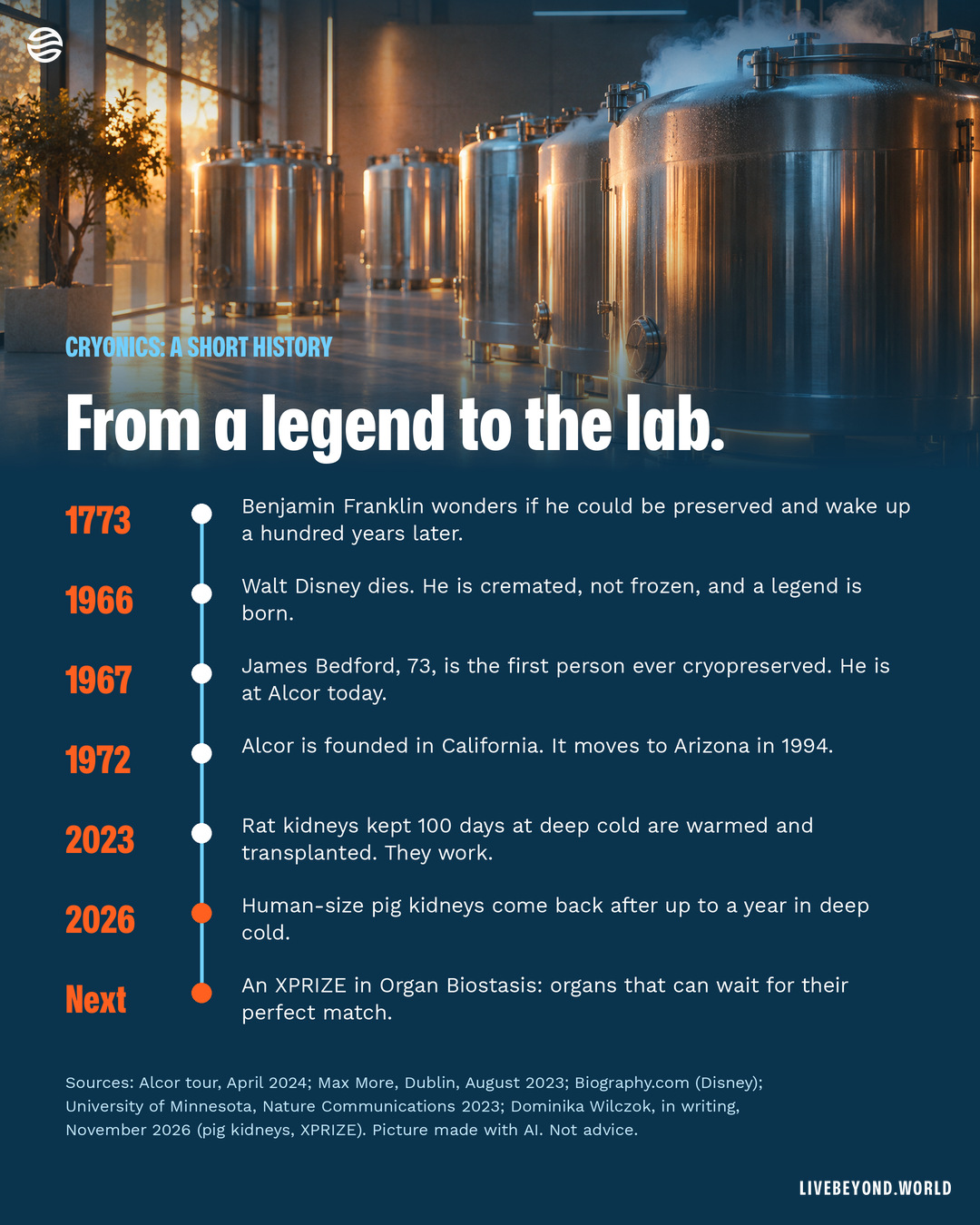
Walt Disney was never frozen
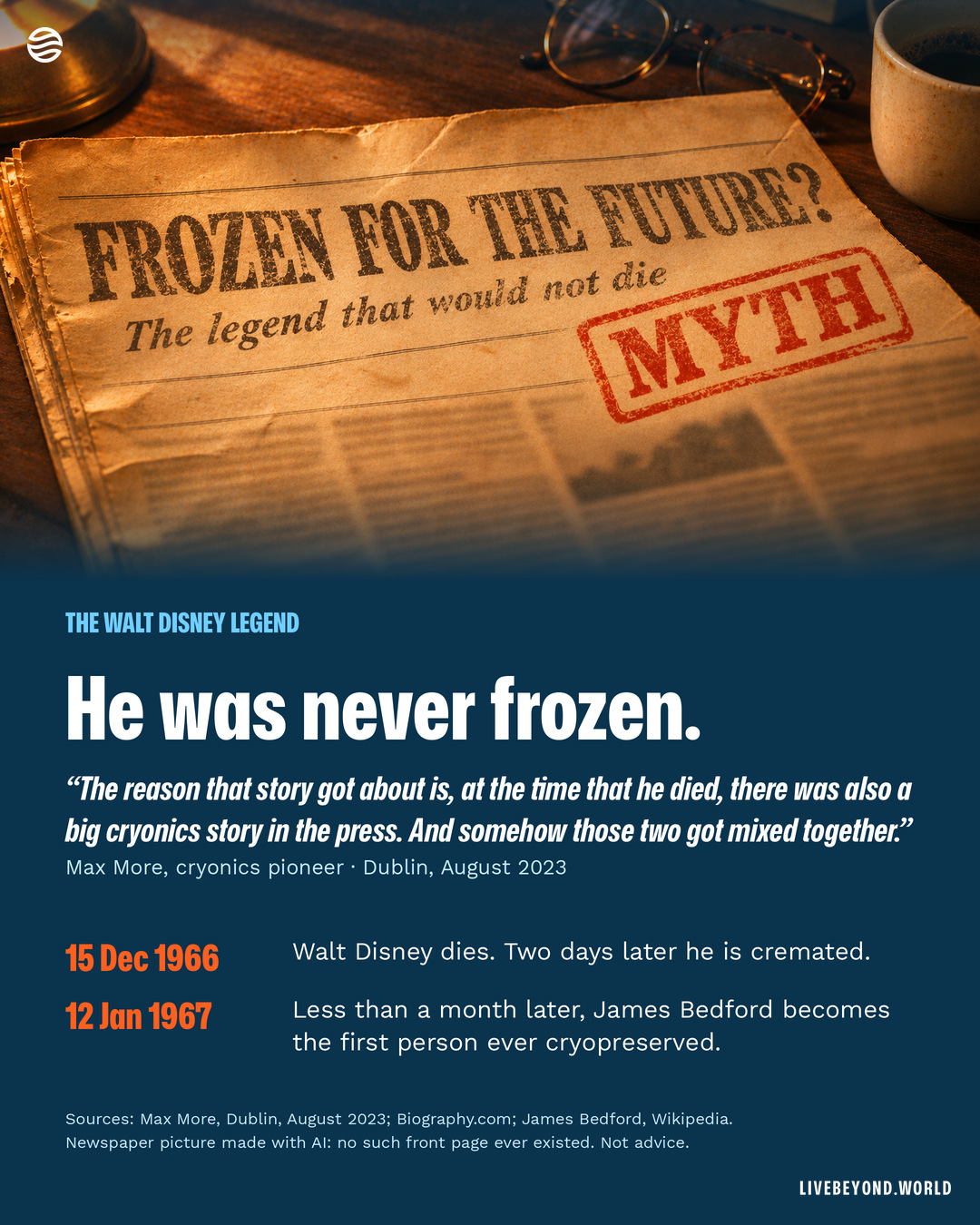
When I tell friends about cryonics, most of them say the same thing first: oh, the Walt Disney thing. I told Max what I always answer:
“No, from what I know, Walt Disney was not put into a cryo chamber. He was cremated.”
Max agreed, and told me where the legend comes from:
“The reason that story got about is, at the time that he died, there was also a big cryonics story in the press. And somehow those two got mixed together, and kind of naturally because Walt Disney had Tomorrowland and Future World, right? So it seems like a natural thing he would do this, but unfortunately he didn’t. … We won’t be seeing Walt again.”
Walt Disney died on 15 December 1966 and was cremated two days later. His ashes rest at Forest Lawn in Glendale, California. But the big cryonics story Max remembered was real. Less than a month later, on 12 January 1967, a 73-year-old psychology professor called James Bedford, dying of cancer, became the first person ever to be cryopreserved.
And here is the part I didn’t expect. At Alcor, among the offices, we stood next to the very first capsule he was kept in. For fifteen years Dr Bedford was moved from one place to another, until his family brought him to Alcor in 1982. He has been there ever since. Almost sixty years now, waiting.
There is a small coincidence I love, too. On 12 January 2009, exactly 42 years after Bedford, the computer scientist Hal Finney received the very first bitcoin ever sent, from Satoshi Nakamoto. Finney later fell ill with ALS, and when he died in 2014, he was cryopreserved at Alcor, in the same building we walked through.
So the Walt Disney story isn’t true. But maybe it isn’t all bad. For sixty years it has made people wonder whether death really has to be the end, and for many of us it was the first time we heard the word cryonics.
Alek’s interview among the tanks
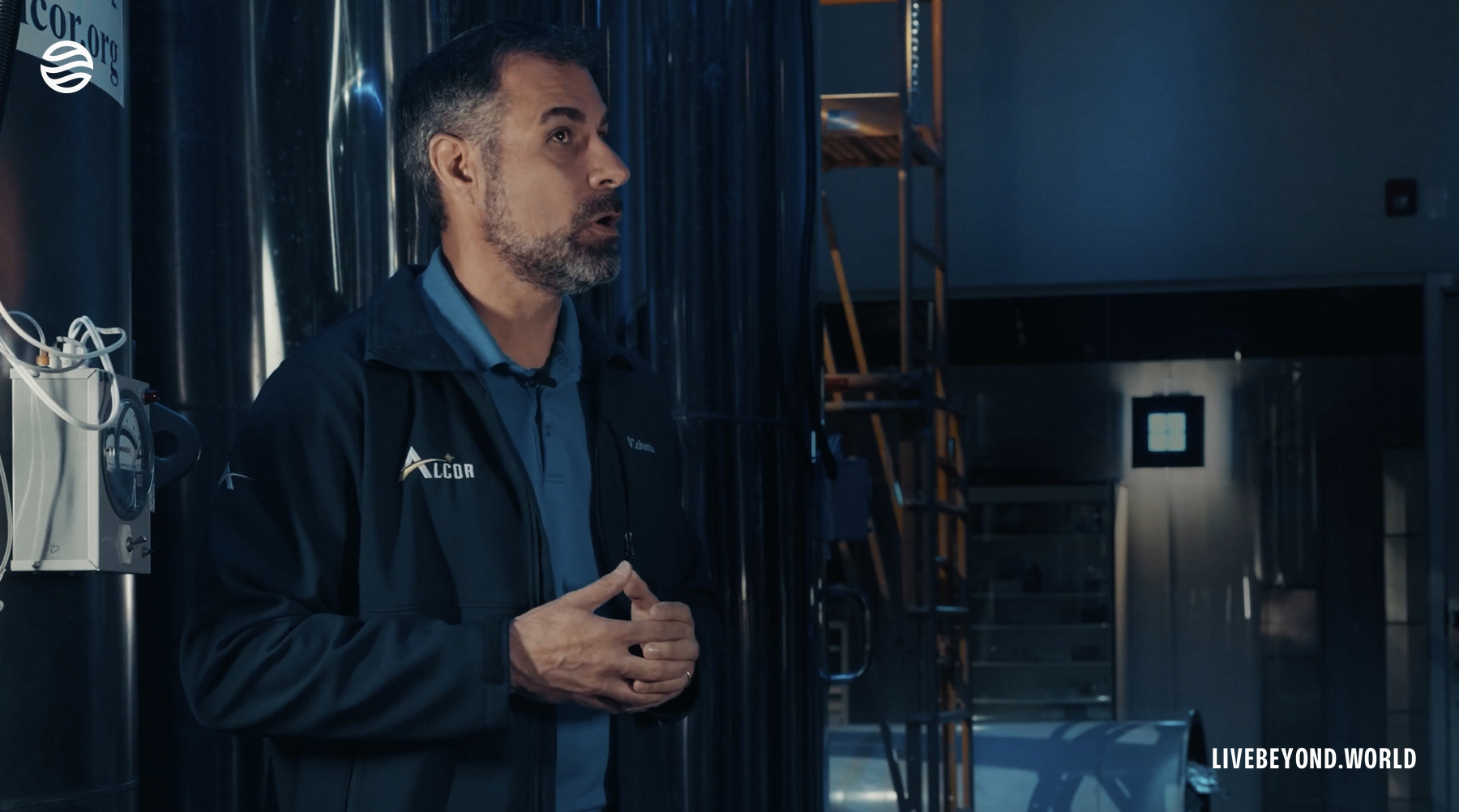
At Alcor, this was Alek’s interview. He sat down with James Arrowood, who leads Alcor, and asked his first question straight away:
“I’m super interested in what the whole process of cryopreserving looks like. Could you please walk me through it?”
James walked him through it. Members carry a necklace, a bracelet and a wallet card. When someone dies, a trained team starts cooling at once, because every minute decides how much damage is done:
“Time to temperature is always the mantra. … But death being so random, it’s impossible to ensure that.”
(In plain words: the faster the body or the brain is cooled after death, the better the chance. But nobody knows when or where they will die.)
Then James gave Alek a picture I keep coming back to:
James: “So your brain is like a solid-state hard drive in a computer. Now, if the mouse breaks on your computer, do you throw it away?”
Alek: “No.”
James: “What do you do with it?”
Alek: “Try to repair it.”
James: “Your mouse is broken, but your hard drive’s fine. What do you do?”
Alek: “I still get the hard drive, so I can plug it into a new computer.”
James: “That’s exactly right. … Well, if your heart goes out, should you lose the entire hard drive of your brain and memories?”
Alek: “No.”
James: “And what we’re saying is, if something stops your power in your heart, is that really a good reason to lose all the value in your brain?”
Alek: “Of course not.”
(In plain words: our memories and who we are live in the brain. Cryonics bets that if the brain can be kept safe, future medicine might one day repair or replace the rest. Nobody can do that today.)
How it is done
Alcor’s team also walked us through the building, step by step. It felt less like science fiction and more like an emergency room.
Waiting at the bedside. When a member is close to death, a standby team travels to them, to a hospital, a hospice or a home: critical care and trauma nurses, and now even former Navy SEALs. They wait until the person has died, and only then do they start.
Cooling, at once. The team puts a cooling mask on the head. Alcor prints its own on a 3D printer, because nothing like it can be bought in a shop.
Glass, not ice. The blood and the body’s fluids are replaced with a special solution called M22. It lets the tissue turn into something like glass instead of ice (scientists call it vitrification), because ice crystals would tear the cells apart.
Minus 196 degrees. Then the body, or only the head, goes into a dewar: a giant steel thermos filled with liquid nitrogen. One kind of tank holds four whole bodies and five heads; the newest ones hold twelve bodies. Everything is arranged so that, if the nitrogen ever ran low, the head would stay covered the longest. A tank keeps its nitrogen for at least six months without a refill.
And yes, there is a tank for pets, too.
The hopeful part: cold already gives us life
Here is what gave me the most hope, and it isn’t about cryonics at all. Cold already works, every day, in medicine. James reminded Alek of the proof walking around us:
“We know people store their eggs and their sperm, and they put them together and make these embryos, and you can do IVF. … The proof is walking around us talking to people, and you don’t know any different.”
Children born from embryos that waited in liquid nitrogen, sometimes for years. And in 2023, a team at the University of Minnesota stored rat kidneys at deep cold for up to 100 days, warmed them up and transplanted them. The kidneys worked as well as fresh ones.
And it has gone further since. Dominika Wilczok, a Polish scientist who works where AI, longevity and deep cold meet, trained in John Bischof’s lab at the University of Minnesota, the team behind those kidneys. Today she sits on the XPRIZE Health Braintrust for organ cryopreservation and helps build AI-for-longevity companies at Qiming Venture Partners in Hong Kong. When I asked her what has changed, she wrote to me:
“In a major 2026 advance, Bischof, Finger and colleagues recovered human-scale pig kidneys after cryogenic storage for up to a year; transplanted kidneys reperfused and immediately produced urine. Importantly, that is not yet proof of long-term survival after transplantation.”
(In plain words: kidneys the size of ours spent up to a year in deep cold, were warmed, transplanted, and started working at once. Nobody knows yet how long they will keep working.)
That is where James sees the biggest prize, and it could help all of us long before anyone is brought back:
“If you pass away, if we could preserve those, right now they only live for six to ten hours. … There’s no reason it couldn’t scientifically preserve those for weeks, and if you preserve them for weeks, you can do perfect matches. So your kidneys could save two people’s lives, and they could have perfect matches that don’t get rejected.”
Organs that can wait for weeks for the perfect match. That alone would save many lives.
Dominika gave me the numbers behind that. Around 110,000 people in the US are waiting for an organ, and 12 of them die every day while they wait. A heart or a lung can wait outside the body for only about six hours today. To speed things up, she helped create a new XPRIZE in Organ Biostasis.
And the scientists themselves are changing their minds. Dominika remembers her first internship interview, about three years ago:
“I remember interviewing for my first real internship and mentioning whole-body cryopreservation as a milestone the field should work towards. The reaction was almost as if I had said Lord Voldemort’s name. … There was a clear reluctance within the scientific community to be associated with cryonics. However, I think this has started to change.”
(She credits the Voldemort comparison to Greg Fahy, one of the pioneers of the field.)

The honest part
Nobody in this field promised us anything. Not one person. Max said it first, with a laugh:
“There are no guarantees, of course. This is not something where we say, “Oh, we promise to bring you back on August 12th, 2086.” … That would be ridiculous.”
And at Harvard, in November 2024, Allison Duettmann, who leads the Foresight Institute, was the most direct of all:
“Current cryopreservation techniques are not good enough that we can actually be recovered.”
Dominika asked me to get one thing right, and I think she is right:
“Cryonics is not the same as cryopreservation, and cryopreservation is not the same as reversible biostasis. We routinely cryopreserve cells, embryos and some tissues with recovery of function. Cryonics is the preservation of legally deceased people in the hope of future revival; that revival has never been demonstrated.”
Nobody has ever been brought back. Not a person, not a large animal. Cryonics can only begin after death, and no doctor can tell you it will work. The people who choose it know that. They are betting on the medicine of the future. Everything we learned, step by step, from what happens at the moment of death to how people pay for it, is on our answer page Cryonics: a lifeboat, not a promise.
And still, Allison made the choice for someone she loves:
“Yes, it’s a lifeboat. I signed up my dad to cryonics once I could. … I think none of the options that we currently have available are really great, so we need a lot of more research into better vitrification methods.”
People often think cryonics costs millions. It doesn’t, but it isn’t cheap either. At Alcor, Max told us, the whole body costs about $220,000, transport included, and the brain alone $80,000 to $100,000. In Europe, Tomorrow Bio in Berlin asks about €200,000 for the whole body and €75,000 for the brain. The Cryonics Institute in Michigan is much cheaper, about $28,000 to $35,000, but it offers less. And almost nobody pays any of it from their savings:
“I started as a poor English undergraduate student, and I didn’t have a lot of money. The fact is, well over 90% of members pay for this with life insurance.”
They take out a life insurance policy and pay a monthly premium, and the policy pays the big sum one day. For a young, healthy person that can be around $30 to $50 a month. And James told Alek, smiling:
“And I can do it for about the cost of a nice funeral, so why not?”
Will it get cheaper? Dominika thinks so, but only after one big step:
“Just as with technologies entering the market, from the first cellphones and laptops to whole-genome sequencing, once reversible biostasis of a whole organism has been demonstrated, I expect costs to become more affordable as science, engineering and scale improve.”
This is not advice for or against cryonics, or any organization. It is what they told us.
Let’s stay open-minded
When Alek asked Max what he wished us for the rest of our quest, he didn’t talk about cryonics at all:
“Keep an open mind and talk to a wide variety of perspectives, and really don’t just listen to a few voices or the loudest voices, but get a wide range of views. And secondly, I think very importantly, think critically about what you hear. Just ’cause I’m very pro life extension doesn’t mean I think all the ideas are sensible.”
Eight months later, at the end of his interview in Arizona, James gave Alek a job:
“You guys are connectors. You’re part of the web. You’re part of the network now because you put yourself there. … Move this thing a centimeter forward. That’s it.”
And Alek closed it with three words I am proud of:
“Let’s stay open-minded.”
The first plan is still the best one
Here is my favorite moment of all. The man who has been signed up for cryonics his whole adult life told my son that he hopes he will never need it:
“Hopefully it’ll save me. I won’t have to be cryopreserved. Maybe we can defeat aging before I get too old, and certainly in time for you.”
Scientists have a name for the moment Max is hoping for: longevity escape velocity, when science adds more than a year of life for every year that passes.
That is the whole point. The joy in this story is not in the tanks. It is in the people who love life so much that they want a second chance at it, and in the science of cold that already gives families children and may soon let a kidney wait for its perfect match.
For me, the first plan is still the best one: to stay healthy and young in this body for as long as possible, and to enjoy every day of it. The lifeboat is there for the moment when today’s medicine has nothing left. I hope we will never need it. And I still think about that little girl, and I hope she gets her chance.
Hey, and I’d like to ask you one question at the end. Would you go for a lifeboat like this, for yourself or for someone you love? Just tell me yes or no.
Send me your answer on Instagram or LinkedIn.
The film. Our year on the road is becoming “Live Beyond. Father and Son on a Quest for Longevity”, coming next year. We filmed Alcor, and Max in Dublin, for it.
More from the quest
Answers on this topic
Earlier stories
James Arrowood and Marek Piotrowski among the tanks at Alcor, Scottsdale, Arizona, April 2024. · Live Beyond
Where each quotation comes from. Max More, Dublin, August 2023. James Arrowood and Aleksander Piotrowski, Alcor, Scottsdale, April 2024. Allison Duettmann, Harvard, November 2024. Dominika Wilczok, in writing, November 2026. University of Minnesota, Nature Communications 2023.