
The Live Beyond article series · 08
Not cholesterol: what Robert Waldinger told my son and me
At 50, the best sign of a healthy, happy 80 wasn’t cholesterol. What the longest study of adult life taught my son and me, on a walk through a Boston cemetery.

It was relationships. At 50, the best sign of who would still be healthy and happy at 80 wasn’t their cholesterol or their blood pressure. It was how satisfied they were with the people in their lives.
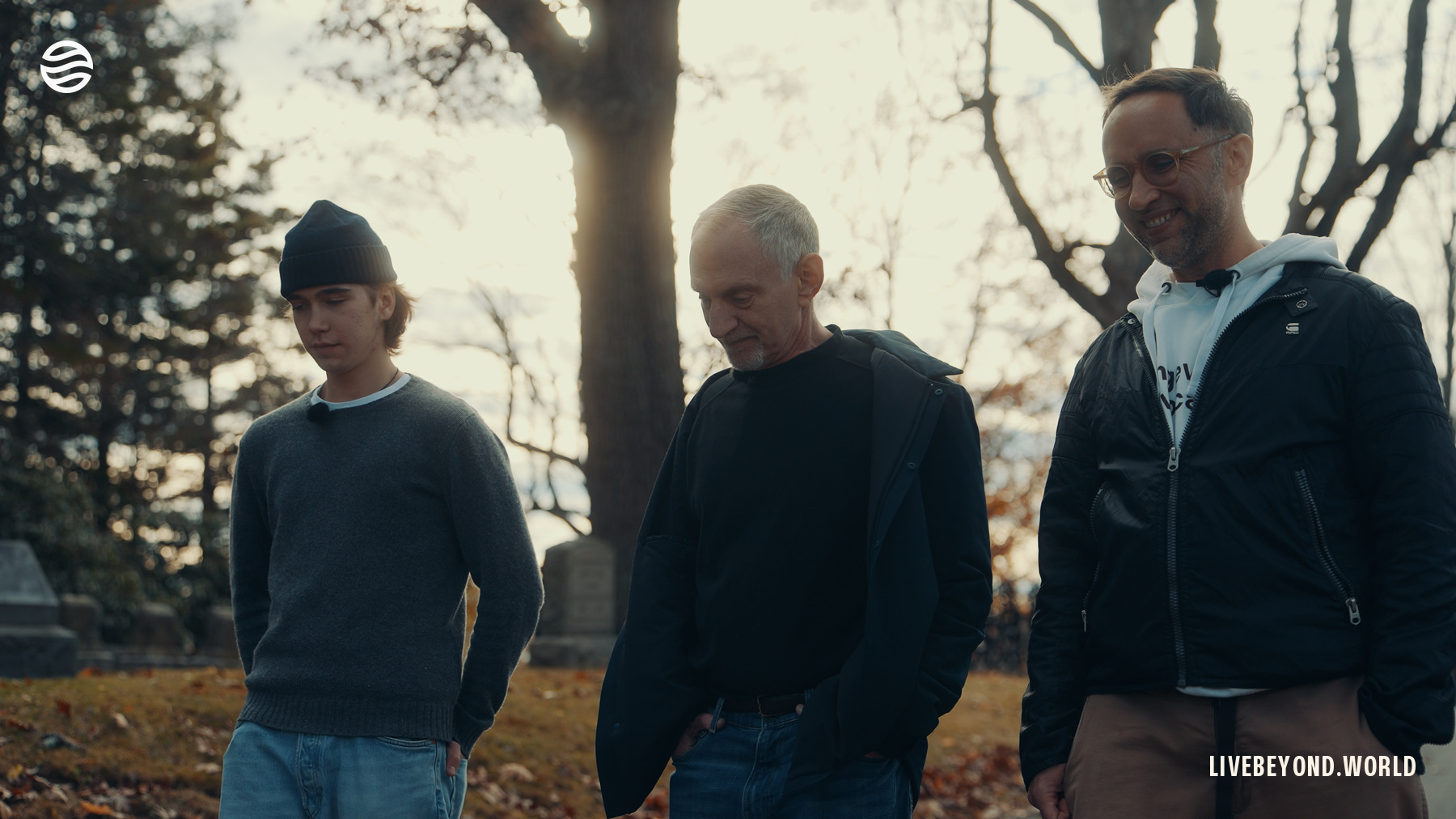
Robert Waldinger told my son Alek and me that on a cold, sunny November day in Boston, in a place he had chosen himself: a cemetery. He directs the Harvard Study of Adult Development, which has followed the same families since 1938.
Alek was 18. So before the walk was over, I asked Robert the question any father would want answered: if you could talk to yourself at 18, what would you say?
I didn’t know who he was. Alireza Haghighi, a geneticist we met at Harvard Medical School, asked me if I had met Robert Waldinger yet, and told me I had to: his TED talk is one of the most watched there has ever been. So I wrote to him on LinkedIn, and sent him the teaser from our first months on the road. He gets a great many requests for interviews, he wrote back, but this one intrigued him. He would love to meet.
He felt like family from the first minute. And he had a reason for the place:
“I thought meeting in the cemetery was appropriate because you’re studying longevity and how we live, and it’s really helpful to be reminded of how beautiful it can be to be in a graveyard.”
I argued, of course. I told him about a cemetery in Sydney, high above the ocean, where I had decided I would much rather walk around a cemetery than lie under one. He agreed. And then he told us something I didn’t expect:
“One of the reasons why people get happier when they get older is that they get more aware of the reality of death. When we’re reminded of the reality of death, actually, instead of making us more depressed, it makes us happier, ’cause we start valuing life more.”
And then, to me: “You will get happier as you get older.” I told him I was already happy. “And you’ll get less worried about death.”
Cholesterol didn’t predict it
Here is how they found out. When the men in the study reached 80, the team looked back at everything they knew about them at 50, including their medical records, and asked what predicted who would be happy, healthy and alive thirty years later:
“We thought it would be blood pressure or cholesterol level, but it wasn’t. It was how satisfied you were with your relationships.”
“And we didn’t believe it at first, so we kept going back and reanalyzing the data, saying, ‘This can’t be true.’”
It was true. And other research teams have found the same. What surprised them most wasn’t happiness. It was the body:
“It’s the physical health effects that were the most surprising, ’cause how could it be that my relationships could actually shape my physiology? How could that be? But we’re finding out how.”
A big part of the answer is stress. Alek said it must be stress, and Robert agreed: “It relates a lot to stress.” When life feels lonely or tense, the body stays on alert. Over the years, that alert turns into chronic inflammation (a small fire in the body that never quite goes out), and that is one of the things that ages us fastest. Good relationships calm the alarm.
Our friend Olivia Lesslar, the mind, heart and body doctor, sees the good side of the same thing in her patients:
“I have seen patients do really well not changing what they eat, so they’re still eating rubbish, but changing how they eat. With gratitude, saying grace, taking the time, smelling the food, eating with friends.”
And it works both ways:
“Healthy people are often happier, and happier people are often healthier.”

The study didn’t set out to prove that people matter. It found it, didn’t believe it, and found it again.
The study that kept its people like family
TED made the study famous as the “happiness study”. When I asked Robert when they started calling it that, he said: “We never did. The TED organization called it the Happiness Study.” Alek wanted to know the real name. It is the Harvard Study of Adult Development, and as Robert put it:
“It’s not a study of happiness. But we do study happiness.”
Why the new name, then? Robert had a four-word answer: “Because happiness sells, right?”
It began in 1938 with 724 young men: students at Harvard, and boys from Boston’s poorest neighborhoods and most troubled families. Later came their wives, then their children. One of the Harvard students was John F. Kennedy. He left the study when he ran for the Senate, and his records are now in the Kennedy Library.
Most studies like this end within ten years, because too many people drop out. When we met Robert, the study was 86 years old, and only 22% had left. Robert said that is “almost unheard of”, and the reason is the most beautiful part of the whole story:
“The study directors took good care of them. These were young men, and they made them feel like they belonged to a community. So if people needed help, they came to the study. If they needed a doctor… Sometimes they needed a loan, a little bit of money. The study would loan them money.”
“We would write them thank-you notes when they would return a questionnaire. We would send them birthday cards. I mean, it’s about building a community.”
So you were like a family to them, I said. “Yeah. Yeah.” And when the time came, most of their children said yes to the study too, because it had meant so much to their parents.
Think about that. The study that found relationships keep us alive kept going for 86 years because of relationships.
Just as happy, and ten years shorter
Then Robert told us something I still think about. The men from Boston’s poorest neighborhoods earned much less, all their lives. And yet:
“They were just as happy, on average, as the Harvard students.”
“But they died 10 years earlier, on average.”
Part of it was medical care. But Robert pointed to something else. In the 1970s and 1980s, when America first learned how much lifestyle matters for health, the better-educated men read about it and changed their lives. The others got the message later, and acted on it less. Happiness didn’t save them from what they didn’t know.
That is the first rule of longevity I always give: don’t die of something you could have prevented. And it isn’t only about knowledge. It is also about the people around you:
“Behaviors are contagious.”
“You’re more likely to behave the way your friends do.”
If your friends smoke, you are more likely to smoke. If they eat a lot, you are more likely to eat a lot. It works the good way too. Robert summed it up: “It’s both education and it’s the company we keep that seems to matter a lot in how we shape our lives.”
The biggest lesson, in two sentences
Alek asked him what the study had taught him most. Robert gave him two things:
“One of our study members said, ‘Take care of your body like you’re going to need it for 100 years.’”
“And then the other thing is that relationships are much more important than we thought they were in quality of life and quality of health. Those are the two big takeaways from the study.”
Peter Diamandis, who has spent his life getting people excited about the future, told us almost the same thing in Los Angeles in December 2025, before I had even mentioned Robert:
“One of the things when I’m going to sleep is I will meditate on the three things I’m most grateful for from the day. And invariably, it’s not a deal I had or some guy I met. It is some experience with my kids or my family, right? And that ultimately is what is so meaningful to us. It’s the connection between humans.”
A minute later, I told him about Robert’s study.
On the very first stop of our quest, in Dublin in August 2023, Andrea Maier wished us exactly this:
“Without joy, you can have a beautiful body, and you can have beautiful genes, and your epigenomic age is very, very low, but you have to really enjoy the interaction with humans and with people because there needs to be purpose in life.”
(Your epigenomic age is how old your body is on the inside, read from your DNA.)

When people ask me what matters most for longevity, I always say: “Treat your mind, heart and body as a temple, not as a trash bin.” I told Robert. “Great idea,” he said.
And the best part is the price:
“Changing mindsets may not require a lot of money, and it may not require a lot of technology. It may require helping people to understand more about lifestyle changes and dealing with stress and being more socially connected. Those are not expensive solutions. And they’re very powerful solutions compared with a lot of the high-tech things that cost a lot of money.”
Eric Verdin, whom we first met in California, knows why people don’t jump at these simple solutions. When we talked in Warsaw in September 2024, he told us:
“People will tell me, ‘Well, you’re gonna talk about lifestyle factors, and we’ve heard this, and yeah, I’m supposed to eat better and sleep better and be less stressed and have more friends.’ So this is all the lifestyle factors. And people say, ‘Well, that’s boring.’ Maybe it’s boring, but it’s the only thing we have today.”
I told him there are a couple more things. But he’s right about what comes first. And “have more friends” is on his list.
Robert is a psychiatrist, and somewhere in the middle of our walk I told him something I rarely say out loud. When I was a kid, I was ill most of the time. When I was sick, my parents didn’t use violence against me. He finished my sentence before I could: “So if you were sick… you were safer.” It is the clearest example I know of how what happens between people gets into the body. It took me a long time, and real help, to get it out again.
Olivia sees the same pattern in her practice. When we talked in Formentera, in August 2024, she told us who falls ill as the stress in our lives grows:
“Whether it’s adverse childhood events or nervous system dysregulation or whatever, those people are becoming sick.”
The good news is the one Robert’s study keeps finding: what people do to us can make us ill, and what people give us can help us heal.
What he would tell himself at 18
Before we said goodbye, I asked him my question. If you could talk to yourself at 18, like my son is now, what would you say? He said he wasn’t thinking about longevity at all at 18. So I tried to help: would you tell yourself to get a wife earlier, because that’s what the study shows? We both laughed. Then he answered:
“No. I would say, find the things that make you happy, find the things that you care about, and don’t worry about what other people think. Find the things you really wanna do and you’ll be happier, and then you’ll be healthier.”
Happier, and then healthier. In that order.
Alek asked the last question of the day: what would Robert wish us for the rest of our quest?
“Well, my hope is that you’ve already found things that surprise you and that turn your assumptions on their heads, and I hope you continue to do that.”
We had. I had gone around the world collecting tests, therapies and protocols. And the longest study of adult life told me the strongest predictor of a long, healthy life is the people I share it with. Including the one walking next to me.
And in that same first week in Dublin, Brian Kennedy told Alek what he wished him most:
“Well, I think the first thing I would wish for you is that you take this time and build that father-son relationship so that it’s really strong and lasts throughout your life, because this is a huge opportunity to do that. And beyond that, just have fun while you’re doing it, and maybe learn a little about longevity too.”
We did all three.
So, what about you? How many people could you call at 3 a.m., just like that? I’d really love to know.
Send me your answer on Instagram: @longevityadvocate.
The film. Our year on the road is becoming “Live Beyond. Father and Son on a Quest for Longevity”, coming next year. We filmed this walk with Robert for it, with our friend Kamil Rydzewski behind one of the cameras.
More from the quest
Earlier stories
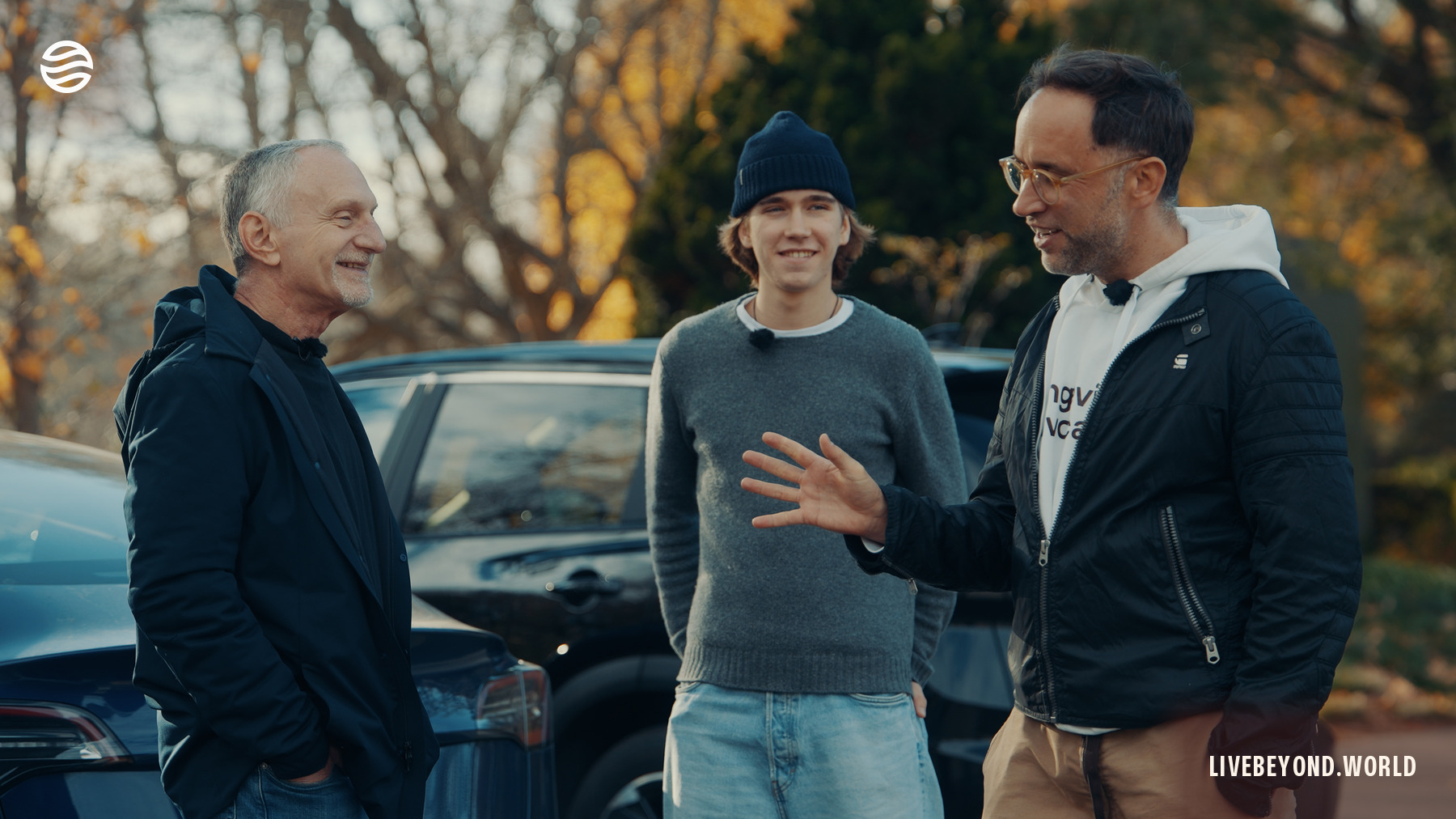
Alek Piotrowski, Robert Waldinger and Marek Piotrowski in Boston, November 2024. · Live Beyond
Where each quotation comes from. Robert Waldinger, Boston, November 2024. Olivia Lesslar, Singapore, February 2024. Peter Diamandis, Los Angeles, December 2025. Andrea Maier, Dublin, August 2023. Eric Verdin, Warsaw, September 2024. Olivia Lesslar, Formentera, August 2024. Brian Kennedy, Dublin, August 2023.