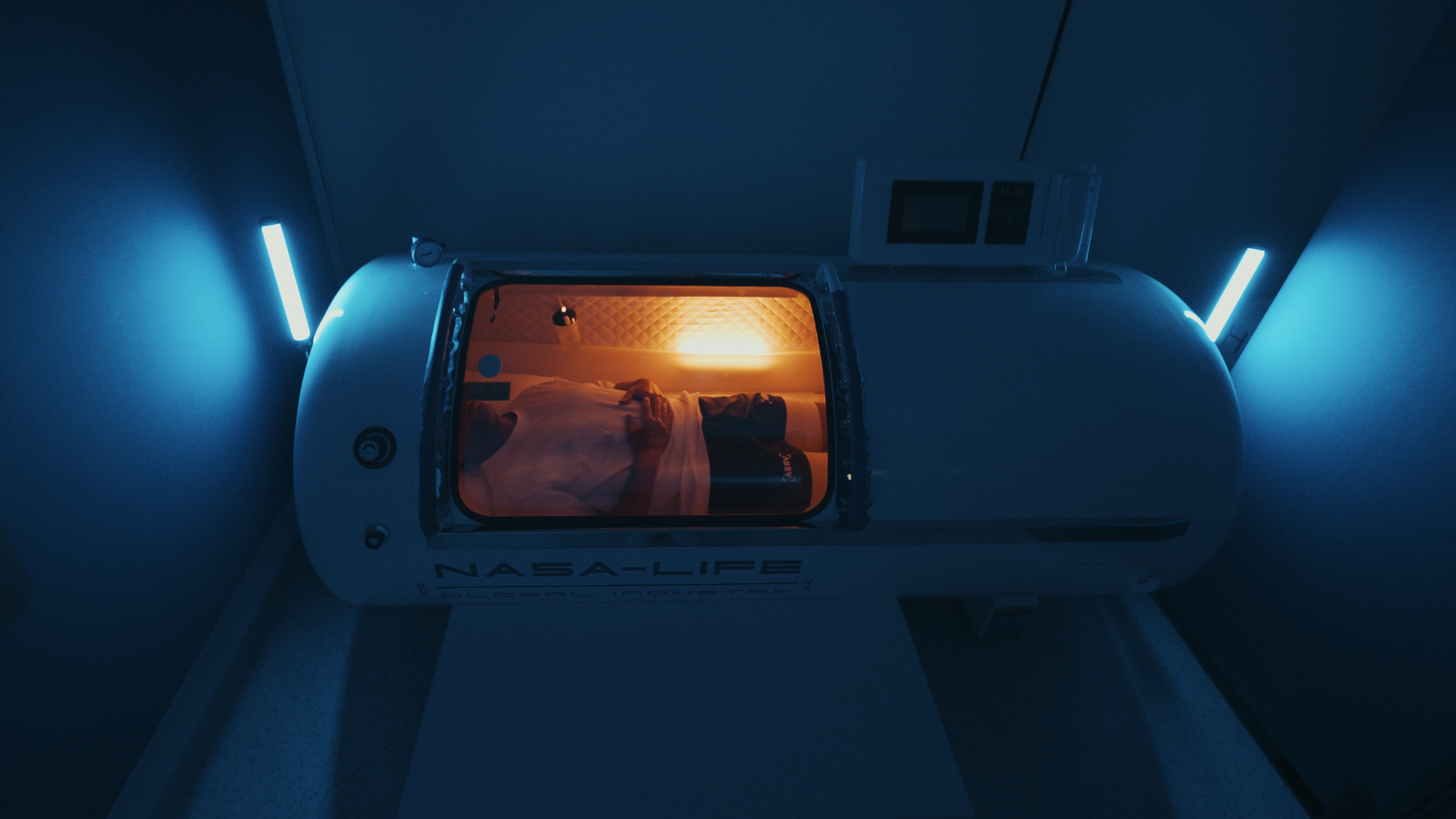
Marek in the hyperbaric oxygen chamber at the Longevity Center, Warsaw, September 2024.
Breathing pure oxygen in a pressure chamber is real medicine for a short list of conditions. In recent years it has also become one of the most talked-about longevity treatments — mostly because of one study on telomeres, the protective caps on the ends of our DNA. On our quest, father and son, we met 100+ longevity experts. Several of them talked to us about hyperbaric oxygen, and Marek lay in a chamber himself at the Longevity Center in Warsaw. Here is what is shown in people, what is only promising, and what nobody knows yet.
This page shares what research and the experts we met say. It is not medical advice, and it does not recommend any medicine, supplement or treatment. It knows nothing about you. Before you start, stop or change anything — especially if you are pregnant, live with a health condition or take any medication — please talk to your doctor. In an emergency, call your local emergency number.
In short
Hyperbaric oxygen is real medicine. Doctors use it to heal wounds that won’t close, to treat divers and carbon monoxide poisoning, and for about a dozen other conditions. Healing, better blood flow and repair are what longevity is made of. Early studies in healthy older people found better memory and attention after a course of sessions; those studies are still small, so the full picture is still being written. Real HBOT happens in a hard chamber with doctors present, so ask your doctor first. [1][2]
Longevity, as we mean it: more healthy, joyful years. What we mean →
2×normal air pressure or more, while breathing almost pure oxygen. That is real, medical HBOT.[3]
1.3–1.4×normal air pressure in a typical soft chamber, usually breathing ordinary air. In the US it is cleared only for altitude sickness.[3]
60sessions over about three months. That is what the most-quoted studies on aging used.[2][4]
What hyperbaric oxygen is
Hyperbaric simply means higher pressure. In hyperbaric oxygen therapy — HBOT — you breathe almost pure oxygen inside a chamber where the air pressure is raised well above normal. Dave Gobel, co-founder of the Methuselah Foundation, explained it to us better than any textbook. We are grateful he took the time:
“You get into a chamber, and what happens is that the pressure in the chamber goes higher than normal, higher than atmospheric pressure. You put on an oxygen mask, 100% oxygen, and the pressure on your own body, which you don't really feel, you may have to clear your ears a couple times, the pressure on your body is like the Coke bottle that squeezes the liquid. The oxygen then goes into solution, meaning that not only is your red blood cell carrying oxygen, but the blood fluid now has oxygen […]”
In plain words: Normally, oxygen travels through your body on your red blood cells. Under pressure, extra oxygen also dissolves into the liquid part of your blood — like the bubbles held inside a closed bottle of cola. So more oxygen reaches places where blood flow is poor.
Hard chamber or soft chamber — not the same thing
Medical HBOT happens in a hard chamber, with trained staff. You breathe almost pure oxygen at twice normal air pressure, or more. Soft, inflatable chambers — often sold as mild HBOT for homes and wellness studios — reach only about 1.3–1.4 times normal pressure, and you usually breathe ordinary air. In the US they are cleared only for altitude sickness. That is not real HBOT, and the studies on this page did not use them.
More than twice the chance that the wound has healed after six weeks of treatment. Whether it still helps a year later, or prevents amputations, is unclear.
“So that's why if someone has diabetic ulcers in their feet, they get hyperbaric oxygen, because it feeds more oxygen to the tissues.”
In plain words: Tissue needs oxygen to heal. Where blood flow is poor — like in the feet of some people with diabetes — HBOT pushes more oxygen in. That is why wound clinics use it.
What it has not been shown to treat
The US Food and Drug Administration (FDA) warns that HBOT has not been shown to treat cancer, autism, diabetes, Alzheimer’s, stroke, sports injuries and many other things it is sold for. It also warns that people may put off treatment that works. Healing a diabetic foot wound is on the accepted list. Treating diabetes itself is not.
Almost everything said about HBOT and aging comes from a handful of small studies. They are interesting. None of them is proof.
Sharper thinking in healthy older people
63 healthy people over 64 took part. Some had 60 sessions over three months; the others had nothing. The HBOT group got better at paying attention and thinking fast, and blood flow in their brains improved. A real signal. But the study was small, everyone knew which group they were in, and nobody had a fake session to compare with.
Based on: Small trial, 63 people · promising, not proof [2]
The telomere study
Telomeres are the protective caps on the ends of our DNA. They get shorter as we age. In this study, about 30 healthy older people had 60 sessions. Afterwards, telomeres in some of their blood cells were longer, and there were fewer worn-out immune cells. But there was no comparison group. Nobody knows if the change lasts, or if it makes anyone healthier. And some of the authors own shares in AVIV Scientific, a company that runs HBOT clinics.
Based on: One group, no comparison, about 30 people · not proof [4]
In plain words: Headlines said HBOT makes you younger. This study can’t show that. It is an interesting first clue — one that other teams still need to check.
Long COVID
73 people with long COVID took part. Some had 40 real sessions; the others had fake ones, and nobody knew who got which. The real sessions helped attention, energy, sleep and pain more. This is the best-made study on this list — and it is about recovering from an illness, not about aging.
Based on: Well-made trial, 73 people · good evidence, but not about aging [7]
PTSD in veterans
35 veterans had PTSD — lasting trauma after war — that medicines and therapy had not helped. After 60 sessions, their symptoms and their brain scans improved compared with veterans who did not get HBOT.
Based on: Small trial, 35 people · promising, not proof [8]
Who did the studies
Most of these studies come from one team: Prof. Shai Efrati’s group at Shamir Medical Center and the Sagol Center in Israel. The team has business links to HBOT clinics. That doesn’t make the results wrong. It means other teams need to repeat them before anyone builds a longevity plan on them.
Based on: From the studies’ own disclosures [2][4]
What rests on theory and animal studies
The anti-aging idea
Articles that call HBOT anti-aging lean mostly on theory, on animal studies and on a few small Israeli studies. Their own authors say nobody really understands yet how it would work, and that more research is needed.
No study has shown that HBOT makes people live longer.
What our experts told us
In Shanghai, Alek asked Dr Evelyne Bischof about hyperbaric oxygen. She works with cancer patients and in longevity medicine. Hers was the most balanced answer we heard, and we are thankful for it:
“I think great potential for the future, and we need to see more studies in order to know for whom, how long, which protocol. But the studies we are seeing, for example, from Professor Efrati from Israel, are showing great results on post-traumatic stress disorder, also athletes, also people with dementia problems. So as long as it's in the right protocol and it's safe, I think there is a good potential.”
In plain words: It may turn out to be useful. But doctors don’t yet know who it helps, for how long, or with which settings. She points to early studies on trauma, athletes and memory problems. Her condition: the right protocol, and safety first.
Where the joy is
Let’s be honest: a pressure chamber is not where joy lives. A course means dozens of sessions, lying still in a closed chamber, popping your ears as the pressure changes. Some people read, listen to music or simply rest. If that works for you, wonderful.
The joy of HBOT is in what it can give back. For a diver with the bends, or for someone whose foot wound finally heals, it means getting their life back. For a healthy person, the joy is in the proven, pleasant things — moving every day, sleeping well, real food, time with the people you love. The chamber is for when a doctor says you need it.
Who should be careful
See a doctor before you get in
If you have a collapsed lung that hasn’t been treated, HBOT is not for you. If you have heart failure, epilepsy that isn’t under control, recent ear or sinus surgery, a cold, a fear of closed spaces, or diabetes treated with insulin, a doctor must check you first. Medical chambers are supervised for good reason. [10]
Side effects, common and rare
The most common is ear and sinus pain from the pressure. It is usually minor — and it is why you must be able to pop your ears. After several weeks of sessions, people often become a little short-sighted for a while; it usually passes within 3–6 weeks. Cataracts, a clouding of the eye’s lens, have been seen after very long courses of 150 sessions or more. Seizures from too much oxygen are rare — about 1 in 2,000 to 1 in 10,000 sessions — and leave no lasting harm.
Oxygen makes fire spread fast, so chambers carry a fire risk. Rare serious harms include an air bubble in a blood vessel. The FDA warns against unapproved chambers used for unproven things.
And for anyone still growing: when Alek, then 17, asked about HBOT, Dr Bischof told him honestly that nobody knows what it does to a young body:
“You know, you're 17, and you are in the growth. I don't know what a hyperbaric stress could do to your growth and to mitochondria. I don't know.”
In plain words: Teenagers are still growing. Nobody has studied what the pressure and the extra oxygen do to a growing body, or to its mitochondria, the tiny power plants inside every cell. When even an expert doesn’t know, it is wise to wait.
What to ask before you decide
Is it a hard chamber, at twice normal pressure or more, with medical staff? If not, it is not the treatment the studies used.
What exactly is it treating? If your reason is on the accepted list, HBOT is real medicine. If the reason is anti-aging, you would be joining an experiment.
Who checks me before the first session? Ears, lungs, heart, medicines, epilepsy — a good centre checks all of it first.
How many sessions, and how will we know if it worked? Agree beforehand what will be measured, and test before and after.
Who did the studies you are quoting? Ask whether any other team has repeated them.
Every number on this page, by the number in square brackets. Quotations come from Live Beyond’s own recorded interviews, cleaned only of “um” and “uh”. Not medical advice. Talk to your doctor before you change anything.
Undersea and Hyperbaric Medical Society (UHMS) indications, as listed by University of Iowa Health Care. https://uihc.org/health-topics/indications-hyperbaric-oxygen-therapy
Hadanny A, Daniel-Kotovsky M, Suzin G, et al. Cognitive enhancement of healthy older adults using hyperbaric oxygen: a randomized controlled trial. Aging (Albany NY). 2020;12(13):13740-13761. doi:10.18632/aging.103571
Parkview Health, ‘Clearing the air on HBOT Lite’ (hyperbaric medicine service blog). https://parkview.com/blog/clearing-the-air-on-hbot-lite
Hachmo Y, Hadanny A, Abu Hamed R, et al. Hyperbaric oxygen therapy increases telomere length and decreases immunosenescence in isolated blood cells: a prospective trial. Aging (Albany NY). 2020;12(22):22445-22456. doi:10.18632/aging.202188 (some authors hold shares in AVIV Scientific, an HBOT clinic company).
Kranke P, Bennett MH, Martyn-St James M, Schnabel A, Debus SE, Weibel S. Hyperbaric oxygen therapy for chronic wounds. Cochrane Database of Systematic Reviews. 2015;(6):CD004123. doi:10.1002/14651858.CD004123.pub4 (Cochrane flagged a conflict-of-interest policy issue in 2020; an update was expected).
US FDA consumer update ‘Hyperbaric Oxygen Therapy: Don't Be Misled’, 22 August 2013 (later updated as ‘Get the Facts’). Reported by HealthDay: https://www.healthday.com/health-news/exercise-and-fitness/hyperbaric-oxygen-chambers-aren-t-cure-alls-fda-warns-679513.html
Zilberman-Itskovich S, Catalogna M, Sasson E, et al. Hyperbaric oxygen therapy improves neurocognitive functions and symptoms of post-COVID condition: randomized controlled trial. Scientific Reports. 2022;12:11252. doi:10.1038/s41598-022-15565-0
Doenyas-Barak K, Catalogna M, Kutz I, et al. Hyperbaric oxygen therapy improves symptoms, brain's microstructure and functionality in veterans with treatment resistant post-traumatic stress disorder: a prospective, randomized, controlled trial. PLoS One. 2022;17(2):e0264161. doi:10.1371/journal.pone.0264161
Gupta M, Rathored J. Hyperbaric oxygen therapy: future prospects in regenerative therapy and anti-aging. Frontiers in Aging. 2024;5:1368982. doi:10.3389/fragi.2024.1368982
Heyboer M 3rd, Sharma D, Santiago W, McCulloch N. Hyperbaric Oxygen Therapy: Side Effects Defined and Quantified. Advances in Wound Care. 2017;6(6):210-224. doi:10.1089/wound.2016.0718