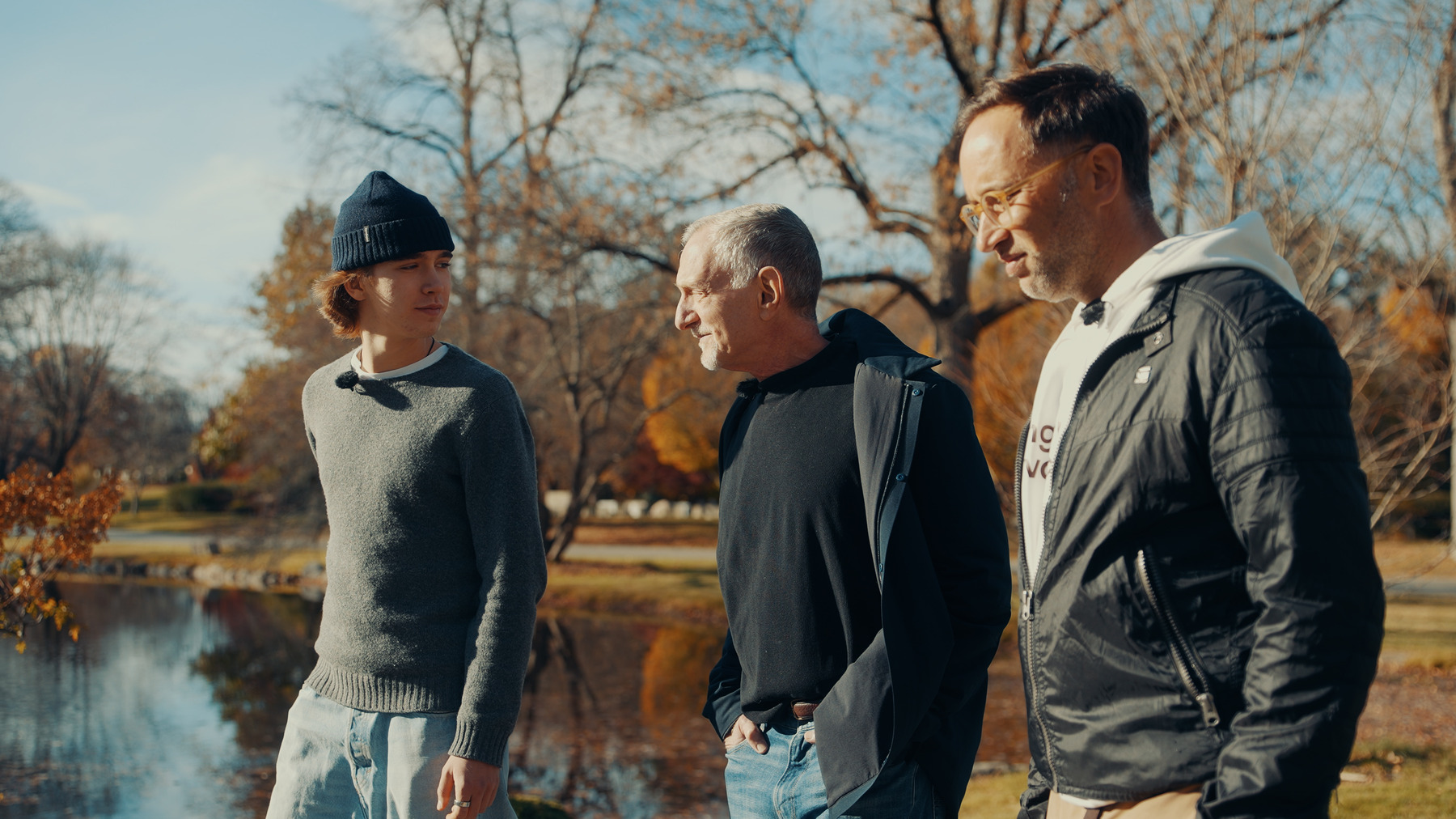
Marek and Alek with Robert Waldinger at Harvard, Boston, November 2024.
On our quest, my son Alek and I met more than a hundred longevity experts. Almost everywhere, the talk came back to people. In Boston, Robert Waldinger, who leads one of the longest studies of adult life in the world, walked with us and told us what surprised his team most. In Okinawa, our host taught Alek the word for chatting. In Sardinia, our guide told us what a Blue Zone means to her: family. This page explains what we learned, in plain words. Every number has its source. Where science only shows a link and not a cause, we tell you.
This page shares what research and the experts we met say. It is not medical advice, and it does not recommend any medicine, supplement or treatment. It knows nothing about you. Before you start, stop or change anything — especially if you are pregnant, live with a health condition or take any medication — please talk to your doctor. In an emergency, call your local emergency number.
In short
Yes — warm relationships are among the strongest things linked to a long, healthy and happy life. Across 148 studies, people with stronger social ties had about 50% higher odds of staying alive during the years they were followed. In the Harvard study, how satisfied people were with their relationships at 50 told more about their health at 80 than their cholesterol did. Most of this shows a strong link, not proof of cause — but the link shows up again and again, and starting costs nothing: one call, one shared meal, one walk with a friend. [1][2][3]
Longevity, as we mean it: more healthy, joyful years. What we mean →
~50%higher odds of survival for people with stronger social ties, across 148 studies and 308,849 people.[1]
50 → 80In the Harvard study, the people most satisfied with their relationships at 50 were the healthiest at 80.[2]
1 in 6people in the world is affected by loneliness. If that is you, you are in very large company.[4]
Most of us know that friends make life better. The surprise is how much they seem to matter for the body too. Scientists who expected blood pressure and cholesterol to tell them who would age well found that relationships told them more. Here is what that means — and what it does not mean.
Why people matter for your body
Nobody knows the whole answer yet, but the scientists we met pointed in the same direction. Good relationships calm stress, and stress that never switches off wears the body down. The people close to us also help when we are sick, nudge us to see a doctor, and pull us into their habits: we tend to eat, move and drink like the people around us.
Friends and the common cold
Scientists gave 276 healthy volunteers nose drops with a cold virus and watched who got sick. People with the fewest kinds of relationships were about four times more likely to catch a cold than people with six kinds or more — family, friends, neighbors, colleagues, a club, a church.
Based on: One careful experiment · a link, not proof [5]
In plain words: The people in your life seem to be part of how your body copes. Not just a nice extra.
What studies in people show
Nobody can pick people at random to have friends or not for fifty years. So almost everything here comes from long-term studies: scientists follow large groups of people for years and see who stays healthy and who lives longer. That shows a link. On its own, it does not prove the cause — and we come back to that below.
Stronger ties, better odds
Across 148 studies with 308,849 people, those with stronger social relationships had about 50% higher odds of survival during the years they were followed. The link held for young and old, for women and men, and for people who were healthy or ill at the start.
Based on: Many long-term studies combined · a link, not proof [1]
Lonely, cut off, or living alone
A second big review looked at people who felt lonely, people who had few contacts, and people who lived alone. Each group had a higher risk of dying early — 26%, 29% and 32%. Feeling lonely and being cut off mattered about equally. And the link was stronger in people under 65, not weaker.
Based on: Many long-term studies combined · a link, not proof [6]
What the Harvard study found
Since 1938, the Harvard Study of Adult Development has followed 268 Harvard students and 456 boys from Boston’s poorest neighborhoods — and later their wives and children. When the team looked back, it wasn’t cholesterol at 50 that predicted who would age well. The people most satisfied with their relationships at 50 were the healthiest at 80.
Based on: One long-term study, more than 80 years · a link, not proof [2]
A health warning from America’s top doctor
In 2023 the US Surgeon General called loneliness an epidemic. About half of American adults say they have felt lonely. Lacking connection can raise the risk of dying early about as much as smoking up to 15 cigarettes a day.
Based on: Official health advisory (US Surgeon General), based on many studies [3]
In plain words: Loneliness is not a weakness and it is not your fault. Health authorities now treat connection as part of health, like sleep, food and movement — not as a private matter.
Close, not crowded
In the big review, simply living with someone showed the weakest link. Being woven into many kinds of relationships — family, friends, groups, helping others — showed the strongest. It is not about how many people share your roof, but how connected you really are. [1]
What our experts told us
We are deeply grateful to every expert who took the time to teach us. Robert Waldinger is a psychiatrist and a Zen teacher, and he directs the Harvard Study of Adult Development. He chose to meet us in a beautiful old cemetery park in Boston — being reminded of death, he told us, makes people value life more. He felt like family from the first minute.
“We didn’t believe it at first when we started finding this. […] Once we had studied people out until they were age 80, we decided to look back at what we knew about them when they were middle-aged ’cause we had a lot of medical records, and we knew what their health was like at age 50. And so we thought, ‘Let’s look at what predicts when you’re 50 that you’re gonna be happy and healthy and alive when you’re 80. What are the biggest predictors?’ And we thought it would be blood pressure or cholesterol level, but it wasn’t. It was how satisfied you were with your relationships.”
In plain words: His team expected a number from a blood test to predict a healthy old age. What predicted it was something no lab measures: how good people felt about their relationships.
“And it turned out it is very true, and many other research groups have found similar findings. And so we now understand that there’s a very strong connection between how good our relationships are, how connected we are to people, and how, not just how happy people are, but how healthy. And it’s the physical health effects that were the most surprising, ’cause how could it be that my relationships could actually shape my physiology? How could that be? But we’re finding out how.”
In plain words: Your relationships seem to reach all the way into your body. Scientists are still working out exactly how — and stress is a big part of it.
“Well, the other thing we know is that behaviors are contagious. So there’s very good work by a guy named Nick Christakis, at Yale, who shows that you’re more likely to behave the way your friends do. […] So what we know is there’s a lot of social contagion that goes on. And so it’s both education and it’s the company we keep that seems to matter a lot in how we shape our lives.”
In plain words: We become a little like the people we spend time with. That works both ways — so spend time with people whose habits you would love to share.
What the long-lived places share
At Eiko’s table in Ogimi, Okinawa, October 2023.
We went to two places famous for long, healthy lives: Okinawa in Japan and Sardinia in Italy. People call them Blue Zones. We expected to hear about food. We kept hearing about people.
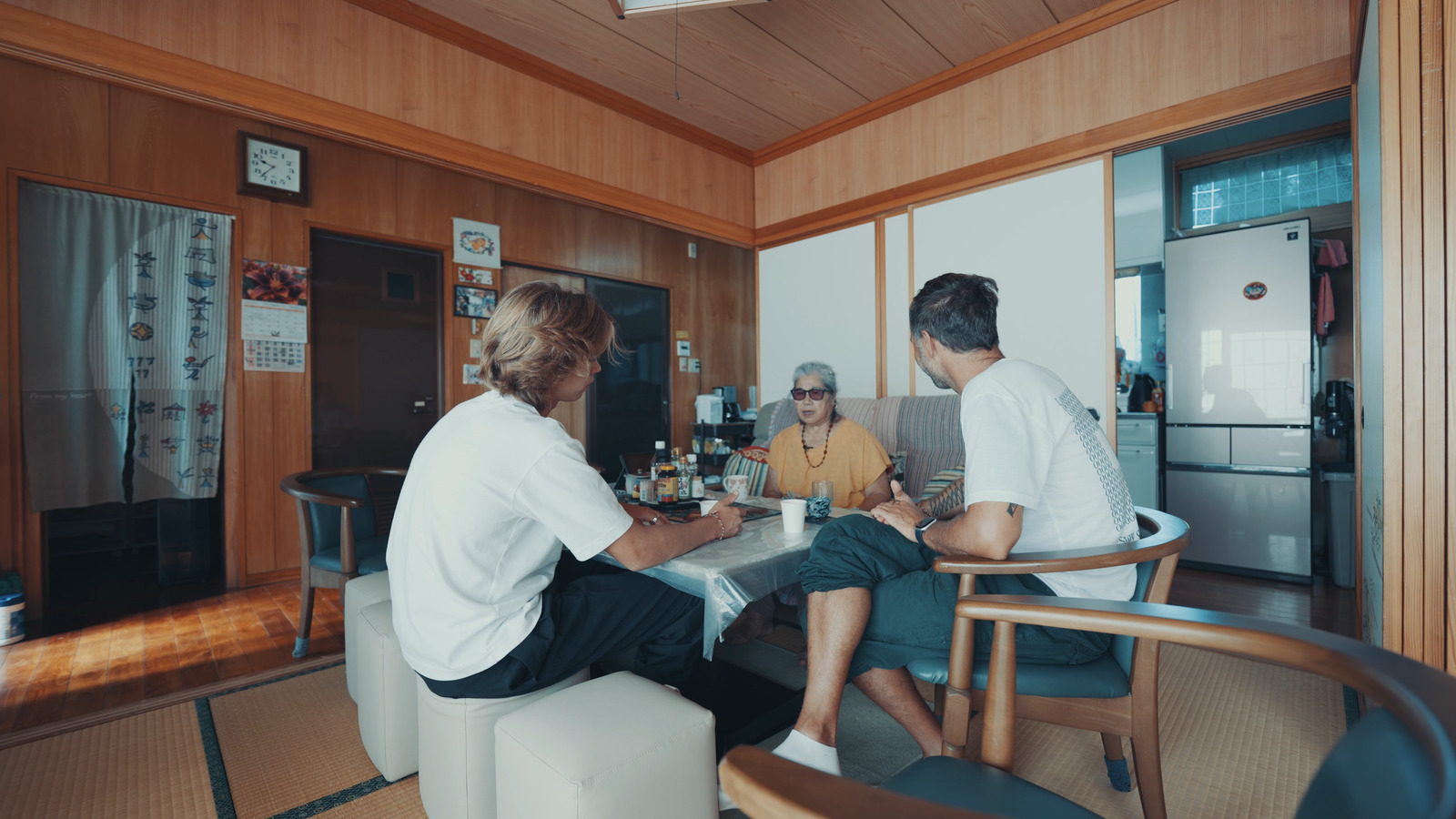
When Alek asked our host in Nanjo, Okinawa, about ikigai — the famous idea of a reason to live — she laughed and said she wasn’t sure. Then she told him what she did know:
“Okinawan people love to communicate with other people. That is very important, I think. Usually people are talking about anything. Communication is very important for Okinawan people. Have you heard of Yuntaku? […] Yuntaku is chatting. And always Yuntaku.”
In plain words:Yuntaku is the Okinawan word for chatting together, about anything at all. It is not a waste of time there. It is part of every day.
A few days later, in Ogimi, the village known for its centenarians, our guide Eiko took us from one elder to the next and translated every word. A man of 78, asked what he would tell Alek, talked about people looking out for each other like one family. A woman of 97 shared her recipe: no brooding, plenty of laughter, talking with friends, cooking her own meals, walking and sleep.
Moai: friends for life
Some Okinawans belong to a moai — a small group of friends who commit to each other for life. The Blue Zones team describes groups of five friends, and one moai that had been together for 97 years. We did not meet a moai ourselves; this comes from their report.
Based on: Popular account by the Blue Zones team · an observation, not a test [7]
“I would say that the Blue Zone, for me, from my point of view, is the sense of community that we have here. So every time that I heard about Blue Zone, it means family. […] Sense of community. This make everything different from other places to me, because you can replicate a lot of things, food or whatever, but the sense of community, the feeling, the vibe that I have here, because I was born and raised here, is different and I can find nothing comparable in other places in the world.”
In plain words: Food can be copied, and olive trees grow in many places. What makes her home different, Paola told us, is that everybody belongs — the old and the young, together.
Alone is not the same as lonely
This matters, because many people who love quiet time worry when they read pages like this one. Being alone and feeling lonely are different things. Loneliness is the feeling that the connection you have is less than the connection you need. Some people are happy with two close friends; some need a crowd. When Alek and I asked Paola what she fears most about getting older, she answered:
“Well, to be honest, it’s the fact of being lonely, which is different of being alone, ’cause I love to be alone sometimes, but it’s different. When you are lonely, it means there is no one around that care about you, and this is really scary. […] It can make a huge difference because everybody has problems. But when you know there is a bunch of people watching, like, for you all the time, it’s different, make your problem, like, smaller.”
In plain words: Time alone can be lovely. What hurts is feeling that nobody cares. And people who look out for each other make every problem a little smaller.
We felt it too. Months into the quest, a doctor in Singapore went through our check-up with us, including a short questionnaire on loneliness, and I told him the truth:
“We are traveling for one year. Okay, we are together, father and son, but still, Alek misses his peers, and I miss my friends too. […] I can’t just call a friend and come and have a chat or go to a cinema.”
You are not alone in feeling alone
About 1 in 6 people in the world is affected by loneliness. It is common, it is nothing to be ashamed of, and it can change — often with one small step toward one person. [4]
What we don’t know yet
We want to be honest about where the science stops.
Cause or link? The numbers on this page come from long-term studies. Researchers try to account for health, money and habits, but a link is still a link.
Which comes first? Healthy people find it easier to stay connected, and connected people may stay healthier. Probably both are true.
How many friends? No study gives a magic number. What counts seems to be how connected you feel, not the size of your address book.
Do the Blue Zones prove it? No. They show what long-lived places have in common. They can’t show which part does the work.
“On the other hand, if you are having health problems, it’s much harder to be happy, it’s much harder to connect with other people. It’s harder to do all those things that we know are good practices. So it’s a two-way street. Healthy people are often happier, and happier people are often healthier.”
In plain words: Feeling well makes it easier to be with people, and being with people helps you feel well. If your health makes connecting hard right now, that is not a failure — it is exactly where a little help from others counts most.
Where the joy is
With Mikiko Kumagai, our host in Nanjo, Okinawa, October 2023.
In the Live Beyond family we have one rule for everything we share: if it brings no joy, nobody keeps doing it. Friendship may be the easiest longevity habit there is, because the joy is the whole point. A long dinner. A walk where you forget the time. Laughing until it hurts. A call with a friend on the other side of the world. And every other healthy habit gets easier with somebody next to you — the run, the vegetables, the early night.
“Looking at the younger people that I see, it seems like more and more social connection is online, and I don’t know if that’s as fulfilling for people as in-person interactions. […] I like to interact with people in person, so I guess I’d encourage young people to do more of that because that’s real and that’s durable and tangible and fulfilling in a way that I don’t think that online connection can be.”
In plain words: Online is good for staying in touch. A hug, a shared meal and a walk side by side give something a screen can’t.
Small ways to start
With Kamil, our filmmaker and a great friend, Singapore, 2024.
No pressure and no rules. Pick the one that feels easiest, and try it this week.
Answer the call
When a friend calls, pick up. Or be the one who calls first.
Volunteer, or do one small act of service. Helping connects us too.
US Surgeon General · World Health Organization [3][4]
In plain words: One small thing, repeated, is how every friendship grows. Start with the person you already miss.
Who should be careful
If loneliness feels heavy
If it lasts, or you feel low most days, please talk to someone you trust or to your doctor. People who feel lonely are about twice as likely to become depressed — talking about it is a strong first step.
These studies are about warm, supportive relationships. If someone close to you hurts or frightens you, please reach out to someone you trust, a doctor or a local helpline. In an emergency, call your local emergency number.
Our advice
Young people
Loneliness is not only about old age. Among people aged 13 to 29, about 17–21% say they feel lonely — teenagers most of all.
We wrote this page from Live Beyond’s own recorded interviews and the published studies listed below, with gratitude to everyone who taught us — and to every friend who kept in touch while we were on the road.
Sources
Every number on this page, by the number in square brackets. Quotations come from Live Beyond’s own recorded interviews, cleaned only of “um” and “uh”. Not medical advice. Talk to your doctor before you change anything.
Holt-Lunstad J, Smith TB, Layton JB. Social relationships and mortality risk: a meta-analytic review. PLoS Med. 2010;7(7):e1000316. doi:10.1371/journal.pmed.1000316
Mineo L. Good genes are nice, but joy is better. Harvard Gazette, 11 April 2017. news.harvard.edu/gazette/story/2017/04/over-nearly-80-years-harvard-study-has-been-showing-how-to-live-a-healthy-and-happy-life/
Office of the US Surgeon General. Our Epidemic of Loneliness and Isolation: The U.S. Surgeon General’s Advisory on the Healing Effects of Social Connection and Community. US Department of Health and Human Services; 2023.
WHO Commission on Social Connection. From loneliness to social connection: charting a path to healthier societies. World Health Organization; 30 June 2025.
Cohen S, Doyle WJ, Skoner DP, Rabin BS, Gwaltney JM Jr. Social ties and susceptibility to the common cold. JAMA. 1997;277(24):1940-1944. doi:10.1001/jama.1997.03540480040036
Holt-Lunstad J, Smith TB, Baker M, Harris T, Stephenson D. Loneliness and social isolation as risk factors for mortality: a meta-analytic review. Perspect Psychol Sci. 2015;10(2):227-237. doi:10.1177/1745691614568352
Buettner D, Skemp S. Blue Zones: lessons from the world’s longest lived. Am J Lifestyle Med. 2016;10(5):318-321. doi:10.1177/1559827616637066