Most of what keeps people healthy for longer is ordinary: moving, sleeping, eating well, being with people. Knowing it is easy. Doing it on a rainy Tuesday, for years, is the whole game. On our quest, Alek and I met 100+ longevity experts, and the ones who live it hardly ever talked about willpower. They talked about routine, friends and enjoying it. Here is what the science of habits shows, said simply.
This page shares what research and the experts we met say. It is not medical advice, and it does not recommend any medicine, supplement or treatment. It knows nothing about you. Before you start, stop or change anything — especially if you are pregnant, live with a health condition or take any medication — please talk to your doctor. In an emergency, call your local emergency number.
In short
Mostly by making it small, regular and enjoyable — and it takes less willpower than you think. Do one small thing at the same moment every day, and it slowly becomes automatic. A simple “if this, then that” plan helps you start. Friends and fun help you keep going. And one missed day changes almost nothing. Give it about two months, often longer. How to keep a habit for many years is still being studied. [1][2][3][4]
Longevity, as we mean it: more healthy, joyful years. What we mean →
The scientists we met kept coming back to the basics, and we are grateful they said it so simply. The gap between knowing and doing is where habits live. A habit is something you do without having to decide.
“We really believe that at least in the United States, where the average person doesn’t have a typically very healthy lifestyle, most people can get 10 to 20 years of healthspan just by dialing in lifestyle. And you don’t even have to dial it in. You just have to kind of get the basics down.”
In plain words:Healthspan means the years you live in good health. Matt’s point: you don’t need to be perfect. Getting the basics roughly right is worth a lot.
How long does a habit take?
Forget the famous “21 days”. Nobody ever measured it. The best-known study asked 96 volunteers to pick one small daily action — fruit with lunch, a glass of water, a short run — and to rate for 12 weeks how automatic it felt.
66 dayswas the typical time before the new action felt automatic — for the half of volunteers whose results could be read clearly.[1]
18–254days: the fastest and the slowest person. Some habits come in weeks, some take most of a year.[1]
59–66days: the typical times found again in a 2024 review of 20 studies with 2,601 people.[2]
Bigger habits take longer
In more than 30,000 gym members, going to the gym took about six months to become a habit. For hospital staff, washing hands took just a few weeks. The clearest sign it was working: no long gaps between visits.
Based on: Large real-life study (tracking, not a trial) [5]
In plain words: A small habit takes about two months. A big one can take half a year. It gets easier on the way — that is exactly what a habit is.
Habits live in moments, not in willpower
The moment starts the action
When people wrote down every hour what they were doing, about 4 in 10 daily actions were repeated almost every day, in the same place — often while they were thinking about something else. Repeat something in the same situation, and your brain links the two. After a while, the situation alone starts the action. From then on you don’t need to decide, or to fight yourself.
Based on: Diary studies and a big review of the research [6][7]
“What you hear in the Blue Zones is that people build in their activity in the day-to-day […] lives, right? So they’re doing gardening, they’re […] hanging out with their friends. They’re building in activity just as part of their routine. So of course they don’t go to the gym necessarily like we do, but it’s actually just part of how they do things.”
Blue Zones are the places where people live longest. Their lesson in a few words: movement is not an appointment there. It is part of the day.
An “if-then” plan helps you start
Write down exactly when and where you will do it: “If it’s 7 in the morning and the kettle is on, then I do ten squats.” Across 94 experiments, people who made plans like this reached their goals clearly more often than people who only meant to.
People call this habit stacking. In one test, 50 people learning to floss were told to do it either just before or just after brushing their teeth. Eight months later, the ones who flossed after brushing had the stronger habit and flossed more often.
In plain words: Don’t rely on remembering. Pick a moment that already happens every day — coffee, brushing your teeth — and put the new thing right after it.
Start smaller than you think
Tiny Habits — a popular method
BJ Fogg, who founded the Behavior Design Lab at Stanford, teaches a method called Tiny Habits. Make the new habit so small it takes under a minute — two push-ups, one flossed tooth. Attach it to something you already do. Then celebrate straight away, so it feels good. Tiny Habits itself has not been tested in a proper trial, but every part of it fits the research on this page.
In one weight-loss trial, people who joined with a friend or family member — and got coaching on supporting each other — were much more likely to finish (95% against 76%). Six months after the program, 66% had kept all the weight off, against 24% of those who came alone.
Based on: One randomized trial (a fair test); friends and coaching came together [10]
“We all belong to herds, like animals. […] You’ve got a herd. I’ve got a herd. And we consciously or unconsciously conform to the behavior of the herd. […] Watch out for your herd and choose people around you who will encourage you by their own behavior to live in a responsible way.”
Sir Christopher Ball calls it the herd. We would call it family, and it can be one person: a walking friend, a partner who cooks with you. Everything is easier when somebody next to you is doing it too.
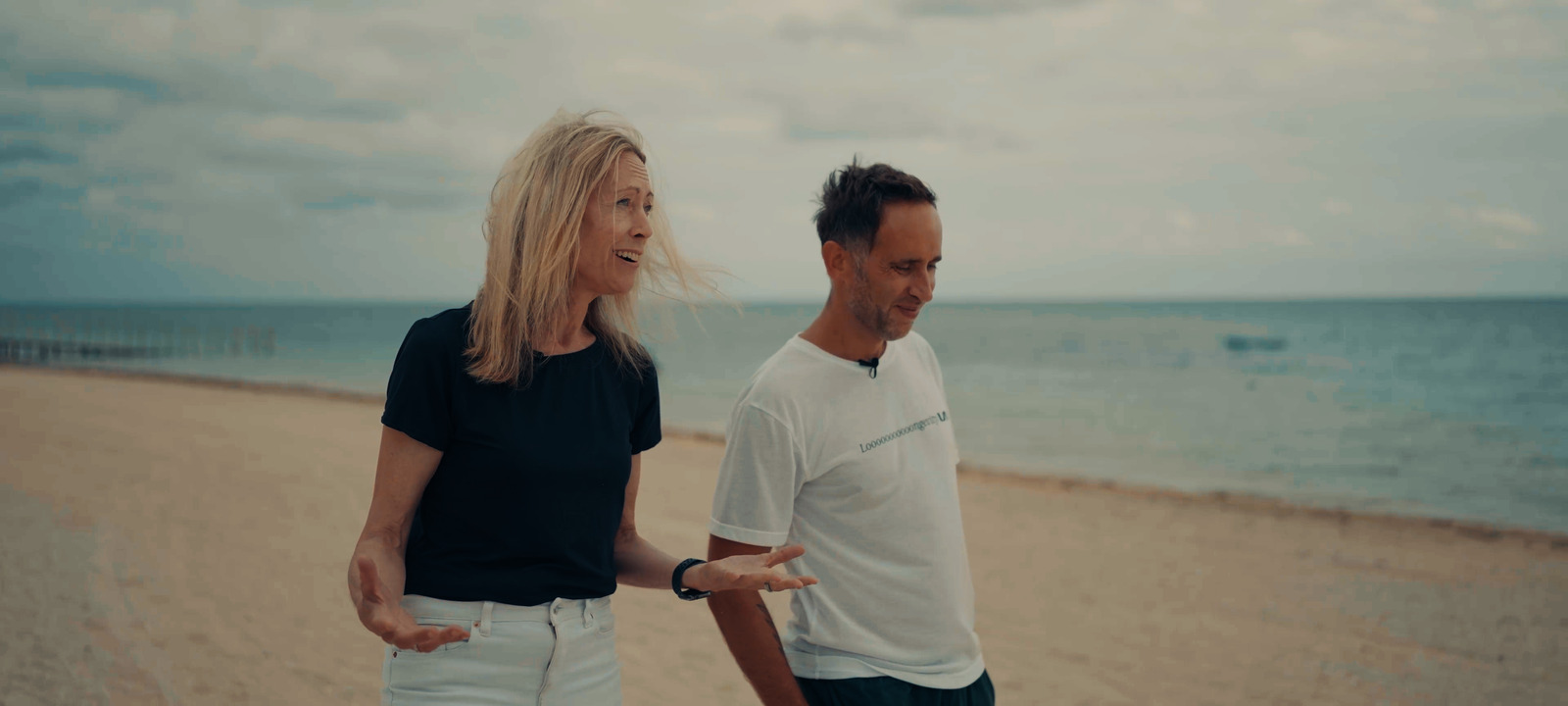
Tina Woods and Marek on the beach in Okinawa.
Where the joy is
This is the part we care about most. Longevity has to be connected with joy, or people simply won’t do it. The research agrees.
“We always say that longevity is not just about lifespan or healthspan, but it’s about enjoying life and living truly.”
Enjoying it predicts who keeps moving
Across 102 studies, people who enjoyed exercise were the people who exercised more. How you feel during a moderate workout predicts whether you come back.
Based on: Many studies combined; they show a link, not proof of cause [11][12]
In plain words: Liking it is not a bonus. It is one of the best signs you will still be doing it next year.
Choose for fun, not only for health
At a gym, people who picked exercises they enjoyed did more sets than people who picked what was good for them. In another study, people could listen to gripping audiobooks only at the gym — and went 51% more often at first. The effect faded after the holidays.
“Of course, without joy, you can have a beautiful body, and you can have beautiful genes, and your epigenomic age is very, very low, but you have to really enjoy the interaction with humans and with people because there needs to be purpose in life.”
In plain words:Epigenomic age is how old your cells look on a lab test. Andrea’s point: a young body on paper is not enough. Joy, people and purpose are part of a long life, not extras.
A missed day is a day not played
There are no streaks on this site, and nobody here will ever tell you that you did badly. The science is on our side.
One miss changes almost nothing
In the 66-day study, missing one day did not really change how automatic the habit became. A huge study then tested 54 programs on 61,293 gym members. The one that worked best simply gave people a small reward for coming back after a missed workout.
Based on: A study of volunteers, and a very large set of experiments [1][4]
In plain words: Missing a day is normal. What counts is the next time. Come back soon — not to make up for anything, just because long gaps make the way back harder.
“Just find something you enjoy. You don’t have to be on the treadmill. […] It could be yoga, it could be Pilates, it could be soccer, it can be anything. Just find something that you enjoy and do it regularly. […] We cannot all be perfect all of the time. It’s exhausting to be perfect all of the time, and life is kind of meant to be lived.”
Who you are becoming
Habits and who you are — a popular idea
In Atomic Habits, James Clear describes lasting habits as a question of who you are, not only what you want to reach. Every small repeat is a bit of proof that you are becoming that kind of person — someone who walks, someone who cooks. It is a book idea, not a trial result.
We are grateful to everyone on the quest who taught us this, mostly by living it. Now we’d love to hear from you: which small habit will you start this week, and who will do it with you? Tell us on Instagram, @longevityadvocate. You are part of this family.
Sources
Every number on this page, by the number in square brackets. Quotations come from Live Beyond’s own recorded interviews, cleaned only of “um” and “uh”. Not medical advice. Talk to your doctor before you change anything.
Lally P, van Jaarsveld CHM, Potts HWW, Wardle J. How are habits formed: modelling habit formation in the real world. European Journal of Social Psychology 2010;40(6):998–1009.
Singh B, Murphy A, Maher C, Smith AE. Time to form a habit: a systematic review and meta-analysis of health behaviour habit formation and its determinants. Healthcare 2024;12(23):2488.
Gollwitzer PM, Sheeran P. Implementation intentions and goal achievement: a meta-analysis of effects and processes. Advances in Experimental Social Psychology 2006;38:69–119.
Milkman KL, Gromet D, Ho H, et al. Megastudies improve the impact of applied behavioural science. Nature 2021;600:478–483.
Buyalskaya A, Ho H, Milkman KL, Li X, Duckworth AL, Camerer C. What can machine learning teach us about habit formation? Evidence from exercise and hygiene. Proceedings of the National Academy of Sciences, 17 April 2023.
Wood W, Quinn JM, Kashy DA. Habits in everyday life: thought, emotion, and action. Journal of Personality and Social Psychology 2002;83(6):1281–1297.
Wood W, Rünger D. Psychology of habit. Annual Review of Psychology 2016;67.
Judah G, Gardner B, Aunger R. Forming a flossing habit: an exploratory study of the psychological determinants of habit formation. British Journal of Health Psychology 2013;18(2):338–353.
Fogg BJ. Tiny Habits: The Small Changes That Change Everything. Houghton Mifflin Harcourt, 2019 (book).
Wing RR, Jeffery RW. Benefits of recruiting participants with friends and increasing social support for weight loss and maintenance. Journal of Consulting and Clinical Psychology 1999;67(1):132–138.
Rhodes RE, Fiala B, Conner M. A review and meta-analysis of affective judgments and physical activity in adult populations. Annals of Behavioral Medicine 2009;38(3):180–204.
Rhodes RE, Kates A. Can the affective response to exercise predict future motives and physical activity behavior? A systematic review of published evidence. Annals of Behavioral Medicine 2015;49(5):715–731.
Woolley K, Fishbach A. For the fun of it: harnessing immediate rewards to increase persistence in long-term goals. Journal of Consumer Research 2016;42(6):952–966.
Milkman KL, Minson JA, Volpp KGM. Holding the Hunger Games hostage at the gym: an evaluation of temptation bundling. Management Science 2014;60(2):283–299.
Clear J. Atomic Habits: An Easy & Proven Way to Build Good Habits & Break Bad Ones. Avery, 2018 (book).