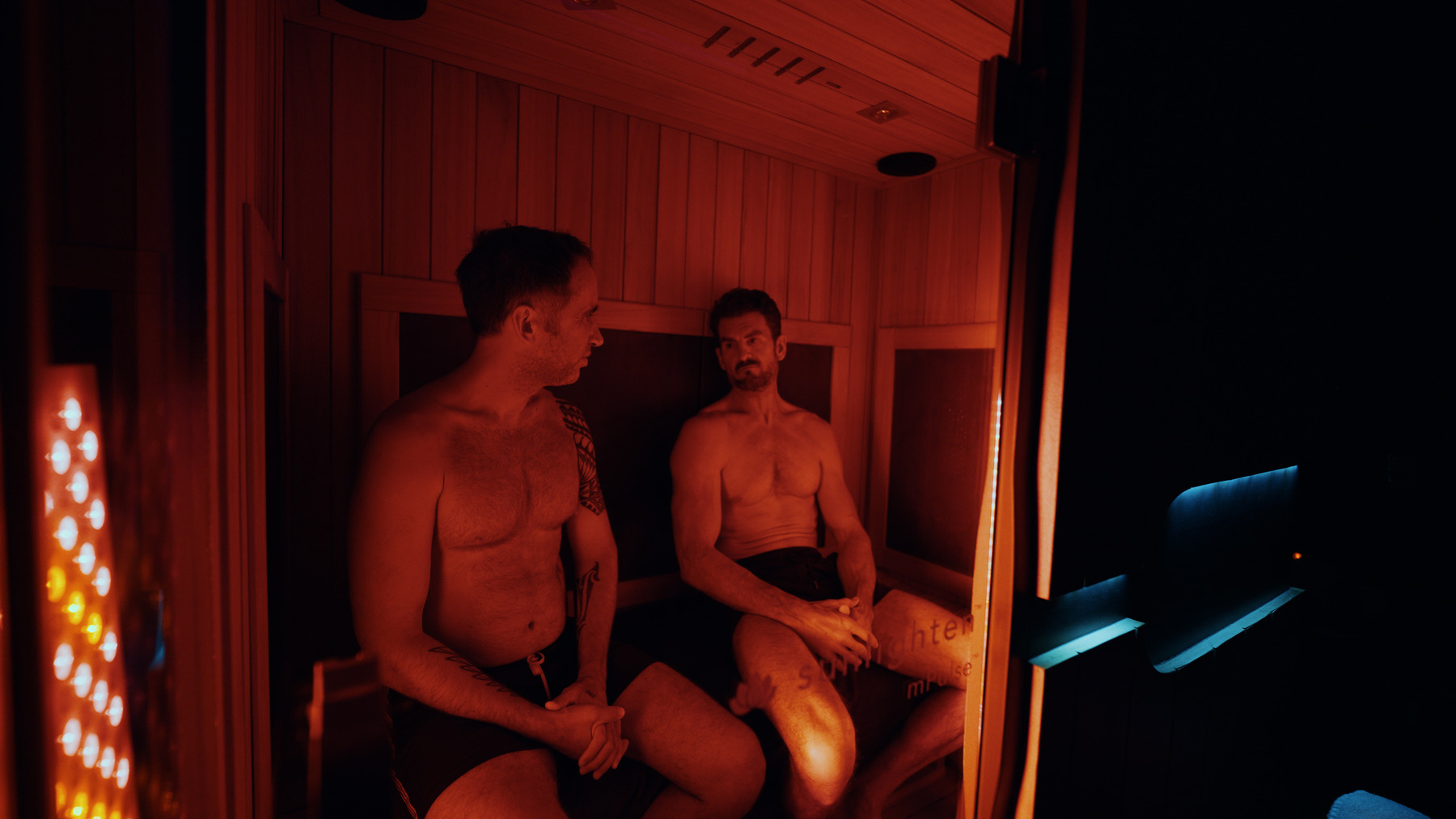
Marek and Gary LeBlanc under red light in Toronto, July 2024.
Red light panels are everywhere now — in gyms, in spas, even in bathrooms. On our quest, father and son, we met 100+ longevity experts: scientists, doctors, biohackers and healers. Red light came up again and again — in a hospital in Shanghai, at a float centre near Toronto, in a podcast studio in Los Angeles. Here is what we learned. What is shown in people. What is only promising. And what has only been seen in fruit flies. Every number has its source.
This page shares what research and the experts we met say. It is not medical advice, and it does not recommend any medicine, supplement or treatment. It knows nothing about you. Before you start, stop or change anything — especially if you are pregnant, live with a health condition or take any medication — please talk to your doctor. In an emergency, call your local emergency number.
In short
Red light helps the body heal. In people it eases knee pain, hospitals use it to soothe painful mouth sores during cancer treatment, it can help thinning hair, and one device is now approved for an eye disease of older age. In fruit flies it even lengthened life. Less pain and faster healing let you keep moving and doing what you love — and that is what longevity is built on. Protect your eyes, and talk to your doctor before you start. [1][2]
Longevity, as we mean it: more healthy, joyful years. What we mean →
204studies in people, with more than 9,000 volunteers, gathered in one big summary in 2025.[1]
12 of 35health problems got a little better with red light. For only five of them is the evidence fairly solid.[1]
0studies showing that red light makes people live longer or age more slowly.[1]
What red light therapy is
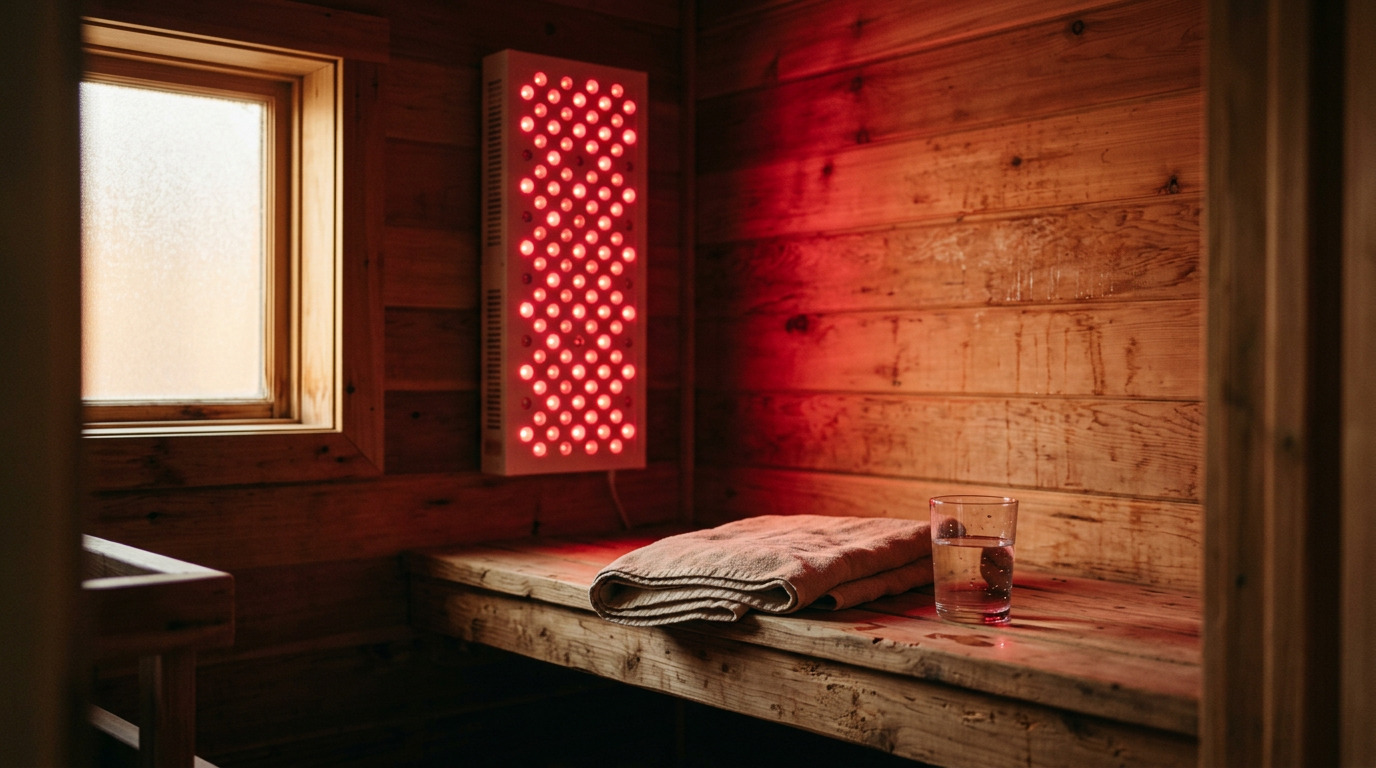
Illustration: a red light panel in a home sauna.
You sit or lie in front of a panel of lights for a few minutes. That’s it. Part of the light is red, which you can see. Part is near-infrared, just past what your eyes can see. It is not a tanning lamp — there is no UV in it. Red light stays near the surface of the skin. Near-infrared goes a little deeper.
Scientists call it photobiomodulation, which simply means light that changes how cells work. The best explanation so far is easy to picture. Inside every cell are tiny power plants called mitochondria. They seem to soak up this light and make a bit more energy for a while.
You can buy big panels for home, face masks and caps for the scalp. Clinics use medical devices aimed at one part of the body. What works depends a lot on which one you use, and how much light it gives.
What is shown in people
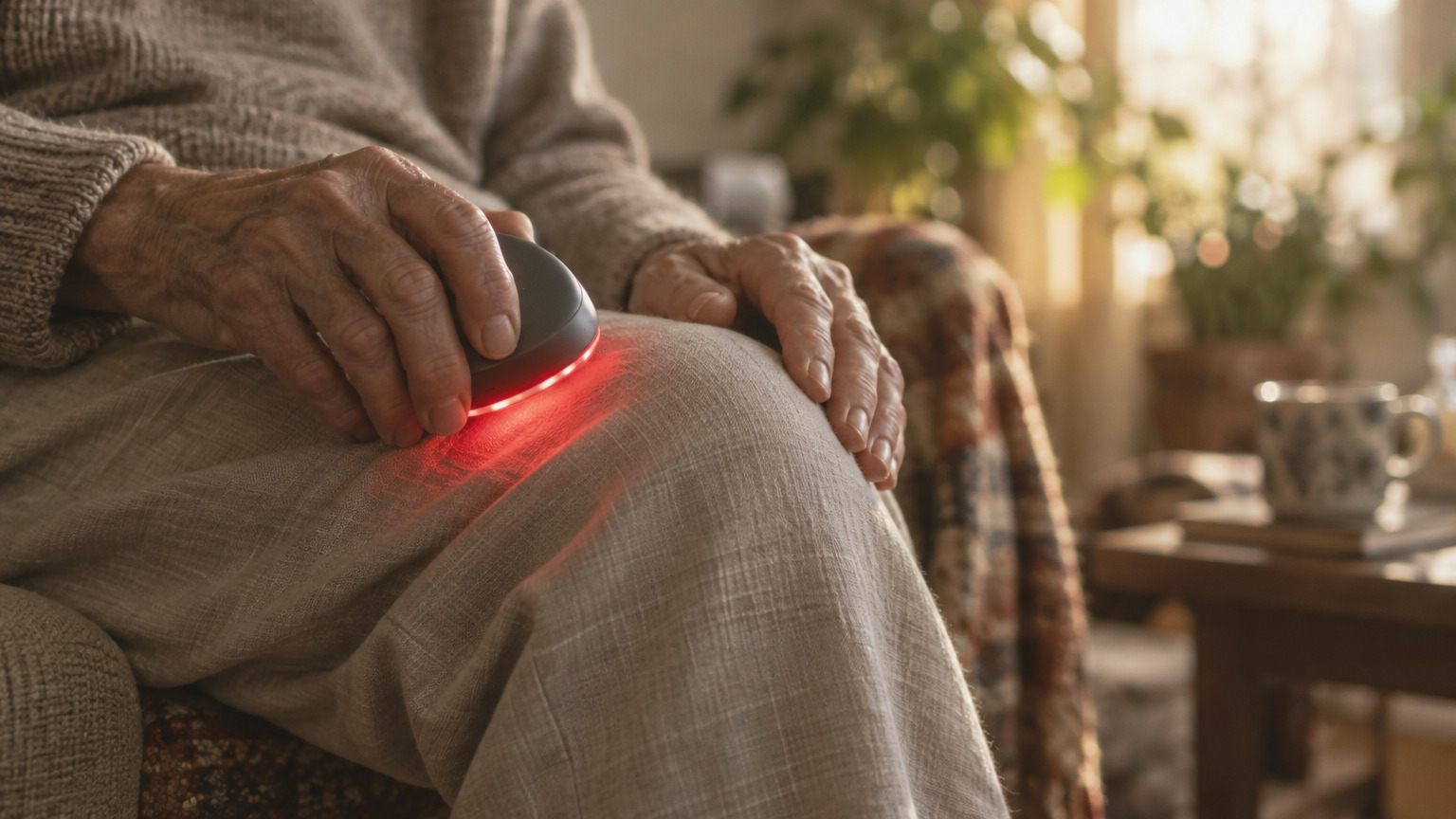
Illustration: red light on a sore knee.
In 2025, researchers gathered all the good studies they could find: 204 trials in which some people got red light and others got a fake treatment or nothing. Together the trials looked at 35 health problems. Red light helped with 12. Here is where it works, and how sure we can be.
Mouth sores during cancer treatment
Cancer treatment can cause painful sores in the mouth. Doctors’ guidelines recommend red light to prevent them in people having a stem-cell transplant, or radiation for cancer of the head and neck. This is its best-established medical use.
An eye disease of older age that blurs the centre of what you see. After 13 months, people read about 2.4 more letters on the eye chart than with a fake treatment. Approved in the US in November 2024 — as a device used in a clinic, not a home panel.
In 136 volunteers, 30 sessions made skin a little smoother and more even, and its collagen — the protein that keeps skin firm — a little denser. Real, small, cosmetic.
For everything else in that big summary, the evidence is weak. That doesn’t mean red light fails there. It means nobody can tell yet.
What is only promising
These results are real. But they are small, early, or not yet linked to living longer.
A week of sharper colour vision
Adults aged 37 to 70 looked at deep red light for just three minutes. For about a week afterwards, they saw colour contrasts better. A lovely experiment on the aging eye — but an experiment, not a treatment.
Red light seems to lift scores on memory and thinking tests a little. There is no evidence yet that it keeps the brain younger, or that it lowers the risk of dementia.
Based on: Test scores only · not proof of a younger brain [1]
What has only been seen in animals
Fruit flies that lived longer
Old fruit flies got deep red light every day. Their cells made more energy, they had less inflammation — the slow, damaging overreaction of the body — and they moved better. And many more of them reached old age — between two and almost three times as many.
This is why people get excited about red light and longevity. And it is why we stay careful. A fruit fly lives a few weeks. Nobody has shown the same in people yet.
What our experts told us
We tried red light ourselves at the Longevity Center in Warsaw in September 2024. And we asked the experts who so generously gave us their time. In Shanghai, Dr Evelyne Bischof works with cancer patients and in longevity medicine. Between her work at the hospital, she sat down with each of us. Alek asked her about red light:
“So there is no one thing, not to be generic, but first of all, something that does not harm and could help is always worth trying. Red light is wonderful for inflammation, so it could potentially be very, very helpful.”
In plain words: She was answering a question about one injury, not giving advice to everyone. Her rule of thumb: if something does no harm and might help, it can be worth a try. In her view, red light can calm inflammation — the swelling and soreness around an injury. She would use it only on the spot that hurts, not on the whole body.
Peter Diamandis was one of the first people who inspired Marek about longevity. We are grateful he took the time to talk with Alek in the studio where he records his podcast. He put red light in its place:
“I think biohacking tools, red light and saunas, both which I did this morning, and eating right, sleeping, exercise, all those things are fundamental. But again, they're not gonna move us that far. They'll allow us to stay healthy to what our current genetic potential has us.”
In plain words: Red light, saunas, good food, sleep and exercise are the foundation. They help you stay as healthy as your body can be. On their own, they won’t carry you much further than that.
Marek sees it the same way. In New York, he explained the Longevity Map to the nutritionist Oz Garcia. He placed red light on Level 2:
“Then the second branch is the biohacking upgrades, as I call it. And I put there, of course, medications, supplements, then also psychedelics, cosmetology, all the treatments that we can do by ourselves, what you said, like saunas and cold plunges and red light therapy, but also those that we can get in the clinics.”
Where the joy is
If you and your doctor decide red light is right for you, it is one of the easier things to enjoy. It asks almost nothing of you. You sit or lie still for a few minutes in soft, warm light, with your eyes protected. It becomes a little pause in the day. Time to breathe slowly. To listen to music. To not look at a screen. The pause itself is the pleasure — not a promise of extra years.
At Float Valley near Toronto, Nadeem Jiwani showed us how he makes it part of a ritual, with the sauna and an ice bath:
“And so I like to do kind of a combo. You do the sauna first, for maybe 10, 15 minutes, the ice bath for two or three, and then I spend about five minutes warming up in front of the red light before I do the cycle again.”
Peter Diamandis had done red light and a sauna that very morning, before we met. For both of them it is part of a routine they enjoy, not a chore.
Who should be careful
Protect your eyes
Never look straight into a panel. Never look into a laser. A 12-year-old used a home red-laser device to treat short-sightedness. The light damaged the retina, the back of the eye, and it only partly healed after the child stopped. Wear the goggles. Keep your eyes closed. Be extra careful with any device for children. [9]
More is not better
In the knee studies, red light worked at one particular colour and strength of light: 785–860 nm (a measure of the light’s colour) and 4–8 joules per spot (a measure of how much light). Less or more worked less well. The benefit was biggest a few weeks after treatment. No side effects were reported in those studies.
Based on: 22 trials with a fake-treatment comparison [4]
Medicines that make you sensitive to light. Some do. If you take one, or have a condition that makes your skin react to light, ask your doctor first.
Spots on your skin. Don’t shine light on a spot that is, or might be, skin cancer without asking a doctor.
What to ask before you decide
What is it for? Name the problem. For sore knees, mouth sores during cancer treatment, thinning hair or one eye disease, there is evidence. For anti-aging, not yet.
What colour of light, and how strong? The studies that worked used specific light. If a device can’t tell you what it gives out, you can’t tell whether it matches.
How do I protect my eyes? Goggles, eyes closed, never staring into the light. Extra care with any device for children.
Is this a medical device or a wellness product? The eye treatment approved in the US is done in a clinic. A home panel is a different thing.
Do my medicines make me sensitive to light? Ask your doctor or pharmacist before you decide.
Every number on this page, by the number in square brackets. Quotations come from Live Beyond’s own recorded interviews, cleaned only of “um” and “uh”. Not medical advice. Talk to your doctor before you change anything.
Son Y, Lee H, Yu S, et al. Effects of photobiomodulation on multiple health outcomes: an umbrella review of randomized clinical trials. Systematic Reviews. 2025;14. doi:10.1186/s13643-025-02902-3
Begum R, Calaza K, Kam JH, Salt TE, Hogg C, Jeffery G. Near-infrared light increases ATP, extends lifespan and improves mobility in aged Drosophila melanogaster. Biology Letters. 2015;11(3):20150073. doi:10.1098/rsbl.2015.0073
Zadik Y, Arany PR, Fregnani ER, et al. Systematic review of photobiomodulation for the management of oral mucositis in cancer patients and clinical practice guidelines. Supportive Care in Cancer. 2019;27(10):3969-3983. doi:10.1007/s00520-019-04890-2
Stausholm MB, Naterstad IF, Joensen J, et al. Efficacy of low-level laser therapy on pain and disability in knee osteoarthritis: systematic review and meta-analysis of randomised placebo-controlled trials. BMJ Open. 2019;9(10):e031142. doi:10.1136/bmjopen-2019-031142
Boyer D, Hu A, Warrow D, et al. LIGHTSITE III: 13-Month Efficacy and Safety Evaluation of Multiwavelength Photobiomodulation in Nonexudative (Dry) Age-Related Macular Degeneration Using the LumiThera Valeda Light Delivery System. Retina. 2024;44(3):487-497. doi:10.1097/IAE.0000000000003980
Wunsch A, Matuschka K. A controlled trial to determine the efficacy of red and near-infrared light treatment in patient satisfaction, reduction of fine lines, wrinkles, skin roughness, and intradermal collagen density increase. Photomedicine and Laser Surgery. 2014;32(2):93-100. doi:10.1089/pho.2013.3616
Shinhmar H, Hogg C, Neveu M, Jeffery G. Weeklong improved colour contrasts sensitivity after single 670 nm exposures associated with enhanced mitochondrial function. Scientific Reports. 2021;11:22872. doi:10.1038/s41598-021-02311-1
Weinrich TW, Coyne A, Salt TE, Hogg C, Jeffery G. Improving mitochondrial function significantly reduces metabolic, visual, motor and cognitive decline in aged Drosophila melanogaster. Neurobiology of Aging. 2017;60:34-43. doi:10.1016/j.neurobiolaging.2017.08.016
Liu H, Yang Y, Guo J, Peng J, Zhao P. Retinal Damage After Repeated Low-level Red-Light Laser Exposure. JAMA Ophthalmology. 2023;141(7):693-695. doi:10.1001/jamaophthalmol.2023.1548