Choices · strength training

Why is strength training so important for longevity?

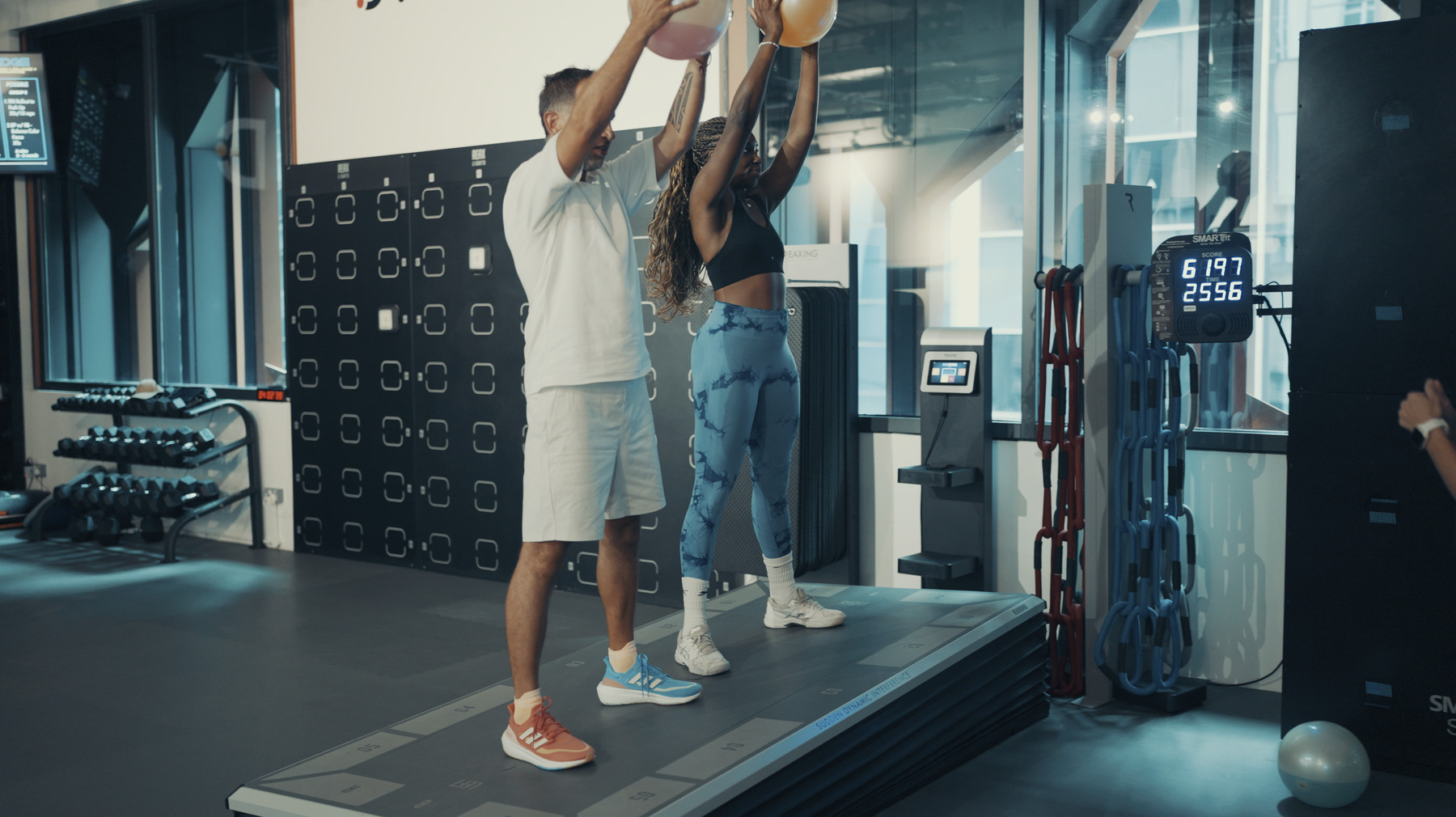
Marek and a trainer lifting medicine balls overhead on a balance platform in a modern gym, with racks of dumbbells and battle ropes around them.
Marek training with Simisola Oke at SparkD, Singapore, 2024.

On our quest, my son Alek and I met more than a hundred longevity experts. Muscle came up again and again — with a doctor for older people in Santiago, a scientist who studies aging in Seattle, the head of a longevity clinic we met at a conference in Copenhagen, and an entrepreneur in Toronto who wants to be bouncing around at 100. This page explains what we learned, in plain words. Every number has its source. Where science only shows a link and not a cause, we tell you.

By Marek Piotrowski · Updated 2026-10-26

Please read this first

This page shares what research and the experts we met say. It is not medical advice, and it does not recommend any medicine, supplement or treatment. It knows nothing about you. Before you start, stop or change anything — especially if you are pregnant, live with a health condition or take any medication — please talk to your doctor. In an emergency, call your local emergency number.

In short

Strength training is one of the best things you can do for a long, healthy life. It builds muscle, strength and bone at any age, and together with balance exercises it prevents falls — the kind of falls that change older lives. People who train their muscles die early less often, by 10–17%, and even less often when they also do exercise that gets them out of breath. Two sessions a week already bring most of the benefit. [1][2][3][4]

Longevity, as we mean it: more healthy, joyful years. What we mean →

10–17%lower risk of dying early, from any cause, among adults who train their muscles.[3]
~40%lower risk when they also do exercise that gets them out of breath.[3]
1/3fewer falls in older people who train balance and strength together.[2]

Muscle is one of the things that changes most as we get older. We build it until our twenties or thirties. After that, if we don’t use it, we slowly lose muscle and strength for the rest of our lives. But here is the good news, and it is the heart of this page: muscle answers to training at any age.

What muscle does for you

Muscle does much more than move you. When muscles work, they pull on your bones, and the bones answer by staying strong. Muscle and balance catch you when you trip. Muscle also helps your body deal with the sugar from a meal. When people lose so much muscle that they become weak, doctors call it sarcopenia — simply, muscle loss with age. Today it is treated as a condition of its own.

The first medicine for muscle loss is exercise

International guidelines for doctors say the first treatment for muscle loss with age is strength training.

Based on: Official guidelines for doctors [5]

Bones grow stronger with load — even later in life

Women after menopause who already had weak bones trained with heavy weights and jumps, with a coach watching closely. Their bones got denser and everyday movement got easier. Nobody broke a bone because of the training.

Based on: One fair test · shows cause [1]

What studies in people show

Science answers this question in two ways, and it helps to know the difference. In a fair test, people are picked at random to train or not, so we can see what training itself does. Fair tests show more muscle, more strength, stronger bones, easier movement and fewer falls. In a long-term study, scientists follow large groups of people for years and see who lives longer. There, people who train their muscles die early less often. A fair test shows a cause. A long-term study shows a link.

Fewer falls — proven

When older people living at home exercise, they fall about a quarter less often. When the exercise combines balance and strength, they fall about a third less. A fall can change an older person’s life, so this matters as much for staying independent as for living long.

Based on: Many fair tests combined (Cochrane review) · shows cause [2]

Less likely to die early — a link

Adults who train their muscles are 10–17% less likely to die early — from any cause, from heart disease and from cancer. The benefit was biggest at about 30–60 minutes a week. People who also did exercise that gets them out of breath were about 40% less likely to die early.

Based on: Many long-term studies combined · a link, not proof [3]

About an hour a week, then no extra gain

Any strength training went with about a 15% lower risk of dying early. The biggest drop, about 27%, came at around 60 minutes a week. More than that brought no extra gain.

Based on: Many long-term studies combined · a link, not proof [6]

Lifting counts on its own

In about 100,000 older Americans, those who lifted weights were less likely to die early, no matter how much walking, running or cycling they did. Those who did both were the least likely of all.

Based on: One big long-term study · a link, not proof [7]

A strong grip as a warning light

Scientists measured the grip of 140,000 people in 17 countries. Every 5 kg of weaker grip went with a 16% higher risk of dying early.

Based on: One big long-term study · a link, not proof [8]

In plain words: Your grip shows how strong your whole body is. It is a warning light, not a target — squeezing a hand gripper will not make you live longer.

It is never too late

Fair tests with older people living at home, and with women after menopause who already had weak bones, show that training works late in life too: stronger bones, easier movement, fewer falls. Starting at 60 or 70 is not too late. [2][1]
What we don’t know yet

No fair test has yet shown that strength training itself makes people live longer. All the numbers about dying early on this page come from long-term studies. And people who lift weights may also eat better, sleep better, smoke less, or simply be healthier to begin with. The scientists say so themselves, and they are asking for fair tests.

What our experts told us

We are deeply grateful to every expert who took the time to teach us. Here is what three of them said about muscle — and what it means for you.

“When you do an exercise program, you need always to put four system into work: the strength, the balance, the aerobic capacity, and your flexibility. […] But what we know now in aging is that some of them are more important. So the strength and the balance are the key motors of the exercise program of all the people, because we have good evidence that they increase the independence for a long time.”
Felipe Salech · doctor for older people and aging researcher, Universidad de Chile · Santiago, April 2024

In plain words: Do four kinds of movement: strength, balance, exercise that gets you out of breath, and stretching. If you have to choose, choose strength and balance — they are what keep you living on your own for longer.

“So I very much am a strong proponent of resistance training. So, lifting weights, doing something to maintain muscle mass as we get older, and bone density.”

In plain words: Lift weights, or do something like it, so you keep your muscle and your bones strong as the years go by.

“Exercise physiologists have got very strong data. There’s good evidence behind the type of resistance training, particularly in men, with the level of effort that you put. So when people train at what’s called 80% effort or two reps in reserve, that type of training program, which has a building effect, can have significant impact […] on muscle synthesis.”
Dr Naras Lapsys · Chief Clinical Officer, Chi Longevity · ARDD, Copenhagen, August 2024

In plain words: How hard you work matters, not only what you do. Make the last repetitions feel hard, and stop when you could still do about two more. That effort is what tells muscle to grow.

Where the joy is

In the Live Beyond family we have one rule for everything we share: if it brings no joy, nobody keeps doing it. Strength is easy to love once you see what it is for. It means picking up your grandchild without a second thought. Carrying the shopping up the stairs. Staying in the sport you love. Saying yes to a hike, a trip, a dance. You don’t need a gym. Your own body, a backpack, a bag of soil in the garden or a child on your shoulders — all of them make your muscles work. And training with a friend turns it into a meeting you look forward to.

“You wanna be bouncing around when you’re 90. You wanna be bouncing around when you’re 100. You need muscle for that, and the problem is that is the one thing that changes as we age more than anything else, and that’s not a grandiose statement. We have a hard time keeping muscle on as we age. We can put it on. We have a hard time keeping it.”
Gary LeBlanc · entrepreneur and author · Toronto, July 2024

In plain words: We can build muscle at any age. The hard part is keeping it — so keep using it, and keep enjoying it.

Play and strength belong together

In the studies, the people least likely to die early did both: strength training and exercise that gets them out of breath. A sport you love, plus a little strength work, is exactly that.

Based on: Many studies combined · a link, not proof [3][7]

How much is enough

These amounts are what official guidelines and studies say. We did not invent them. Talk to your doctor before you start if you have a health condition.

Every adultTrain all the big muscles — legs, hips, back, chest, shoulders, arms, belly — on two or more days a week. Add 150–300 minutes a week of exercise that makes you breathe faster, such as brisk walking.Official guideline (World Health Organization) [4]
Over 65Mix in balance and strength on three or more days a week. This helps prevent falls.Official guideline (World Health Organization) [4]
A first stepPick 8–10 exercises. Do each one 8–12 times in a row, with a weight that feels moderate. Twice a week.Official advice from heart doctors (American Heart Association) [9]
The sweet spotAbout 30–60 minutes of strength training a week. Beyond about an hour, no clear extra gain.Many long-term studies · a link, not proof [3][6]

In plain words: Two short sessions a week, plus everyday walking, already put you where the studies see most of the benefit.

Who should be careful

Most adultsStrength training is safe for most adults — even for people with a stable heart condition. Start light, learn good form, and add weight slowly.Official advice from heart doctors (AHA) [9]
Ask your doctor firstIf you have an unstable heart condition, high blood pressure that is not under control, recent surgery or a recent broken bone. If blood pressure is a worry, don’t hold your breath while lifting something heavy.Heart doctors (AHA) · strength coaches’ guidance (NSCA) [9][10]
Older age or weak bonesTrain with a coach who raises the load step by step. In the bone study, the heavy lifting was done with a coach watching closely.Strength coaches’ guidance · one fair test [10][1]
More is not betterThe benefit levels off at about 30–60 minutes a week. Strength training adds to walking, cycling or swimming — it does not replace them.Many long-term studies · a link, not proof [3][6][7]

Strength on the Longevity Map

We wrote this page from Live Beyond’s own recorded interviews and the published studies listed below, with gratitude to everyone who taught us.

Sources

Every number on this page, by the number in square brackets. Quotations come from Live Beyond’s own recorded interviews, cleaned only of “um” and “uh”. Not medical advice. Talk to your doctor before you change anything.

  1. Watson SL, Weeks BK, Weis LJ, Harding AT, Horan SA, Beck BR. High-intensity resistance and impact training improves bone mineral density and physical function in postmenopausal women with osteopenia and osteoporosis: the LIFTMOR randomized controlled trial. J Bone Miner Res. 2018;33(2):211-220. doi:10.1002/jbmr.3284
  2. Sherrington C, Fairhall NJ, Wallbank GK, et al. Exercise for preventing falls in older people living in the community. Cochrane Database Syst Rev. 2019;1:CD012424. doi:10.1002/14651858.CD012424.pub2
  3. Momma H, Kawakami R, Honda T, Sawada SS. Muscle-strengthening activities are associated with lower risk and mortality in major non-communicable diseases: a systematic review and meta-analysis of cohort studies. Br J Sports Med. 2022;56(13):755-763. doi:10.1136/bjsports-2021-105061
  4. Bull FC, Al-Ansari SS, Biddle S, et al. World Health Organization 2020 guidelines on physical activity and sedentary behaviour. Br J Sports Med. 2020;54(24):1451-1462. doi:10.1136/bjsports-2020-102955
  5. Dent E, Morley JE, Cruz-Jentoft AJ, et al. International Clinical Practice Guidelines for Sarcopenia (ICFSR): screening, diagnosis and management. J Nutr Health Aging. 2018;22(10):1148-1161. doi:10.1007/s12603-018-1139-9
  6. Shailendra P, Baldock KL, Li LSK, Bennie JA, Boyle T. Resistance training and mortality risk: a systematic review and meta-analysis. Am J Prev Med. 2022;63(2):277-285. doi:10.1016/j.amepre.2022.03.020
  7. Gorzelitz J, Trabert B, Katki HA, Moore SC, Watts EL, Matthews CE. Independent and joint associations of weightlifting and aerobic activity with all-cause, cardiovascular disease and cancer mortality in the Prostate, Lung, Colorectal and Ovarian Cancer Screening Trial. Br J Sports Med. 2022;56(22):1277-1283. doi:10.1136/bjsports-2021-105315
  8. Leong DP, Teo KK, Rangarajan S, et al. Prognostic value of grip strength: findings from the Prospective Urban Rural Epidemiology (PURE) study. Lancet. 2015;386(9990):266-273. doi:10.1016/S0140-6736(14)62000-6
  9. Paluch AE, Boyer WR, Franklin BA, et al. Resistance exercise training in individuals with and without cardiovascular disease: 2023 update: a scientific statement from the American Heart Association. Circulation. 2024;149(3):e217-e231. doi:10.1161/CIR.0000000000001189
  10. Fragala MS, et al. Resistance training for older adults: position statement from the National Strength and Conditioning Association. J Strength Cond Res. 2019;33(8):2019-2052. doi:10.1519/JSC.0000000000003230