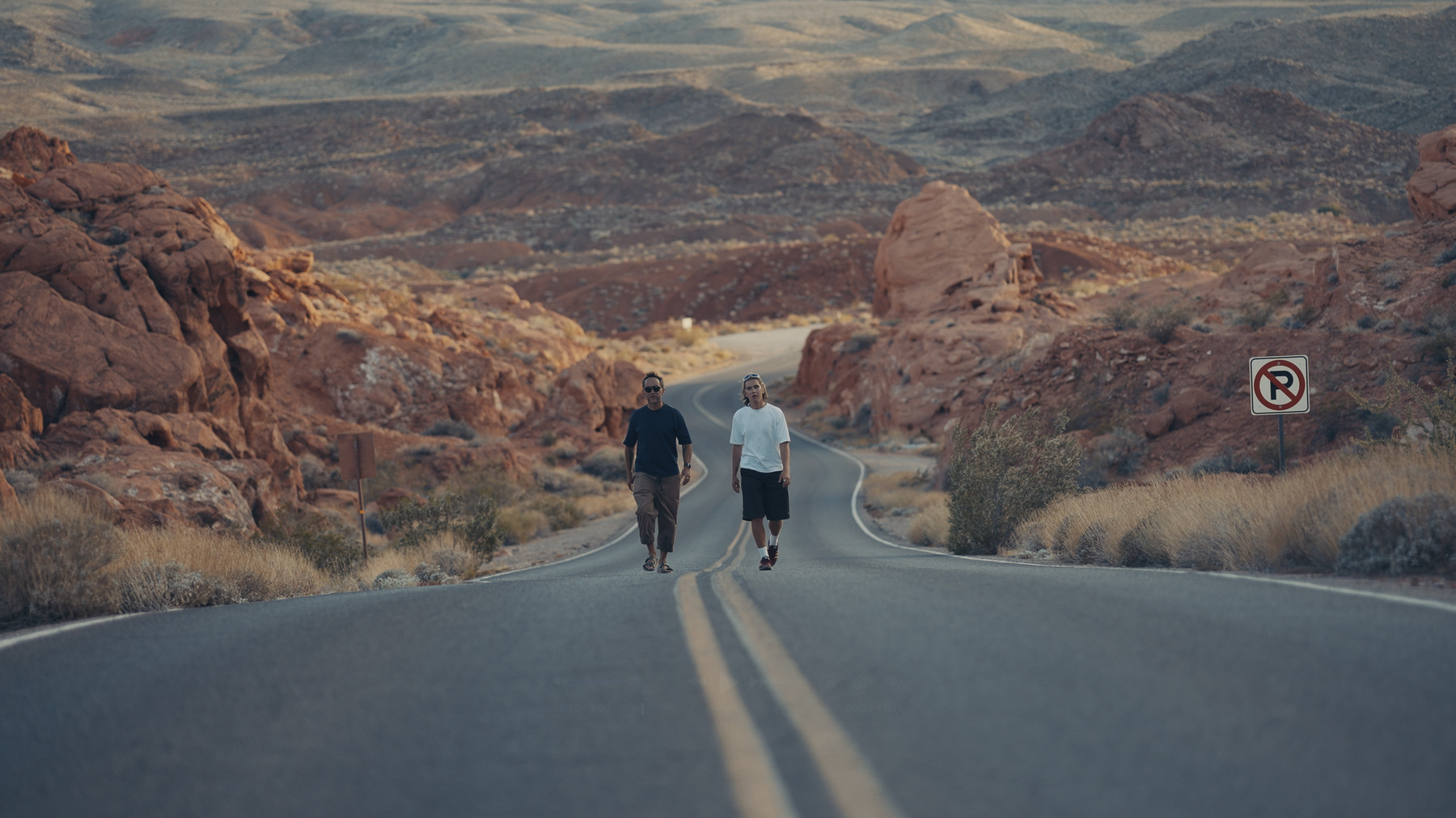
Marek and Alek walking through the desert in Arizona, 2024.
On our quest, my son Alek and I met more than a hundred longevity experts. Walking came up everywhere — with our guide in Ogimi, the Japanese village famous for its long lives; in a mountain village in Sardinia, where we did a whole interview on foot; and in Oxford, where an 80-year-old doctor told us exactly how many minutes he walks each day. This page explains what we learned, in plain words. Every number has its source. Where science only shows a link and not a cause, we tell you.
This page shares what research and the experts we met say. It is not medical advice, and it does not recommend any medicine, supplement or treatment. It knows nothing about you. Before you start, stop or change anything — especially if you are pregnant, live with a health condition or take any medication — please talk to your doctor. In an emergency, call your local emergency number.
In short
Walking is one of the simplest and best things you can do for a long, healthy life — no gym, no equipment, at any age. In the largest studies, people who walk about 7,000 steps a day are 47% less likely to die early than people who walk 2,000, and they get heart disease, dementia and depression less often too. You don’t need 10,000: most of the gain comes with the first few thousand steps. Fair tests show that walking lowers blood pressure and makes you fitter. [1][2][3]
Longevity, as we mean it: more healthy, joyful years. What we mean →
47%lower risk of dying early at about 7,000 steps a day, compared with 2,000.[1]
15%lower risk with every extra 1,000 steps a day.[4]
1965the year “10,000 steps” was born — as the name of a Japanese step counter, not as a scientific finding.[5]
Walking is the movement our bodies were made for. And here is the good news, the heart of this page: you don’t have to walk far or fast for it to count. The biggest step forward is the one from very little to a little more.
What walking does for you
When you walk, your heart and lungs work a little harder, your legs carry your weight, and your bones feel the load. Do it often, and your body answers. Walking is gentle enough for almost anybody, which is exactly why it matters so much: it is the movement people actually keep doing.
Lower blood pressure, better fitness — proven
When people were picked at random to start walking, their blood pressure went down, their fitness went up, and they lost a little weight and waist. These are among the numbers doctors watch most closely for a healthy heart.
Based on: Many fair tests combined · shows cause [3]
A short walk after a meal
In small fair tests, people who got up for light walks while sitting for a long time after eating had lower blood sugar and insulin after their meals than people who stayed seated — and lower than people who only stood up.
Based on: A few small fair tests combined · shows cause, in the short term [6]
This one we live ourselves. On the quest, I started going for a short walk after a bigger meal — ten or fifteen minutes. As kids, we heard it from our grandmothers and just shrugged. Grandma was right.
What studies in people show
Illustration: a walk down a sunny street.
Science answers this question in two ways, and it helps to know the difference. In a fair test, people are picked at random to walk more or not, so we can see what walking itself does. Fair tests show lower blood pressure and better fitness. In a long-term study, scientists give people a step counter and follow them for years to see who stays healthy and who lives longer. A fair test shows a cause. A long-term study shows a link. All the step numbers below are links.
About 7,000 steps bring most of the benefit
Scientists combined 57 studies. Compared with 2,000 steps a day, people who walked about 7,000 were 47% less likely to die early, got heart disease 25% less often and dementia 38% less often, and had 22% fewer signs of depression. For most of these, the curve got flatter after about 5,000–7,000 steps.
Based on: Many long-term studies combined · a link, not proof [1]
How many steps — by age
In 15 studies with more than 47,000 adults, the risk of dying early kept falling up to about 6,000–8,000 steps a day for people over 60, and about 8,000–10,000 for people under 60. People in the group with the most steps were about half as likely to die during the study as people with the fewest.
Based on: Many long-term studies combined · a link, not proof [2]
Every 1,000 steps helps
In 17 studies with almost 227,000 people, every extra 1,000 steps a day went with a 15% lower risk of dying early. This analysis saw no point where more steps stopped helping, up to 20,000 a day.
Based on: Many long-term studies combined · a link, not proof [4]
Even a few good days a week count
In about 3,100 American adults followed for ten years, people who walked 8,000 steps or more on just one or two days a week were almost as much less likely to die in those years as people who did it on three to seven days.
Based on: One long-term study · a link, not proof [7]
In plain words: There is no streak to keep. A quiet day is just a day — the steps you take on the other days still count.
Where did 10,000 steps come from?
The famous goal most likely comes from the name of a step counter sold in Japan in 1965: manpo-kei, which means “10,000 steps meter.” A good name, not a scientific finding. In a study of about 16,700 older women, those who walked about 4,400 steps a day were 41% less likely to die during the study than those who walked about 2,700 — and the benefit leveled off at about 7,500 steps. [5]
What we don’t know yet
All the step numbers on this page come from long-term studies. People who walk more may also be healthier to begin with — someone who is ill walks less. The scientists try to correct for that, but they cannot remove it completely. No fair test has yet followed people for many years to see whether a walking habit itself makes them live longer.
More years of life? The link is strong and shows up in many countries. It has not been tested in a fair test that lasts long enough.
Where does the benefit stop? The studies don’t agree yet. Some see the gain level off at about 6,000–10,000 steps, depending on age. One large analysis saw no point where it stopped, up to 20,000.
Does speed matter? When scientists count the total steps, walking faster added little clear extra benefit in several studies. Brisk walking still counts toward the weekly time for exercise that gets you breathing faster.
Fewer falls? People who walked more fell less often in a few studies, but the scientists rate that evidence as very weak. Walking on its own does not train balance.
What our experts told us
We are deeply grateful to every expert who took the time to teach us. In Oxford, Sir Muir Gray, a doctor who has spent his life asking what the evidence really shows, told us that much of what we blame on age is really lost fitness. He is 80. This is what he does about it.
“70 is the end of the beginning, not the beginning of the end. So you have to think every year do a little bit more. So I do a little bit more stretching. I walk briskly 33 minutes a day, because 30 minutes is what everyone should do, brisk walking, but I add a minute on every decade. So I did 31 minutes in my 60s, 32 minutes in my 70s.”
In plain words: Walking is not only for the young. The older we get, the more a little extra effort gives back — so instead of doing less each year, do a little more. Half an hour of brisk walking on most days is exactly what the official guideline asks for. [8]
On the same day in Oxford, Sir Christopher Ball, 89, named regular exercise as one of his three keys to a long, healthy life. Most people know it matters, he said. So how do we help them actually do it?
“And how can we help them? Walk a mile a day, for example. Make it simple for them.”
In plain words: You don’t need a plan, a gym or a gadget. A mile is about 1.6 kilometers — around twenty minutes at an easy pace.
In Okinawa, Tina Woods — the person who first told us that longevity starts before you are born — explained what people in the Blue Zones, the places where people live longest, do differently.
“What you hear in the Blue Zones is that people build in their activity in the day-to-day sort of daily lives, right? So they’re doing gardening, they’re going, sort of hanging out with their friends. They’re building in activity just as part of their routine. So of course, they don’t go to the gym necessarily like we do, but it’s actually just part of how they do things. […] I remember just even on my first day in Japan, I saw a lot of people walking, a lot of people cycling.”
In plain words: In the places where people live longest, nobody books a walk. They walk to a friend, to the garden, to the shop. Movement is built into the day, so it never needs willpower.
A few days later we reached Ogimi, the village at the north of the island. Our guide and interpreter, Eiko, 83, translated for the elders after their dance rehearsal, and then walked us around the village herself.
“People smile, you talk to people around here like this. And then also eat well three meals a day. […] And the most important, walk a lot.”
In plain words: In Ogimi, walking sits right next to smiling, talking and eating well. It is part of a joyful life, not a task.
Where the joy is
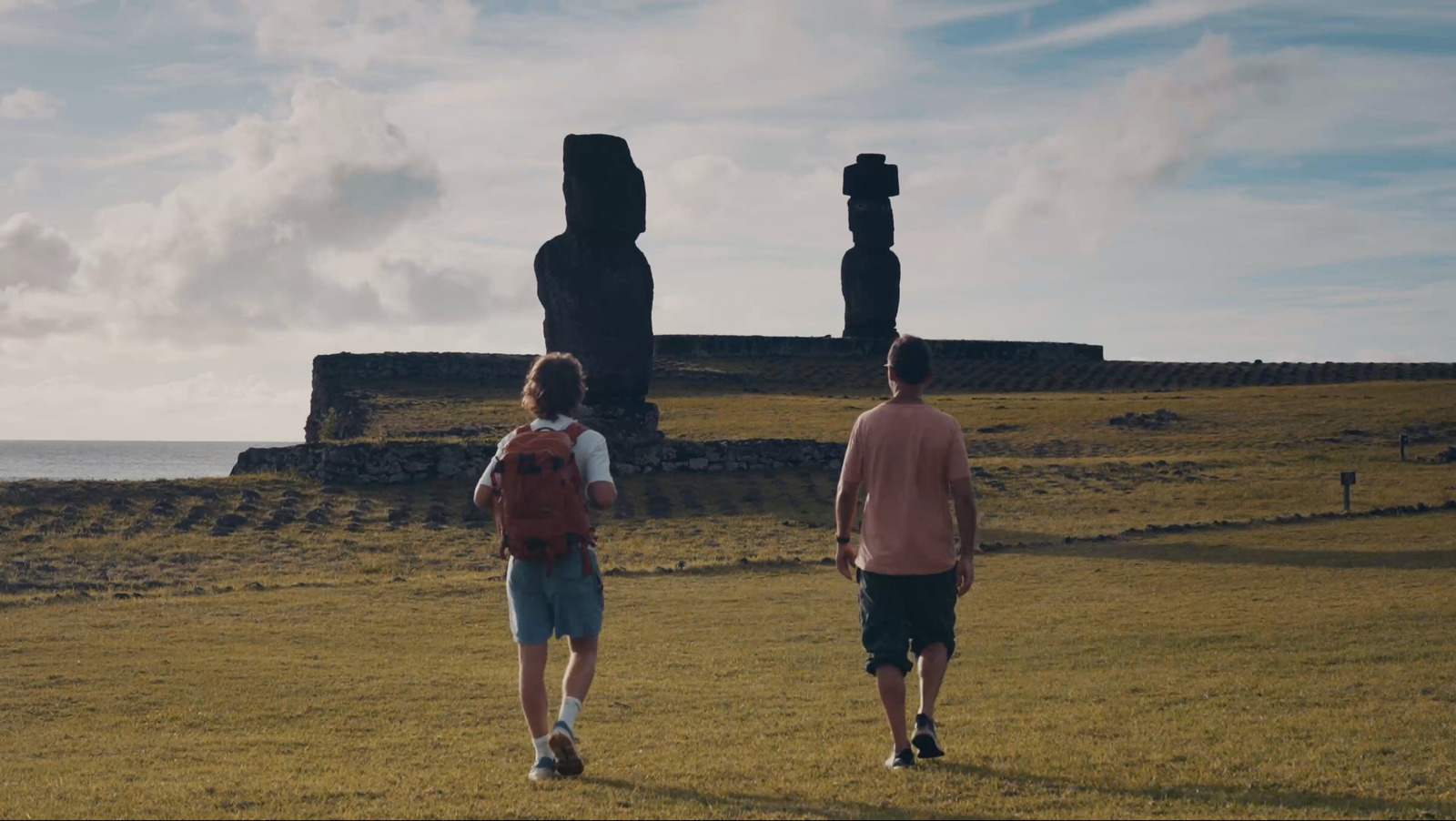
Walking to the moai on Rapa Nui (Easter Island).
In the Live Beyond family we have one rule for everything we share: if it brings no joy, nobody keeps doing it. Walking may be the easiest movement of all to love. You can do it with your child, your parents, a dog, a friend you haven’t seen in a while. Some of our best conversations on the quest happened on foot — in Sardinia and in Los Angeles we did whole interviews walking. A walk can be a meeting, a phone call, a thinking break, or the best way to see a new city.
“I strongly recommend you to go to the village and see how people, especially as this time of the day, used to hang around all together just to chat. It’s very natural. You can see even strong, very old women just going for a walk up here. So you will be really surprised.”
In plain words: In the long-life villages, walking and meeting people are the same thing. The walk is how you see your friends.
Walking together is good for body and mood
Scientists combined 42 studies of outdoor walking groups with about 1,800 people. After the programs, people had lower blood pressure and resting heart rate, less body fat, better fitness and fewer signs of depression. People stuck with it, and no notable harms were reported.
Based on: Many studies combined · before and after [9]
A walk in nature calms the mind
In a small fair test, people who took a 90-minute walk in nature brooded less afterwards, and a part of the brain linked to brooding calmed down. People who walked the same time in the city did not change.
“Just find something you enjoy. You don’t have to be on the treadmill. […] Just find something that you enjoy and do it regularly.”
In plain words: The best walk is the one you enjoy enough to take again tomorrow.
For us, longevity means more healthy, joyful years — not only more years. Everything that is good for your health is part of the longevity game. And walking, with people you love, may be the most joyful move in it.
How much is enough
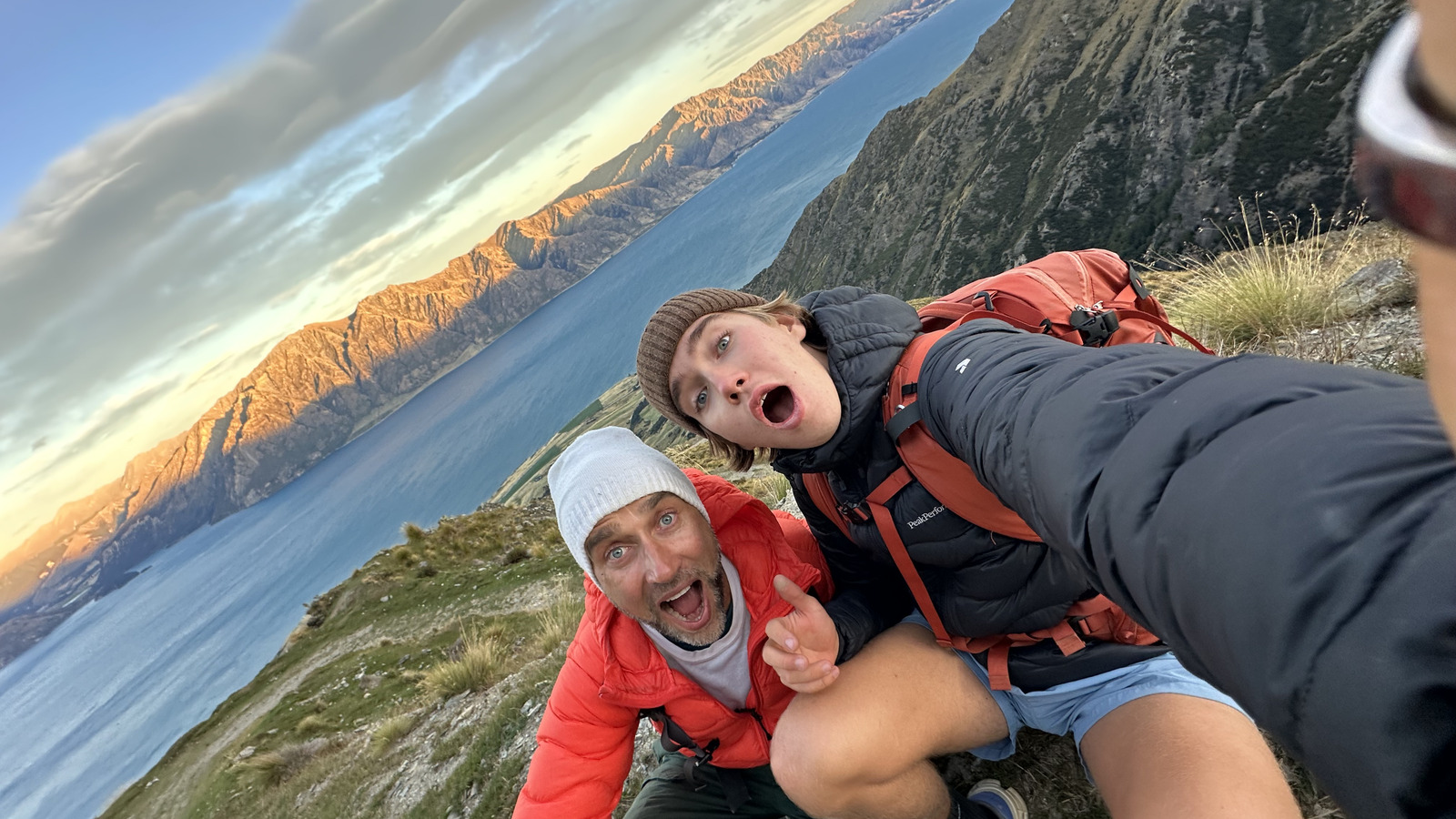
Every step counts — on a trail in New Zealand, February 2024.
These amounts are what official guidelines and studies say. We did not invent them. If you have a health condition, talk to your doctor before you change a lot at once.
Every day
Every step counts. Some movement is better than none, and more is better still. Start where you are and add a little.
Official guideline (World Health Organization) [8]
Every adult
150–300 minutes a week of activity that makes you breathe faster, such as brisk walking — for example, 30 minutes on five days. Plus muscle-strengthening on two or more days.
Official guideline (World Health Organization) [8]
A step target
About 7,000 steps a day brings most of the benefit seen in the studies. 10,000 is still a fine goal if you are already active.
Many long-term studies combined · a link, not proof [1]
Over 60
In the studies, the benefit leveled off at about 6,000–8,000 steps a day. Add balance and strength exercises on three or more days a week.
Long-term studies · official guideline (WHO) [2][8]
After meals
A short, easy walk after eating helps your body deal with the sugar from the meal.
In plain words: You don’t need to count. Walk on most days, a little briskly, and take a short walk after bigger meals. If you like numbers, 7,000 steps a day is a kind, realistic target.
Who should be careful
Most people
Walking is one of the gentlest ways to move. In the walking-group studies, no notable harms were reported.
If you get chest pain, become very short of breath or feel dizzy when you walk, or if you have a heart condition, recent surgery or an injury. Start with short walks and build up slowly.
Common sense, and your doctor
Balance worries or older age
Walking alone does not train balance. Add balance and strength exercises on three or more days a week — that is what helps prevent falls. Good shoes and an even path help you feel steady.
Official guideline (World Health Organization) [8]
Living with a long-term condition
The guideline for people living with conditions such as high blood pressure or type 2 diabetes is the same as for everyone. If you can’t do that much yet, be as active as you can.
Official guideline (World Health Organization) [8]
We wrote this page from Live Beyond’s own recorded interviews and the published studies listed below, with gratitude to everyone who taught us. Now we’d love to hear from you: who will you walk with this week? Tell us on Instagram, @longevityadvocate. You are part of this family.
Sources
Every number on this page, by the number in square brackets. Quotations come from Live Beyond’s own recorded interviews, cleaned only of “um” and “uh”. Not medical advice. Talk to your doctor before you change anything.
Ding D, Nguyen B, Nau T, et al. Daily steps and health outcomes in adults: a systematic review and dose-response meta-analysis. Lancet Public Health. 2025;10(8):e668-e681. doi:10.1016/S2468-2667(25)00164-1
Paluch AE, Bajpai S, Bassett DR, et al. Daily steps and all-cause mortality: a meta-analysis of 15 international cohorts. Lancet Public Health. 2022;7(3):e219-e228. doi:10.1016/S2468-2667(21)00302-9
Murtagh EM, Nichols L, Mohammed MA, Holder R, Nevill AM, Murphy MH. The effect of walking on risk factors for cardiovascular disease: an updated systematic review and meta-analysis of randomised control trials. Prev Med. 2015;72:34-43. doi:10.1016/j.ypmed.2014.12.041
Banach M, Lewek J, Surma S, et al. The association between daily step count and all-cause and cardiovascular mortality: a meta-analysis. Eur J Prev Cardiol. 2023;30(18):1975-1985. doi:10.1093/eurjpc/zwad229
Lee IM, Shiroma EJ, Kamada M, Bassett DR, Matthews CE, Buring JE. Association of step volume and intensity with all-cause mortality in older women. JAMA Intern Med. 2019;179(8):1105-1112. doi:10.1001/jamainternmed.2019.0899
Buffey AJ, Herring MP, Langley CK, Donnelly AE, Carson BP. The acute effects of interrupting prolonged sitting time in adults with standing and light-intensity walking on biomarkers of cardiometabolic health in adults: a systematic review and meta-analysis. Sports Med. 2022;52(8):1765-1787. doi:10.1007/s40279-022-01649-4
Inoue K, Tsugawa Y, Mayeda ER, Ritz B. Association of daily step patterns with mortality in US adults. JAMA Netw Open. 2023;6(3):e235174. doi:10.1001/jamanetworkopen.2023.5174
Bull FC, Al-Ansari SS, Biddle S, et al. World Health Organization 2020 guidelines on physical activity and sedentary behaviour. Br J Sports Med. 2020;54(24):1451-1462. doi:10.1136/bjsports-2020-102955
Hanson S, Jones A. Is there evidence that walking groups have health benefits? A systematic review and meta-analysis. Br J Sports Med. 2015;49(11):710-715. doi:10.1136/bjsports-2014-094157
Bratman GN, Hamilton JP, Hahn KS, Daily GC, Gross JJ. Nature experience reduces rumination and subgenual prefrontal cortex activation. Proc Natl Acad Sci U S A. 2015;112(28):8567-8572. doi:10.1073/pnas.1510459112