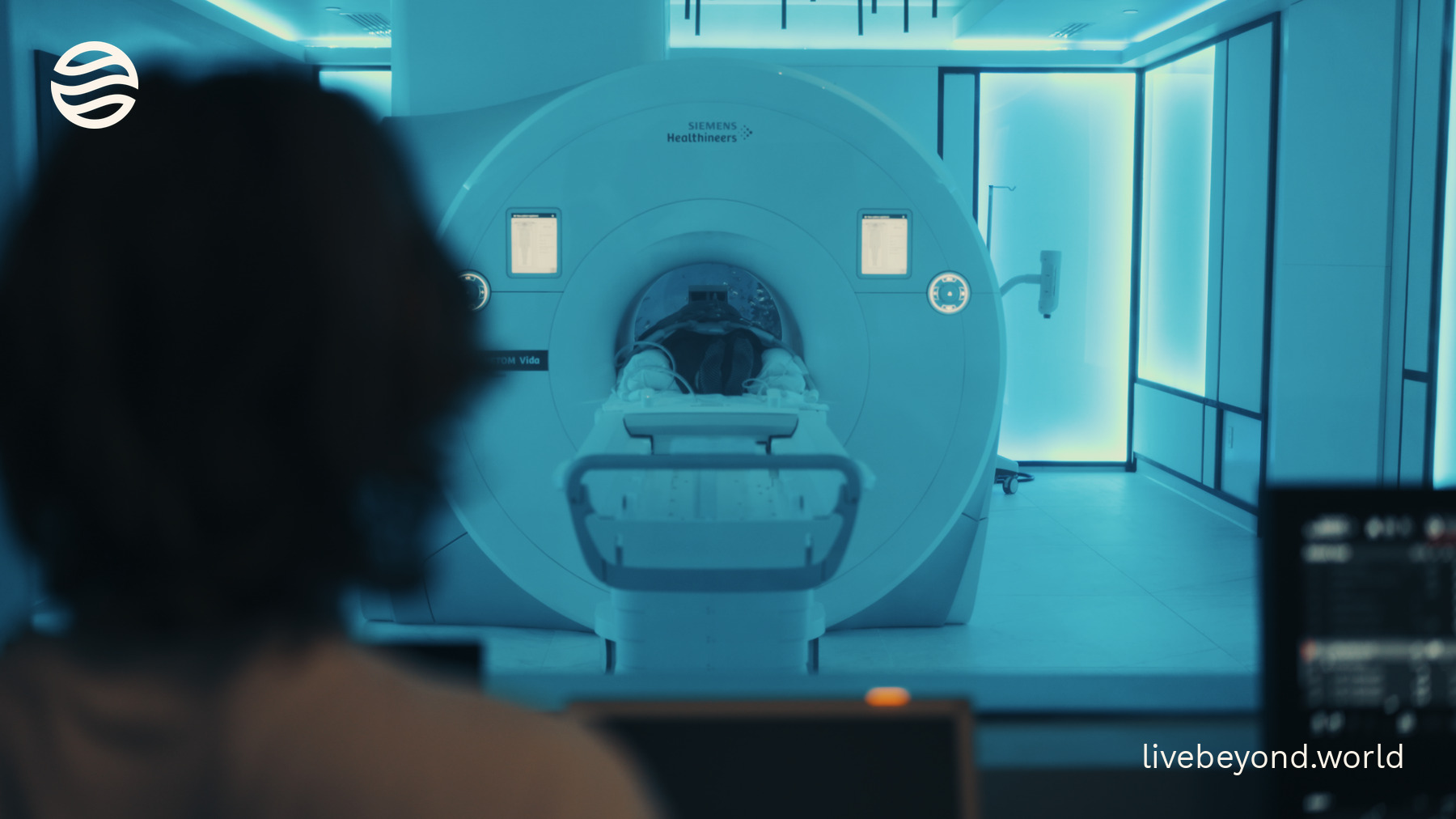
Alek watching Marek’s whole-body MRI at Human Longevity, San Francisco, 2024.
A whole-body MRI looks inside you, organ by organ, in one sitting and without a single X-ray. It can find things while they are still small. It can also find things that turn out to be nothing, and send you on a long chase. On our quest, father and son, we met 100+ longevity experts, and we both lay in the scanner at Human Longevity in San Francisco. Here is what a whole-body MRI can find, what nobody has proven yet, and the questions worth asking before you book.
A whole-body MRI can show what is happening inside you years before you would feel it: a small tumor, fat building up in the liver, a change in the heart. It uses no X-rays. For people born with a high inherited risk of cancer, it is already part of good care, and it finds cancers early enough to treat.
For everyone else the picture is still being written. In people without symptoms, about 1 or 2 in 100 have a cancer found, while many more get a finding that turns out to be nothing. That is why the reading matters as much as the scan.
New ways of processing the images make tumors light up, and AI now helps doctors read them. But software is only as good as what it has learned from: the more scans and real outcomes a clinic’s doctors and tools have seen, the better they can tell a real finding from a false alarm. Talk it through with your doctor first. [1][2][3]
Longevity, as we mean it: more healthy, joyful years. What we mean →
1.57%of people without symptoms had a cancer found by a whole-body MRI. That is about 1 or 2 people in 100, across 10 studies and 9,024 people.[3]
1 in 5of the possibly serious findings turned out to be serious, where doctors followed them up. The other four were not.[4]
$2,499for a whole-body scan at one well-known US company in 2024. Insurance did not pay for it.[5]
Before you change anything
This page shares what research and the experts we met say. It is not medical advice, and it does not recommend any medicine, supplement or treatment. It knows nothing about you. Before you start, stop or change anything — especially if you are pregnant, live with a health condition or take any medication — please talk to your doctor. In an emergency, call your local emergency number.
What a whole-body MRI is
MRI stands for magnetic resonance imaging. You lie still inside a large tube while a strong magnet and radio waves build pictures of your brain, organs, bones and blood vessels, slice by slice. There is no X-ray and no radiation. It is loud — a steady knocking — so you wear ear protection. When Marek had his at Human Longevity in San Francisco in May 2024, it took 45 minutes.
MRI is not the same as a CT scan
A CT scan uses X-rays. An MRI uses a magnet and radio waves, so it adds no radiation to your body, and that is part of why it is used to look at healthy people. Some scans add a contrast dye, called gadolinium, to make certain things stand out; it carries some risk of its own, so ask whether yours uses it.
Whole-body scanning for healthy people is not new. Craig Venter, who sequenced the human genome and co-founded Human Longevity, told us how the first attempt went wrong. We are grateful he gave us his time; he died in April 2026.
“Because in the '70s, CT scanning was developed. CT scanning, as you probably know, is just x-ray. But clinics opened around the world to do whole body CT scanning with the idea to try and do early diagnosis for disease. It started out with very good intentions, but CT cannot distinguish between a cyst and a tumor. […] Most people have cysts, so they then had to distinguish between a cyst and a tumor. And so it involved doing extra tests like ultrasound, and quite often biopsies.”
In plain words: In the 1970s and after, clinics scanned healthy people with X-ray CT. The scans found lots of small, harmless sacs of fluid called cysts, and could not tell them apart from tumors. So people needed more tests, and sometimes a biopsy — a small cut to take a piece of tissue — just to be told it was nothing. That problem has a name today: the incidental finding.
What it can find
What one clinic found in its own clients
In its own published study of 1,190 people who signed up for its check-up, Human Longevity found early-stage tumors, most of them cancers, in 1.7%. It also found fat building up in the liver in 29.2%, and a change in the structure or work of the heart in 16.2%. The scan was only one part of that check-up, which also included the genome and a large blood panel.
Based on: The clinic’s own study, 1,190 people · its authors work for the company [1]
“We had a physician come through […] We discovered this physician had a tumor underneath his breastbone, and he was just totally shocked 'cause he had no symptoms. And that was the first hint that we're gonna start to find things. And we went on almost every individual. On average now it's 53% of people, we find a major disease that they were unaware that they had.”
In plain words: Many people who feel perfectly well carry something they don’t know about. This is Human Longevity’s own count from its own clients, and major disease covers much more than cancer — it includes things like diabetes and problems with the heart and blood vessels.
People born with Li-Fraumeni syndrome
A rare inherited condition with a very high risk of cancer. On their first whole-body MRI, 7 in 100 had a new cancer found, and 35 of the 42 cancers were caught early enough to treat with the aim of a cure.
For people with a strong inherited risk of cancer, like Li-Fraumeni syndrome, a whole-body MRI is part of regular check-ups. Radiologists in Australia and New Zealand, who advise against it for people without symptoms, make the exception for people who have had cancer or were born with a high risk of it.
Based on: Review of studies, and the doctors’ own guidance [2][7]
How do you make sure a scan doesn’t raise false alarms? Craig Venter told us that what changed is not only the scanner, but how the pictures are read:
“So what’s different today, Anders Dale at UCSD developed totally new algorithms for the MRI that post-process the MRI data. It’s called restriction spectrum imaging. So tumor cells have larger nuclei than normal cells. They have more water in them, but the water is less mobile, perhaps because it interacts with DNA, so it becomes more gel-like. That gives off a totally different MRI signal and turns into a bright light, because the difference in the mobility of water.”
In plain words: Tumor cells hold water differently from healthy cells. Newer software turns that difference into a bright spot on the image, so a tumor stands out from a harmless cyst — the very problem that sank the old CT scans.
And the reading keeps getting better. AI tools now help radiologists, but a model only learns from the cases it has seen. The bigger the collection of scans, genomes and real outcomes behind a clinic, the better it recognizes a pattern it has met before, and the fewer people are sent home worried about nothing. For Craig, that collection was the most valuable thing Human Longevity has:
“AI will certainly help as we get better data sets, and that’s what we’re trying to do. But the data set here at HLI is probably the most important one in the world, where we have fairly complete human genomes, plus very extensive phenotypes on these individuals. So these will become the future training sets for the world.”
In plain words: AI is only as good as what it learns from. A large, well-described group of real people — their genes, their scans, what happened to them later — is what teaches it to read well.
Words worth knowing
Three words behind the scan
From our glossary. Tap a card to turn it over: the science on the back, and the people we met who explained it to us.
No. 20 / 66Everyday word
Prevention
Prevention is king: staying well, instead of waiting to be treated.
No. 20 / 66Everyday word
Prevention
Screening, genomics, imaging and biomarkers catch a problem while it is still small, cheap to treat and yours to decide about. Most health systems are still built for sick care and act when something breaks; longevity turns that into healthcare. Read more →
The years in which you can still do what you love: move freely, think clearly, travel, play with your grandchildren. For most people the gap between lifespan and healthspan is about a decade, and closing it is what most of the field is really working on.
The American College of Radiology — the radiologists’ own professional body in the US — says there is not enough evidence to recommend a whole-body scan for people with no symptoms, no risk factors and no family history. It adds that nobody has shown it helps people live longer or is worth the cost. The newest review of the studies says the same: no study yet has followed scanned people to see whether they live longer.
Based on: Official statement and review of studies [8][3]
Most findings are nothing
In the five studies that followed up the possibly serious findings, only 48 of 234 — about 1 in 5 — turned out to be serious. The rest meant more appointments, more scans and some worry, and then the all-clear. That is not a reason to fear the scan. It is a reason to know beforehand what will happen if it shows something.
Based on: Review of 32 studies · good evidence on findings, not on lives saved [4]
The same view from the other side of the world
The Royal Australian and New Zealand College of Radiologists does not recommend whole-body MRI screening for people without symptoms, and lists the risks that come with it.
One whole-body MRI company plans to follow 100,000 people who had the scan, with results expected in 2034 or later. Until studies like that report, the honest answer is: promising, and not proven for healthy people.
Craig Venter, who sequenced the human genome and co-founded Human Longevity, had his own reason to believe in the scan:
“I had two rounds of biopsies. I was told by one of the best urologists in the world that I definitely did not have prostate cancer. That was a month before I had the test here at HLI and found that, in fact, I had very high grade prostate cancer, and had I waited three months to get the test, it would have metastasized. […] It saved my life 'cause I had immediate surgery. This was eight years ago, so I've been cancer-free now for eight years.”
In plain words: Standard tests had told him he was fine. The whole-body MRI at his own clinic found a fast-growing prostate cancer, and he had it removed in time. One story is not a study, and he founded the company. But it shows what is at stake when a scan does find something real.
In Salt Lake City, Dr Amy Killen welcomed us into her home. She works in regenerative medicine and is about as open to new tools as any doctor we met. When Marek asked how often she has a full-body MRI, her answer was the most honest we heard on this subject, and we are thankful for it:
“I've only done it once. I did it a year ago. And I will say that the problem with those studies are that they find things that aren't problems, but then you have to chase them down. So like I did a full body MRI. They saw something on my ovary. They were like, ‘Oh, it could be, could be nothing, could be something.’ But then I spent the next nine months doing multiple ultrasounds to try to figure out if it was something or if it was nothing, and it was nothing. But that is the problem with doing all these tests if you have no symptoms, is you end up spending a lot of time and a lot of money, and in some cases, a lot of your sort of stress and mental health trying to figure out what to do with it.”
In plain words: The scan saw something small on her ovary. It took nine months of ultrasounds to be sure it was nothing. Nothing was wrong, but the time, the money and the worry were real.
“And that's the downside, is you just have to kind of weigh, and at what age should you start doing a full body MRIs. I mean, it doesn't make sense for a 30-year-old. Maybe not 40-year-old, 50-year-old. Like, there's always a risk and a benefit with any sort of test or any sort of new protocol. So I think that's something that we haven't quite figured out in this space. Like, we're just like, ‘Let's do all the things.’ But sometimes you don't actually wanna do all the things because it doesn't end up being a net positive.”
In plain words: Every test has a good side and a bad side. She doesn’t think a full-body MRI makes sense for a healthy 30-year-old, and she isn’t sure where the right age begins. Nobody has worked that out yet.
Where the joy is
We did it together. Alek watched from behind the glass while Marek went in, and then they swapped. The scanner had a little periscope, so you could look out, and neither of us felt closed in. Then came the part nobody warns you about: waiting for the results.
“I must confess, I'm relieved… It's amazing things you do here. It's exciting, but I felt a little bit of anxiety at the beginning.”
That is the joy of a good scan: peace of mind, and a clear picture to build on. And sometimes it is much more. At Human Longevity in San Diego, Dr Tina Ziainia, who looks after women’s health there, told us what an early finding meant to one family:
“I had a patient, a female patient, that her husband found his cancer here, and she said, ‘He would've been gone, but I get to celebrate Christmas with him because of your company.’”
In plain words: A cancer found early gave a wife another Christmas with her husband. That is why people choose to look.
And the biggest joy needs no scanner at all: moving every day, sleeping well, real food and time with the people you love. A scan can tell you where you stand. What you do on the way home is what builds a long, healthy life.
Who should be careful
Check with a doctor before you book
If you have a pacemaker, a cochlear implant, a stent, an artificial joint or any other metal in your body, the clinic must check first that it is safe in the magnet. The scanner is loud, and some people feel closed in inside it. If dye is used, ask what it is and why. [6]
The worry after a finding
A finding that might be something can mean weeks or months of tests before the all-clear. If you tend to worry, think about that before you book, and ask who will help you through it.
Based on: Review of studies, and Dr Killen’s own story [4]
The cost, and the cost of what comes after
In the US in 2024, one company charged $999 for the torso, $1,799 for the head and torso and $2,499 for the whole body, and insurance did not pay for it. Follow-up scans and tests can cost more again.
Why am I having it? A family history or an inherited risk is a strong reason. Curiosity is a fine reason too — as long as you know what can follow.
Who reads my scan, and will I talk to them? A senior radiologist, and a doctor who sits with you and explains it — not only a report in your inbox.
How is my scan read, and what has the reading learned from? Ask whether a senior radiologist reads it, whether software helps, and how many scans the clinic has to compare yours with.
What happens if you find something? Ask who decides on the next step, how fast, and what the follow-up tests would cost.
Is dye used, and is my body safe in the magnet? Implants, pacemakers and any metal must be checked first.
What does this scan see well, and what does it miss? No scan sees everything. A good team tells you plainly.
Can my own doctor see the images? Your pictures should travel with you, so next year’s scan can be compared with this one.
Not medical advice, and not a recommendation for or against the scan. We describe what the studies say and what we went through ourselves.
Every number on this page, by the number in square brackets. Quotations come from Live Beyond’s own recorded interviews, cleaned only of “um” and “uh”. Not medical advice. Talk to your doctor before you change anything.
Hou YC, Yu HC, Martin R, et al. Precision medicine integrating whole-genome sequencing, comprehensive metabolomics, and advanced imaging. PNAS. 2020;117(6):3053-3062. doi:10.1073/pnas.1909378117 (the authors work for Human Longevity, Inc.; the 1,190 participants were self-referred clients).
Ballinger ML, Best A, Mai PL, et al. Baseline surveillance in Li-Fraumeni syndrome using whole-body magnetic resonance imaging: a meta-analysis. JAMA Oncology. 2017;3(12):1634-1639. doi:10.1001/jamaoncol.2017.1968
Martins da Fonseca J, Trennepohl T, Pinheiro LG, et al. Whole-body MRI for opportunistic cancer detection in asymptomatic individuals: a systematic review and meta-analysis. European Radiology. 2025 (published online 30 August 2025). doi:10.1007/s00330-025-11976-5
Gibson LM, Paul L, Chappell FM, et al. Potentially serious incidental findings on brain and body magnetic resonance imaging of apparently asymptomatic adults: systematic review and meta-analysis. BMJ. 2018;363:k4577. doi:10.1136/bmj.k4577
Associated Press. Celebrities are getting $2,000 MRI scans to learn about their health. Should you? July 2024. https://abcnews.go.com/Health/wireStory/celebrities-2000-mri-scans-learn-health-111954619
US Food and Drug Administration. MRI (Magnetic Resonance Imaging): Benefits and Risks. https://www.fda.gov/radiation-emitting-products/mri-magnetic-resonance-imaging/benefits-and-risks
The Royal Australian and New Zealand College of Radiologists (RANZCR). Whole Body MRI Screening in Low-Risk Patients — Position Statement (v1.1, July 2025). https://www.ranzcr.com/document/2024-position-statement-on-whole-body-mri/
American College of Radiology. ACR Statement on Screening Total Body MRI. 17 April 2023. https://www.acr.org/News-and-Publications/Media-Center/2023/ACR-Statement-on-Screening-Total-Body-MRI