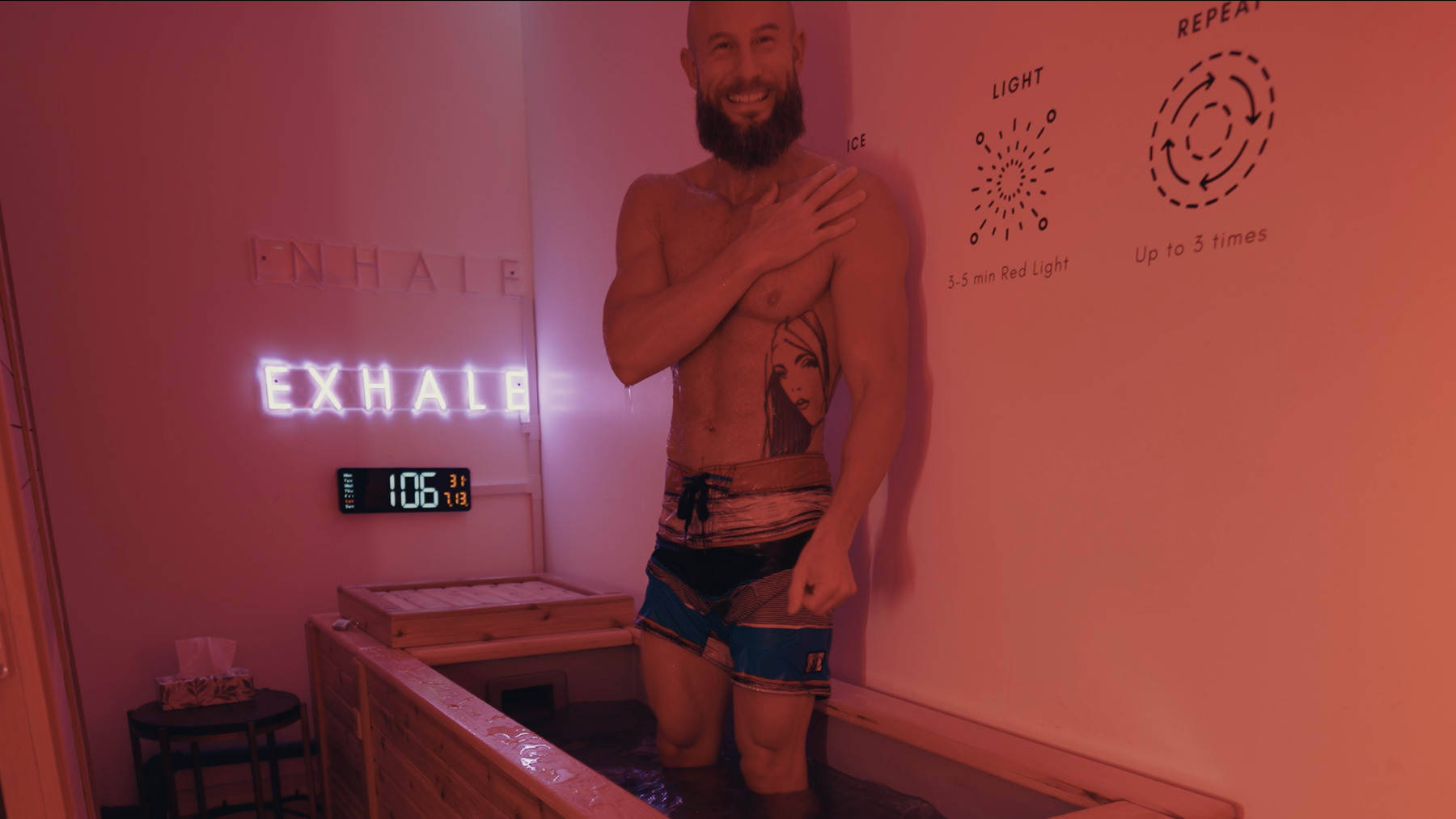
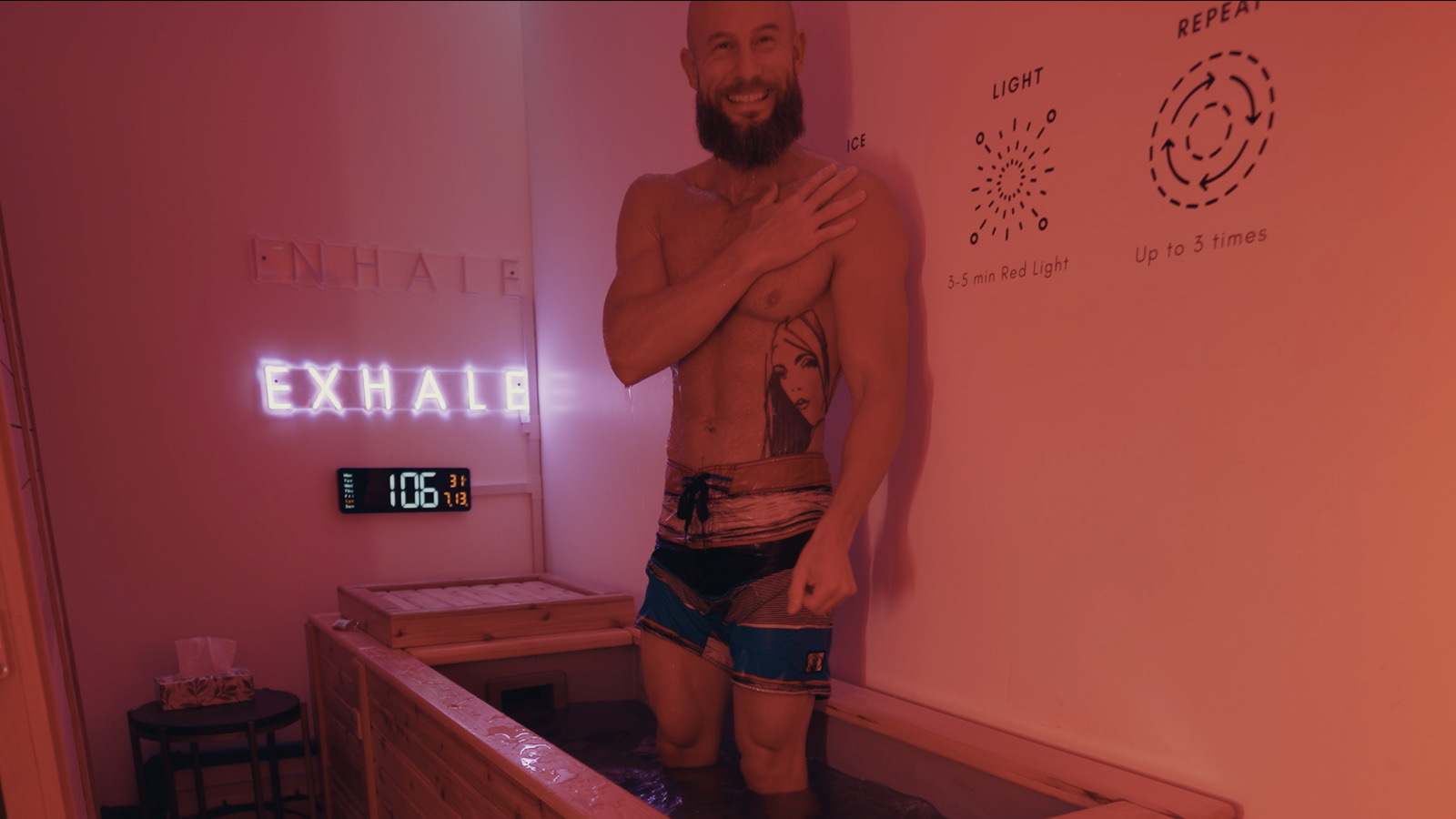
Brendan Coates in the cold plunge, Toronto, July 2024.
Cold is everywhere right now: ice baths at parties, cold plunges in gyms, freezing cryotherapy rooms in clinics. In Poland, crowds of winter swimmers walk into icy lakes all winter long. On our quest, my son Alek and I met Toronto's cold-water community. I stood in a cryotherapy chamber in Warsaw and lay in a cold water bed in Merano. And we asked the scientists: does cold help you live longer? This page covers cold showers, cold plunges and cryotherapy chambers. Where a study only shows that two things go together, not that one causes the other, we tell you.
This page shares what research and the experts we met say. It is not medical advice, and it does not recommend any medicine, supplement or treatment. It knows nothing about you. Before you start, stop or change anything — especially if you are pregnant, live with a health condition or take any medication — please talk to your doctor. In an emergency, call your local emergency number.
In short
Cold water does real things for your body and mind. After a cold plunge many people feel calmer and more awake, and studies show less stress in the hours after. In one big study in the Netherlands, people who ended their shower cold took fewer sick days from work. Your body also learns to handle a shock better — and that is what longevity is about: staying strong when life gets hard. The first minutes in cold water carry real risk, so start gently, and talk to your doctor first if you have a heart condition. [1][2]
Longevity, as we mean it: more healthy, joyful years. What we mean →
11 studieswith 3,177 people, looked at together: a little less stress 12 hours later, but no measurable boost to immunity.[1]
29%fewer sick days off work when people ended their hot shower with 30–90 seconds of cold. But they were not ill any less often.[2]
−110 °Cthe air in a cryotherapy chamber. Studies have not shown that it eases sore muscles.[3]
What we know in people
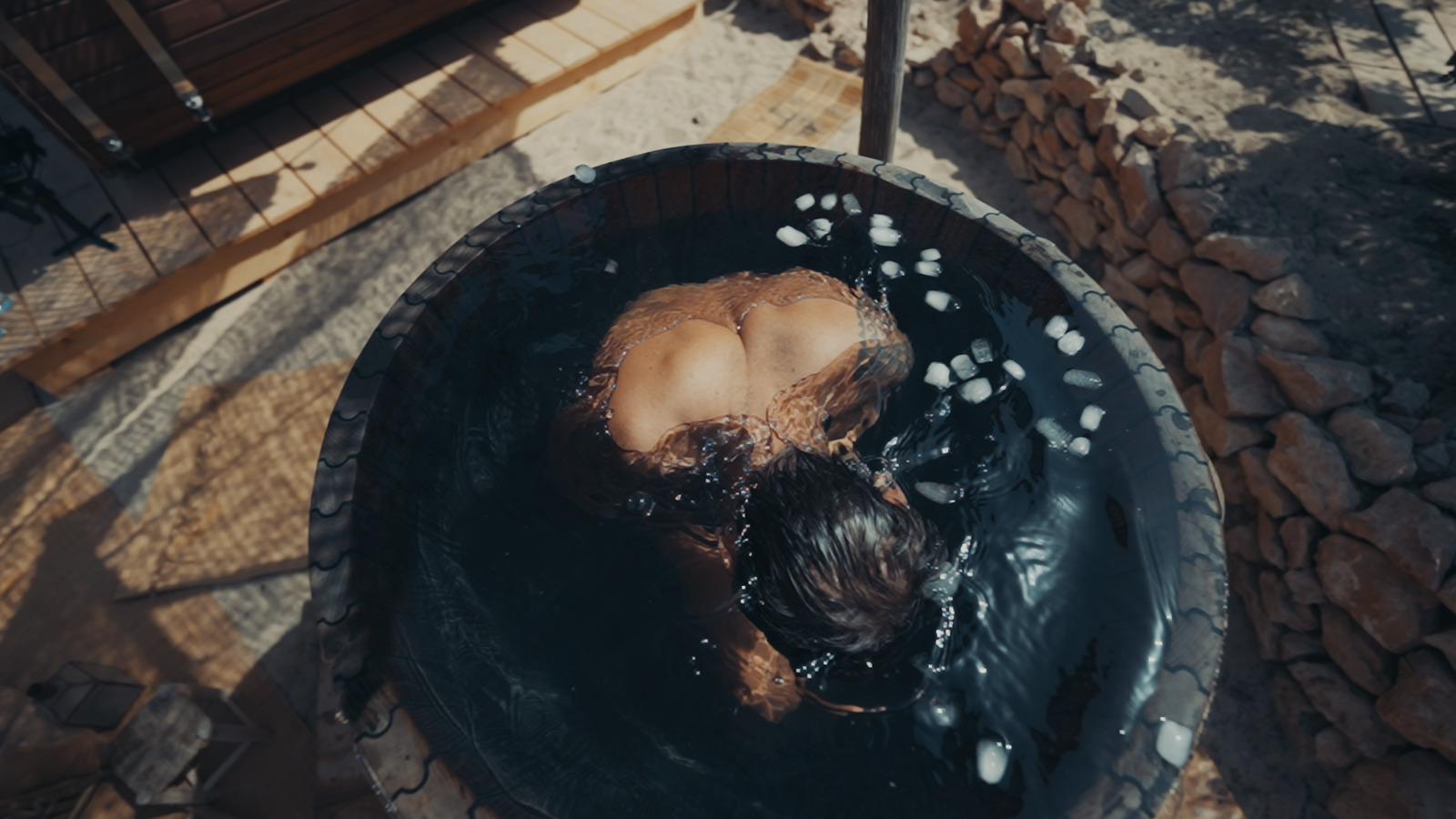
Marek in an ice bath on the quest.
A little less stress, maybe better sleep
Researchers combined 11 experiments with 3,177 people. Getting into cold water lowered how stressed people felt 12 hours later. It may help a little with sleep and with how good people feel about their lives. In the first hour, signs of inflammation (the body's alarm system) went up in the blood, not down. Immunity did not measurably change. Most studies were small, short, and mostly in young men.
Based on: 11 experiments combined · 3,177 people [1]
Cold showers: fewer days off work, not fewer days sick
In the Netherlands, 3,018 people finished their daily hot shower with 30, 60 or 90 seconds of cold, for a month. They took 29% fewer sick days off work. But they were not ill any less often. They felt well enough to go to work, and that is real. A stronger immune system was not shown.
24 men trained for ten days in breathing, cold and meditation, the method of the Dutch ‘Iceman’ Wim Hof. Then doctors gave them a small, safe dose of a toxin from bacteria, which normally brings a few hours of flu-like symptoms. The trained men felt less ill, and their bodies' alarm reaction was calmer. Much of that seemed to come from the breathing, not from the cold.
In whole-body cryotherapy you stand in air at around −110 °C. The Cochrane review, a trusted summary of medical studies, found no proof that it eases sore muscles or speeds recovery. There were only four tiny studies with 64 people, and none of them checked for side effects.
Based on: Trusted review · 4 small experiments · 64 people [3]
Your body does get used to the cold
Experienced winter swimmers who also used sauna made more body heat in the cold than people who don't swim in winter. Their brown fat, a kind of fat that burns energy to keep you warm, and their muscles had adapted. That shows the body adapts. It does not show that it makes you healthier.
Based on: Small comparison · young men · not proof of benefit [6]
What is only in animals, or not shown at all
Worms live longer in the cold
Worms kept cooler lived longer. The cold switched on a cleaning crew inside their cells that clears away damaged proteins. In human cells in a dish, the same crew cleared the protein clumps linked to ALS and Huntington's disease. In a dish, not in a person.
Based on: Worms and cells in a dish · not shown in people [7]
Mice that run cooler live longer
Mice whose genes were changed so their bodies ran a little cooler lived longer. But they were cooler every hour of their lives. A few minutes of cold a day is not the same thing.
No study has shown that cold plunges, ice baths, cold showers or cryotherapy help people live longer. Reviews find many promises, for mood, immunity and metabolism (how your body uses energy), but few strong studies, small groups of enthusiasts, and real risks to the heart.
Based on: Nothing found yet · as of October 2026 [1][9]
What the experts we met told us
Brendan Coates at the cold plunge, Canada.
Cold came up again and again on the quest, from a surfing scientist in California to a longevity doctor in the Italian Alps. We are grateful to both of them for their time and their honesty.
“I love surfing. […] I encourage everybody to go in the water, and also cold water. Here in the Bay Area, oftentimes in the upper 40s, lower 50s, so that's pretty cold. […] You're causing this hormetic response, and the cold shock proteins are activated. So I think those are overall pro-longevity molecules.”
In plain words: Cold water is a small, safe shock. Your body answers by switching on proteins that protect it. David believes these help us age well. That belief rests mostly on studies in cells and animals, not yet in people. (Upper 40s to lower 50s Fahrenheit is about 8–11 °C.)
“It's a floating bed with water, and it has two membranes that get full from water four degrees. So you will be cover, wrap from this, and you can stay for three up to eight minutes. […] Especially the first one, two minutes, they are hard. You wanna go out. […] I use it mostly for the mitochondria biogenesis to reduce pain and inflammation and muscle soreness, and then also to boost metabolism.”
In plain words: The first minutes in the cold are the hardest, and that is normal. Mitochondria are the tiny power stations in your cells, and Emanuele uses the cold to help the body build more of them, and to ease pain and sore muscles. The studies we know of tested freezing-air chambers, not water beds, and found no proof that they ease sore muscles. I lay in that bed for five minutes myself.
Where the joy is
Ask people why they keep going into cold water, and they rarely say longevity. They talk about the people. And about how good they feel afterwards. In Poland, winter swimmers, called morsy (walruses), meet in groups at lakes and on Baltic beaches from autumn to spring. Woolly hats, lots of laughing. It is one of the most sociable things Poland does in winter. In Toronto we met a cold-water community built on the same idea.
“It's like when people see ice bath sauna, people think it's just, okay, it's all serious, right? I think part of it too, why people go, they return every time […] is the sense of community, right? They get to meet new people. Instead of going in bars, you meet new people […] like-minded people.”
The lift afterwards: small, but measured
In those 11 experiments, people felt less stressed 12 hours after cold water. A small effect, from small studies. The rest of this section is culture and our own experience, not science. And the company is also the safety rule: never go in alone.
Based on: 11 experiments combined · small studies [1]
Who should be careful
The first minutes are the dangerous part
In the first 1–3 minutes, cold makes you gasp without meaning to. You breathe fast, and your heart rate and blood pressure jump. Get in slowly. Keep your head above water. Never go in alone. [10]
Heart, blood pressure, pregnancy
Cold can set off two body reflexes at once, and together they can upset the heart's rhythm. If you have heart disease, high blood pressure or an irregular heartbeat, or you are pregnant, ask a doctor first.
Never do fast, heavy breathing or breath-holding in or near water, as in the Wim Hof method. You can black out and drown. The method itself warns against it, and people have died.
The studies did not check for side effects. You can get frostbite or cold burns if your skin or clothes are wet, or if you stay in too long. If your fingers turn white in the cold (Raynaud's), you get hives from cold, or your blood pressure is not under control, avoid extreme cold.
Don't mix cold water and alcohol. Afterwards, dry off and move to warm up slowly. Your body temperature can keep dropping for a while after you get out.
Standard cold-water safety advice
How people who love it do it
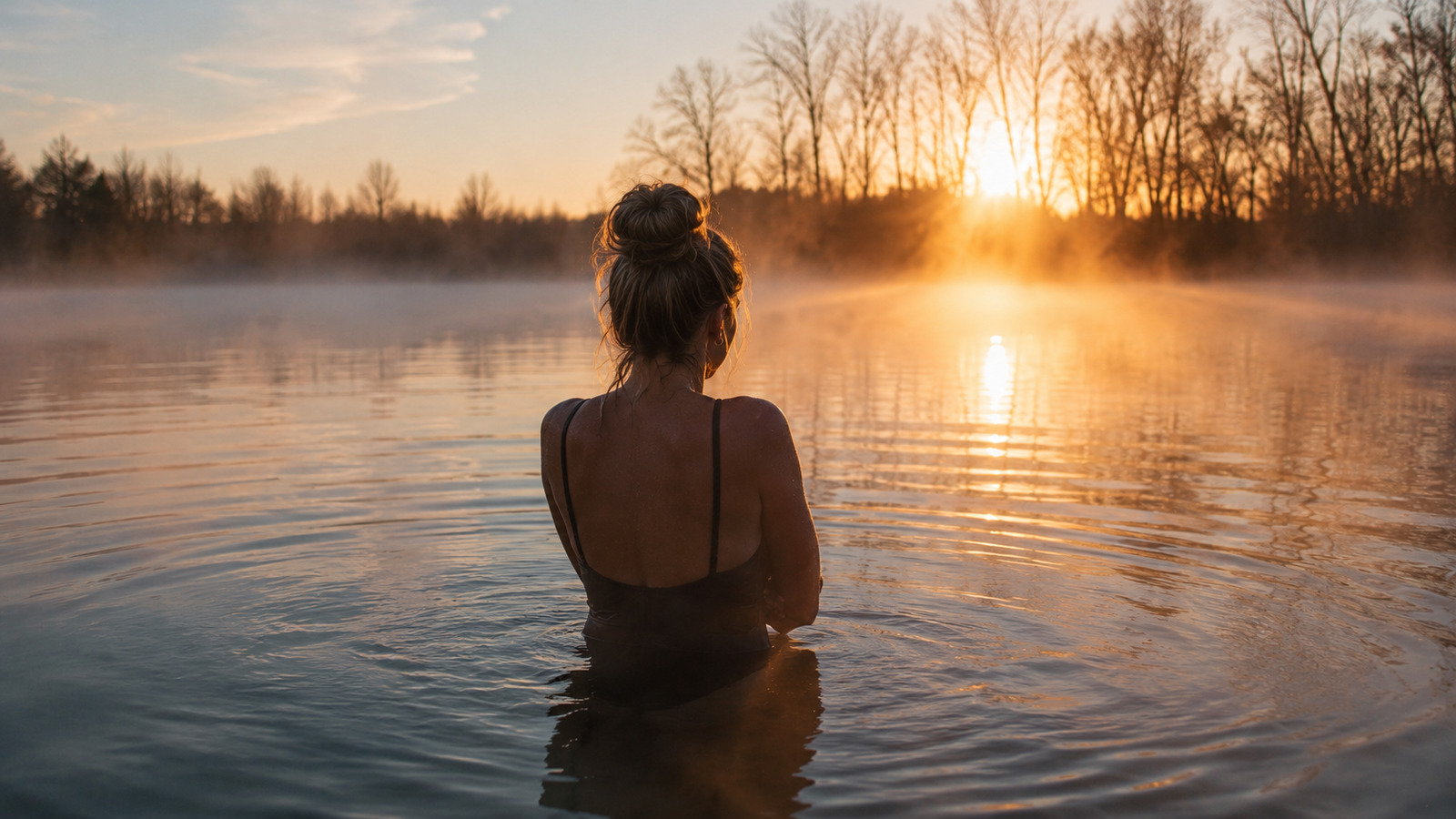
Illustration: a cold lake at sunrise.
We won't give you a plan we made up. Here is what was actually tested, one kind of cold at a time.
Cold shower
The biggest study: end your usual hot shower with 30–90 seconds of cold, every day, for a month.
Every number on this page, by the number in square brackets. Quotations come from Live Beyond’s own recorded interviews, cleaned only of “um” and “uh”. Not medical advice. Talk to your doctor before you change anything.
Cain T, Brinsley J, Bennett H, Nelson M, Maher C, Singh B. Effects of cold-water immersion on health and wellbeing: a systematic review and meta-analysis. PLoS One. 2025;20(1):e0317615. doi:10.1371/journal.pone.0317615
Buijze GA, Sierevelt IN, van der Heijden BCJM, Dijkgraaf MG, Frings-Dresen MHW. The effect of cold showering on health and work: a randomized controlled trial. PLoS One. 2016;11(9):e0161749. doi:10.1371/journal.pone.0161749
Costello JT, Baker PRA, Minett GM, Bieuzen F, Stewart IB, Bleakley C. Whole-body cryotherapy (extreme cold air exposure) for preventing and treating muscle soreness after exercise in adults. Cochrane Database of Systematic Reviews. 2015;(9):CD010789. doi:10.1002/14651858.CD010789.pub2
Kox M, van Eijk LT, Zwaag J, et al. Voluntary activation of the sympathetic nervous system and attenuation of the innate immune response in humans. PNAS. 2014;111(20):7379-7384. doi:10.1073/pnas.1322174111
Roberts LA, Raastad T, Markworth JF, et al. Post-exercise cold water immersion attenuates acute anabolic signalling and long-term adaptations in muscle to strength training. Journal of Physiology. 2015;593(18):4285-4301. doi:10.1113/JP270570
Søberg S, Löfgren J, Philipsen FE, et al. Altered brown fat thermoregulation and enhanced cold-induced thermogenesis in young, healthy, winter-swimming men. Cell Reports Medicine. 2021;2(10):100408. doi:10.1016/j.xcrm.2021.100408
Lee HJ, Alirzayeva H, Koyuncu S, Khodakarami A, Noormohammadi A, Vilchez D. Cold temperature extends longevity and prevents disease-related protein aggregation through PA28γ-induced proteasomes. Nature Aging. 2023;3:546-566. doi:10.1038/s43587-023-00383-4
Conti B, Sanchez-Alavez M, Winsky-Sommerer R, et al. Transgenic mice with a reduced core body temperature have an increased life span. Science. 2006;314(5800):825-828. doi:10.1126/science.1132191
Esperland D, de Weerd L, Mercer JB. Health effects of voluntary exposure to cold water – a continuing subject of debate. International Journal of Circumpolar Health. 2022;81(1):2111789. doi:10.1080/22423982.2022.2111789
Tipton MJ, Collier N, Massey H, Corbett J, Harper M. Cold water immersion: kill or cure? Experimental Physiology. 2017;102(11):1335-1355. doi:10.1113/EP086283
Shattock MJ, Tipton MJ. ‘Autonomic conflict’: a different way to die during cold water immersion? Journal of Physiology. 2012;590(14):3219-3230. doi:10.1113/jphysiol.2012.229864
Pester P. ‘Gambling with your life’: experts weigh in on dangers of the Wim Hof method. Live Science, 5 April 2024. https://livescience.com/health/gambling-with-your-life-experts-weigh-in-on-dangers-of-the-wim-hof-method
Laukkanen JA, Laukkanen T, Kunutsor SK. Cardiovascular and other health benefits of sauna bathing: a review of the evidence. Mayo Clin Proc. 2018;93(8):1111-1121. doi:10.1016/j.mayocp.2018.04.008