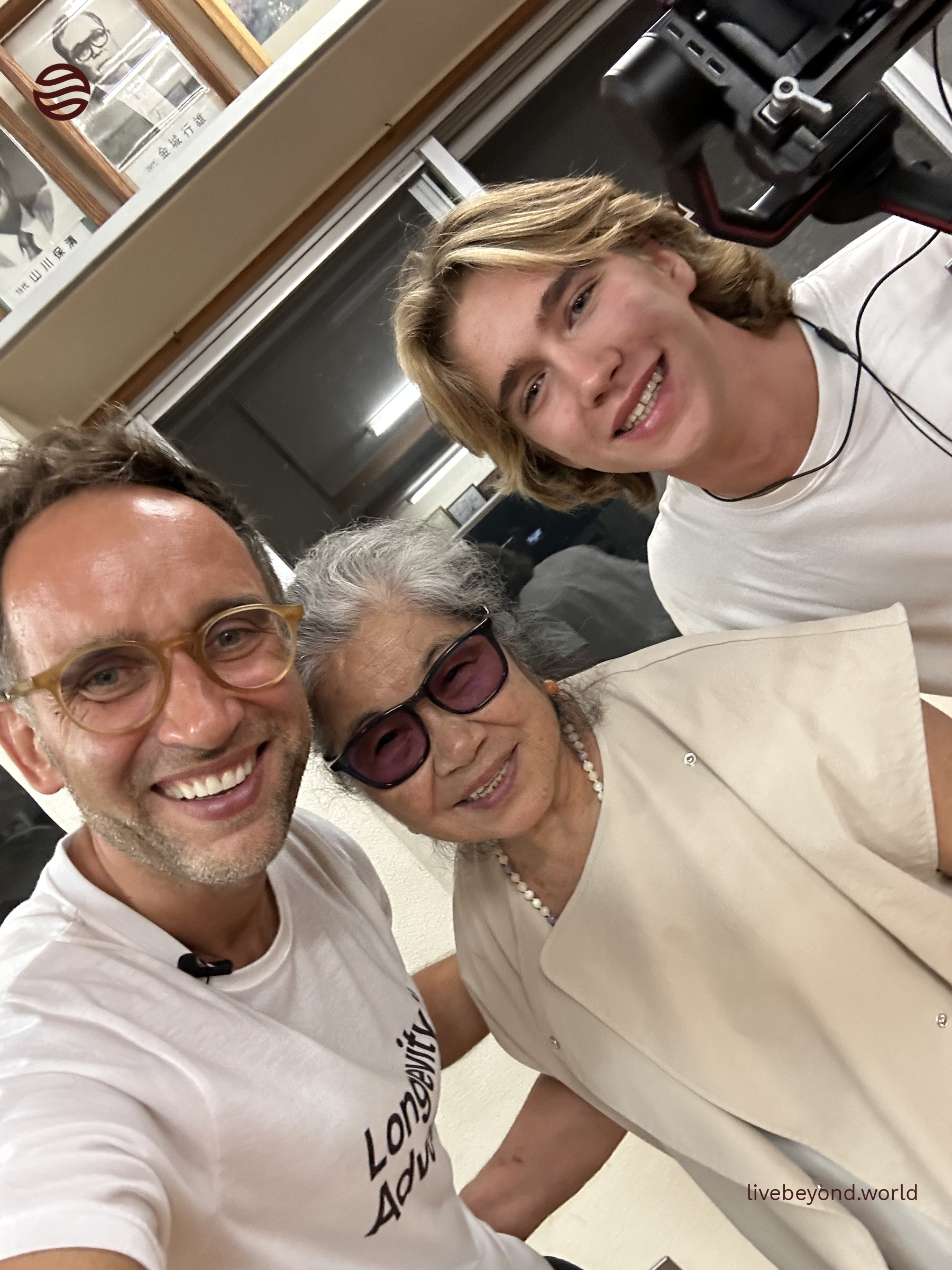
Marek, Eiko and Alek at the community centre in Ogimi, Okinawa, October 2023.
On our quest, my son Alek and I met more than a hundred longevity experts in 39 countries. In Okinawa, everybody told us about ikigai, the Japanese word for a reason to get up in the morning. So we went looking for it: in a small field in Nanjo, in the village of Ogimi, at a science conference in Singapore and in a house on Long Island. This page explains what we found, in plain words. Every number has its source. Where science only shows a link and not a cause, we tell you.
Yes — people who feel their life has a purpose tend to live longer and stay healthier, with stronger hearts and sharper minds into old age. Across ten studies and more than 136,000 people, those with a stronger sense of purpose had about 17% lower risk of dying during the years they were followed, and about 17% fewer heart and blood-vessel problems. In Japan, people who said they had no ikigai had about 1.5 times the risk of dying over seven years.
This is a strong link, not proof of cause. And purpose doesn’t have to be big: the people we met in Okinawa found theirs in a garden, a grandchild, a dance class. [1][2][3]
Longevity, as we mean it: more healthy, joyful years. What we mean →
17%lower risk of dying for people with a stronger sense of purpose, across 10 studies and 136,265 people. A link, not proof.[1]
1.5×the risk of dying over seven years for Japanese adults who said they had no ikigai, among 43,391 people.[2]
2.4×more likely to stay free of Alzheimer’s disease: older people with a high sense of purpose, compared with a low one.[3]
Most of us feel that a reason to get up makes life better. The surprise is how clearly it shows up in the body too. Scientists who followed tens of thousands of people for years found the same thing in America and in Japan: people with a sense of purpose lived longer. Here is what that means — and what it does not mean.
What purpose and ikigai mean
Ikigai is a Japanese word. It is usually translated as what makes life worth living. In Japan it is not a grand mission statement. It can be your work, your garden, your grandchildren, your friends, your morning walk. Scientists who study purpose in the West use a very similar idea: the feeling that your days are going somewhere, and that what you do matters.
Big or small, both count
In the studies on this page, nobody was asked to have a mission to change the world. People answered a few simple questions about whether their life has a direction, or simply whether they have ikigai. A small, everyday reason counts. [4][2]
What studies in people show
Nobody can hand out purpose at random and wait thirty years. So almost everything here comes from long-term studies: scientists ask large groups of people about their lives, then follow them for years and see who stays healthy and who lives longer. That shows a link. On its own, it does not prove the cause — and we come back to that below.
Ten studies, one direction
A review brought together 10 long-term studies with 136,265 people from the United States and Japan. People with a stronger sense of purpose had about 17% lower risk of dying during the years they were followed, and about 17% fewer heart attacks, strokes and other heart and blood-vessel problems.
Based on: Many long-term studies combined · a link, not proof [1]
Ikigai in Japan
In Miyagi, in the north of Japan, scientists asked 43,391 adults aged 40 to 79 one simple question: do you have ikigai in your life? Over the next seven years, those who said no were about 1.5 times as likely to die, mostly from heart and blood-vessel disease and from accidents and other outside causes. There was no clear difference for cancer.
Based on: One large long-term study · a link, not proof [2]
Americans over 50
Scientists followed 6,985 Americans over 50 from 2006 to 2010. Those with the weakest sense of purpose were about 2.4 times as likely to die in that time as those with the strongest. The link held after the scientists took account of money, education, health, and mood.
Based on: One large long-term study · a link, not proof [4]
At any age
More than 6,000 American adults were followed for 14 years. People with more purpose were less likely to die — and it made no difference whether they were young, middle-aged or older when the study began.
Based on: One large long-term study · a link, not proof [5]
A clearer mind in later life
In the Chicago area, 1,238 older people, on average 78 years old, were less likely to die in the following years if they had more purpose — even after taking account of low mood, disability and income. In the same research group, 951 older people without dementia were followed for up to seven years. Those with a high sense of purpose were about 2.4 times more likely to stay free of Alzheimer’s disease than those with a low one.
Based on: Two long-term studies · a link, not proof [6][3]
People with purpose look after themselves
Purpose may work through ordinary things. In one large American study, each step up on a six-point purpose scale went with more health check-ups, such as cholesterol tests, and 17% fewer nights in hospital.
In plain words: A reason to get up seems to be part of how the body stays well. Not just a nice extra. It may work through very ordinary things: getting up, moving, seeing people, looking after yourself. Scientists are still working out exactly how.
Words worth knowing
Three words behind a reason to get up
From our glossary. Tap a card to turn it over: the science on the back, and the people we met who explained it to us.
No. 07 / 66Everyday word
Purpose
A reason to get up in the morning that is bigger than yourself.
No. 07 / 66Everyday word
Purpose
In Okinawa they call it ikigai; in Nicoya, Costa Rica, plan de vida; in Bali, Ketut Arsana calls it the goal you play for. People with a strong sense of purpose live longer and stay healthier, and doctors see what happens when it disappears at retirement. It does not have to be grand: grandchildren, a garden, a craft, a cause. Read more →
“Life is altogether too short … if your blood is not singing at the thought of being who you are and doing what you do, then your life is wasted.”
Performing at your best and feeling your best, at the same moment.
No. 05 / 66Everyday word
Flow
Time disappears, the self goes quiet and hard things feel easy. You find it in music, sport, writing, painting, a deep conversation, on a wave, and it grows when you share it with others. It sits between boredom and anxiety. Read more →
“When you’re in flow state, you’re happy, you’re not too bored, you’re not too anxious, you’re in that Goldilocks zone.”
The places where people live the longest, and stay well while they do.
No. 15 / 66Everyday word
The Blue Zones
Okinawa in Japan, Sardinia in Italy, Nicoya in Costa Rica, Ikaria in Greece and Loma Linda in California. What they share is not a pill but a way of life: moving all day, eating mostly plants, a reason to get up, and people close by. On the quest we sat with the elders of Ogimi, in Okinawa. Read more →
We are deeply grateful to every expert who took the time to teach us. Guido Kroemer is one of the world’s most-cited biologists and one of the authors of the famous Hallmarks of Aging papers. We met him in Singapore, halfway through our year. We end every interview with the same question — what would you wish us for the rest of the trip? Alek asked it, and Guido didn’t talk about cells.
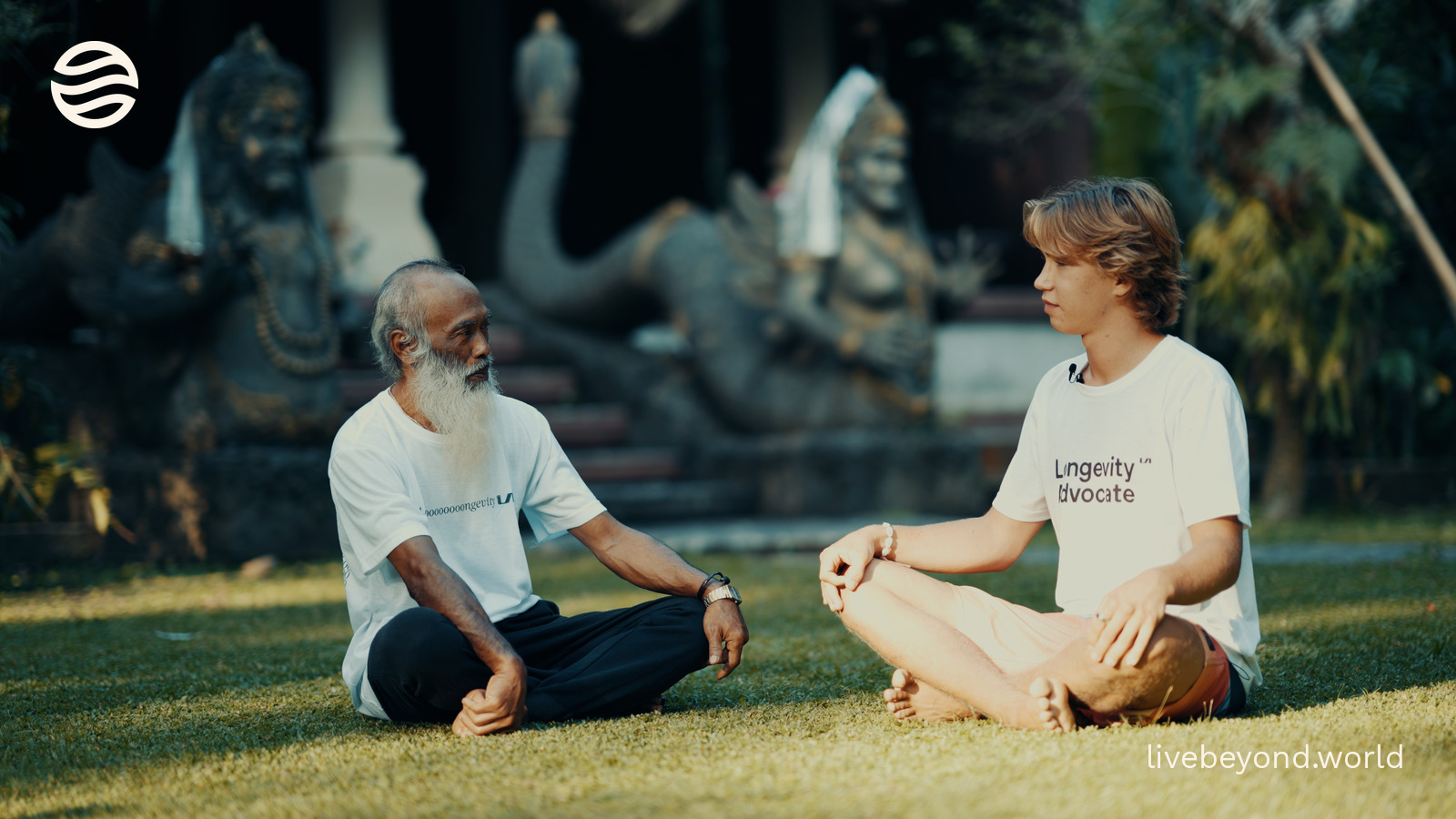
Alek and Master Ketut Arsana talking in his garden in Ubud, Bali, 2023.
“I think the most important thing that you need in life is actually a purpose. So if it is just observing the beauty of the world without a purpose, it’s a nice trip, but it will not give you the motivation to find a common denominator and to go beyond what other people do. So don’t be a consumer, be an artist.”
In plain words: Seeing the world is lovely. Having something you want to make of it is what gets you moving. Guido says: don’t only take from life — make something.
In Boston, on a cold and beautiful autumn day, Robert Waldinger took Alek and me for a long walk through a park he chose himself. He directs the Harvard Study of Adult Development, which has followed the same people, and then their children, since 1938. Most people know it as the happiness study. He told us what surprised them most:
“So we thought, ‘Let’s look at what predicts when you’re 50 that you’re gonna be happy and healthy and alive when you’re 80. What are the biggest predictors?’ And we thought it would be blood pressure or cholesterol level, but it wasn’t. It was how satisfied you were with your relationships.”
In plain words: At 50, the best clue to who would be healthy at 80 was not a number from the doctor. It was how good their relationships were. People and purpose often come together: something you care about, shared with people you care about.
I asked him, half joking, whether the lesson is to get married earlier. He laughed and said no — and gave us this instead:
“Find the things that make you happy, find the things that you care about, and don’t worry about what other people think. Find the things you really wanna do and you’ll be happier, and then you’ll be healthier.”
In plain words: Purpose doesn’t have to impress anybody. Find what you really care about, do it, and the happiness and the health tend to follow.
Srikumar Rao teaches people to change the world around them by changing the way they look at it. He told us he was not a longevity expert. I told him he was the longevity master, and his teaching became our rule for the rest of the quest: whenever something went wrong, Alek and I asked each other what good could come out of it. At his home on Long Island, I told him what I had learned about purpose:
“A lot of people think when they find a purpose, it’s constant, and that’s something they have to chase all their lives. And then there comes a day when they feel like this purpose is not theirs anymore. […] And sometimes it’s very important to understand that your purpose can change. And then when you feel like it’s not your purpose anymore, just give it up and go to another one.”
“That kind of purpose is like a suit of clothes. You wear it, it gets dirty or torn, you throw it away, and you put on another suit of clothes.”
In plain words: The purpose that gets you up today doesn’t have to be the one you keep forever. Raising children, building a company, caring for a garden — each can be right for a season, and then you can choose a new one.
In Ubud, on Bali, Master Ketut Arsana is a healer and yoga master; people book him months before they arrive. Alek asked him whether he would like to live 200 years, or whether he would be at peace whenever his time came:
“I’m okay, but I never stop to create, to give the people example. As long I can create something in this world, as long I can give the example to the world, to the people, I still need to do something. That mean I still have a life. So that my purpose in my life. I need to continue. That why I never stop to do something.”
In plain words: Ketut is not chasing more years. He keeps creating and helping people, and that is what makes him feel alive. The long life comes along with it.
What Okinawa taught us
In Okinawa we had planned a week and stayed a month. Our host in Nanjo, Mikiko, laughed when Alek first asked her about ikigai: she wasn’t sure. Later he asked whether she works in her garden:
“Many people in Okinawa, without Naha, the city, many people have their small field, so they grow vegetables. […] So I think that is one of ikigai.”
In plain words: For Mikiko, ikigai isn’t a big idea. It is the small field behind the house, and a reason to go out to it every morning.
Then we went north, to Ogimi, the village famous for its centenarians. There were no guides, so we spent a whole day on buses, with our questions printed in Japanese. And then Eiko appeared: 83, sunglasses on all day, perfect English from years as a nurse in America. She became our guide, our translator, and our friend. When we asked her what kept the old generation going, she said:
“Yes, because they eat fresh vegetable, fresh food, and then work mostly outside. […] And then nobody stay home. […] If you go earlier morning, they go to the farm and they cultivate the vegetables and anything. And then come home and then evening, they go again for the farm to take care of the vegetables or whatever growing. […] They always go outside. They don’t stay inside the house.”
In plain words: In Ogimi, people don’t stop working when they get old. There is always a field to tend, morning and evening — work that keeps the body moving and gives every day a reason.
At the community centre we met Okushima Kikue. She is 97, and her mother lived to 108. I asked what she would tell my son. She looked at Alek and answered in Japanese:
“He’s so lovely — looking at the son gives me energy again, enough to reach 100 again.”
In plain words: The young give the old energy, and the old give the young their wisdom. A reason to keep going can be as simple as the people around you.
Her week was full, too. When we invited her to come along with us on Monday morning, she had to check — Monday, or was it Tuesday? Something was already booked.
Ten months later, in Sardinia, our guide Paola Demurtas told Alek about the shepherds she grew up among:
“I remember I asked to a shepherd, ‘What was your biggest stress in life?’ And he told me, ‘Oh, losing a goat.’ And I was, ‘Hmm, interesting.’ And now we are always worried for so many things, but when you have less thing to carry, just your family, and your main purpose just to feed them, you don’t have to worry about anything else.”
In plain words: A simple, clear purpose — feeding the people you love — can make a life lighter. Fewer things to carry, less to worry about.
The same idea, in two languages
When the Blue Zones team studied the world’s longest-lived places, purpose was on their short list of what those places share. Okinawans call it ikigai; in Nicoya, Costa Rica, people call it plan de vida. For both, it means why I wake up in the morning.
Based on: Popular account by the Blue Zones team · an observation, not a test [8]
What we don’t know yet
We want to be honest about where the science stops.
Cause or link? Every number on this page comes from long-term studies. Researchers try to account for health, money and mood, but a link is still a link.
Which comes first? Healthy people may find it easier to feel that life has a direction, and illness can take that feeling away. Probably both are true.
Can purpose be learned? We found no study yet showing that helping people build a sense of purpose makes them live longer. That is still an open question.
Seven extra years? You may read that purpose is worth up to seven extra years of life. That figure appears in a popular Blue Zones article without a study behind it, so we don’t use it.
Do the Blue Zones prove it? No. They show what long-lived places have in common. They can’t show which part does the work.
Where the joy is
In the Live Beyond family we have one rule for everything we share: if it brings no joy, nobody keeps doing it. Purpose may be where joy and a long life meet. The elders of Ogimi rehearse a dance show at their community centre. Mikiko has her small field. Ketut is in his garden whenever he is not with patients. None of them would call it a longevity habit. It is simply what makes their day good.
“Make your peace with that. Embrace it. Pick the two or three things that are really important and focus on those, and as I told you earlier, pour all of your attention into whatever you’re doing. And remember, the purpose of washing dishes is not to get them clean. The purpose of washing dishes is to wash the dishes. The byproduct is they become clean. […] Live your life like that.”
In plain words: You don’t have to wait for a big purpose to enjoy your life. Choose the few things that matter to you, and give whatever you are doing your full attention. That is already a good day.
Small ways to start
No pressure and no rules. Pick the one that feels easiest, and try it this week.
Name one small thing
Tonight, write down one thing that made today worth getting up for. A person, a plant, a piece of work.
From our quest
Grow something
A pot of herbs on the windowsill, a corner of a garden. Mikiko’s ikigai is a small field.
From Okinawa
Keep something on the calendar
Something to look forward to next week — a class, a visit, a game. At 97, Kikue’s week was already booked.
From Ogimi
Share what you know
Teach a skill to someone younger, or learn one from someone older. Purpose often lives between generations.
From our quest
Make, don’t only take
Cook, build, write, paint, plant. As Guido Kroemer told Alek: don’t be a consumer, be an artist.
From our quest
Let it change
If a purpose no longer fits, it’s okay to put on a new one — like a suit of clothes.
From our quest
In plain words: One small reason, found again every morning, is how a purpose grows. Start with the thing you already love.
When purpose feels far away
If you feel empty for weeks
Feeling that nothing matters, most days, can be a sign of depression. Please talk to someone you trust or to your doctor. In an emergency, call your local emergency number.
Our advice
After a big change
Retirement, children leaving home, an illness, losing someone close — purpose often moves when life moves. It’s normal to feel lost for a while. Give yourself time, and let people help.
Our advice
Purpose is not pressure
You don’t need a mission to change the world. Waking up for a garden, a friend or a grandchild counts.
Our advice
Never a reason to blame
If someone is ill, it is never because they lacked purpose. These studies show links across large groups of people, not anybody’s fault.
We wrote this page from Live Beyond’s own recorded interviews and the published studies listed below, with gratitude to everyone who taught us — and especially to Eiko, who turned a long day of buses into the heart of our month in Okinawa.
Sources
Every number on this page, by the number in square brackets. Quotations come from Live Beyond’s own recorded interviews, cleaned only of “um” and “uh”. Not medical advice. Talk to your doctor before you change anything.
Cohen R, Bavishi C, Rozanski A. Purpose in life and its relationship to all-cause mortality and cardiovascular events: a meta-analysis. Psychosom Med. 2016;78(2):122-133. doi:10.1097/PSY.0000000000000274
Sone T, Nakaya N, Ohmori K, Shimazu T, Higashiguchi M, Kakizaki M, Kikuchi N, Kuriyama S, Tsuji I. Sense of life worth living (ikigai) and mortality in Japan: Ohsaki Study. Psychosom Med. 2008;70(6):709-715. doi:10.1097/PSY.0b013e31817e7e64
Boyle PA, Buchman AS, Barnes LL, Bennett DA. Effect of a purpose in life on risk of incident Alzheimer disease and mild cognitive impairment in community-dwelling older persons. Arch Gen Psychiatry. 2010;67(3):304-310. doi:10.1001/archgenpsychiatry.2009.208
Alimujiang A, Wiensch A, Boss J, Fleischer NL, Mondul AM, McLean K, Mukherjee B, Pearce CL. Association between life purpose and mortality among US adults older than 50 years. JAMA Netw Open. 2019;2(5):e194270. doi:10.1001/jamanetworkopen.2019.4270
Hill PL, Turiano NA. Purpose in life as a predictor of mortality across adulthood. Psychol Sci. 2014;25(7):1482-1486. doi:10.1177/0956797614531799
Boyle PA, Barnes LL, Buchman AS, Bennett DA. Purpose in life is associated with mortality among community-dwelling older persons. Psychosom Med. 2009;71(5):574-579. doi:10.1097/PSY.0b013e3181a5a7c0
Kim ES, Strecher VJ, Ryff CD. Purpose in life and use of preventive health care services. Proc Natl Acad Sci U S A. 2014;111(46):16331-16336. doi:10.1073/pnas.1414826111
Buettner D, Skemp S. Blue Zones: lessons from the world’s longest lived. Am J Lifestyle Med. 2016;10(5):318-321. doi:10.1177/1559827616637066