The shingles vaccine for longevity: protection against shingles, and a hopeful clue for the brain
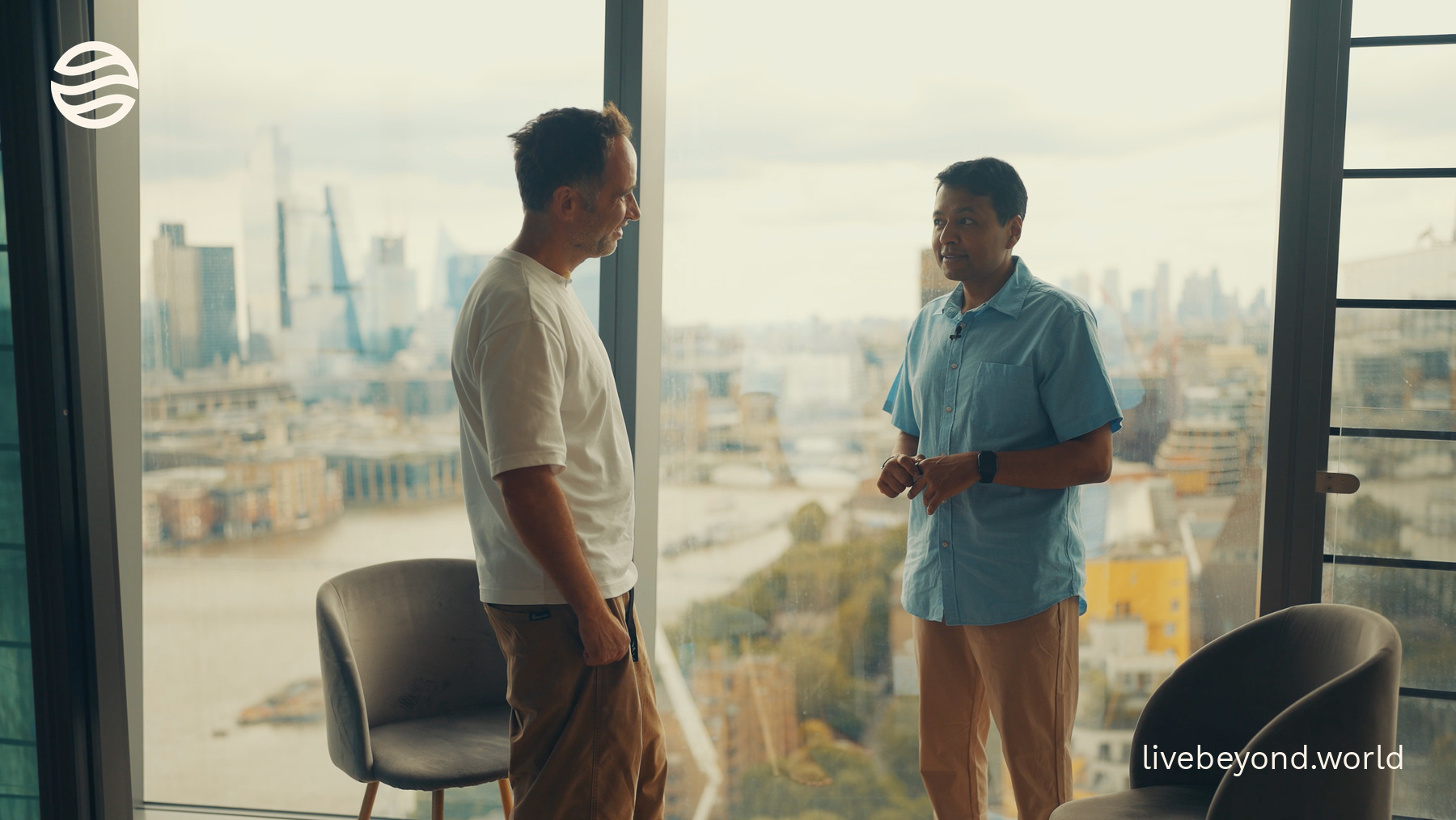
Marek Piotrowski and Avi Roy in London, July 2024 — a Live Beyond interview on aging and medicine. Their conversation on the shingles vaccine took place online in April 2026.
When I wrote my book, I went through every part of the Longevity Map, including old medicines that might be reused against aging. I didn’t write a word about vaccines. Then, in April 2026, Avi Roy, a cell biologist who has studied aging for eighteen years, told me about the shingles vaccine and dementia, and I couldn’t stop thinking about it. A vaccine that already exists, that millions of people already get, might also protect the brain. Here is what is known, and what is not.
The shingles vaccine protects very well against shingles, a painful illness that hits about one in three people at some point in their life. And in large natural experiments in Wales and Australia, people who got the vaccine were less likely to be diagnosed with dementia in the next seven years. In Wales, the drop was about one in five, and it was clearly stronger in women.
These were not trials designed to test dementia, so we can’t yet say the vaccine prevents it.
The good news: the vaccine already exists, is well studied for safety, and in many countries is offered free to people over a certain age. If you are eligible, talking to your doctor about it is a simple step that is already in your hands. [1][2][3]
This is not medical advice.
This page shares experiences from our quest and what scientists told us. It does not recommend any medicine, peptide, supplement or treatment, and it knows nothing about you.
Never start, stop or change any medicine, peptide, supplement or treatment without your own doctor, who knows your health and can check your blood work. That matters even more if you are pregnant or planning a pregnancy, live with a health condition, or take other medicines.
Longevity, as we mean it: more healthy, joyful years. What we mean →
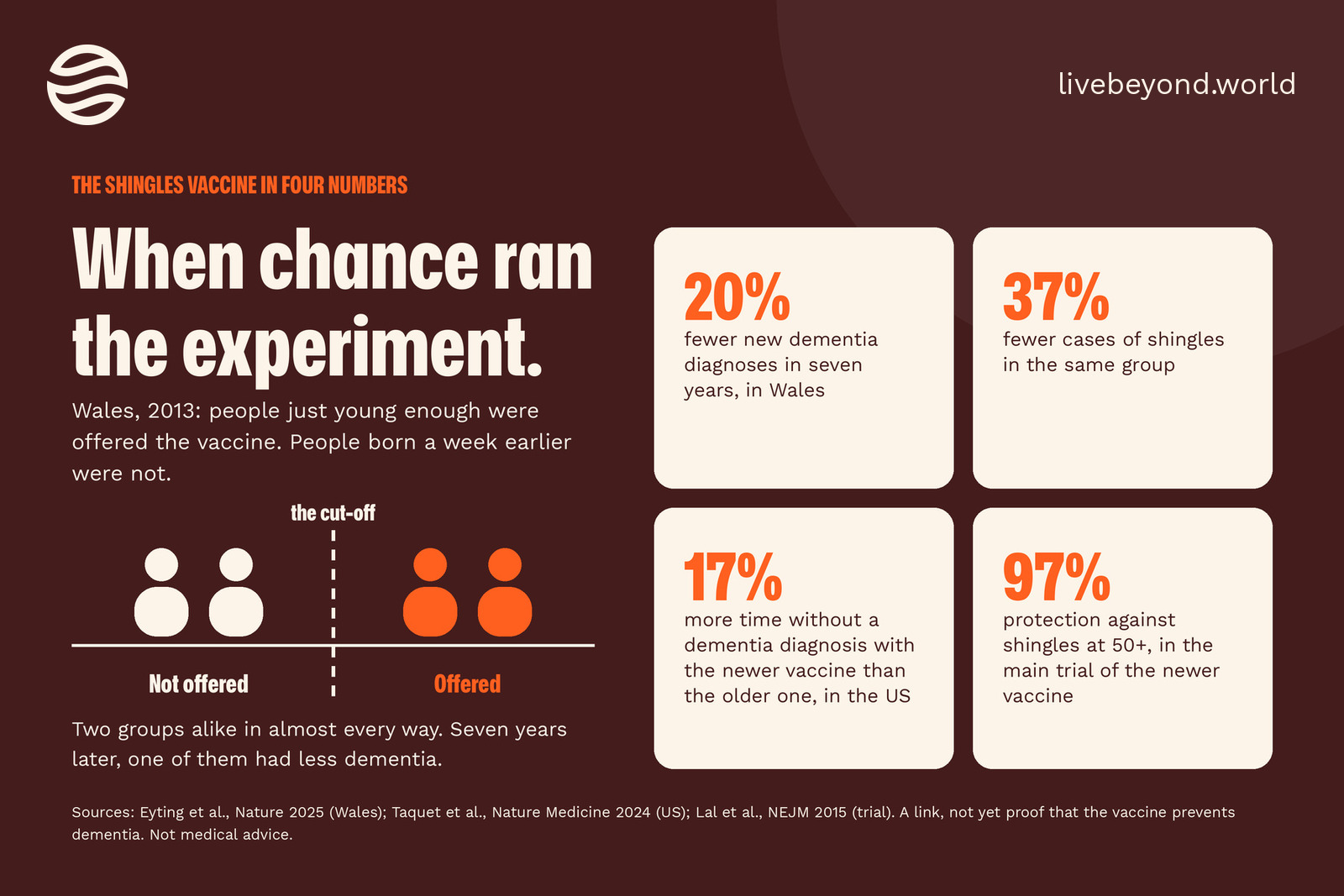
20%fewer new dementia diagnoses over seven years among older people in Wales who got the shingles vaccine.[1]
17%more time without a dementia diagnosis, over six years, with the newer shingles vaccine than with the older one.[4]
97%protection against shingles in adults aged 50 and over in the main trial of the newer, two-dose vaccine.[5]
What shingles is
Almost every adult carried the chickenpox virus as a child. When the chickenpox goes away, the virus doesn’t: it hides in the nerves for the rest of our life. Later, often when our immune system gets weaker with age or stress, it can wake up again as shingles, a band of painful blisters on one side of the body. For some people, the nerve pain lasts for months after the rash is gone.
Two kinds of vaccine
The older vaccine (sold as Zostavax) used a weakened live virus and was given once. The newer one (Shingrix) contains no live virus, only one protein of the virus plus an ingredient that wakes up the immune system, and is given in two doses. In its main trials, it prevented about 97% of shingles cases in people aged 50 and over, and about 90% in people aged 70 and over.
You can’t easily run a trial where half of older people are refused a vaccine for years. So scientists looked for situations where chance did that for them. Avi explained it to me:
The shingles vaccine in four numbers — a Live Beyond infographic from the studies in Wales (Nature 2025), the United States (Nature Medicine 2024) and the main trial of the newer vaccine (NEJM 2015).
“So when the shingles vaccine got approved, then people who were above a certain age, but below a certain age as well, like there was a birth date cutoff, got it, and then just the year before didn’t get it. And then you just follow them over time […] So that is called a […] natural experiment.”
In plain words: When a country starts a vaccine program with an age cut-off, two people born a week apart can end up on opposite sides of it. They are alike in almost every way, so if one group later gets less dementia, the vaccine is the most likely reason. That is a natural experiment, and it is much stronger evidence than an ordinary comparison.
Wales: one in five fewer diagnoses
In 2013, Wales offered the shingles vaccine to people who were 79, but not to people who were already 80. Researchers compared more than 280,000 people born just before and just after the cut-off date. Over the next seven years, those who got the vaccine were about 20% less likely to be diagnosed with dementia, and shingles itself dropped by about 37%. The effect was much stronger in women.
Australia had a similar birth-date cut-off in 2016. In the records of more than 100,000 patients, followed for about seven years, people who became eligible for the vaccine were 1.8 percentage points less likely to get a new dementia diagnosis.
When the United States switched from the older vaccine to the newer one in 2017, researchers compared people vaccinated just before and just after the switch. In the six years after vaccination, the newer vaccine was linked to 17% more time lived without a dementia diagnosis, about 164 extra days for those who did develop dementia. The effect was seen in both sexes and was stronger in women.
“We’ve seen the Shingles vaccine is linked with reduced risk of Alzheimer’s and dementias in 4 large natural experiments.”
Words worth knowing
Three words behind the vaccine
From our glossary. Tap a card to turn it over: the science on the back, and the people we met who explained it to us.
No. 20 / 66Everyday word
Prevention
Prevention is king: staying well, instead of waiting to be treated.
No. 20 / 66Everyday word
Prevention
Screening, genomics, imaging and biomarkers catch a problem while it is still small, cheap to treat and yours to decide about. Most health systems are still built for sick care and act when something breaks; longevity turns that into healthcare. Read more →
Sleep, weight, muscle, oral health, and treating the obvious sources. Omega-3s have decent evidence. This is also one of the few processes where a simple blood test — high-sensitivity CRP — tells you something useful and cheap.
The years in which you can still do what you love: move freely, think clearly, travel, play with your grandchildren. For most people the gap between lifespan and healthspan is about a decade, and closing it is what most of the field is really working on.
Avi likes this story because it was found the right way round, from the data first:
“So we have epidemiological data of something is happening. Then we go down, and we pick a thing that could have modified that. And in this case, this is the shingles vaccine.”
In plain words: Nobody started with a theory and then went looking for proof. Researchers first saw fewer dementia cases in vaccinated people, and only then asked why. One idea is that keeping the hidden virus asleep protects the brain from repeated inflammation. Another is that the vaccine trains the immune system in a broader way. Nobody knows yet which is right.
If the second idea is right, other vaccines that older people get should show something similar. That is exactly what Avi was watching:
“And the data, by the way, so far from the vaccines are going all in the same direction. So that gives us good strength.”
A clue from the flu vaccine
In a 2026 study of about 165,000 Americans aged 65 and over, those who got the high-dose flu vaccine had a lower risk of an Alzheimer’s diagnosis in the following two years than those who got the standard dose. As with the shingles vaccine, the link held longer in women. It is an observational study, so it shows a link, not a proof.
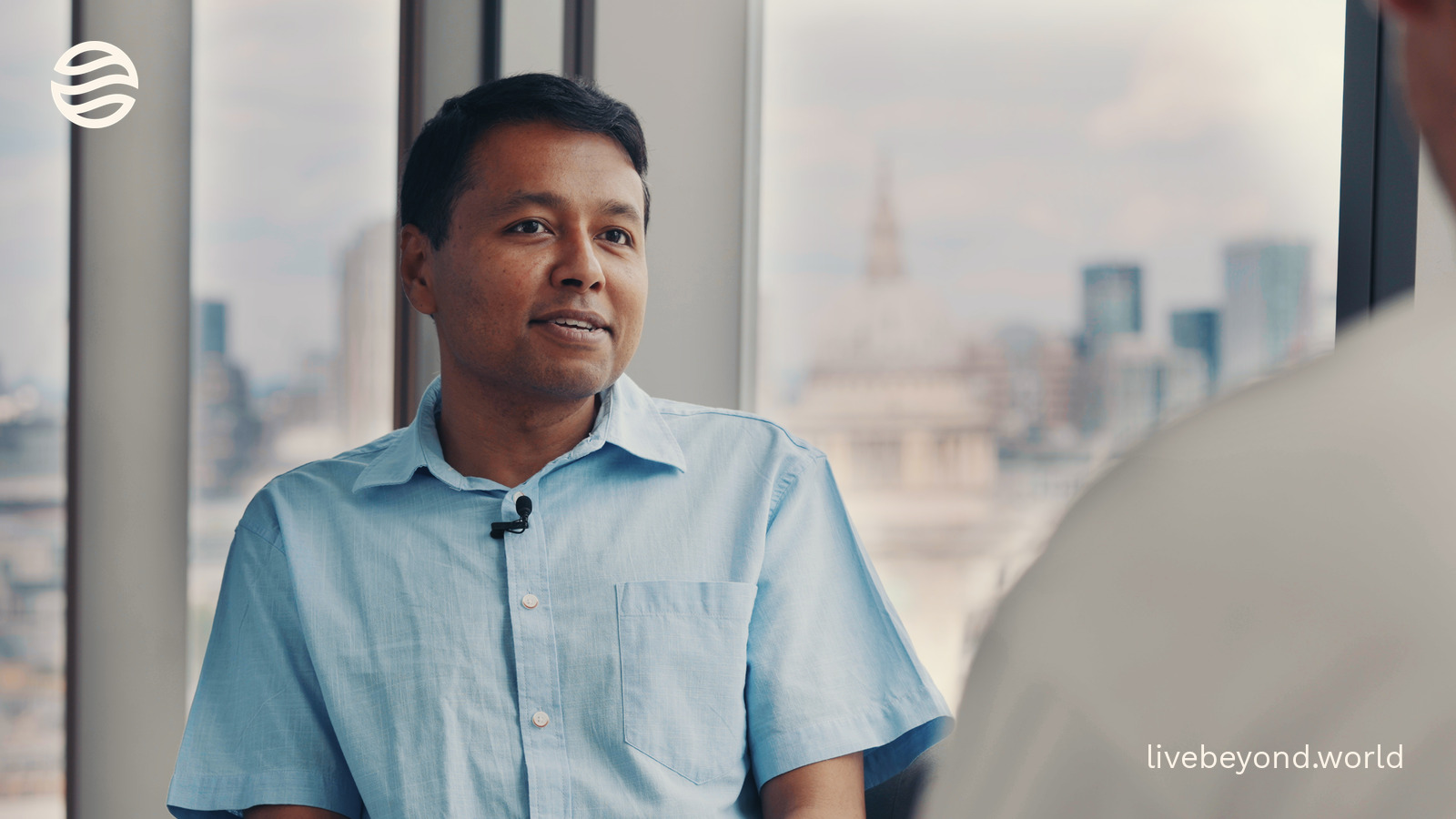
Avi Roy in London, July 2024 — a Live Beyond interview with Marek Piotrowski.
“Some natural experiments have pulled it up to 40, but I think there’s a lot of confounding results on that. […] I think it would be closer to 20 to 25%, which is huge because there’s nothing in works that has that much impact.”
In plain words: Different studies give different numbers, from about 20% upwards. Avi’s own best guess is around 20 to 25%. Even that would be very big for dementia, where almost nothing else works so well.
And he was careful to tell me where the evidence ends:
“I’m just trying to separate where the threshold is of evidence-based and then where we’re taking a leap of faith […] with the best evidence that we have.”
In plain words: The vaccine is proven to prevent shingles. That it also protects the brain is a strong, hopeful signal from several large studies, not yet a proven fact. Giving it earlier or more often than the official programs, to protect the brain, would be a step beyond the evidence.
What has not been shown
No trial has yet been designed to test whether the shingles vaccine prevents dementia. We don’t know how long any protection lasts, whether a booster would help, or whether people who were vaccinated against chickenpox as children will see the same effect.
Who is offered the vaccine
In the United States
Two doses of the newer vaccine are recommended for adults aged 50 and over, and for adults from 19 whose immune system is weakened by illness or treatment.
Since September 2023, the NHS offers two doses of the newer vaccine to people aged 70 to 79, to people as they turn 65, and to people aged 18 and over with a severely weakened immune system. The plan is to lower the age to 60 over the following years.
Other countries have their own rules, and the vaccine is not free everywhere. Avi thinks many doctors simply haven’t heard about the brain findings yet:
“I don’t think medical community is for or against it. I think it’s just lack of awareness.”
Side effects
What people feel
With the newer vaccine, a sore, red arm, muscle aches, tiredness, headache and sometimes a fever are common, especially for a day or two after each dose. They usually pass quickly.
Based on: Product information and public-health guidance [8][3]
When to ask first
Talk to your doctor before vaccination if you have had a severe allergic reaction to a vaccine, if you are ill with a fever, or if your immune system is weakened. Your doctor knows which vaccine, and which schedule, fits you.
Questions for your doctor
Am I eligible for the shingles vaccine where I live? Ask whether it is free for you, and which vaccine is offered.
Do I need both doses? The newer vaccine is given in two doses; ask about the gap between them.
Is there any reason I should not have it? Allergies, illness, pregnancy or medicines that weaken the immune system can change the answer.
What about other vaccines for my age? Ask about the flu, pneumococcal and other vaccines recommended for older adults.
Where the joy is
For me, this is one of the most hopeful stories of our whole quest. Dementia is what many of us fear most about growing old, and we have so few tools against it. Here is a vaccine that already exists, that already protects against a painful illness, and that might, as a gift on top, help keep our memories. Most longevity ideas are expensive or far away. This one is in the clinic around the corner.
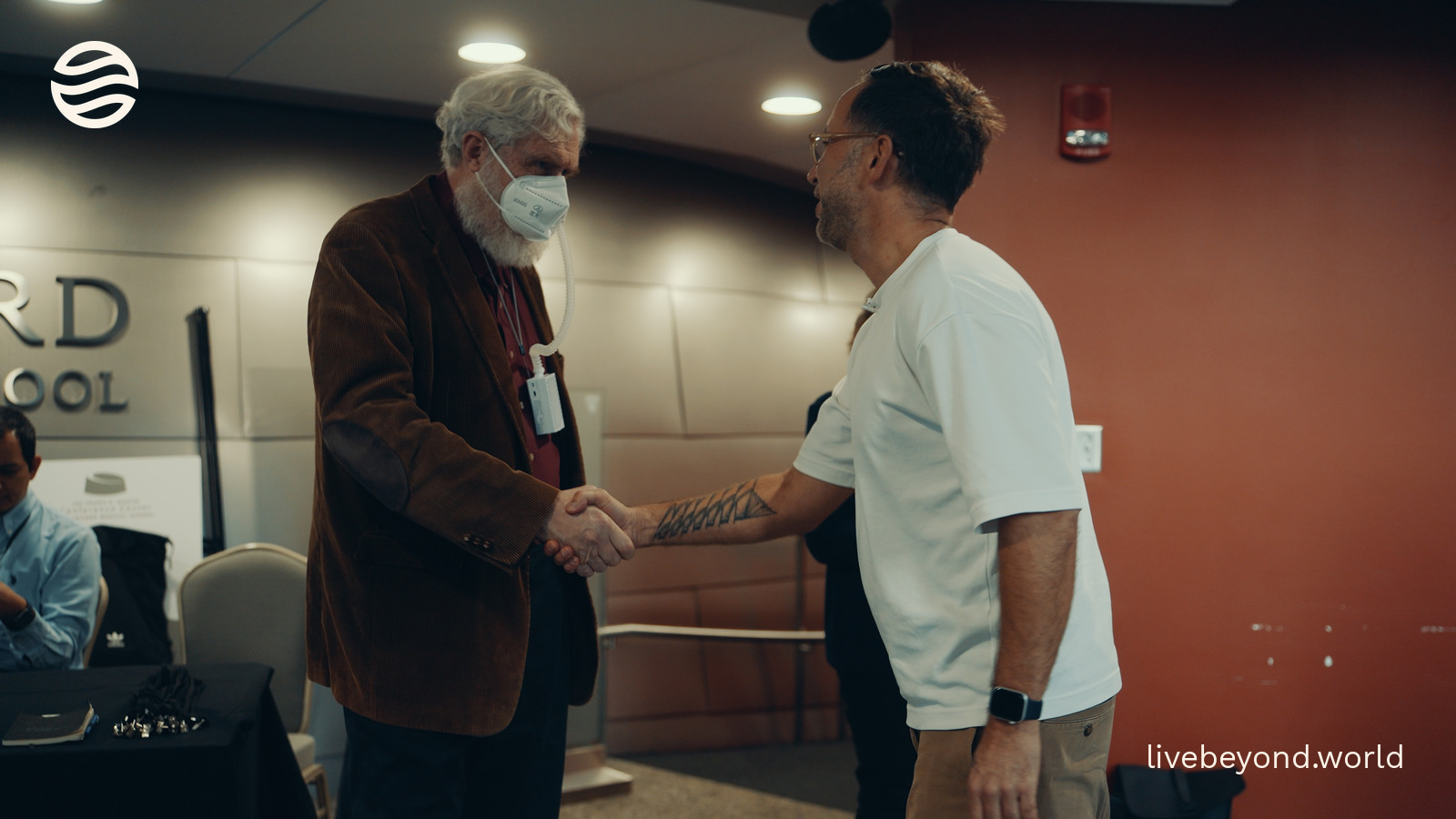
Marek Piotrowski and George Church at Harvard Medical School, Boston, November 2024 — after a Live Beyond interview on gene therapy and aging.
And this is longevity too. Longevity is not only how many years we live, but how many of them we live healthy, active and joyful, and with a clear mind. Anything that protects the brain from dementia lengthens our cognitive span, and that is one of the spans of longevity. What we mean by longevity. Alongside the vaccine, the everyday basics protect the brain too: good sleep, walking every day and time with the people you love.
At Harvard, in November 2024, I asked the geneticist George Church whether medicines against aging could ever reach everybody, and not only the rich. His answer started with vaccines:
“And we have a test bed for that already, which was pandemic. So the COVID-19 pandemic was actually vaccinated with 2 categories of gene therapy. […] It is, absolutely. And it cost 20, 30 dollars and 6 billion people took it, so it’s safe and effective, and cheap. And I think aging, age-related diseases should be exactly the same kind of market and effect.”
In plain words: The COVID-19 vaccines worked by delivering one gene into our cells, so George sees them as gene therapies that already reached billions of people, at a few dollars a dose. That is the scale he hopes for with medicines against aging. And it is why a cheap vaccine that might also help protect the brain moves me so much: it could reach whole societies, not just a few.
And I love how it was found: not by someone selling a pill, but by economists and doctors who looked carefully at what happened to real people when chance decided who got a vaccine. I’m grateful to Avi for bringing it to me.
Not medical advice, and not a recommendation for or against any vaccine. We describe what the studies say and what the experts told us.
This is not medical advice.
This page shares experiences from our quest and what scientists told us. Shingles vaccines are approved to prevent shingles; they are not approved to prevent dementia. Every body is different: what works for one person may not work the same way for another.
Never start, stop or change any medicine, peptide, supplement or treatment without your own doctor, who knows your health and can check your blood work. In an emergency, call your local emergency number.
Sources
Every number on this page, by the number in square brackets. Quotations come from Live Beyond’s own recorded interviews, cleaned only of “um” and “uh”. Not medical advice. Talk to your doctor before you change anything.
Eyting M, Xie M, Michalik F, et al. A natural experiment on the effect of herpes zoster vaccination on dementia. Nature. 2025;641:438-446. doi:10.1038/s41586-025-08800-x
Pomirchy M, Bommer C, Pradella F, Michalik F, Peters R, Geldsetzer P. Herpes zoster vaccination and dementia occurrence. JAMA. 2025;333(23):2083-2092. doi:10.1001/jama.2025.5013
US Centers for Disease Control and Prevention. Shingles (herpes zoster) vaccination: what everyone should know.
Taquet M, Dercon Q, Todd JA, Harrison PJ. The recombinant shingles vaccine is associated with lower risk of dementia. Nat Med. 2024;30:2777-2781. doi:10.1038/s41591-024-03201-5
Lal H, Cunningham AL, Godeaux O, et al. Efficacy of an adjuvanted herpes zoster subunit vaccine in older adults. N Engl J Med. 2015;372(22):2087-2096. doi:10.1056/NEJMoa1501184
Cunningham AL, Lal H, Kovac M, et al. Efficacy of the herpes zoster subunit vaccine in adults 70 years of age or older. N Engl J Med. 2016;375(11):1019-1032. doi:10.1056/NEJMoa1603800
Bukhbinder AS, Ling Y, Jhin L, et al. High-dose versus standard-dose influenza vaccination and Alzheimer dementia risk in older adults. Neurology. 2026;106(8):e214782. doi:10.1212/WNL.0000000000214782
UK Health Security Agency. Vaccination against shingles: a guide for adults, from September 2023.