Marek Piotrowski and Max More at the Longevity Summit Dublin, August 2023 — a Live Beyond interview on cryonics and biostasis.
I came to cryonics before I came to longevity. At a conference on future technologies in San Francisco, years before our quest, I heard people talk about asteroid mining, solar plants in orbit, longevity, and freezing people to bring them back one day. On our quest, my son Alek and I went to Alcor in Arizona, one of the oldest cryonics organizations in the world, and we sat down with the people who run this field. Here is what we learned, the hopeful part and the honest part.
Cryonics is a hope built on real science about cold. Today, cold already keeps human embryos alive for years, and in 2023 researchers in Minnesota stored rat kidneys at deep-freeze temperatures for up to 100 days, warmed them up and transplanted them, and the kidneys worked.
Cryonics takes that idea to the whole body, or the brain, after legal death, and waits for a future medicine that can repair what killed the person and the damage done by the cold. Nobody has ever been brought back, and nobody can promise it will work. The people who choose it call it a lifeboat: a chance, not a guarantee.
The good news: the same science is already moving toward something that could save many lives today, organs that can be stored for weeks until the perfect match is found. [1][2]
Longevity, as we mean it: more healthy, joyful years. What we mean →
−196 °Cthe temperature of liquid nitrogen, where people in cryonics are stored. At that cold, Max More told us, “nothing is happening”.[3]
100 daysthat vitrified rat kidneys were stored before they were warmed up and transplanted. They worked as well as fresh ones.[1]
About 1,500members at Alcor in 2024, by James Arrowood’s count. Only a few thousand people in the world have arrangements.[4][3]
Before you change anything
This page shares what research and the experts we met say. It is not medical advice, and it does not recommend any medicine, supplement or treatment. It knows nothing about you. Before you start, stop or change anything — especially if you are pregnant, live with a health condition or take any medication — please talk to your doctor. In an emergency, call your local emergency number.
What cryonics is
In Dublin, in August 2023, Alek and I met Max More, who led Alcor for years and has been signed up for cryonics since he was 22. The first thing he told us surprised me:
“My goal is certainly not to die in the first place. That’s number one priority. […] Nobody wants to die. Nobody wants to be in a tank of liquid nitrogen either.”
In plain words: Cryonics is a back-up plan. The people in it want to live, here and now, as long and as well as possible. Cryonics is only for the moment when today’s medicine has nothing left to offer.
Then he explained the idea in one breath:
“The core idea really is at the point of legal death, which I have to stress is not the same as real death […] we’re going to protect the cells with various chemicals, cool you down very rapidly to an extremely cold temperature, minus 196 Celsius, at which point nothing is happening. […] You can then wait for as long as it takes, 50 years, 75 years, 100 years, until hopefully we develop a technology that can fix your problem in the first place, including aging.”
In plain words: When a doctor declares someone dead, many of their cells are still alive for a while. Cryonics tries to stop the damage at that moment: the body or the brain is protected with special liquids and cooled to −196 °C, the temperature of liquid nitrogen, where chemistry almost stops. Then you wait until medicine can fix both the illness and the damage done by cooling.
Words worth knowing
Three words behind the cold
From our glossary. Tap a card to turn it over: the science on the back, and the people we met who explained it to us.
No. 19 / 66Everyday word
Cryonics
Cooling a body or a brain to very low temperature after legal death, in the hope that future medicine can bring it back.
No. 19 / 66Everyday word
Cryonics
Its supporters see it as a plan B: the first plan is not to die at all. A few thousand people in the world have arrangements. Nobody has been brought back yet and nobody knows whether it will work; the argument for it is that a small chance is better than none.
“Cryonics really is life insurance. It’s ensuring your life.”
Not keeping you well for longer, but raising the ceiling itself.
No. 18 / 66Everyday word
Radical life extension
Not 85 good years, but 120, 150 or more. Gene and cell therapy, partial reprogramming, new organs and, as a backup plan, cryonics: the furthest-out part of the field, and further along than most people think. Many of the people we met are working on it. Read more →
“So are we closer? Yes. Yes. We’re definitely closer … But are we close? I think we’re incredibly close.”
The point at which science adds more than a year of life for every year that passes.
No. 21 / 66Everyday word
Longevity escape velocity
Reach it, and ageing stops being a countdown. It is the idea most closely tied to Aubrey de Grey, whom we met on the quest. Nobody knows yet when, or whether, we will get there. Read more →
“So longevity escape velocity is gonna happen. The question is when.”
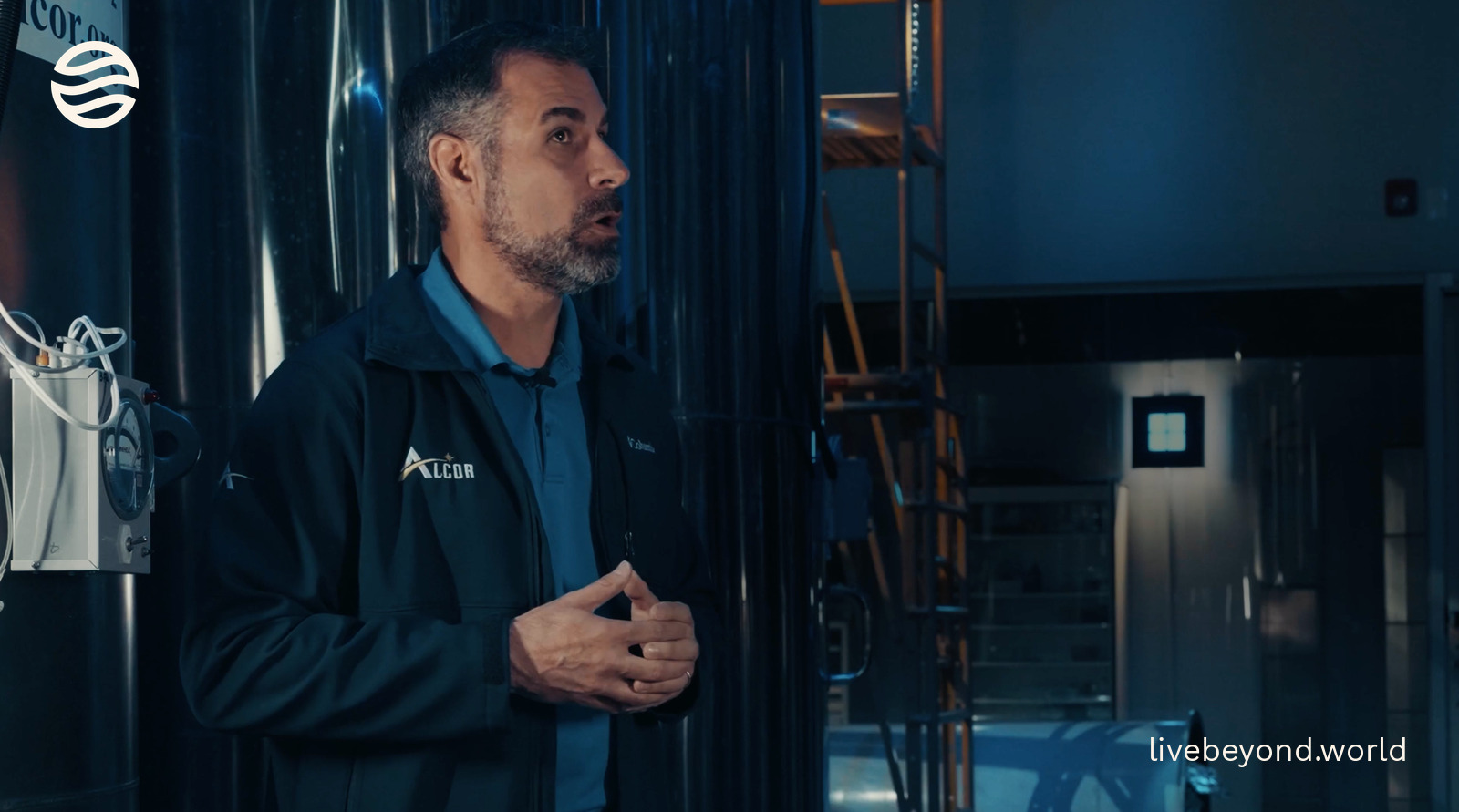
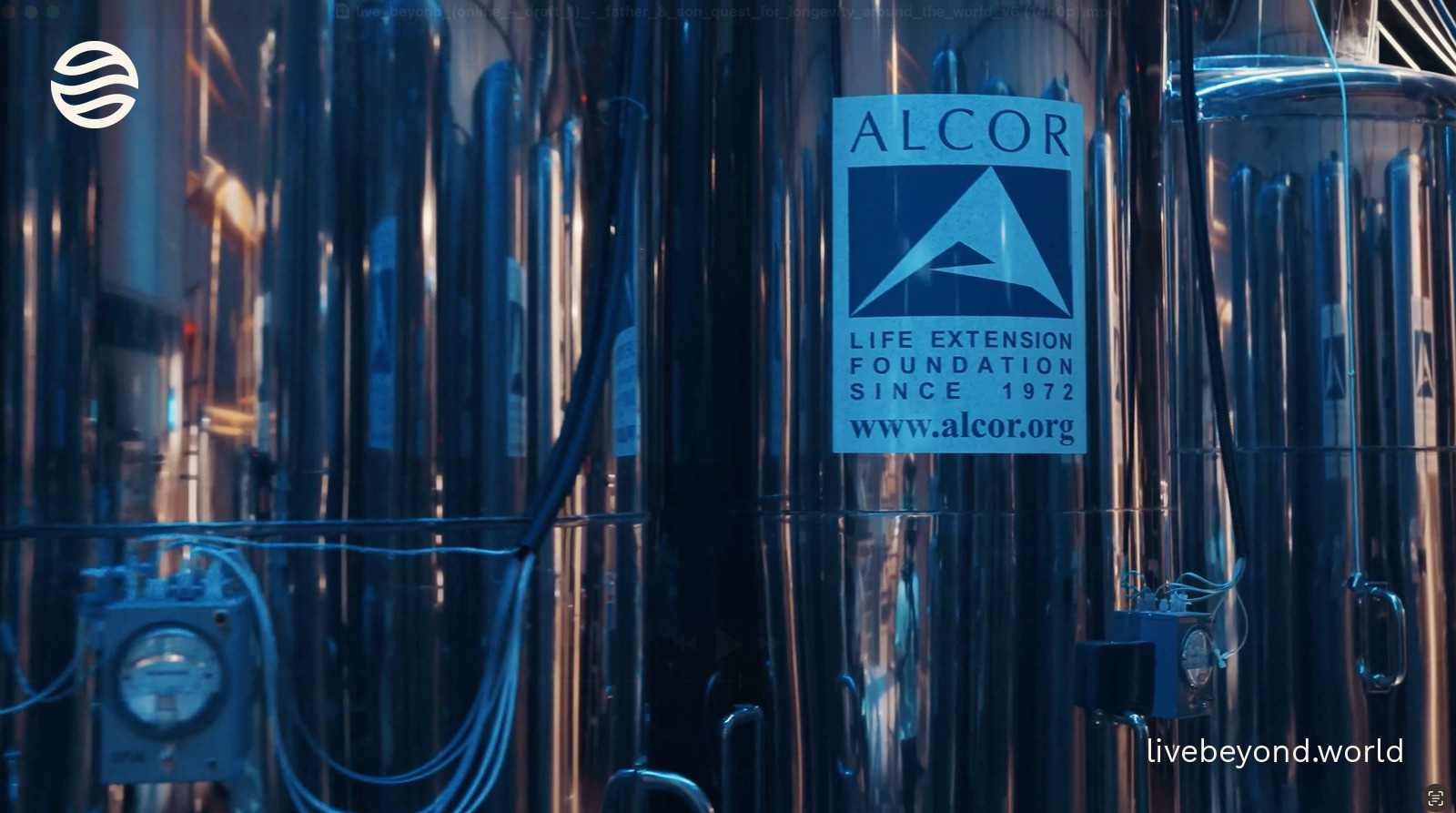
In April 2024, Alek and I went to Alcor in Scottsdale, Arizona, and talked with its CEO, James Arrowood, among the steel tanks where the patients are stored. Members carry a necklace, a bracelet and a wallet card with an emergency number. When the number rings, a trained team flies to the hospital, waits for the legal declaration of death, and starts cooling at once. James told us the one rule that matters most:
James Arrowood at Alcor, Scottsdale, Arizona, April 2024 — a Live Beyond interview with Marek and Aleksander Piotrowski on how cryopreservation works.
“Time to temperature is always the mantra. […] But death being so random, it’s impossible to ensure that.”
In plain words: Every minute counts. The faster the cooling starts, the less damage. But nobody knows when or where they will die, so the best conditions can never be promised.
From freezing to vitrification
In the early decades, people were simply frozen, and ice crystals damaged the cells. Since around the year 2000, organizations use vitrification: the water in the tissues is replaced with a protective liquid that turns into a kind of glass when it is cooled, instead of forming ice.
Based on: How the field describes its own method [3]
Max told us how far the method has come, and how far it still has to go:
“It’s not mature, no. It’s very much maturing. […] We really couldn’t protect the tissues very much. Basically, you were straight frozen. You had ice crystals in the body. […] Around twenty-five years or so, vitrification came along, which is the idea that we introduce very high concentrations of a solution that when you drop the temperature, it doesn’t crystallize and have sharp edges, it just gets thicker and thicker and holds everything in place.”
In plain words: Think of honey in a freezer: it gets thicker and thicker but never turns into sharp crystals. That is the idea of vitrification. It was a big step forward, and the people in the field themselves say it is still far from perfect.
What science can already do with cold
This is the part that gave me hope, because it is not about cryonics. It is about medicine that already works, or is close.
The patient storage room at Alcor, Scottsdale, Arizona, April 2024 — filmed for Live Beyond.
Embryos, eggs and sperm
Human embryos, eggs and sperm are stored in liquid nitrogen every day in IVF clinics, sometimes for years, and healthy children are born from them.
“We know people store their eggs and their sperm, and they put them together and make these embryos, and you can do IVF. […] The proof is walking around us talking to people, and you don’t know any different.”
In plain words: Cold can already pause life at the level of a few cells and restart it. The open question is whether that can ever be done for something as big and complex as a whole organ, or a brain.
Rat kidneys stored for 100 days
In 2023, a team at the University of Minnesota vitrified rat kidneys, kept them at deep-cold temperatures for up to 100 days, rewarmed them evenly with tiny iron particles heated by a magnetic field, and transplanted them. Within one to two weeks, the kidneys worked as well as fresh ones.
In 2015, scientists showed that a rabbit brain could be fixed with chemicals and then vitrified so that, after rewarming, its connections looked intact under the electron microscope. The method won the Brain Preservation Prize. It preserves structure; it is not a way to bring anything back to life.
At Alcor, James told us why this matters for everybody, not only for people who sign up:
“If you pass away, if we could preserve those, right now they only live for six to ten hours. […] There’s no reason it couldn’t scientifically preserve those for weeks, and if you preserve them for weeks, you can do perfect matches. So your kidneys could save two people’s lives, and they could have perfect matches that don’t get rejected.”
In plain words: Today, a donated kidney can wait outside the body only for hours, so it goes to whoever is close enough, not to the best match. If organs could be stored for weeks, more transplants would be perfect matches, and fewer would be rejected. That is the most hopeful thing cryonics research could give us soon.
The honest part
Nobody in this field promised us anything. Max said it first:
Allison Duettmann at Harvard, Boston, November 2024 — a Live Beyond interview with Marek Piotrowski on nanotechnology and cryonics.
“There are no guarantees, of course. This is not something where we say, “Oh, we promise to bring you back on August 12th, 2086.” […] That would be ridiculous.”
“But we can’t guarantee anything, and we’re explicit about that. We’ll tell you, and I’m telling you right now, we can’t guarantee because you could die on an island in the middle of nowhere.”
And at Harvard, in November 2024, Allison Duettmann, who leads the Foresight Institute and is signed up herself, was the most direct of all:
“Current cryopreservation techniques are not good enough that we can actually be recovered.”
In plain words: Even the people who believe in cryonics say today’s methods are not good enough to revive anyone. They are betting that future technology, perhaps tiny machines working at the level of molecules, will be able to repair what cannot be repaired today.
What has never happened
No human being, and no large animal, has ever been brought back after being cryopreserved. Cryonics can only start after legal death, and it is not medicine: no doctor can tell you it will work.
Who does it, and what it costs
Cryonics is tiny. Max told us only a few thousand people in the world have made arrangements. In 2024, James counted about 1,500 members at Alcor. In Europe, Max pointed us to a newer organization, Tomorrow Biostasis, with teams in Germany and Switzerland.
What surprised Alek and me was the price. In 2023, Max told us that at Alcor it was about $220,000 for the whole body and $80,000 to $100,000 for the brain only, transport included. Most people don’t pay that from savings:
“I started as a poor English undergraduate student, and I didn’t have a lot of money. The fact is, well over 90% of members pay for this with life insurance.”
In plain words: Members name the cryonics organization in a life-insurance policy and pay a monthly premium. The younger you start, the cheaper it is. James Arrowood told us that, done this way, it can cost about the same as a funeral.
A lifeboat, not plan A
Everyone we met used the same picture: a lifeboat. You don’t plan to need it, but you are glad it is there. Max put it this way:
“Cryonics really is life insurance. It’s ensuring your life. […] Cryonicists want to carry on living. They think life is good, it’s full of opportunity.”
And Allison told us why she signed up her father:
“Yes, it’s a lifeboat. I signed up my dad to cryonics once I could. […] I think none of the options that we currently have available are really great, so we need a lot of more research into better vitrification methods.”
In plain words: For the people who choose cryonics, it is an act of hope and of love for life, and also a reason to fund better science. Even its strongest supporters say the methods must get much better.
Before you sign anything
What exactly happens if I die far away? Ask which countries the team can reach, and how fast. Time to temperature decides everything.
What do my family and my doctor know? Your wishes must be written down, legal, and known to the people around you, or the team may never get the call.
How is it paid for, and what if prices rise? Ask about life insurance, what the fee covers, and how long-term storage is funded.
Who keeps the organization going for a hundred years? Ask how it is governed, how the money for storage is protected, and what happens if it closes.
What do the scientists outside the field say? Read both sides. Max More himself asked us to think critically about everything we hear.
Where the joy is
When we asked Max what he wished Alek and me for our quest, he didn’t talk about cryonics at all:
“Keep an open mind and talk to a wide variety of perspectives, and really don’t just listen to a few voices or the loudest voices, but get a wide range of views. And secondly, I think very importantly, think critically about what you hear. Just ’cause I’m very pro life extension doesn’t mean I think all the ideas are sensible.”
That became one of the rules of our quest. And the joy in this story is not in the tanks. It is in the science of cold that already gives families children through IVF, and may soon let a kidney wait for its perfect match. And it is in the attitude of the people we met: they love life so much that they want a second chance at it.
For me, the first plan is still the best one: to stay healthy and young in this body for as long as possible, and to enjoy every day of it. Longevity is not just about living longer. It is about living, and enjoying all of it.
Not medical, legal or financial advice. We describe what the people we met told us and what the published studies say; we do not recommend for or against cryonics or any organization.
Sources
Every number on this page, by the number in square brackets. Quotations come from Live Beyond’s own recorded interviews, cleaned only of “um” and “uh”. Not medical advice. Talk to your doctor before you change anything.
Han Z, Rao JS, Gangwar L, et al. Vitrification and nanowarming enable long-term organ cryopreservation and life-sustaining kidney transplantation in a rat model. Nat Commun. 2023;14:3407. doi:10.1038/s41467-023-38824-8
Human Fertilisation and Embryology Authority (UK). Freezing and storing embryos — information for patients.
Max More, interview with Marek and Aleksander Piotrowski, Longevity Summit Dublin, August 2023 (Live Beyond).
James Arrowood, interview with Marek and Aleksander Piotrowski, Alcor, Scottsdale, Arizona, April 2024 (Live Beyond).