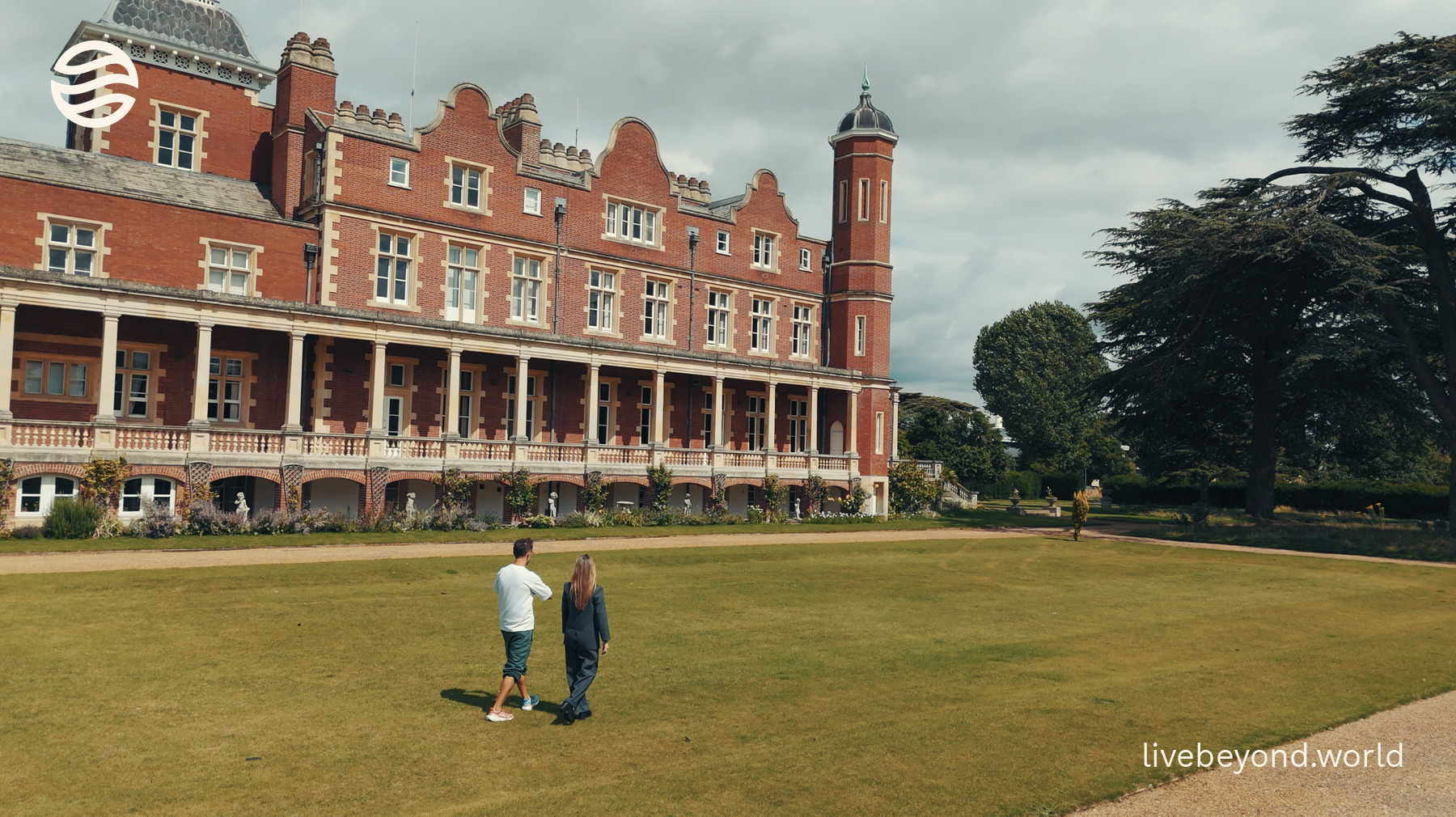
Marek and Staša Stanković at the Babraham Institute, Cambridge, 2024.
Menopause is a natural chapter of every woman’s life, not an illness. And it matters for a long, healthy life far more than most of us were ever told. On our quest, my son Alek and I met more than a hundred longevity scientists and doctors in 39 countries and states. For months I never once asked about women’s health. Then I met Staša Stanković in Cambridge, and she changed my questions for the rest of the journey. Here is what we learned, in plain words: what menopause is, why it matters, what the big hormone studies really showed, and what every woman can do. Every number has a source.
Menopause is a natural stage of life, and the years after it can be some of the best. It is also a real change for the body: the ovaries make far less estrogen, and some of its protection for the heart and bones fades. That is why women’s health is longevity.
Moving every day, building strength, sleeping well, not smoking and regular check-ups help at every age. Hormone therapy is a personal decision to make with your doctor — and what science knows about it has changed a lot in twenty years. [1][2][3]
This is not medical advice.
This page shares experiences from our quest and what scientists told us. It does not recommend any medicine, peptide, supplement or treatment, and it knows nothing about you.
Never start, stop or change any medicine, peptide, supplement or treatment without your own doctor, who knows your health and can check your blood work. That matters even more if you are pregnant or planning a pregnancy, live with a health condition, or take other medicines.
Longevity, as we mean it: more healthy, joyful years. What we mean →
51is the average age of menopause in the UK. For most women it comes between 45 and 55.[4]
7.4 yearsis how long hot flashes and night sweats lasted for the typical woman in a big US study that followed women for years.[5]
1.55×the risk of a heart or blood-vessel event before 60, for women whose menopause came before 40, compared with menopause at 50–51. A link, not proof.[2]
What menopause is
Menopause is the day a woman has gone a full twelve months without a period. In the UK the average age is 51, and for most women it comes between 45 and 55. The years before it, when periods change and symptoms often begin, are called perimenopause. Dr Amy Killen, a doctor who works with hormones and regenerative medicine, explained to us why this is about so much more than having children. We spent two unforgettable days with her and her family in Salt Lake City, and we are grateful for every minute:
“For me, the topic of ovarian aging is really important for women's health, and it's important for women's longevity because it's not just about being able to have babies. I mean, that is a thing, but we know that the ovaries also produce your estrogen and your progesterone and a lot of your testosterone. And so when you lose function of your ovaries, which is at menopause between 45, 55, all of a sudden you lose the ability to make those hormones for the most part.”
In plain words: The ovaries are not only about babies. They are also the body’s main factory for female hormones. At menopause that factory slows down almost to a stop, and the whole body feels the change.
In London, Nikolina Lauc, the CEO of GlycanAge — and the friend who sent us to Staša — told us something that surprises many women:
“I actually learned five, six years ago that you don't actually diagnose menopause when it happens, meaning when you have symptoms and when it affects your health. You diagnose it at the end, which is a year plus a day that you don't have a cycle, while these symptoms and the hormone decline happens ten, fifteen years before. So you could be suffering from seventeen different symptoms, which go from insomnia to depression to heart palpitations, hot flushes. It's a cascade of different things.”
In plain words: The official diagnosis comes only at the end, after twelve months with no period. But the changes, and the symptoms, often start years earlier. Many women don’t connect poor sleep, low mood or a racing heart with their hormones. Researchers measure it more carefully: in a big US study, hot flashes and night sweats lasted 7.4 years for the typical woman, and often went on for years after the last period. [4][5]
Why it matters for a long life
In Cambridge, Staša Stanković — a geneticist who studies how the ovaries age — told me the fact that stopped me in my tracks:
“Ovaries age five, almost five times faster than any other organ in the body. So when I'm 30, my ovaries are almost geriatric, meaning that even before I use them for fertility purposes, their function has started declining.”
In plain words: Most of the body ages slowly. The ovaries age fast. That is why scientists like Staša see them as an early clock for a woman’s whole health — not just for having children.
“Reproductive aging is very much connected to not only fertility potential of females, but also their overall health span. We very well know that menopause timing, for example, is strictly connected to the risk of number of diseases that women can go through post-menopausal time. So for example, women who have early menopause, and we have about 10% of those in the overall population, have increased risk for diseases such as osteoporosis, type 2 diabetes, cardiovascular disorders. While on the other side, women who have later aged menopause are predisposed to breast cancer, ovarian cancer.”
In plain words: When menopause comes matters. A very early menopause goes together with a higher risk of weak bones, diabetes and heart disease. A very late one goes together with a higher risk of some cancers. Neither is anyone’s fault — much of it is written in our genes.
Early menopause and the heart
Researchers pooled data from 301,438 women. Compared with women whose menopause came at 50–51, women whose menopause came before 40 had about 55% more heart and blood-vessel events before the age of 60, and women whose menopause came at 40–44 about 30% more. The extra risk was not seen after 70.
Based on: Pooled study of 301,438 women · a link, not proof [2]
In plain words: This doesn’t mean a woman with early menopause will get heart disease. It means her heart deserves attention earlier — with her doctor, and with the everyday habits that protect it.
What the hormone studies say
Few topics in women’s health have swung back and forth as much as hormone therapy — estrogen, often with a second hormone called progestogen, given to replace what the ovaries no longer make. We don’t recommend it, and we don’t advise against it. Here is the story of the evidence, so you can talk about it with your doctor.
2002: the big trial that changed everything
The Women’s Health Initiative gave 16,608 women aged 50 to 79 either estrogen plus progestin or a dummy pill. It was stopped after about five years, because the risks outweighed the benefits. For every 10,000 women per year on the hormones, there were 7 more heart events, 8 more strokes, 8 more blood clots in the lungs and 8 more invasive breast cancers — and 6 fewer bowel cancers and 5 fewer hip fractures.
Based on: Large randomized trial · strong evidence [6]
18 years later: a calmer picture
The same researchers followed 27,347 women from both hormone trials for 18 years. Taking the hormones for about five to seven years was not linked to a higher, or a lower, risk of dying — from any cause, from heart disease or from cancer. Women who were in their fifties when they started did relatively better than women in their seventies.
Based on: Long follow-up of large randomized trials · strong evidence [7]
2022: what menopause doctors say now
The Menopause Society (then called The North American Menopause Society) reviewed all the evidence. For women younger than 60, or within 10 years of their last period, who have no medical reason to avoid it, it says the benefits outweigh the risks for treating bothersome hot flashes and night sweats and for preventing bone loss. For women who start later, or are older than 60, it says the balance looks less good, because of higher risks of heart disease, stroke, blood clots and dementia. And it says treatment should be fitted to each woman and looked at again regularly.
Based on: Expert position statement, based on many studies [1]
In plain words: Timing and the person matter. The same treatment can look very different for a healthy 52-year-old with bad hot flashes and for a 70-year-old with heart disease. No study has shown that hormone therapy makes healthy women live longer. It is a decision for each woman, with a doctor who knows her history.
Words worth knowing
Three words behind the change
From our glossary. Tap a card to turn it over: the science on the back, and the people we met who explained it to us.
No. 03 / 66Everyday word
Healthspan
How long you are well.
No. 03 / 66Everyday word
Healthspan
The years in which you can still do what you love: move freely, think clearly, travel, play with your grandchildren. For most people the gap between lifespan and healthspan is about a decade, and closing it is what most of the field is really working on.
How old your body is, rather than how many birthdays you have had.
No. 11 / 66Everyday word
Biological age
Two people born in the same year can be years apart inside. Biological age is estimated from blood markers, from the way your DNA is switched on and off, and from tests of strength and fitness. Unlike your birthday, it can move — in both directions. Read more →
Prevention is king: staying well, instead of waiting to be treated.
No. 20 / 66Everyday word
Prevention
Screening, genomics, imaging and biomarkers catch a problem while it is still small, cheap to treat and yours to decide about. Most health systems are still built for sick care and act when something breaks; longevity turns that into healthcare. Read more →
I asked Staša whether a healthy life could keep the ovaries young for longer. Her answer was honest, and I am thankful for that:
“So with nutrition, with healthy lifestyle, with good diet, exercise, et cetera, we can impact our ovarian aging slightly.”
In plain words: Healthy habits can nudge the timing of menopause a little — they don’t move it by years. But that is not the whole story. The same habits protect the heart, bones, brain and mood through menopause and long after it. That is where they really pay off.
Strong bones, even after menopause
101 women past menopause with thin bones took part. Half did supervised, heavy strength and impact training — lifts and jumps — for 30 minutes twice a week, for eight months. The others did gentle exercise at home. The strength group’s spine bones got denser by about 3%; in the other group they got thinner. Only one minor injury was reported.
Based on: Small randomized trial, 101 women · promising [3]
In plain words: Bones respond to load at any age. With the right coach, heavy-ish lifting can be safe and can make bones stronger, even after menopause.
What science is working on
The genes behind the timing
Using data from around 200,000 women, a large team found 290 places in our DNA linked to when menopause comes. Many of them are about DNA repair — how cells fix damage. When the researchers changed some of these pathways in mice, the mice stayed fertile for longer. Staša Stanković is one of the authors.
Based on: Large genetic study, plus experiments in mice · early science [8]
In plain words: Scientists are starting to understand why some women reach menopause at 40 and others at 58. One day this may help women know their own timing early — and plan their health and family with that knowledge. For now, it is research, not a treatment.
Where the joy is
Here is the part I love most. Staša told me that we share menopause with almost no other animal:
“Humans are one of the rarest species in this world who have menopause. So only human beings and some types of whales go through menopause. […] There is definitely this social aspect of evolutionary explanation around menopause, which is called grandmother hypothesis, and what it means is basically, you as a grandmother, you now don't implement your energy to have more children, but rather raise children of your daughter or your son. […] So there is a social explanation why that could be better in order to raise healthy communities and pass on the knowledge from generation to generation.”
In plain words: For a long time, biologists asked why a woman lives for decades after she can no longer have children. One answer is the grandmother: her energy goes into her children and grandchildren, and into everything she knows and passes on.
Grandmothers, and the whales
Anthropologists set out the grandmother idea in detail in 1998: grandmothers who help feed and raise their grandchildren may be one reason humans live so long. In 2024, a study of toothed whales — killer whales, belugas, narwhals and others — found that menopause evolved there by females living longer, not by stopping having young earlier. The extra years mean more time together with their children and grandchildren. Female whales with menopause live about 40 years longer than females of similar-sized whales.
Based on: Evolutionary studies · ideas well supported, still debated [9][10]
So the years after menopause are not an epilogue. They are a chapter of their own — often freer, often wiser, and full of people. We saw it in Salt Lake City, on a mountain-bike ride with Amy and her daughter, and at a dinner with her whole family. Women’s health is not only about longer lives. It is about the grandmothers, mothers, friends and leaders our families and communities can’t do without.
Who should talk to a doctor early
Don’t wait — speak to a doctor
If your periods stop before 45, and especially before 40, see a doctor: about 1 in 100 women reach menopause before 40, and an early menopause matters for the heart and bones. The same goes if symptoms like sleeplessness, low mood, a racing heart or hot flushes are hurting your daily life — they may be linked to your hormones. And anyone thinking about hormone therapy should go through their own history with a doctor first, especially blood clots, stroke, heart disease and breast cancer, the risks seen in the big trial. [4][2][6]
Nikolina was frank about one more thing — finding the right doctor:
“At the moment, you need a very sophisticated doctor who's educated in perimenopause and menopause, and most doctors are not.”
In plain words: Menopause care is a skill. It is fine to look for a doctor or a clinic who knows it well, and to ask for a second opinion.
Questions for your doctor
Could my symptoms be perimenopause? Sleep, mood, a racing heart and hot flushes can all start years before the last period.
What do my age at menopause and my family history mean for my heart and bones? Especially if menopause came, or is coming, before 45.
Should my bone density be checked? And what kind of strength training is safe for me?
What are the benefits and risks of hormone therapy for me — at my age, with my history? Ask about timing, the type of treatment, and when to review it.
Which non-hormone options exist for my symptoms? So that you can compare all the choices together.
How will we know if something is working? Agree what you will track, and check again.
This page shares experiences from our quest and what scientists told us. Hormone therapy is a prescription treatment: whether it suits you, and in which form and dose, is a decision to make with your doctor, who knows your history. Every body is different: what works for one person may not work the same way for another.
Never start, stop or change any medicine, peptide, supplement or treatment without your own doctor, who knows your health and can check your blood work. In an emergency, call your local emergency number.
Sources
Every number on this page, by the number in square brackets. Quotations come from Live Beyond’s own recorded interviews, cleaned only of “um” and “uh”. Not medical advice. Talk to your doctor before you change anything.
The 2022 hormone therapy position statement of The North American Menopause Society (now The Menopause Society). Menopause. 2022;29(7):767-794. doi:10.1097/GME.0000000000002028
Zhu D, Chung HF, Dobson AJ, et al. Age at natural menopause and risk of incident cardiovascular disease: a pooled analysis of individual patient data. Lancet Public Health. 2019;4(11):e553-e564. doi:10.1016/S2468-2667(19)30155-0
Watson SL, Weeks BK, Weis LJ, Harding AT, Horan SA, Beck BR. High-intensity resistance and impact training improves bone mineral density and physical function in postmenopausal women with osteopenia and osteoporosis: the LIFTMOR randomized controlled trial. Journal of Bone and Mineral Research. 2018;33(2):211-220. doi:10.1002/jbmr.3284
Cwm Taf Morgannwg University Health Board (NHS Wales), ‘Menopause’, WISE CTM health conditions. https://ctmuhb.nhs.wales/wise-ctm/health-conditions/menopause
Avis NE, Crawford SL, Greendale G, et al. Duration of menopausal vasomotor symptoms over the menopause transition. JAMA Internal Medicine. 2015;175(4):531-539. doi:10.1001/jamainternmed.2014.8063
Rossouw JE, Anderson GL, Prentice RL, et al. Risks and benefits of estrogen plus progestin in healthy postmenopausal women: principal results from the Women’s Health Initiative randomized controlled trial. JAMA. 2002;288(3):321-333. doi:10.1001/jama.288.3.321
Manson JE, Aragaki AK, Rossouw JE, et al. Menopausal hormone therapy and long-term all-cause and cause-specific mortality: the Women’s Health Initiative randomized trials. JAMA. 2017;318(11):927-938. doi:10.1001/jama.2017.11217
Ruth KS, Day FR, Hussain J, et al. (including Stankovic S). Genetic insights into biological mechanisms governing human ovarian ageing. Nature. 2021;596(7872):393-397. doi:10.1038/s41586-021-03779-7
Hawkes K, O’Connell JF, Blurton Jones NG, Alvarez H, Charnov EL. Grandmothering, menopause, and the evolution of human life histories. Proceedings of the National Academy of Sciences. 1998;95(3):1336-1339. doi:10.1073/pnas.95.3.1336
Ellis S, Franks DW, Nielsen MLK, Weiss MN, Croft DP. The evolution of menopause in toothed whales. Nature. 2024;627:579-585. doi:10.1038/s41586-024-07159-9