Protein for longevity: enough for your muscles, without the arms race
Felipe Salech at the University of Chile, Santiago, April 2024 — a Live Beyond interview with Marek Piotrowski on healthy aging, muscle and protein.
I’ll be honest: of all the questions on our quest, this is the one where the experts my son Alek and I met agreed the least. Some told us everyone needs more protein to keep their muscles. Others told us to eat less, and more of it from plants. Both sides had good reasons. So here is what each of them said, what the big studies show, and where they actually agree.
Protein is the building material of our muscles, and strong muscles are one of the best predictors of a long, independent life. Most healthy adults already get the basic amount they need, but after about 65 the body uses protein less well, and experts advise older adults to eat more, together with strength training.
In midlife, very high protein from animal sources has been linked to higher death rates in some studies, while protein from plants such as beans, lentils and nuts is linked to living longer.
The good news: you don’t need shakes or bars to get it right. Real food, a little more protein as you get older, and lifting something heavy a few times a week are already in your hands. [1][2][3]
Longevity, as we mean it: more healthy, joyful years. What we mean →
Why protein matters
In Santiago, in April 2024, we met Felipe Salech, a geriatrician at the University of Chile who studies how people age. Protein was the first thing he talked about after exercise:
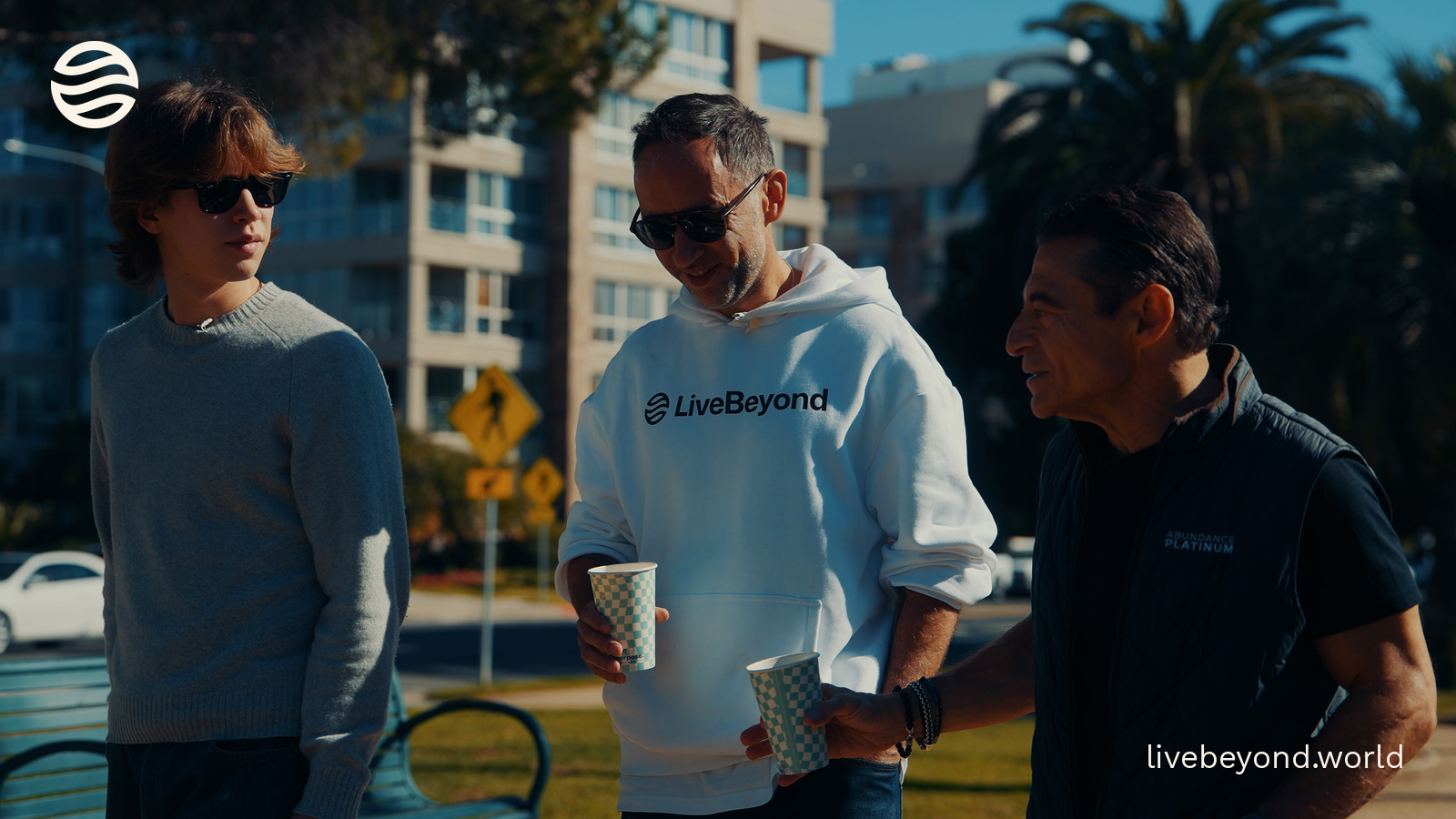
Alek Piotrowski, Marek Piotrowski and Peter Diamandis in Santa Monica, California, December 2025 — a Live Beyond walking interview on longevity and what our bodies lose with age.
“Why proteins are so important? Because of the health of your muscles. As you are getting older, your muscle, are going, losing mass and function, and you need to keep the nutrition of your muscle for a long time as you can.”
In plain words: From our 30s, we slowly lose muscle, and the loss speeds up in our 60s. Muscle is not only for looks: it keeps us walking, standing up from a chair, and living on our own. To keep it, the body needs both protein and the signal to use it, which is exercise.
In Los Angeles, in December 2025, Peter Diamandis, the founder of the XPRIZE Foundation, told Alek why this matters so much:
“And so we need to realize that evolution dealt us this hand where our body is in this very consistent decline from age 30 till the end, right? Your hormonal balance, your stem cell populations, your cognitive ability, immune ability, ability to build muscle, sarcopenia and such. And we need to reverse that, reverse what evolution has given us.”
Words worth knowing
Three words behind the protein
From our glossary. Tap a card to turn it over: the science on the back, and the people we met who explained it to us.
It starts in your thirties, and almost nobody notices until it costs them something — a fall, a stair, an independence.
What helps
Resistance training at least twice a week, enough protein, and vitamin D if you are low. Grip strength and how fast you can stand up from a chair predict how the rest of your life goes better than most blood tests. Read more →
It came up most in our conversations with: Liz Parrish, David Karow, Avi Roy
The goal is not to switch it off — you need it to build muscle — but to stop it running all day.
What helps
Periods without food and without constant protein. This one has a real tension in it: the same signal that drives ageing also builds the muscle that keeps you alive after seventy. Read more →
The years in which you can still do what you love: move freely, think clearly, travel, play with your grandchildren. For most people the gap between lifespan and healthspan is about a decade, and closing it is what most of the field is really working on.
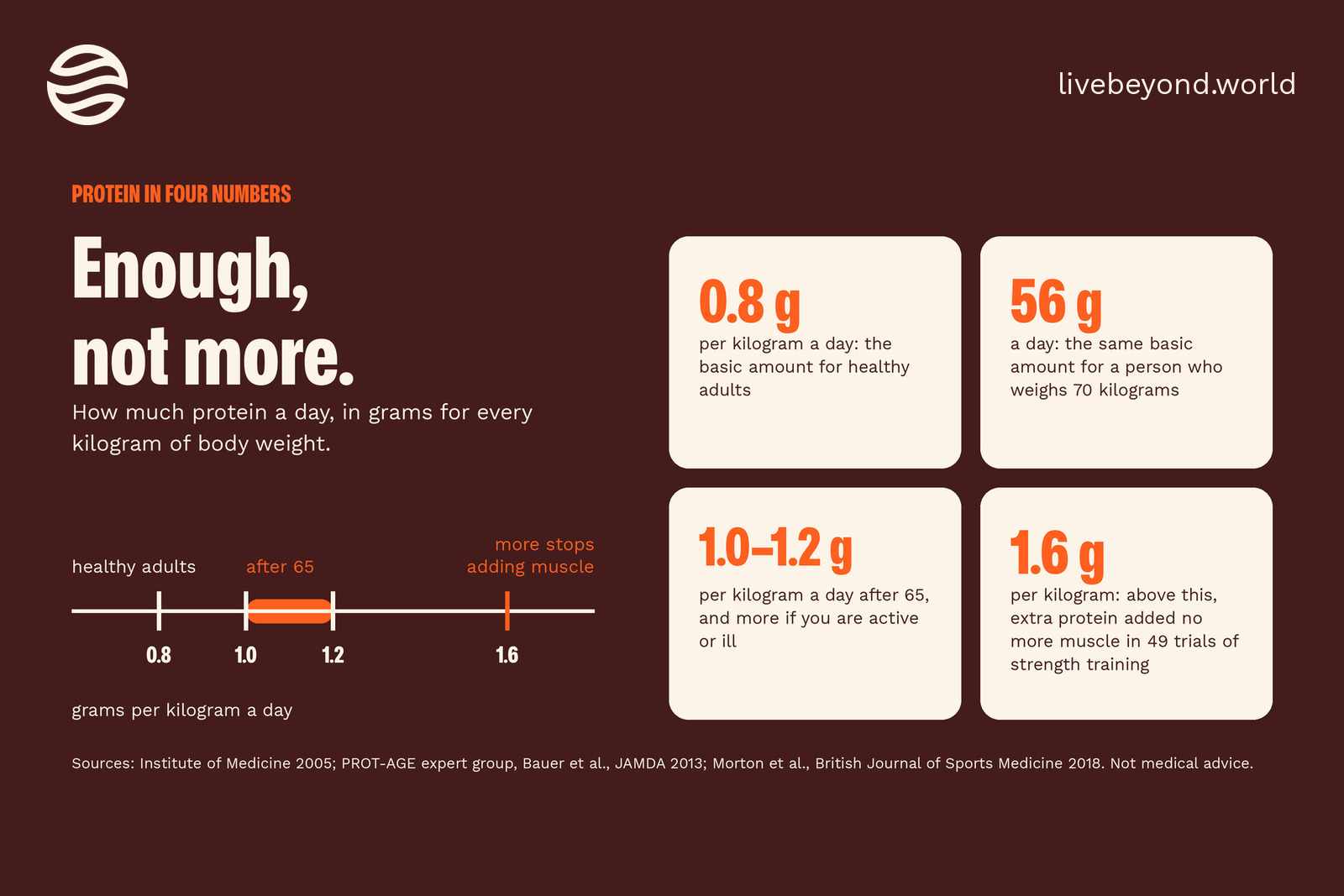
For healthy adults, the official answer is 0.8 grams of protein per kilogram of body weight per day: about 56 grams for a person who weighs 70 kilograms. That is a minimum to avoid a deficiency, not a target for strength.
Dr Amy Killen in Salt Lake City, Utah, May 2024 — a Live Beyond interview with Marek Piotrowski.Marek Piotrowski and Margot Hiller in Switzerland, July 2025 — after a Live Beyond interview on nutrition and protein.
In Switzerland, in July 2025, the nutrition coach Margot Hiller told us the right amount depends on who you are:
“If on top of that, like you, he or even she goes every second day to the gym, they will definitely need more protein”
Protein and strength training
A review of 49 trials with 1,863 people found that adding protein to strength training gave slightly more muscle and strength. The extra benefit stopped at about 1.6 grams per kilogram per day, and it got smaller with age.
Even doctors who know all this find it hard in practice. In Utah, in May 2024, Dr Amy Killen told us:
“It’s just hard for me to get that much protein, so that’s why, probably why I have a hard time building muscle.”
In plain words: Eating enough protein every day takes some planning, especially for people who are small or who eat little. It’s easier to spread it over the day: some at every meal, rather than one big steak at night.
After 65, the needs go up
Protein in four numbers — a Live Beyond infographic from the Institute of Medicine (2005), the PROT-AGE expert group (2013) and a review of 49 strength-training trials (British Journal of Sports Medicine, 2018).
An expert recommendation for older people
An international group of experts reviewed the evidence and recommended at least 1.0 to 1.2 grams per kilogram per day for healthy people over 65, at least 1.2 grams for those who are active, and 1.2 to 1.5 grams for older people with an acute or long-term illness. People with severe kidney disease are the exception and may need less.
In plain words: An older body needs more protein to build the same amount of muscle. So the advice is to eat a little more protein after 65, together with strength exercise, not instead of it.
Can too much be a problem?
This is where the answer starts to depend on your age.
Brendan Coates, the Gut Whisperer, in Canada, July 2024 — a Live Beyond interview with Marek Piotrowski on food, the gut and longevity.
Midlife and old age may be different
In about 6,400 Americans aged 50 and over, followed for 18 years, those aged 50 to 65 who got 20% or more of their calories from protein had a higher risk of dying, mainly from cancer. The link disappeared or weakened when the protein came from plants. After 65, the picture reversed: more protein went with a lower risk of dying.
In plain words: Protein, especially animal protein, raises growth signals in the body, such as IGF-1. When we are young or old, growth and repair are welcome. In midlife, constantly high growth signals may not be ideal. This study shows a link, not proof, but it is one reason some longevity scientists are careful about very high-protein diets before 65.
In Toronto, in July 2024, Brendan Coates, a clinical nutritionist known as the Gut Whisperer, who once competed in bodybuilding, put both sides in one breath:
“If you are on the path for longevity, science shows that putting yourself in a caloric deficit more often than not induces the longevity aspect of things, right? It’s healthier. But we still need muscle, we still need protein.”
Plant or animal?
Felipe told us the source matters as much as the amount:
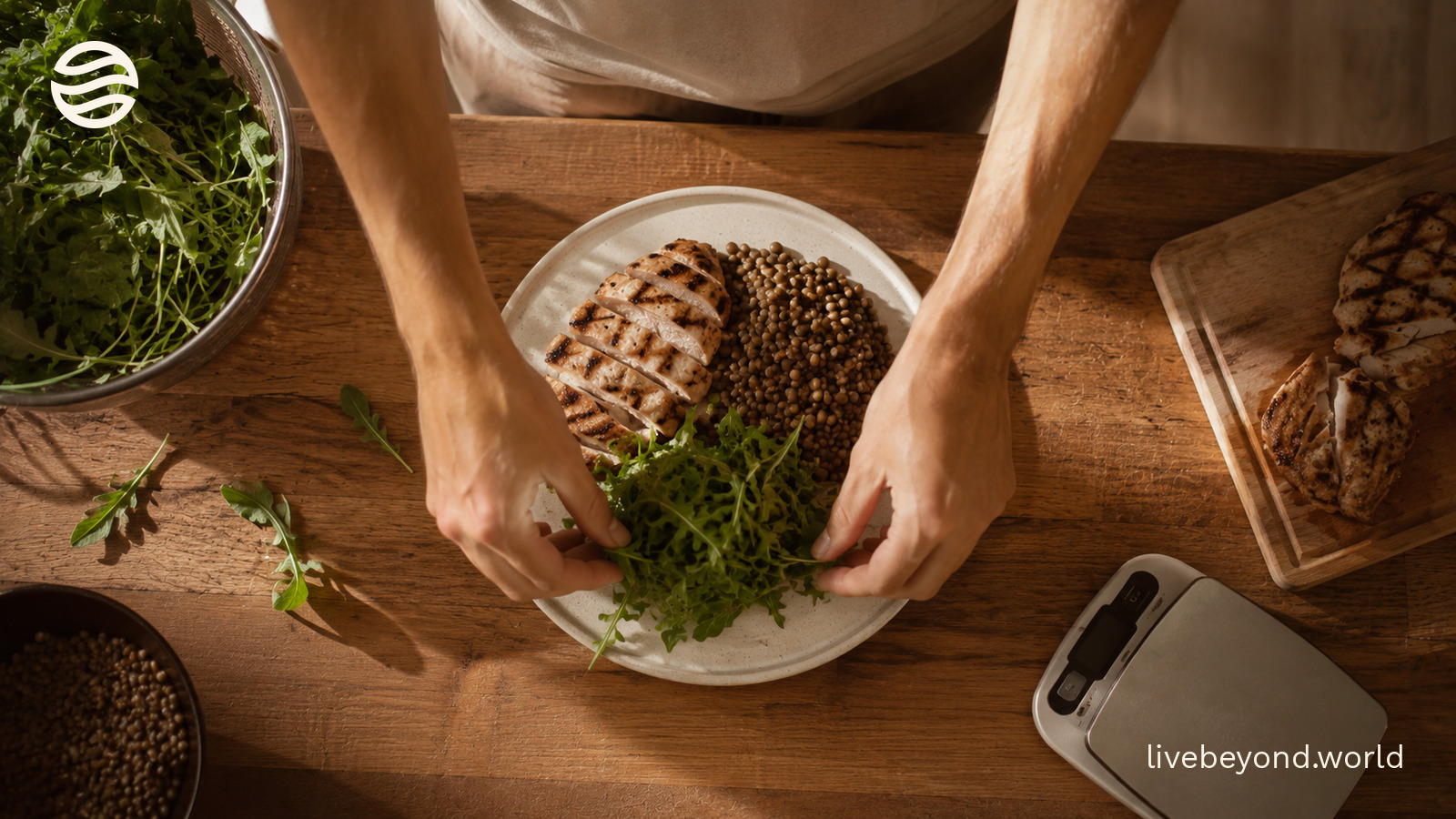
Marek Piotrowski and Oz Garcia in Central Park, New York, June 2024 — a Live Beyond interview on nutrition for longevity.Lentils and a little meat on one plate: plant and animal protein together. An illustration generated for Live Beyond.
“Animal meats are important for our nutrition, but it’s not the only way to get proteins. Legumes, lentils, beans are good way to get proteins for your body, for example.”
Swapping animal for plant protein
In more than 416,000 Americans followed for 16 years, those who ate more plant protein lived longer. Replacing just 3% of daily calories from animal protein with plant protein was linked to a 10% lower risk of dying, in both men and women.
In New York, in June 2024, the nutritionist Oz Garcia described the way of eating he has seen work best:
“So what you have is you have a highly complex, primarily plant-based way of eating with extremely healthy proteins. Right? And that seems to be, of all the ways of eating that we now understand, the most successful in terms of reducing the risk of heart disease”
And Margot reminded us of the protein most of us have forgotten:
“The beans, legumes, that somehow we’ve forgotten. They are almost in every natural cuisine, natural diet, traditional diet in the world, yet somehow they lost popularity. They are an amazing source of nutrients, good source of protein, amazing source of fiber”
In plain words: Beans, lentils, chickpeas and peas bring protein together with fiber, which our gut bacteria love. They are cheap, they are in almost every traditional cuisine of the longest-lived people, and they are easy to add to any meal.
Shakes and supplements
Not needed for most people
Most people can get enough protein from food. Shakes and bars can help people who can’t eat enough, but they are processed products: check what else is inside, such as sugar and added vitamins.
If you have kidney disease, diabetes or another long-term illness, talk to your doctor before you change how much protein you eat.
Where the experts agree
Marek Piotrowski and Fritz Thieme at Can7 on Formentera, July 2024 — watching lunch being made, for the Live Beyond film.
Keep your muscles Every expert we met wanted strong muscles, at every age, and especially after 65.
Move as well as eat Protein builds muscle only when muscles are used. Strength training is the signal.
Real food first Beans, lentils, fish, eggs, dairy, nuts, and meat in moderation, rather than processed products.
More plants Even those who eat meat told us to put more plants on the plate.
One size doesn’t fit all Your age, size, activity and health change how much you need.
Questions to ask
How much protein am I eating now? Write it down for three ordinary days before changing anything.
Am I keeping my strength? Ask how to measure it: grip strength, standing up from a chair, how much you can lift.
Is my kidney function normal? A simple blood test answers this, and it matters before eating much more protein.
Where does my protein come from? Ask whether you could move some of it from meat to beans, lentils and other plants.
Where the joy is
In the Blue Zones we visited, in Ogimi on Okinawa and in Sardinia, nobody we met counted grams of protein. Much of what they ate grew in a garden, and beans and vegetables were part of almost every day. But it was not only plants. In the Sardinian village of Baunei, our guide Paola Demurtas, who was born and raised in the blue zone, told us about the local cheese, and about meat in the old days:
Paola Demurtas and Marek Piotrowski with the elders of Baunei, Sardinia, August 2024 — a Live Beyond visit to the centenarians of the blue zone.
“I’m obsessed with cheese but, to be honest, just with cheese produced here. […] In the past, to be honest, they didn’t eat so much meat. It could be, like, even sometimes twice a month.”
Cheese from the local sheep and goats, meat a couple of times a month, beans almost every day, and meals shared with family and friends: animal protein too, but always real food.
So here is my joy-filled version: eat real food with people you love, put beans on the table more often, and lift something heavy a few times a week, with a smile. Your muscles will thank you at 90.
Not medical advice. We describe what the studies say and what the experts told us. If you have a health condition, talk to your doctor before changing your diet.
Before you change anything
This page shares what research and the experts we met say. It is not medical advice, and it does not recommend any medicine, supplement or treatment. It knows nothing about you. Before you start, stop or change anything — especially if you are pregnant, live with a health condition or take any medication — please talk to your doctor. In an emergency, call your local emergency number.
Sources
Every number on this page, by the number in square brackets. Quotations come from Live Beyond’s own recorded interviews, cleaned only of “um” and “uh”. Not medical advice. Talk to your doctor before you change anything.
Bauer J, Biolo G, Cederholm T, et al. Evidence-based recommendations for optimal dietary protein intake in older people: a position paper from the PROT-AGE Study Group. J Am Med Dir Assoc. 2013;14(8):542-559. doi:10.1016/j.jamda.2013.05.021
Morton RW, Murphy KT, McKellar SR, et al. A systematic review, meta-analysis and meta-regression of the effect of protein supplementation on resistance training-induced gains in muscle mass and strength in healthy adults. Br J Sports Med. 2018;52(6):376-384. doi:10.1136/bjsports-2017-097608
Huang J, Liao LM, Weinstein SJ, Sinha R, Graubard BI, Albanes D. Association between plant and animal protein intake and overall and cause-specific mortality. JAMA Intern Med. 2020;180(9):1173-1184. doi:10.1001/jamainternmed.2020.2790
Levine ME, Suarez JA, Brandhorst S, et al. Low protein intake is associated with a major reduction in IGF-1, cancer, and overall mortality in the 65 and younger but not older population. Cell Metab. 2014;19(3):407-417. doi:10.1016/j.cmet.2014.02.006