Senolytics: clearing the “zombie cells”, and what we know so far
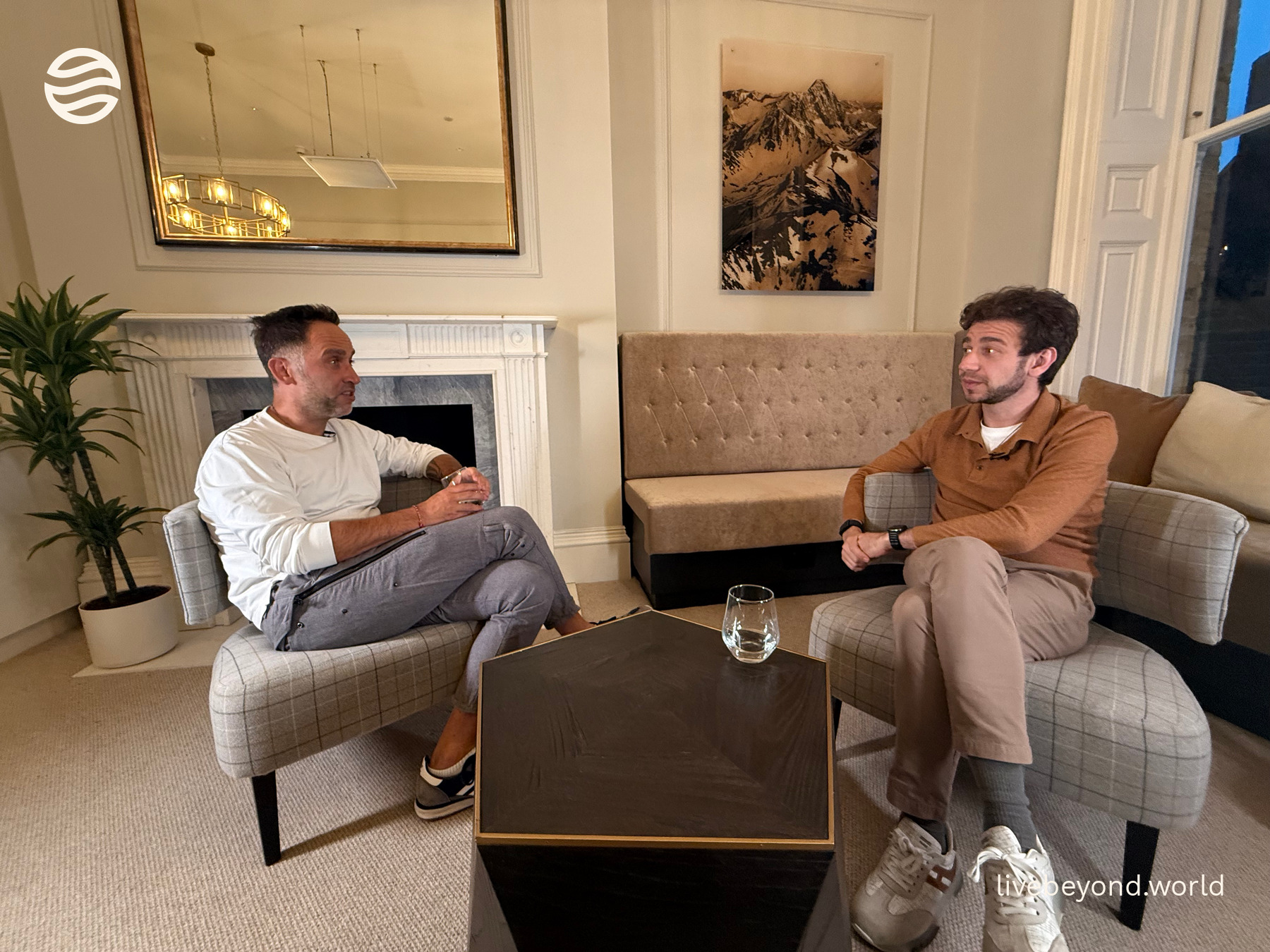
Marek Piotrowski and Boris Djordjevic in London, February 2025 — a Live Beyond interview on senolytics and cell rejuvenation.
Zombie cells. That is what people on our quest kept calling them: cells that have stopped dividing but refuse to die, and keep sending out signals that inflame everything around them. Clearing them away is one of the most exciting ideas in longevity science, and one of the most argued about. Here is what the scientists told Alek and me, and what the studies actually show.
One of the most hopeful ideas in longevity science. As we age, worn-out “senescent” cells pile up in our tissues and keep sending out signals that cause inflammation. In mice, clearing them away helped the animals stay healthier and live longer, and the first small studies in people show that some drugs can reduce these cells.
What nobody has shown yet is that senolytics make people healthier or let them live longer: the human trials are small and short, one bigger trial failed, and scientists still argue about how it all works.
The good news: moving your body is linked to fewer of these cells, and it is in your hands today. [1][2][3][4][5][6]
This is not medical advice.
This page shares experiences from our quest and what scientists told us. It does not recommend any medicine, peptide, supplement or treatment, and it knows nothing about you.
Never start, stop or change any medicine, peptide, supplement or treatment without your own doctor, who knows your health and can check your blood work. That matters even more if you are pregnant or planning a pregnancy, live with a health condition, or take other medicines.
Longevity, as we mean it: more healthy, joyful years. What we mean →
24–27%longer median life in mice whose senescent cells were removed from middle age.[1]
9 peoplein the first study to show a senolytic drug combination lowering senescent cells in human tissue, over three days.[3]
12 weeksin the largest early trial in knee arthritis: the senolytic drug did no better than a placebo.[5]
What “zombie cells” are
Boris Djordjevic in London, February 2025 — a Live Beyond interview with Marek Piotrowski on “zombie cells”.
Our cells divide again and again through life. When a cell is badly damaged, it can stop dividing for good. That is called senescence, and it is first of all a protection: a damaged cell that stops dividing cannot turn into cancer, and senescent cells also help wounds heal. Normally the immune system clears them away. With age, more of them stay, and they keep releasing inflammatory signals that harm the healthy cells around them.
Senescent cells also help us
In mice, senescent cells appeared at wounds and released a signal that helped the wound close. Removing them slowed the healing. They are not simply the enemy; it is too many of them, for too long, that seems to cause harm.
In London, in February 2025, Boris Djordjevic, who founded a biotech company working on cell rejuvenation and also works on the clinical side, explained it to us like this:
“Senolytics are very interesting, yet a bit controversial topic, and there’s drugs or interventions that are going to reduce the cells that are essentially creating this chronic inflammation. We call them zombie cells, maybe not in the science community, but they’re often called zombie cells.”
In plain words: Senolytics are medicines or other treatments that remove the cells that keep the body inflamed. People call them zombie cells because they have stopped working, but they don’t go away.
Words worth knowing
Two words behind the zombie cells
From our glossary. Tap a card to turn it over: the science on the back, and the people we met who explained it to us.
No. 59 / 66Inside the body
Cellular senescence
Cells that retired but stayed in the building, complaining loudly enough to make everyone else worse at their jobs.
Clearing them extends healthy life in mice, which is why senolytics attracted so much attention. Human trials so far have been small and the results mixed. This is a genuinely promising area that is not yet a thing you should be dosing yourself for.
The best-studied pairing is the cancer drug dasatinib with quercetin, a plant compound in onions and apples; fisetin, from strawberries, is another. Human trials are under way and the science is debated: this belongs with a doctor, not in a shopping basket.
“A senolytic has a huge potential to improve the quality of life, health span, potentially lifespan.”
Eric Verdin at the Buck Institute, California, May 2024 — a Live Beyond interview with Marek Piotrowski on the science of aging.
At the Buck Institute in California, in May 2024, Eric Verdin told us about the scientist who opened the whole field, Judith Campisi, who had died a few months earlier:
“We have a big emphasis on senescence […] But also senescence, we had [Judith Campisi] was a faculty member here at the Buck who sadly passed away early this year. She really was the pioneer in the whole field, so many of us still work on senescence, and we think that is one of the critical determinant of aging.”
In plain words: Judith Campisi was one of the first to show how important these cells are for aging. Many scientists continue her work, because they believe these cells are one of the main reasons we age.
What happened in mice
Removing the cells, longer and healthier lives
Scientists bred mice in which senescent cells could be switched off with a drug. When those cells were cleared from middle age, the mice lived 24 to 27% longer on average, and their kidneys and hearts aged more slowly.
In 2015, James Kirkland’s team found that the cancer drug dasatinib together with quercetin, a plant pigment found in onions and apples, killed senescent cells in the lab. In old mice, this combination given now and then improved walking speed, grip strength and endurance, and the mice lived about 36% longer from the start of treatment.
Dr Evelyne Bischof and Marek Piotrowski in Shanghai, December 2023 — a Live Beyond interview on longevity medicine and cancer.
A first, tiny trial
Fourteen people with a serious lung disease (idiopathic pulmonary fibrosis) took dasatinib and quercetin on a few days over three weeks. Their walking distance and speed improved. There was no placebo group, so it is a first signal, not proof.
Nine people with diabetic kidney disease took dasatinib and quercetin for three days. Eleven days later, they had fewer senescent cells in their fat and skin. It was the first time a senolytic was shown to reduce these cells in people.
In 60 older women followed for 20 weeks, dasatinib and quercetin did not change bone health overall. In the women who had the most senescent cells to begin with, it increased bone formation. That points to a future where a test tells who might benefit.
The first big hope for knee arthritis, a drug injected straight into the knee, did no better than a placebo after 12 weeks, and the company stopped that program.
Based on: Randomized, placebo-controlled trial [5]
Boris told us how much testing is going on now. His own company is developing a senolytic compound too; we have left out what he said about it, because those results had not been published when we spoke.
“The existing drugs that target senescent cells, one is called dasatinib, and is often paired with quercetin, and is undergoing over a dozen clinical trial. It’s an old drug, so it doesn’t hold any, like, intellectual property and so on. But it’s probably one of the most used. There are several drugs being developed and are in phase one or phase two clinical trials at the moment.”
In plain words: The best-known combination uses an old cancer drug, dasatinib, together with quercetin. It is being tested in many small trials, and new drugs are in the first stages of testing in people.
In Shanghai, in December 2023, Dr Evelyne Bischof, a doctor who works in cancer and longevity medicine, told us where she hopes this science will help first:
“We have great conversations with Professor James Kirkland, who is working a lot on right now triple negative breast cancer, something that I’m super passionate about, and glioblastoma, both entities that probably will benefit a lot from senolytics.”
In plain words: Evelyne hopes senolytics may one day help treat some very hard cancers. It is still a hope, being tested, not a treatment today.
Why scientists still disagree
Marek Piotrowski and Phil Newman at the Longevity Summit in Dublin, August 2023 — a Live Beyond interview on where longevity science is going.
When I asked Boris whether he could say by how much these treatments reduce senescent cells, he stopped me:
“I want to be very careful when making any claim. […] I would say there is a lack of consensus on the science about senescence, to truly say by how many percent it diminish the number of senescent cell.”
In plain words: Even a scientist who works on senolytics every day says the experts do not yet agree on how to measure these cells, so nobody can honestly promise a number.
In Singapore, in October 2023, Brian Kennedy, who has studied aging for decades, told us about fisetin:
“Fisetin has many properties, one of which is it’s a senolytic, it can kill senescent cells, and there’s pretty good data on that as well. We haven’t had as much luck with it in the lab, but it may be the conditions we’re running, I don’t know.”
In plain words: Other scientists have found that fisetin clears senescent cells, but in Brian’s own lab the results were not so clear. That happens often in science, and it is why more studies are needed.
And in Dublin, in August 2023, Phil Newman, who follows the longevity industry closely, gave us an honest view of the odds:
“Senolytic therapies, senotherapeutics are... They’ve been around a lot longer, and there’s a lot of, again, very, very serious people looking at senolytics and senotherapeutics and I feel that there are gonna be some breakthroughs there. But if you ask some of the experts in the industry, they will say we have a 20% chance of it actually breaking through to being a final therapy.”
In plain words: Many serious people are working on senolytics and breakthroughs may come. But many experts think there is only about a one-in-five chance that it becomes a real, approved treatment.
Drugs, supplements and caution
Dasatinib is a cancer drug
Dasatinib is a prescription medicine for leukemia. In people with cancer who take it every day, it can cause serious side effects, such as low blood counts, bleeding and fluid around the lungs. In the senolytic trials it was given only on a few days, under medical supervision.
Both are plant pigments that can be bought freely. Neither has been shown to slow aging or make people live longer, and trials of fisetin in people are still running or have not yet published full results, as far as we could find.
Based on:
Not tested is not the same as safe
A supplement labeled “senolytic” has not been tested the way a medicine is. Some of these compounds can change how other medicines work. Talk to your doctor or pharmacist before taking anything, especially if you take other medicines.
Before you try anything
What was shown in people? Most results are in mice. Ask how many people were studied, for how long, and whether there was a placebo group.
Who is behind the claim? Many people speaking about senolytics also develop or sell them. That is not wrong, but it is worth knowing.
Is it a medicine or a supplement? Medicines are tested and prescribed. Supplements are not checked in the same way, and what is in the bottle can vary.
What else do I take? Show your doctor or pharmacist everything you take, before you add anything new.
Not medical advice, and not a recommendation for or against any senolytic drug or supplement. We describe what the studies say and what the experts told us.
Where the joy is
I love this part of the science, because it is so hopeful. The body already knows how to clear these cells; when we are young it does it every day. Scientists are trying to help it do what it once did by itself.
Movement and senescent cells
In older adults who did a 12-week exercise program, markers of senescent cells in the blood went down. It is a small study, but it fits everything else we heard about movement.
So while the trials go on, I keep doing what every expert we met agreed on: moving every day, real food, good sleep, and time with the people I love. And I’m grateful to Judith Campisi and to everyone who carries her work on. One day, maybe soon, we will know much more.
This page shares experiences from our quest and what scientists told us. Senolytics are still experimental: the compounds tested so far are cancer medicines or supplements used outside their approved purpose, and none is approved to treat aging. Every body is different: what works for one person may not work the same way for another.
Never start, stop or change any medicine, peptide, supplement or treatment without your own doctor, who knows your health and can check your blood work. In an emergency, call your local emergency number.
Sources
Every number on this page, by the number in square brackets. Quotations come from Live Beyond’s own recorded interviews, cleaned only of “um” and “uh”. Not medical advice. Talk to your doctor before you change anything.
Baker DJ, Childs BG, Durik M, et al. Naturally occurring p16Ink4a-positive cells shorten healthy lifespan. Nature. 2016;530(7589):184-189. doi:10.1038/nature16932
Xu M, Pirtskhalava T, Farr JN, et al. Senolytics improve physical function and increase lifespan in old age. Nat Med. 2018;24(8):1246-1256. doi:10.1038/s41591-018-0092-9
Hickson LJ, Langhi Prata LGP, Bobart SA, et al. Senolytics decrease senescent cells in humans: preliminary report from a clinical trial of dasatinib plus quercetin in individuals with diabetic kidney disease. EBioMedicine. 2019;47:446-456. doi:10.1016/j.ebiom.2019.08.069
Farr JN, Atkinson EJ, Achenbach SJ, et al. Effects of intermittent senolytic therapy on bone metabolism in postmenopausal women: a phase 2 randomized controlled trial. Nat Med. 2024;30(9):2605-2612. doi:10.1038/s41591-024-03096-2
Unity Biotechnology. UBX0101 phase 2 study in patients with painful osteoarthritis of the knee did not meet its primary endpoint at 12 weeks. Company announcement, 17 August 2020.
Englund DA, Sakamoto AE, Fritsche CM, et al. Exercise reduces circulating biomarkers of cellular senescence in humans. Aging Cell. 2021;20(7):e13415. doi:10.1111/acel.13415
Demaria M, Ohtani N, Youssef SA, et al. An essential role for senescent cells in optimal wound healing through secretion of PDGF-AA. Dev Cell. 2014;31(6):722-733. doi:10.1016/j.devcel.2014.11.012
Zhu Y, Tchkonia T, Pirtskhalava T, et al. The Achilles’ heel of senescent cells: from transcriptome to senolytic drugs. Aging Cell. 2015;14(4):644-658. doi:10.1111/acel.12344
Yousefzadeh MJ, Zhu Y, McGowan SJ, et al. Fisetin is a senotherapeutic that extends health and lifespan. EBioMedicine. 2018;36:18-28. doi:10.1016/j.ebiom.2018.09.015
Justice JN, Nambiar AM, Tchkonia T, et al. Senolytics in idiopathic pulmonary fibrosis: results from a first-in-human, open-label, pilot study. EBioMedicine. 2019;40:554-563. doi:10.1016/j.ebiom.2018.12.052
SPRYCEL (dasatinib) prescribing information. Bristol-Myers Squibb; US Food and Drug Administration label.