Stem cells for longevity: real promise, and the right questions
Amy Killen and her family with Marek Piotrowski and Alek Piotrowski above Salt Lake City, Utah, May 2024 — the evening of our Live Beyond interview on stem cells.
On our quest, my son Alek and I met more than a hundred longevity experts in 39 countries and states, and stem cells came up again and again. Some people call them magic cells. Others say it’s all hype. I wanted the truth, so I asked a doctor who uses them with her patients, a scientist who has studied them for most of his life, and a doctor who works on waking up the ones we already have. This page explains what stem cells are, why they fade as we age, what is sold as “stem cell therapy,” what is proven and what isn’t, and the questions to ask before anyone puts anything into your body. I’m deeply grateful to every one of them for their honesty.
Real promise, and the first proofs are already here. Stem cells are your body’s own repair crew, and helping them may one day bring more strong, pain-free, healthy and good-looking years. Blood stem cell transplants have saved lives for decades, and new stem cell medicines are now approved for specific diseases. Scientists have also discovered that these cells work mostly by sending messages that switch on your own repair — which opens the door to gentler, smarter treatments. For aging itself, the big trials are still ahead, so the best questions are: which cells, from where, for what, and in which trial? [1][2]
Longevity, as we mean it: more healthy, joyful years. What we mean →
1.5 millionblood stem cell transplants done worldwide since the first in 1957 (estimated by 2019) — the proven, life-saving use of stem cells.[1]
2024the year the FDA approved its first mesenchymal stem cell medicine — for children with a severe complication after a bone marrow transplant.[2]
2,754clinics in the US selling stem cell treatments the FDA had not approved, in 2021 — up from 570 in 2016.[3]
Before you change anything
This page shares what research and the experts we met say. It is not medical advice, and it does not recommend any medicine, supplement or treatment. It knows nothing about you. Before you start, stop or change anything — especially if you are pregnant, live with a health condition or take any medication — please talk to your doctor. In an emergency, call your local emergency number.
What stem cells are
Amy Killen in Salt Lake City, Utah, May 2024 — a Live Beyond interview with Marek Piotrowski on what stem cells can and can't do.
Most cells in your body have one job: a skin cell stays a skin cell. Stem cells are different. They can make copies of themselves, and they can turn into other kinds of cells when the body needs repair. Think of them as your body’s repair crew, waiting in the bone marrow, in fat, in the skin, in the gut and in many other places.
At her house above the valley in Salt Lake City, before a bike ride and a dinner with her whole family, I asked Amy Killen — a doctor who has used stem cells with her patients for years — for her truth about stem cells. Her answer is the best short summary I have heard:
“I think stem cells are incredible. They don't do everything. They're not a panacea. They're not gonna fix every problem. However, they definitely can be beneficial in certain circumstances.”
In plain words: Stem cells can really help in some situations. They are not a cure for everything.
Not all stem cells are the same, and that’s the first thing to understand. In Toronto, through a friend, we met John Davies, a scientist who has spent most of his career on one kind of stem cell. He explained the family tree:
“Pluripotent stem cells are those which you find in the embryo. […] So there are other types of stem cells too which are a bit more restricted, so they don't make everything. And the type of stem cell which I've been interested in now for many years is called a mesenchymal stem cell, and for short we call them MSCs. And an MSC is a cell which only gives rise to what people call the connective tissues of the body, which are bones, cartilage, fibrous tissue, ligaments, tendons, this sort of thing. Fat is another connective tissue.”
In plain words: Stem cells from an embryo can become anything. The ones most clinics talk about are MSCs: a more limited kind that builds bone, cartilage, tendons and fat — and, as you’ll see, does a lot more than build.
Three kinds you will hear about
Blood-forming stem cells live in the bone marrow and make all our blood and immune cells; these are the cells used in bone marrow transplants. Mesenchymal stem cells (MSCs) come from bone marrow, fat, the umbilical cord or the placenta, and they are what most clinics mean by “stem cells.” Pluripotent stem cells can become any cell in the body; they come from embryos or are made in the lab from adult cells, and they are still mostly in research.
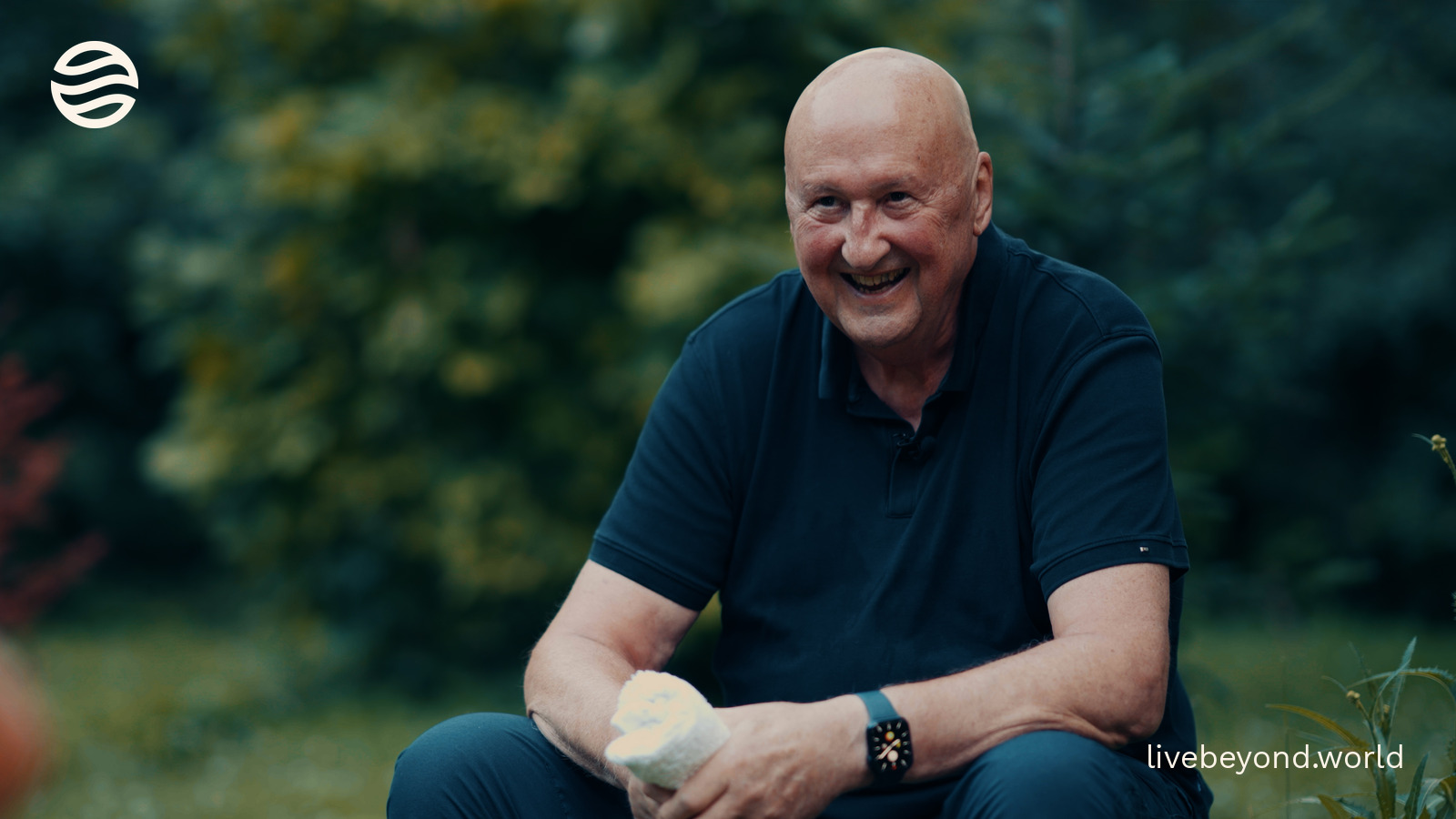
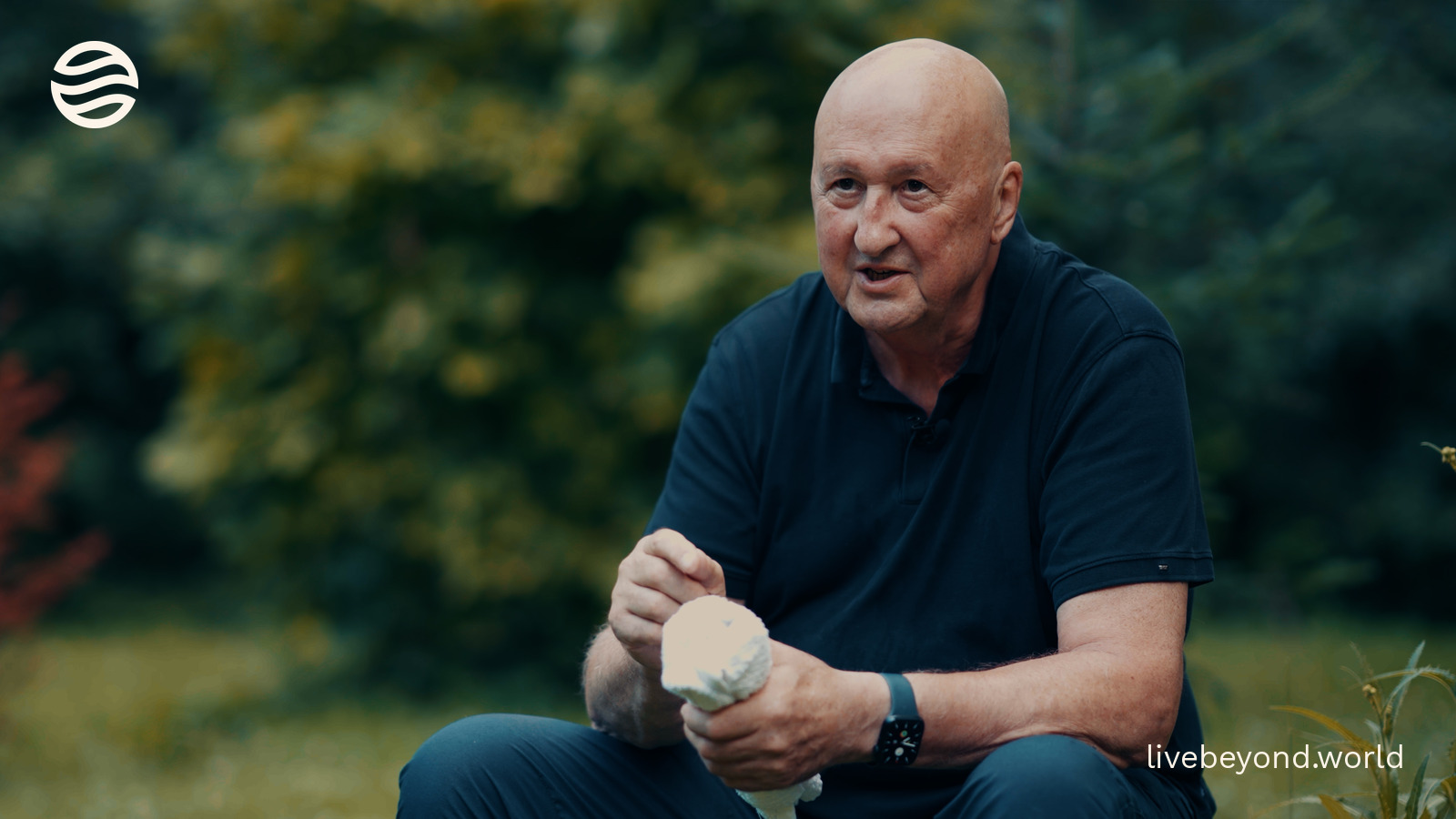
John Davies in Toronto, July 2024 — a Live Beyond interview with Marek Piotrowski on why our stem cells fade with age.
Stem cell exhaustion, a hallmark of aging
In 2013, and again in 2023, a group of leading scientists described the main processes that drive aging. One of the twelve hallmarks is stem cell exhaustion: over the years our stem cells become fewer and more tired, so the body repairs itself more slowly. Guido Kroemer, one of the authors, explained the hallmarks to us in Singapore in February 2024.
John Davies told us how early it starts, at least for MSCs:
“The other thing I can tell you about MSCs, it's very well known that the number that you've got in bone marrow […] drops off precipitously in the last half of your teenage years. […] So by the time you're 18 or so, […] you've got far less MSCs in your bone marrow than you had when you were born. And as you continue to age, that number continues to decrease.”
In plain words: We are born with plenty of these repair cells, and we lose many of them while we are still young. Fewer repair cells means slower repair.
And then John told me the thing that changed how I think about all of this. These cells don’t only build:
“But it turns out, and it's discovered many years ago, that they have other very important properties. One of them is that these MSCs are anti-inflammatory. […] Well, when you think about it, aging is in fact an inflammatory disease. […] So as people grow older, the way the body ages and the reasons why it ages is to a large extent to do with inflammation. So if you've got a biologic system which can be used to reduce that inflammation, you can improve the life of people who are aging. […] It's not about cells making people live longer. It's making people live more comfortably as they age.”
In plain words: Inflammation is the body’s alarm and fire brigade. When it stays switched on for years, it wears us down. MSCs can calm it. That’s where stem cells meet longevity: not living forever, but aging more comfortably, with healthier joints and a calmer body.
They send messages more than they build
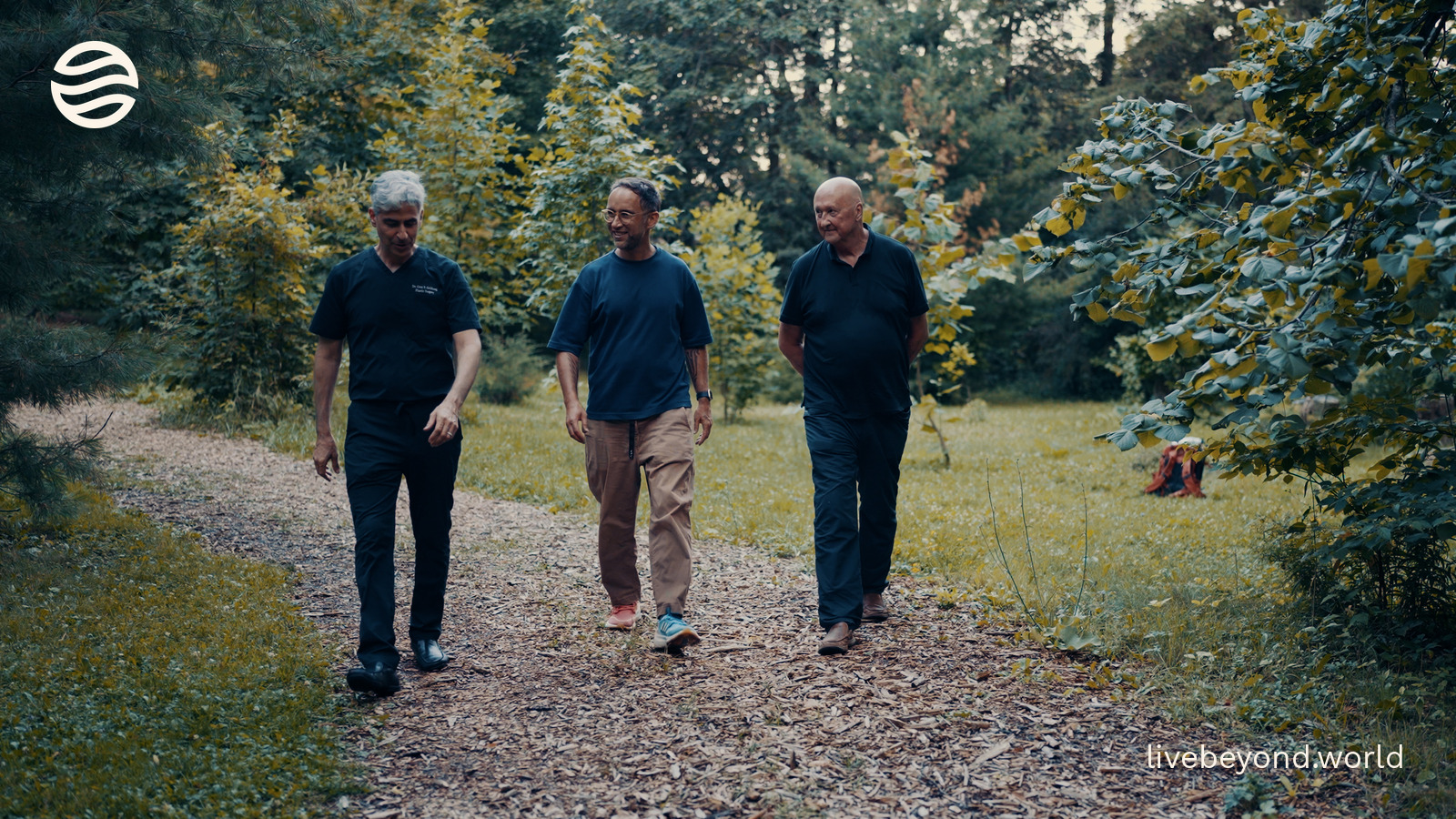
John Davies, Marek Piotrowski and Cory Goldberg walking in the woods near Toronto, July 2024 — a Live Beyond conversation about how stem cells send their signals.
When I started the quest, I believed what most people believe: you inject stem cells, they travel to your knee, and they turn into a new knee. Amy corrected me:
“One thing that we've learned in the last five years or so is that stem cells, if we give you stem cells from someone else, or take your stem cells from your fat or bone marrow and put them, for instance, in your knee, the stem cells don't turn into that new tissue. So it doesn't turn into cartilage cells or bone cells or things like that. We used to think that's how it worked, that they would actually turn into new cells. What we know now is the stem cells send out signaling molecules. So they release these proteins and cytokines and these extracellular vesicles to the area, and that stimulates your own cells that are in that area to become more effective.”
In plain words: Stem cells work mostly like messengers. They tell your own cells to do the repair, instead of becoming the repair themselves.
Two months later, in Toronto, John Davies took it one step further:
“We know when you inject live cells into a person, usually through the vein in the cubital fossa in the arm here, the cells go to the lung and they get trapped in the lung very, very rapidly, within minutes. And yes, you can't find them after a couple of days. And where have they gone? Well, they get broken up in the lungs. And these cells have been shown to work not because the cells themselves are active signaling cells, but the fact that they get broken up into particles. The particles get eaten up by the host cells, another type of cell called a macrophage. […] So it's the host body that's doing all the work. We're just giving it the stimulus.”
In plain words: Cells dripped into a vein get stuck in the lungs and are gone within days. The body’s own clean-up cells eat their pieces, and it’s those clean-up cells that then calm the body down. The injection is a nudge. Your body does the work.
What the lab studies show
In mice, MSCs dripped into a vein stayed in the lungs and were gone within about a day. In another study, the body’s clean-up cells swallowed the infused MSCs and then switched into a calming, anti-inflammatory mode. That’s why Arnold Caplan, the scientist who gave MSCs their name, later proposed calling them medicinal signaling cells.
That discovery opened a new door. If the messages are what matter, maybe we can send the messages without the cells. Those messages travel in tiny bubbles called exosomes. Amy explained:
“So the stem cells, one of the ways they communicate with other cells is they release these little tiny bubbles of information that are called extracellular vesicles, or EVs. Exosomes are one type of EV. But these little EVs are just these little bubbles that float around, and they have inside of them messenger RNA and cytokines and growth factors, and these are the signaling molecules. And what happens is they float around and then, if you put them into you, your cells will engulf those EVs, and then that reprograms how your cells act. So it's basically giving a new instruction manual to your cells.”
In plain words: Exosomes are tiny packages of instructions that cells send to each other. Some clinics now use them instead of whole cells, often for skin and hair. They are being studied for many things — and in the US, no exosome product is approved yet. [9]
Words worth knowing
Three words behind the repair crew
From our glossary. Tap a card to turn it over: the science on the back, and the people we met who explained it to us.
No. 32 / 66Therapy
Stem cell therapy
Putting young, active cells into the body to help it repair itself.
No. 32 / 66Therapy
Stem cell therapy
What surprised us on the quest: the cells mostly do not become new tissue; they send signals that wake up the repair work of the cells already there. Some uses are long proven, like bone-marrow transplants for blood cancers; many clinics promise far more than trials show.
“I think stem cells are incredible. They don’t do everything. They’re not a panacea. … However, they definitely can be beneficial in certain circumstances.”
Nothing looks wrong until something needs mending.
What helps
Nothing yet reliably rebuilds a reserve in a human. Stem cell transplants are standard care in a few blood cancers and are not an anti-ageing treatment — clinics selling infusions for ageing are selling ahead of the evidence, and some of what they sell is dangerous. Read more →
Sleep, weight, muscle, oral health, and treating the obvious sources. Omega-3s have decent evidence. This is also one of the few processes where a simple blood test — high-sensitivity CRP — tells you something useful and cheap.
Michael Lim explaining his approach at his clinic in Kuala Lumpur, October 2023 — Live Beyond.
“Stem cell therapy” sounds like one thing. It isn’t. Here’s what can hide behind those three words — from proven medicine to early ideas.
Blood stem cell transplant
Blood-forming stem cells from a donor or from yourself, given after strong chemotherapy to rebuild the blood and immune system. Used for leukemia, lymphoma and other blood diseases.
Taken from your belly fat or hip bone, sometimes concentrated or grown in a lab, then injected back, often into a joint, the skin or a vein. They are yours, so there is no rejection — but an older body has fewer and older stem cells.
Donor cells, from umbilical cord, placenta or bone marrow
Young MSCs from tissue that is usually thrown away after a birth, or from a donor. Plentiful and young, and mostly cleared by the body within days. One donor MSC medicine is approved in the US, for a rare and severe transplant complication in children.
Your own blood, spun to concentrate the platelets, and injected. Sometimes called a stem cell treatment, but platelets are not stem cells.
Not a stem cell
Waking up your own stem cells
No new cells added. Instead, proteins, signals or nutrients meant to wake up and multiply the stem cells you already have — like Michael Lim’s approach below. Gene therapies and drugs that would do the same are in research.
Early, still being tested
So which source is best? Even the experts don’t agree. Amy Killen:
“I think that it probably matters, and it's probably different for different disease processes as well as different people. So we know that older people, their stem cells are not as young, so […] placental cells make a lot more sense for that population 'cause they have older stem cells. If you're young and healthy, you're 20 or 30, potentially using your own cells makes more sense because your cells know how to communicate with your body better than any other cells. So this is a big debate, for sure.”
In plain words: There is no single best source yet. Young cells may suit older bodies; your own cells may fit a young body best. It is still an open question, and a big one.
Waking up the stem cells you already have
Marek Piotrowski and Michael Lim at Longevity Summit Dublin, August 2023 — a Live Beyond interview on waking up our own stem cells.
At our very first conference of the quest, in Dublin in August 2023, we met Michael Lim, a doctor from Kuala Lumpur. He doesn’t inject stem cells. He gives proteins meant to wake up the stem cells we already have. Two months later we visited him at his clinic in Kuala Lumpur.
This is how Michael explained his approach to Alek:
“This protein is actually, you have been exposed to it before when you were a baby. So we are taking it from the umbilical cord. […] So from there, we actually isolate that protein that your body has used it before, and we just add it into your system. […] So basically, our technology is pretty simple. Once we put in the proteins, the proteins will then be absorbed into the cell. So the cell walls, they have what we call a communication walls, where we have our own proprietary way. So we make sure that the door open, and then your stem cell of your father will receive the proteins. And after that, you will kickstart the stem cells to rejuvenate. Not only rejuvenate, but also increase its ability to grow its own. And that means the stem cell can grow its own stem cell. Basically, it's the MSC, or we call mesenchymal stem cells.”
In plain words: In his words: a protein taken from the umbilical cord gets into your own stem cells and switches them back on, so they multiply and go to work. No new cells are added.
And he was honest about where his work stands:
“We are currently doing studies with animals and also progressing to phase one clinical trials, and two and three, looking at different diseases spectrum that we are doing. […] We will publish the papers, then you'll be able to see what we are achieving. […] Our focus is nevertheless the health span. So we want to keep you as healthy as possible, not as old, because that would take time to evaluate. […] I can't tell you I can achieve longevity now, because I don't have enough datas and proof to show you that.”
In plain words: His approach is early. Trials and published papers are what will show how well it works, and for whom.
Later on the quest, in Toronto, I described Michael’s approach to John Davies. This is what he said:
“So yes, I've heard of that, some of that work. Not very much, to be honest. It's not my particular field. But it's certainly a very interesting approach. And coming back to my own field, the MSC field, […] you've got millions of these cells in your body. They only spring into action when you wound yourself, when you need them. Otherwise, they're lying dormant. So if you can, by one way or another, encourage these cells to proliferate so you've got a bigger population of these cells waiting to work for you, that's clearly an advantage. […] Now, I don't think that's actually been done yet by the scientific community, but certainly it's an intriguing prospect.”
In plain words: A bigger, wide-awake repair crew would be a real advantage. No one has shown yet that we can make that happen safely, but scientists find the idea fascinating.
The stem cell’s home matters too
In a hospital in Shanghai, Evelyne Bischof, a doctor working in cancer and longevity medicine, told us that the place where a stem cell sits — its niche — is almost as powerful as the cell itself. She compared it to a charger that tells the cell when to go to work. For longevity, she said, the goal is to make that home young again.
Based on: Interview, Shanghai, December 2023
What is proven, and what is still being tested
Amy Killen and Marek Piotrowski at her home in Salt Lake City, Utah, May 2024 — a Live Beyond interview on what is proven about stem cells.
Proven: blood stem cell transplants
Since the first in 1957, an estimated 1.5 million blood stem cell transplants had been done worldwide by 2019. They save lives in leukemia, lymphoma and other diseases of the blood and immune system.
In Europe, a treatment grown from a patient’s own eye stem cells was recommended for approval in 2014, for people whose eyes were damaged by burns. In the US, for years the only approved stem cell products were blood-forming cells from cord blood, for blood disorders. In December 2024 the FDA approved its first MSC medicine, made from donor bone marrow, for children with a severe complication after a bone marrow transplant.
No stem cell or exosome treatment is approved by the FDA to slow aging or to make healthy people healthier, and the FDA says there are no approved exosome products at all. Treatments for joints, skin, hair, sexual health or general renewal are offered at clinics, but the large, careful trials that would show how well they work — for whom, at what dose and how often — are still missing.
In Salt Lake City I told Amy I thought it was all still new:
“I think that it’s still a new thing, so probably in 5 or 10 years we will know much more and maybe we can make it much more effective.”
She corrected me:
“People have been doing stem cell procedures for 10 to 15 or more years. […] So this is not necessarily new, but I do think it's understudied. It's difficult to get the funding to do big studies on stem cells because who's gonna pay for you to study your stem cells in your body? […] I do think we have a lot to learn about how best to use these cells and these EVs. Like, what's the concentration? What are the indications? How often? Like, things like that are still questions that we have.”
In plain words: Clinics have used stem cells for years, but big studies are very expensive, and nobody can own your cells — so few companies pay for those studies. That’s why so many basic questions are still open.
The hype, and the risks
Eric Verdin at the Buck Institute, California, May 2024 — a Live Beyond interview with Marek Piotrowski on donor stem cells.
A fast-growing market
In 2016, researchers counted 570 clinics in the US selling stem cell treatments the FDA had not approved. By 2021 they counted 2,754.
I asked John Davies what clinics really do when they say “we do stem cells.” His answer surprised me:
“There are probably some of them that actually do use stem cells, but, I think, the majority of clinicians who make a lot of noise about the fact that they're injecting stem cells are not really injecting stem cells at all. One example of this is something called platelet-rich plasma. […] Clinicians will sometimes call them stem cells, but a platelet is a type of blood cell which is not a stem cell. And if you concentrate those platelets, it doesn't suddenly make them stem cells. So, many of the claims that are made, especially in the adverts that you see through clinicians who are maybe working outside the limits of the normal jurisdiction areas, […] it may not be any stem cells at all. That's dangerous.”
In plain words: Not everything called a stem cell treatment contains stem cells. And when you don’t know what’s in the syringe, nobody can know what it will do.
When it goes wrong
Doctors have published what can happen. Three women in Florida lost much or all of their sight after cells from their own fat were injected into both eyes. A man who had stem cell injections abroad developed a growth on his spinal cord made of cells that were not his own. A review of reports from around the world found infections, tumors and even deaths after unproven stem cell treatments, and in 2019 the FDA warned of serious side effects in people given products sold as exosomes.
Based on: Published case reports and reviews [11][12][13][9]
Eric Verdin, who runs the Buck Institute for Research on Aging and became a friend on the quest, told us why he would not take donor stem cells himself:
“The stem cells, if they're not coming from yourself, they're coming from another, from a placenta or from some other place, there are two options. Most likely they're gonna be killed within five minutes when they arrive in your body because they're recognized as foreign, and we have this incredible defense mechanism to recognize anything foreign. […] And maybe during their killing it will induce some local inflammation, and maybe that will lead to tissue remodeling. Maybe that's how something might benefit. Some people claim they feel better. The other option that would worry me the most is they might persist in some immune privileged sites. We have areas in our body, the eye, testis in men and others where antigens or foreign things can persist for a longer time. I don't know if I would like the idea that I have placental stem cells persisting in my eye from someone else, with the potential of tumor genesis and all this. So I think there's just too much unknown for me to take that chance.”
In plain words: Donor cells are usually destroyed by our immune system soon after they arrive, and that may even be part of how they help. What worries him are the rare cells that might hide in protected places in the body. When the unknowns are this big, he waits.
Where the joy is
John Davies in Toronto, July 2024 — a Live Beyond conversation with Marek Piotrowski about the repair crew already inside us.
I am fascinated by stem cells, and I see real promise in them — I also see the hype, which is why the questions below matter so much. For myself, I know what I would do: I would go to Amy Killen for her full-body stem cell treatment without hesitating, and if I had a bad bruise or an injury, I would go for stem cells straight away. That is my own choice, made after everything I heard on the road — not advice for you. For injuries the early results are encouraging, but the big trials are still to come.
And here’s what gives me joy: the most powerful repair crew is already inside us. As John showed us, even when something is injected, it is our own body that does the healing. Moving every day, sleeping well, real food, a calm mind and the people we love keep the whole body in good shape while the science catches up. I said it to John in Toronto:
“If we can produce something ourselves, why get it from the outside? So we are an amazing factory, and I think we just have to keep this factory going better.”
The science is moving fast, and every year we understand a little better how our cells talk to each other. I want to be around — healthy, curious and joyful — for what comes next.
What to ask: which cells, from where, for what, in which trial
What stem cell scientists advise
The International Society for Stem Cell Research, the main professional society of stem cell scientists, publishes a free guide for patients and families, with the questions to ask before any stem cell treatment.
These are the questions the experts taught us. Ask them, and talk to your own doctor first.
Which cells, exactly? Blood-forming stem cells, MSCs, exosomes, platelets? Ask for the name of the product and how many cells it contains.
From where? Your own fat or bone marrow, a donor, an umbilical cord or a placenta? How were they tested and prepared?
For what? A specific problem, or “general renewal”? Be careful with any treatment that promises to help with almost everything.
In which trial? Is it part of a registered clinical trial? Look for its number on a public registry such as ClinicalTrials.gov, and ask what has happened in people so far.
Is it approved for this use? Only a few stem cell products are approved, each for a specific disease. Ask whether this one is approved for your use, and by whom.
Is my body ready? Amy Killen told us her team won’t treat smokers or people with poorly controlled diabetes, because the body has to work well for these procedures to work well.
What can go wrong, and who looks after me? Ask about side effects, what happens if something goes wrong, and how long they will follow up with you.
Not medical advice, and not a recommendation for or against any stem cell, exosome or other treatment. We describe what the studies say and what the experts told us.
Every number on this page, by the number in square brackets. Quotations come from Live Beyond’s own recorded interviews, cleaned only of “um” and “uh”. Not medical advice. Talk to your doctor before you change anything.
Niederwieser D, Baldomero H, Bazuaye N, et al. One and a half million hematopoietic stem cell transplants: continuous and differential improvement in worldwide access with the use of non-identical family donors. Haematologica. 2022;107(5):1045-1053. doi:10.3324/haematol.2021.279189
U.S. Food and Drug Administration. FDA approves remestemcel-L-rknd for steroid-refractory acute graft versus host disease in pediatric patients. 18 December 2024. (“Ryoncil is the first FDA-approved MSC therapy.”)
Turner L. The American stem cell sell in 2021: U.S. businesses selling unlicensed and unproven stem cell interventions. Cell Stem Cell. 2021;28(11):1891-1895. doi:10.1016/j.stem.2021.10.008
U.S. Food and Drug Administration. Consumer Alert on Regenerative Medicine Products Including Stem Cells and Exosomes. 22 July 2020, updated 9 April 2024.
Caplan AI. Mesenchymal Stem Cells: Time to Change the Name! Stem Cells Transl Med. 2017;6(6):1445-1451. doi:10.1002/sctm.17-0051
López-Otín C, Blasco MA, Partridge L, Serrano M, Kroemer G. Hallmarks of aging: An expanding universe. Cell. 2023;186(2):243-278. doi:10.1016/j.cell.2022.11.001
Eggenhofer E, Benseler V, Kroemer A, et al., Hoogduijn MJ. Mesenchymal stem cells are short-lived and do not migrate beyond the lungs after intravenous infusion. Front Immunol. 2012;3:297. doi:10.3389/fimmu.2012.00297 (study in mice)
de Witte SFH, Luk F, Sierra Parraga JM, et al. Immunomodulation by Therapeutic Mesenchymal Stromal Cells (MSC) Is Triggered Through Phagocytosis of MSC By Monocytic Cells. Stem Cells. 2018;36(4):602-615. doi:10.1002/stem.2779
U.S. Food and Drug Administration. Public Safety Notification on Exosome Products. 6 December 2019.
European Medicines Agency. First stem-cell therapy recommended for approval in EU (Holoclar, for limbal stem cell deficiency after eye burns). News release, 19 December 2014.
Kuriyan AE, Albini TA, Townsend JH, et al., Goldberg JL. Vision Loss after Intravitreal Injection of Autologous “Stem Cells” for AMD. N Engl J Med. 2017;376(11):1047-1053. doi:10.1056/NEJMoa1609583
Berkowitz AL, Miller MB, Mir S, et al., Chi JH. Glioproliferative Lesion of the Spinal Cord as a Complication of “Stem-Cell Tourism”. N Engl J Med. 2016;375(2):196-198. doi:10.1056/NEJMc1600188
Bauer G, Elsallab M, Abou-El-Enein M. Concise Review: A Comprehensive Analysis of Reported Adverse Events in Patients Receiving Unproven Stem Cell-Based Interventions. Stem Cells Transl Med. 2018;7(9):676-685. doi:10.1002/sctm.17-0282
International Society for Stem Cell Research (ISSCR). The ISSCR Guide to Stem Cell Treatments. isscr.org/resources/patient-guide (accessed October 2026).