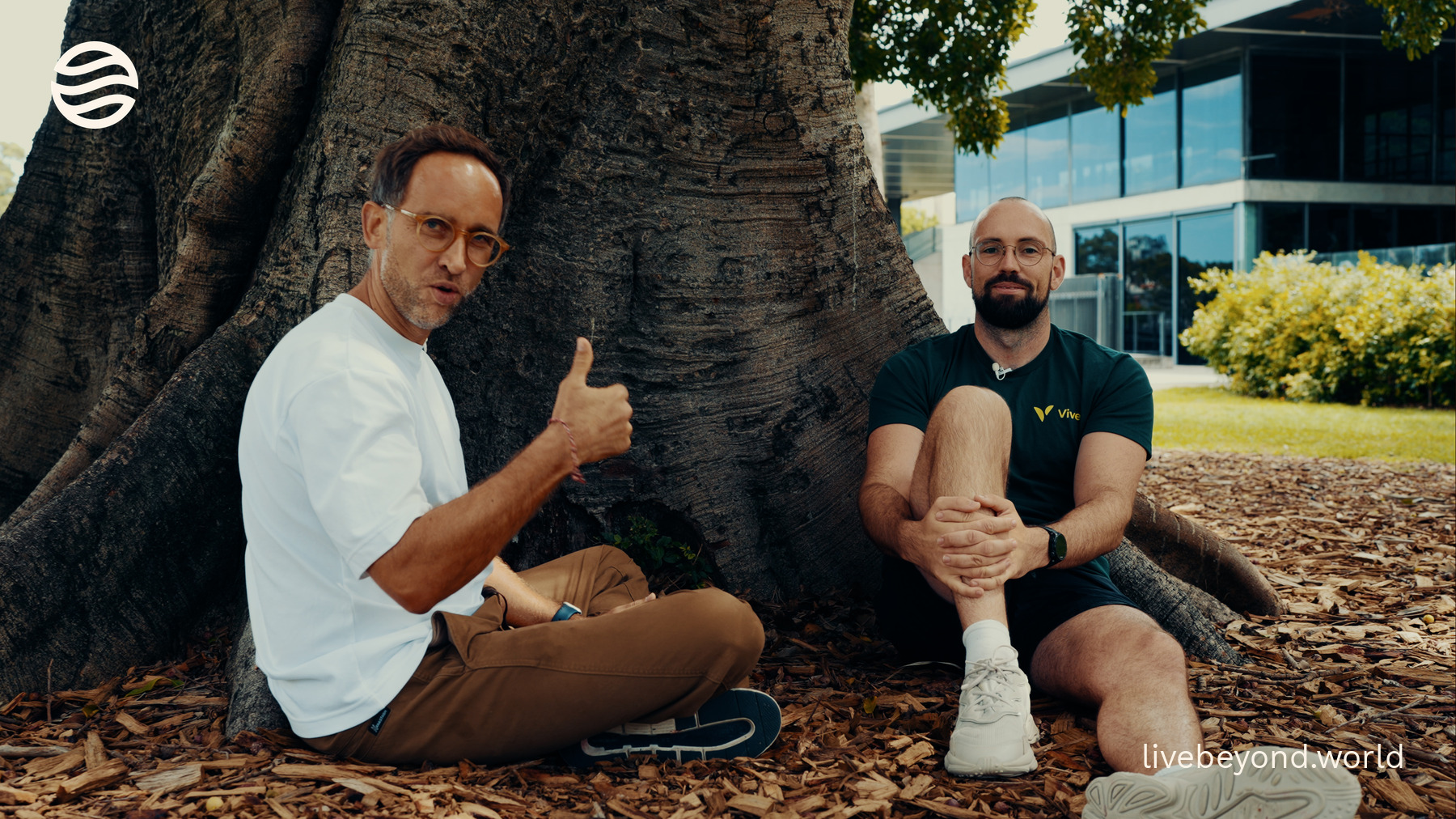
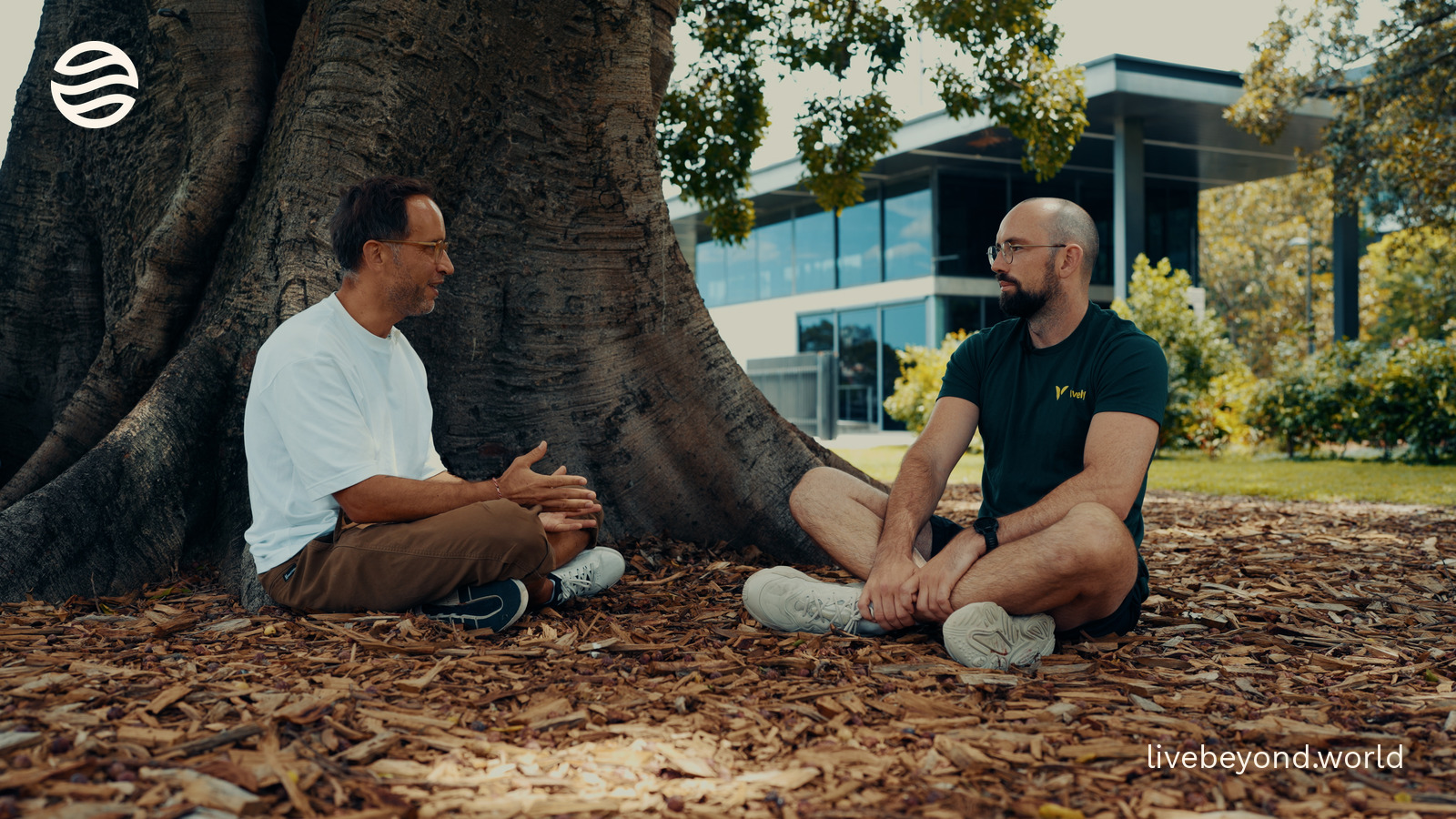
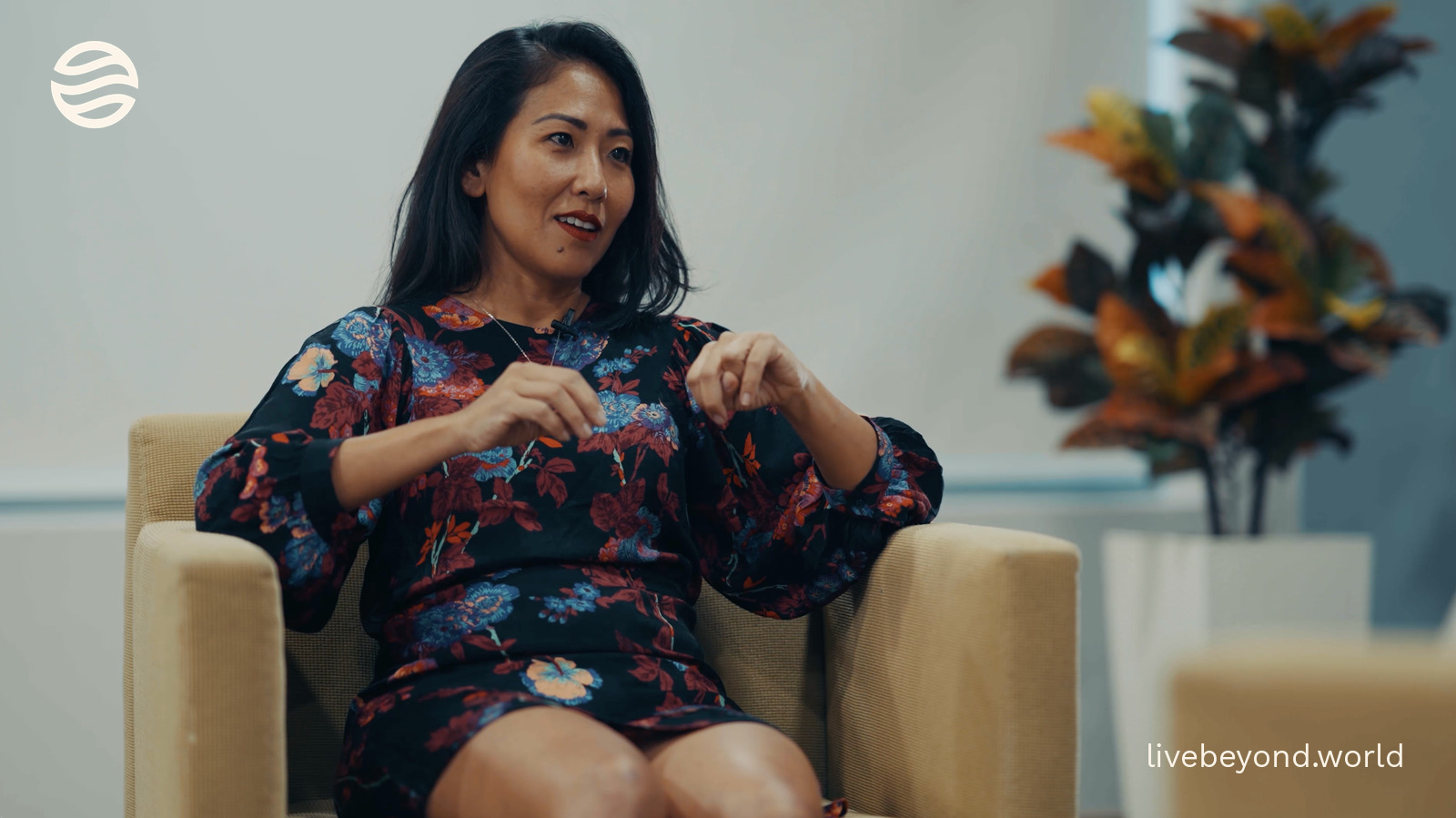
Marek Piotrowski and Tim Veron under a giant tree in Sydney, January 2024 — a Live Beyond interview on what a glucose monitor teaches you.
On our quest, my son Alek and I met more than a hundred longevity experts in 39 countries and states, and again and again the talk turned to measuring: rings, watches, sensors on the arm. I’m not a fan of measuring everything. But one small sensor changed the way I eat: a continuous glucose monitor. This page is about what a CGM teaches you about food, what sleep and activity trackers can and can’t tell you, and how to know when data helps you and when it only makes you worry — in the words of the experts who taught us, with gratitude, and with the doubts too.
A little curiosity about your own body can teach you more than years of advice. Wearing a continuous glucose monitor (CGM) for a couple of weeks shows you, in real time, what a meal, a walk after dinner, a stressful day or a short night does to your blood sugar — and that your body answers in its own way. Step and sleep trackers help you move more and keep regular habits. The real gift is what you learn: once you know it, you can take the device off and simply live it, with more energy and less worry. [1][2][3]
Longevity, as we mean it: more healthy, joyful years. What we mean →
800people in Israel wore a glucose monitor for a week. Their blood sugar answered the very same meals in wildly different ways.[1]
96%of the day: how long healthy adults without diabetes stayed in the normal blood-sugar range in one CGM study. Short rises after meals are normal.[4]
6,000–10,000steps a day is where the benefit leveled off in a pooled study of 47,471 adults: about 6,000–8,000 for people over 60, 8,000–10,000 for younger adults.[3]
What a CGM teaches you about food
Matt Kaeberlein in Seattle, June 2024 — a Live Beyond interview with Marek Piotrowski on habits that stick.
A continuous glucose monitor, or CGM, is a small sensor you stick on the back of your upper arm. A tiny, thin filament sits just under the skin and reads the sugar in the fluid around your cells, day and night, and your phone draws it as a curve. It is a medical device, made first for people with diabetes. For people without diabetes, it can be something else: a short course in your own body.
I’m not a huge fan of measuring everything. But I am a huge fan of the CGM. Wearing one was amazingly educational: it made me finally understand nutritionists. Not just what you eat, but when you eat and how much. I learned three things. A big bowl of rice did to my blood sugar what a pack of sweets does, so now I eat a smaller portion. A short walk soon after a big meal flattened the rise — the old advice from our grandmothers, suddenly visible. And a lentil soup with a halloumi salad, two very healthy dishes, gave me one of my biggest spikes, simply because it was too much food at once. Nutritionists had told me all of this before. Now I knew it, because I had seen it.
In Sydney, Katia Dowling introduced us to Tim Veron, who founded a company that builds a metabolic-health platform around glucose monitors. He explained why the lesson comes so fast:
“One of the really sort of interesting or exciting properties of continuous glucose monitoring in general is that it's real-time feedback. Humans are feedback machines. We need data and we need inputs to make decisions. […] It's the first time we can actually get real-time feedback on how our behaviors are affecting our health.”
In plain words: A CGM works like a mirror for your meals. You eat, and soon after you see what it did. That quick answer is what turns advice into understanding.
In Seattle, Matt Kaeberlein, who studies the biology of aging, told us why that kind of lesson lasts:
“So I think, again, this is about trying to help people identify which aspects of their lifestyle can they modify, how do they need to modify it, and then the trick is how do you actually create sticky solutions that they will stay with, right? […] One of the things that I've done and that we see in our program is continuous glucose monitoring for some people is actually a very sticky behavioral modifier because when you see your blood glucose change in real time based exactly on what you ate, you can't unlearn that.”
In plain words: Changing a habit is hard. Seeing your own body react, right after you eat, makes the change stick — you can’t un-see it.
A short walk after eating lowers the rise
In a review of seven lab studies, adults who broke up long sitting with short, light walks had lower blood sugar and insulin after meals than when they kept sitting.
Based on: A review of seven lab studies in people · shows cause over hours, not years [5]
Every body answers in its own way
Marek Piotrowski and Brian Kennedy at Longevity Summit Dublin, August 2023 — a Live Beyond interview on why every body answers differently.
The same food doesn’t do the same thing to everybody. That is why reading your own body can teach you more than a general rule. In Dublin, at the very first conference of our quest, I told Brian Kennedy that a CGM was the simplest thing that had ever changed my habits. He agreed, and told us why:
“I completely agree with that. I've done it myself as well, and one of the things you learn is that people react differently. Some people, when they drink wine, they have a big glucose spike, other people don't. And you need to know how your body's responding to what you eat and drink. Also, it teaches biochemistry to people because I've had a number of people come to me and say, 'I don't understand. I go for a run, and my glucose goes up instead of going down. What does that mean?' And then you have an opportunity to explain a little bit of biochemistry and metabolism to people.”
In plain words: Wine, bread, fruit or even a run can move your blood sugar in your own way. A CGM shows you your way — and it gives a curious mind a lesson in how the body works.
“Well, I think the interesting thing is that everybody is different, so everybody responds differently […]. And there are so many different variables. They actually did a study, I think, looking at twins, looking at identical twins, and did an experiment of looking at how their food was impacting their glucose levels and found large differences in between the twins. And so there are so many different factors at play, lifestyle factors, how much you move, your sleep, your mood, other stresses that you have on the system.”
Even identical twins answer differently
In the PREDICT study, 1,002 adults in the UK, many of them twins, ate standardized meals while their blood sugar and fats were measured. Responses to the very same meals varied widely from person to person — even between identical twins, who share all their genes.
800 people in Israel wore a glucose monitor for a week while scientists recorded their responses to 46,898 meals. The same meal could send one person’s blood sugar soaring and barely move another’s. A computer model that also used each person’s gut bacteria, blood tests and habits predicted their responses far better than counting carbohydrates.
Muscle is the largest glucose sink you own, so resistance training matters as much as diet. Walking after meals works. A continuous glucose monitor worn for a few weeks is one of the few pieces of consumer tech that reliably changes behaviour, because you see your own response rather than a general rule.
A biohacker who knows what is good for them, does most of it, and is at peace with the rest.
No. 17 / 66Everyday word
Bioslacker
Our answer to over-optimising. Measure what matters, try what you are curious about, and then live: the walk with friends, the cookie after dinner, the night without the tracker. Read more →
“I do say I’m a biohacker sometimes, but I also sometimes say that I’m a ‘bioslacker’. … For me personally, I don’t want to track everything. I don’t want to do everything right all the time. I want to enjoy a cookie with dinner sometimes.”
Richard Barker in London, July 2024 — a Live Beyond interview with Marek Piotrowski on teaching young people about their own bodies.
Here is my dream, and I shared it with many of the experts we met: every citizen gets a CGM for about two weeks, just to learn about themselves — starting with high-school kids. Not to wear forever. Not to chase a number. Two weeks of seeing what a soda, a breakfast or a walk does to your own body could teach you more about biology than a year of lessons. And what you learn young tends to stay with you.
In London, when I asked Richard Barker, who works on precision medicine, for his message to young people, he came back to it himself:
“It would be about teaching them the simple things that they either want to do, should do, shouldn't do, and the impact of that, and giving them the evidence of that. You mentioned CGMs, right? Get them all to wear a CGM for a period of time and learn what spikes their blood glucose. Beneath all of that, I think there is this desire that we now should have to use technology for human fulfillment.”
In plain words: Teach young people the simple things, show them the evidence in their own body, and let technology serve a happier life — not the other way round.
What sleep and activity trackers can and can’t tell you
Amy Killen and Marek Piotrowski at her home in Salt Lake City, Utah, May 2024 — a Live Beyond interview on tracking what works for you.
I wore a smartwatch for a while, and I learned from it. Today I don’t wear it anymore — to be honest, I don’t even charge it. My rule: use these devices as much as you need them, and not more. Don’t get crazy about measuring. I don’t need my wrist telling me you’re running, Marek — I know I’m running. What would make sense to me is a system that quietly gathers the data and, at the end of the month, tells me: you did this, this and that, and based on it, here is one change that will make a real difference. When devices can do that, I’ll put one on again. Until then, I’d rather not watch what is happening right now, minute by minute — for my own peace of mind. Here is what the research says trackers measure well, and what they don’t.
Steps
Counted well by most devices in lab tests. And steps are worth counting: in a pooled study of 47,471 adults, people who walked more each day were less likely to die early, up to the point where the benefit leveled off.
Counted well · a strong link in long-term studies [6][3]
Heart rate
Measured fairly well on average, though it differs from device to device.
Not everybody sees it the way I do, and that’s good. Amy Killen, a doctor who calls herself a bio-slacker and loves to experiment, sees a tracker as the way to test any change you make:
“I think that the best way to see if it's helping is to be tracking whatever you're doing. Track, use your wearables, track your sleep, track your heart rate, track your steps, track all the things, and make sure that you're following along and seeing if this seems to be helping you or not.”
In plain words: If you try something new — an earlier bedtime, a new workout — a tracker can show you whether it works for you. Use it to answer a question, not to fill a dashboard.
When data helps — and when it only makes you worry
Marek Piotrowski and Tim Veron in Sydney, January 2024 — a Live Beyond interview on why a rise after a meal is not a failure.
Sleep tracking taught me something I didn’t expect: to stop worrying about my sleep.
In Singapore, Dr Olivia Lesslar — who, after we became friends, decided to join Live Beyond as its Medical Director — told us about a patient who woke up in a panic because his tracker said he had slept badly. She asked him how he felt. Fine, he said. Then don’t worry about it, she told him. Her rule for every device:
“My opinion on wearables is that you have to make sure that you stay the master of them and not the slave to a wearable. […] It's very easy for some patients to become the slave, right? They wake up, the first thing they do is check their CGM, […] and they're then making changes to their life, not because they feel better, not because they're a better husband, not because they're a better daughter, not because they're producing better work at the company, but because the numbers look better. So again, it's what sings to you.”
In plain words: Your device works for you, not the other way round. If you feel rested, kind and full of energy, that counts more than any score.
When a sleep score keeps you awake
Sleep doctors described three patients who had become so focused on getting perfect sleep scores from their trackers that the effort made them more anxious about sleep. They gave it a name: orthosomnia.
Based on: Three patient stories (case reports) · not a study of many people [8]
Blood sugar can scare people too. Tim Veron explained why a rise after a meal is not a failure:
“It's about the ability to then come back to that baseline, to a healthy baseline. It's how well you come back to that baseline. […] And so the same sort of thing applies with glucose, is that it's okay to have spikes, particularly if you have something sugary or high carb, but you do wanna minimize those spikes. So if your glucose is swinging all over the place all day, every day, that's not good.”
Healthy blood sugar moves, and comes back
153 healthy people aged 7 to 80, without diabetes, wore a CGM. Their blood sugar stayed in the normal range (70–140 mg/dL) for about 96% of the day. Short rises after meals were part of normal life.
In plain words: A rise after a meal is your body doing its job. What matters is the pattern over the whole day — and how you feel.
What we don’t know yet
Most of what CGMs have proven, they have proven in people with diabetes. Nobody has yet followed people without diabetes for years to see whether wearing a CGM helps them live longer or healthier. The scientists say so themselves.
Early days for healthy people
A review of CGM use in healthy adults saw a high potential for health, wellness and sport, but found that how food, exercise and stress move blood sugar in healthy people is still largely unknown, and that more studies are needed to read the curves well.
Does a CGM help healthy people live longer? Not tested yet. What is clear is how much it can teach you about your own meals and habits.
Are trackers accurate? Good at steps and at telling when you sleep. Weaker at calories, time awake and sleep stages.
Is every glucose spike bad? No. Short rises after meals are normal. Scientists are still studying which patterns matter for health over the years.
Is more data always better? No. Data you don’t act on can only add worry.
Learn from your data, then let it go
Dr Olivia Lesslar in Singapore, February 2024 — a Live Beyond interview with Marek Piotrowski on staying the master of your wearables.
Olivia did what I did: a few weeks with a CGM, and lessons for life.
“I did a CGM in November for a month. Loved it. And I now know the combination of jet lag, having flown in from the Southern Hemisphere to Denver at altitude, and the jet lag obviously, and also being stressed because I was giving a talk, is terrible for my blood sugar. Who would have thought it, right? So now, if I do do that again, which I will in November again, I'm going to do things differently. How I eat and exposure to light and all those things that we know how to change.”
In plain words: A short time with a sensor can show you patterns you would never guess — like travel, stress and blood sugar — so next time you can plan differently.
Start with a question. What does my breakfast do? Does a walk after dinner help? Ask first, then look.
Learn, then take it off. For me, a CGM was a short course in my own body, not something to wear forever.
Talk it through. A CGM is a medical device. Your doctor or a dietitian can tell you whether it is right for you and help you read what you see.
Keep only the data you’ll act on. If a number won’t change what you do, you don’t need it.
Trust how you feel. Energy, mood, sleep and joy are meters too.
Where the joy is
Dr Tamsin Lewis and Marek Piotrowski by the sea in Formentera, August 2024 — a Live Beyond conversation about measuring less and living more.
For me, the joy of a CGM was discovery. Every meal became a little experiment, and every walk after dinner became a small win I could see. And then comes the second joy, the one our experts reminded us of: taking the device off and living — listening to your body, eating with the people you love, sleeping without a score.
On Formentera, Dr Tamsin Lewis, who had invited me to the island, told us how she helps people who measure too much:
“People come to me with a lot of problems, right? And they want to be quite strict around certain areas of their life, and I encourage them to not overtrack, overhack, but to harmonize, and that has become my approach to encourage bio harmony. And a big part of that is encouraging joy and connection, which is often very difficult for people, especially those who have spent a long time being very performance or very dopamine-driven in their life, very achievement-focused.”
In plain words: Measure less, live more. Joy and connection are part of good health too.
And Olivia told us why she doesn’t wear anything at all:
“I don't wear anything. I've definitely started to try and come back more into myself. Maybe that sounds a little woo, but I spent years not listening to my body, not hearing what my symptoms had to say, and I don't wanna lose any more time.”
In plain words: Your body talks to you all day. A device can teach you its language; then you can listen on your own.
Wearables and glucose monitors on the Longevity Map
This page shares what research and the experts we met say. It is not medical advice, and it does not recommend any medicine, supplement or treatment. It knows nothing about you. Before you start, stop or change anything — especially if you are pregnant, live with a health condition or take any medication — please talk to your doctor. In an emergency, call your local emergency number.
Sources
Every number on this page, by the number in square brackets. Quotations come from Live Beyond’s own recorded interviews, cleaned only of “um” and “uh”. Not medical advice. Talk to your doctor before you change anything.
Zeevi D, Korem T, Zmora N, et al. Personalized nutrition by prediction of glycemic responses. Cell. 2015;163(5):1079-1094. doi:10.1016/j.cell.2015.11.001
Berry SE, Valdes AM, Drew DA, et al. Human postprandial responses to food and potential for precision nutrition. Nat Med. 2020;26(6):964-973. doi:10.1038/s41591-020-0934-0
Paluch AE, Bajpai S, Bassett DR, et al. Daily steps and all-cause mortality: a meta-analysis of 15 international cohorts. Lancet Public Health. 2022;7(3):e219-e228. doi:10.1016/S2468-2667(21)00302-9
Shah VN, DuBose SN, Li Z, et al. Continuous glucose monitoring profiles in healthy nondiabetic participants: a multicenter prospective study. J Clin Endocrinol Metab. 2019;104(10):4356-4364. doi:10.1210/jc.2018-02763
Buffey AJ, Herring MP, Langley CK, Donnelly AE, Carson BP. The acute effects of interrupting prolonged sitting time in adults with standing and light-intensity walking on biomarkers of cardiometabolic health in adults: a systematic review and meta-analysis. Sports Med. 2022;52(8):1765-1787. doi:10.1007/s40279-022-01649-4
Fuller D, Colwell E, Low J, et al. Reliability and validity of commercially available wearable devices for measuring steps, energy expenditure, and heart rate: systematic review. JMIR Mhealth Uhealth. 2020;8(9):e18694. doi:10.2196/18694
Chinoy ED, Cuellar JA, Huwa KE, et al. Performance of seven consumer sleep-tracking devices compared with polysomnography. Sleep. 2021;44(5):zsaa291. doi:10.1093/sleep/zsaa291
Baron KG, Abbott S, Jao N, Manalo N, Mullen R. Orthosomnia: are some patients taking the quantified self too far? J Clin Sleep Med. 2017;13(2):351-354. doi:10.5664/jcsm.6472
Holzer R, Bloch W, Brinkmann C. Continuous glucose monitoring in healthy adults—possible applications in health care, wellness, and sports. Sensors (Basel). 2022;22(5):2030. doi:10.3390/s22052030