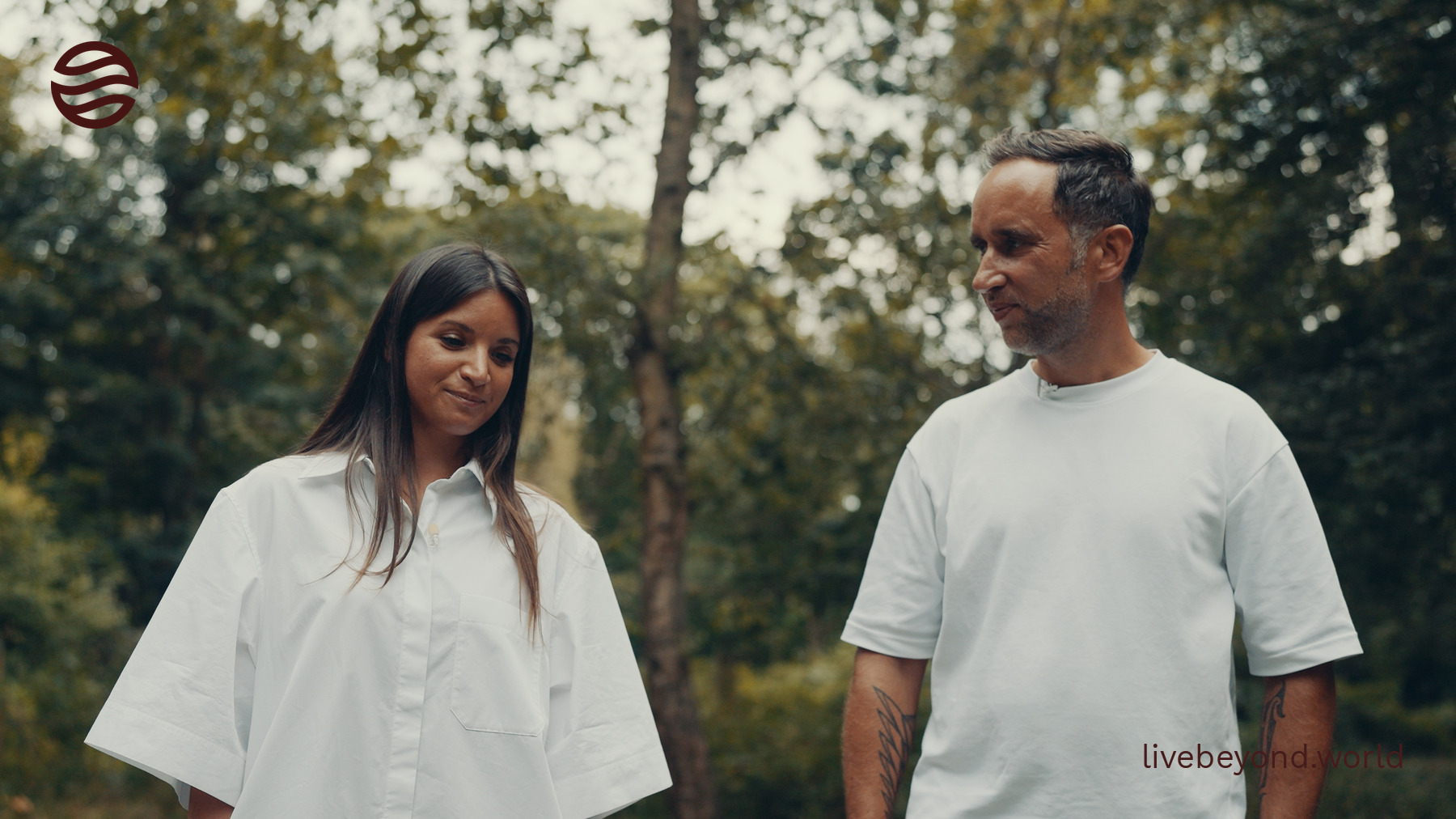
Marek Piotrowski and Nikolina Lauc on a walk in London, July 2024 — a Live Beyond interview on biological age and glycans.
On our quest, my son Alek and I met more than a hundred longevity experts in 39 countries and states — and we did our share of biological age tests. Here’s what I learned: there is no one biological age. There are many aging clocks, each reading a different part of you. This page explains what they measure, how they differ, and how to use them well, in the words of the scientists who build them.
Useful — once you know what you’re measuring. There is no single biological age. Every aging clock reads a different part of you, with its own algorithm and its own data, so two tests can give you two different ages on the same day. Used well, clocks are meters on a dashboard: they show where you’re aging fastest, and whether what you’re doing is working. So the first question is always: according to which clock? [1][2]
Longevity, as we mean it: more healthy, joyful years. What we mean →
2013the year Steve Horvath published the first epigenetic clock that works across the tissues of the body.[3]
11organs whose age scientists can now estimate separately from proteins in one blood sample — and they don’t all age at the same pace.[2]
30different clocks Eric Verdin’s team used to measure one intervention. About a third of them pointed the opposite way, he told us.
There is no such thing as one biological age
Steve Horvath in Dublin, August 2023 — a Live Beyond interview with Marek Piotrowski on the clocks he built.
I hear it all the time: “My biological age is 20 years younger than I am.” Here’s how I feel about it:
“I’m usually nervous when I see people saying, oh, my biological age is this and that, 20 years younger than I am, and I want to shout to them: hey, it’s not true until you say what aging clock you use. So you can say your biological age is this and that according to this and that aging clock. Because there is no universal biological age clock, and probably there never will be. It’s just different algorithms and different input data.”
Even the man who built the first epigenetic clock says it plainly:
“We want to build ever more accurate clocks, accurate in the sense that they really capture what people call biologic age. Everybody talks about it, but nobody really knows how to measure it.”
What an aging clock is
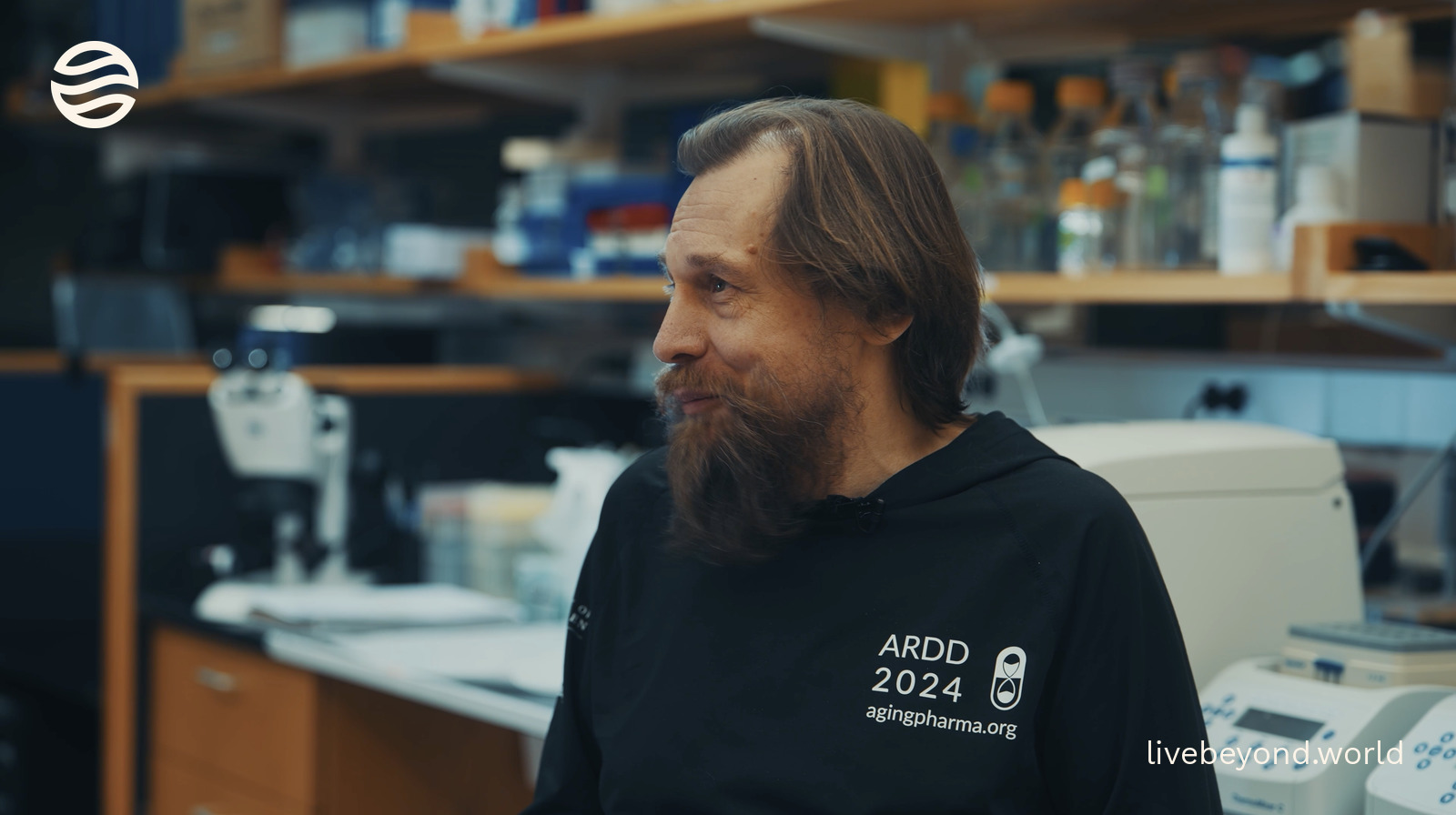
Vadim Gladyshev in his lab, Boston, November 2024 — a Live Beyond interview on how to measure aging.
Your chronological age is the number of birthdays you’ve had. An aging clock is a formula. Scientists collect one kind of data from thousands of people — chemical tags on DNA, sugars on antibodies, proteins in the blood, ordinary blood tests — and teach a computer to estimate either how old someone is, or how likely they are to get ill and die. Different data and different goals give different clocks.
“Epigenetic clocks capture only one aspect of aging. So now there is epigenetic clocks, transcriptomic clocks, proteomic clocks, metabolomics clocks. So we could basically quantify aging at multiple levels, imaging even photos. You can, for example, see a person and you can guess approximately the age, right? By simply looking at face.”
And there’s a deeper reason the clocks disagree. Scientists don’t even agree on what aging is:
“At the most fundamental level, […] we differ in how we understand aging. And so for somebody who thinks aging is increased chance of dying, they would develop clocks that quantify mortality. Other people would focus on loss of function. They can develop clocks that quantify loss of function. Other people can use clocks that trained for predicting chronological age, maybe some other features of aging.”
In plain words: Every clock answers its own question. One measures risk of dying, another loss of function, another how old you look on paper. None of them is “the” biological age.
Meters on a dashboard
Andrea Maier and Marek Piotrowski in Dublin, August 2023 — a Live Beyond interview on how differently our organs age.
Your body doesn’t age in one piece.
Each of us ages in our own way
In a Stanford study that followed 106 people for several years with blood, gut and other tests, people aged at different speeds in different systems: some fastest in their metabolism, others in their immune system, kidneys or liver.
“Our body is aging so differently inside of our body, so what test we do, you will have different results, and I think making sense of all of it's very important. Because our organs are changing so differently during the lifetime.”
“I think it’s just one of the meters on the dashboard.”
Nikolina Lauc, who runs one of the best-known clock tests, told me the same on a walk through London:
“It's not a beauty thing at all. […] The mistake is people think that there's this one biological age or there's this holy grail we're gonna discover, and there's gonna be better and worse markers at predicting mortality and morbidity. […] But they're not gonna predict your age perfectly.”
“It's showing one major risk factor, which is inflammation. But aging is not one thing, and it's never going to be simple, and it's always going to be different things in different people. 'Cause what we know now, for example, is that epigenetic clocks and glycan clocks don't correlate. So you can have a young glycan age and an old epigenetic age, and both of them can be good predictors in mortality and morbidity.”
In plain words: A young result on one clock and an old result on another can both be true. They’re looking at different things.
The main aging clocks, compared
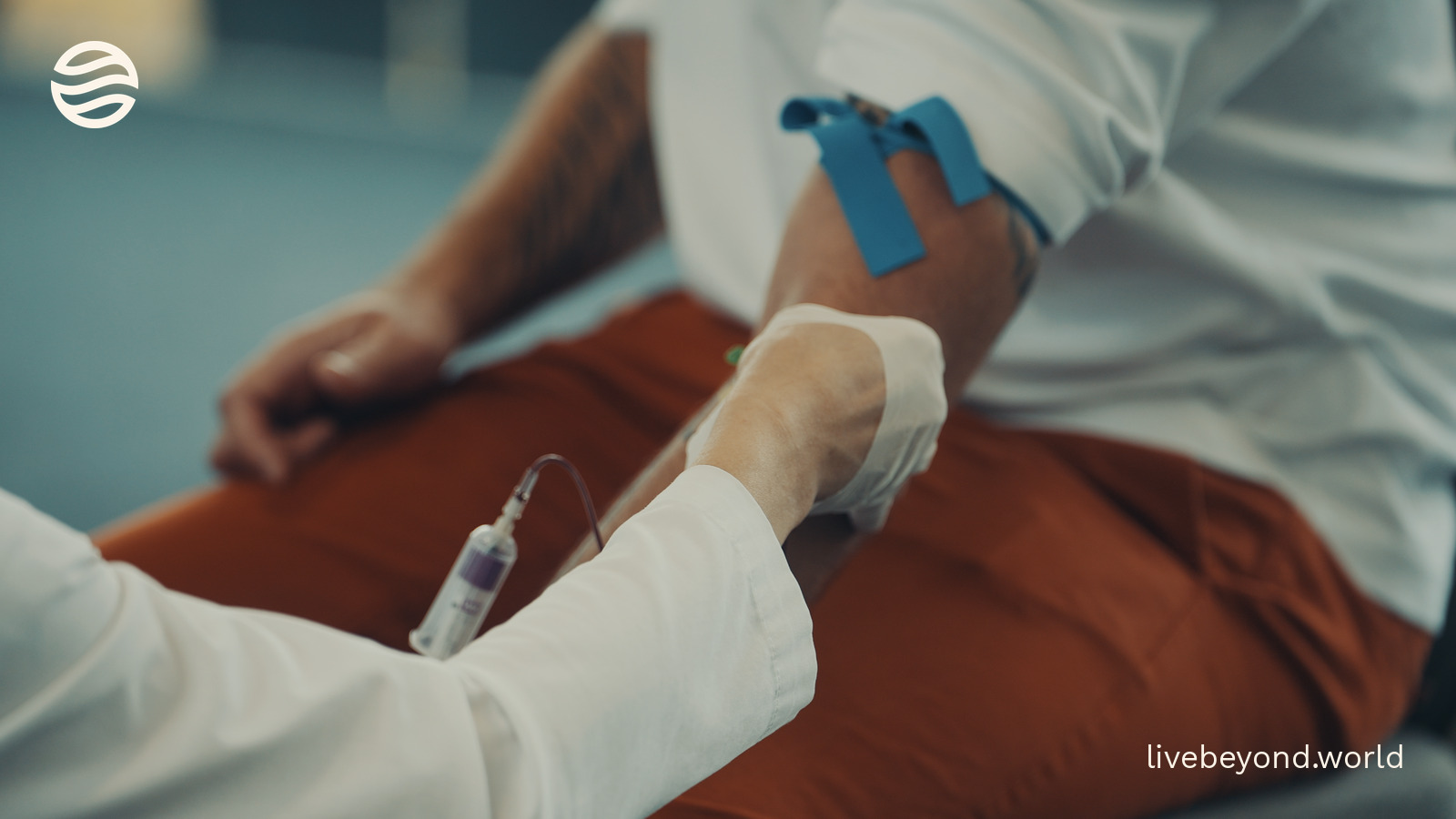
Marek Piotrowski giving blood for aging tests at Harvard, Boston, November 2024 — Live Beyond.
What each one reads, and what it’s good for.
Epigenetic clocks
Read chemical tags on your DNA (methylation), from blood or saliva. The most studied family. The first ones estimated age; newer ones like PhenoAge and GrimAge were trained to predict disease and death; DunedinPACE works like a speedometer, showing how fast you’re aging right now.
Read the sugars attached to your antibodies, from a drop of blood. They mostly reflect inflammation, so they’re good for seeing how lifestyle changes — food, sleep, stress — move it.
Read thousands of proteins in your blood and estimate the age of separate organs — heart, brain, kidneys, liver and more. They show which part of you is aging fastest.
Built from routine blood tests your doctor already orders: blood sugar, kidney and liver markers, inflammation, blood cells. Cheap, and you can see every number behind the result.
Marek Piotrowski and Eric Verdin at the Buck Institute, California, May 2024 — a Live Beyond interview on aging clocks and what they can’t do yet.
“These clocks are not ready for public usage. They are research tool. We just did a study where we had one specific intervention, and so to measure the effect of this intervention like we think we will do in the field in the future, we deployed thirty different clocks, and the responses were all over the place. So the intervention worked, but […] about a third of the clock showed the opposite. So it really gives you pause.”
“One big challenge is that the field and the community and the public, they all think that we already have these biomarkers. And because they are buying these biological tests from the market, they go online, they buy a kit and they say, 'Oh, my age is 2 years younger or older.' […] They think we already have them and they think they are already reliable and at the clinical level. But we feel that we are not there yet.”
Jan Gruber explained what a clock has to prove before we can trust it to judge a treatment:
“You can't do this with a long study for 30 years in humans, so you need to have some sort of marker that tells you after 2 years whether the person aged one year or maybe aging reversed by 3 years. But for that to be meaningful, that reversal has to be related to future mortality. It has to tell you mortality, morbidity, disease, and death. It's not enough to just reverse some sort of marker that doesn't really map to future health.”
In plain words: A good clock has to predict real things — illness and how long we live — not just move a number.
How to use a clock well
Mahdi Moqri with Marek and Alek Piotrowski at Harvard Medical School, Boston, November 2024 — a Live Beyond interview on biomarkers of aging.
None of this means you shouldn’t measure. Brian Kennedy put it simply:
“If you're already in pretty optimal health, then I would suggest using these biologic clocks. There's a lot of them that you can use now. You can send in your blood or saliva or stool and get measured for your biologic age. None of them are fully validated. We still argue about which ones are best. But they're telling us something about aging, and if you're really motivated, I would suggest testing those.”
Mahdi Moqri showed us what measuring can do when it’s done right:
“We already know there are some interventions, there are some ways that you can improve your aging, healthy aging. The easy ones are exercise, sleep, diet, but we don't know which one is more important. We don't know for you which one is more important, and we can measure those. If we measure how you are aging, that's one way. We can then tell you, 'Okay, your sleep is not helping your aging. You are aging faster because you are eating a lot of sugar.' The other thing is, I can see that your hair is probably 40 years old and your skin is probably 35, but I don't know how old is your liver, how old is your heart. And those are another aspects of these biomarkers that they can tell us that which one of your organs is the oldest.”
And here’s the most useful advice I got about reading the result:
“The trick is not to take your favorite one, because the one you score well on is not your problem, not at the moment. The one you score high on is your risk and the opportunity to do something about it. So what people unfortunately do, they think of it as a vanity metric, so they take their favorite number and they say that, 'This is my age.'”
“I think we're not really looking for the lowest number. We are really looking for the weakest link.”
Ask which clock. Before you compare yourself with anyone, ask what the test measured and how.
Look for your weakest link. The organ or system that comes out oldest is where your effort pays off most.
Use the same test over time. The real value is the change in your own result, measured the same way, in the same lab.
Pair it with how you feel and what you can do. Strength, energy, sleep and mood are meters too.
Don’t chase a number. A younger result is a reward, not the goal. The goal is more good years.
“Every time somebody’s saying, “Oh, my biological age is 20 or 30 or 40,” they should always be obliged to disclose according to which biological clock.”
Where the joy is
Brian Kennedy and Marek Piotrowski walking at the National University of Singapore, October 2023 — Live Beyond.
Measuring can be part of the fun of the Longevity Game: you try something — more sleep, more walking, less sugar — and a few months later you see one of your meters move. That’s the joy for me. Not a number to boast about, but a dashboard that tells you what’s working, so you can keep doing more of it, together with the people you love.
This page shares what research and the experts we met say. It is not medical advice, and it does not recommend any medicine, supplement or treatment. It knows nothing about you. Before you start, stop or change anything — especially if you are pregnant, live with a health condition or take any medication — please talk to your doctor. In an emergency, call your local emergency number.
Sources
Every number on this page, by the number in square brackets. Quotations come from Live Beyond’s own recorded interviews, cleaned only of “um” and “uh”. Not medical advice. Talk to your doctor before you change anything.
Moqri M, Herzog C, Poganik JR, et al. Biomarkers of aging for the identification and evaluation of longevity interventions. Cell. 2023;186(18):3758-3775. doi:10.1016/j.cell.2023.08.003
Oh HS, Rutledge J, Nachun D, et al. Organ aging signatures in the plasma proteome track health and disease. Nature. 2023;624(7990):164-172. doi:10.1038/s41586-023-06802-1
Horvath S. DNA methylation age of human tissues and cell types. Genome Biol. 2013;14(10):R115. doi:10.1186/gb-2013-14-10-r115
Ahadi S, Zhou W, Schüssler-Fiorenza Rose SM, et al. Personal aging markers and ageotypes revealed by deep longitudinal profiling. Nat Med. 2020;26(1):83-90. doi:10.1038/s41591-019-0719-5
Levine ME, Lu AT, Quach A, et al. An epigenetic biomarker of aging for lifespan and healthspan. Aging (Albany NY). 2018;10(4):573-591. doi:10.18632/aging.101414
Lu AT, Quach A, Wilson JG, et al. DNA methylation GrimAge strongly predicts lifespan and healthspan. Aging (Albany NY). 2019;11(2):303-327. doi:10.18632/aging.101684
Belsky DW, Caspi A, Corcoran DL, et al. DunedinPACE, a DNA methylation biomarker of the pace of aging. eLife. 2022;11:e73420. doi:10.7554/eLife.73420
Krištić J, Vučković F, Menni C, et al. Glycans are a novel biomarker of chronological and biological ages. J Gerontol A Biol Sci Med Sci. 2014;69(7):779-789. doi:10.1093/gerona/glt190