Marek Piotrowski and Dr Olivia Lesslar on stage at LifeSummit Berlin, May 2026 — Live Beyond on mindset and heartset.
On our quest, my son Alek and I met more than a hundred scientists, doctors, healers and experts in 39 countries and states. Whenever we talked about what matters most for a long, healthy and joyful life, most of them agreed with what I found on the road: it starts in the mind. Mindset is the basis of everything in longevity. But I don’t want it to sound like magic. So this page is the science — do optimists really live longer, how a thought reaches the body, how a mindset can be trained, and what scientists still doubt — in the words of the people who taught us, with all our gratitude.
Yes — on average, optimists live longer, and they tend to stay healthier along the way. In large studies that followed tens of thousands of people for years, the most optimistic lived about 11 to 15% longer than the least optimistic and were more likely to reach 85. And here’s the hopeful part: a mindset isn’t fixed at birth. Like a muscle, it can be trained — with small daily habits, kind people around you and the stories you choose to tell yourself. It’s free, it feels good, and it may be the ground everything else in longevity grows from. [1][2][3]
Longevity, as we mean it: more healthy, joyful years. What we mean →
~15%longer life for the most optimistic women compared with the least optimistic, among 69,744 nurses followed for 10 years. For men, about 11%.[1]
35%lower risk of heart attacks, strokes and other heart problems for more optimistic people, across 15 studies and 229,391 people.[2]
7.5 yearslonger life for people aged 50 and older who felt good about growing older, compared with those who didn’t.[4]
Why I start with the mind
Marek Piotrowski and Dr Olivia Lesslar in Singapore, February 2024 — a Live Beyond interview on how the mind talks to the body.
When friends ask me where to start with longevity, I tell them: with the mindset. It’s the basis of everything. Then comes the second step: the mindset is shaped by everything else too — by sleep, food, movement and the people around you. So you can start anywhere. But if you don’t love your life, why would you want more of it? When you’re happy and you like yourself, you find the strength to choose what’s good for you over what’s convenient. That’s why I say: treat your mind, heart and body as a temple, not as a trash bin.
On the quest, most of the scientists and doctors we talked with agreed that the mind comes first. And I don’t want it to sound like magic, so I was happy to hear it from a doctor who has studied it for years. We met Dr Olivia Lesslar on the first day of a conference in Singapore in February 2024, and afterwards sat for hours at the edge of the hotel pool, talking about science and about what each of us wants to do in the world. She works in psychoneuroimmunology: how our thoughts and feelings affect our hormones, nerves and immune system. After we became friends and saw how our missions align, she decided to join Live Beyond as its Medical Director. On stage with me in Berlin, she said:
“Mindset and heartset are the basis of everything. And as a psychoneuroimmunologist, I can tell you that when someone's psychology and their mindset and their emotions are behind their identity and how they see themselves as far as medicine and healthcare goes, it actually makes a massive difference to their physiology.”
In plain words: How you see yourself — your thoughts, your feelings, who you believe you are — shows up in your body, not only in your mood.
In Oxford, Sir Christopher Ball, then 89, told us he has a rule that every big subject can be boiled down to three ideas. For a long, healthy life, his first idea was this:
“I have a rule in life that all complex subjects, like longevity, for example, in humans, can, at a high level of simplification, be rendered down to three key ideas. […] And the secret of a healthy longevity are these three things. Probably the first and most important is a healthy mindset, a positive outlook on life, loving relationships. So the mind and the positivity of the mind comes first for me.”
In plain words: Before exercise and before food: a healthy mind, a positive outlook and people you love.
Do optimists really live longer?
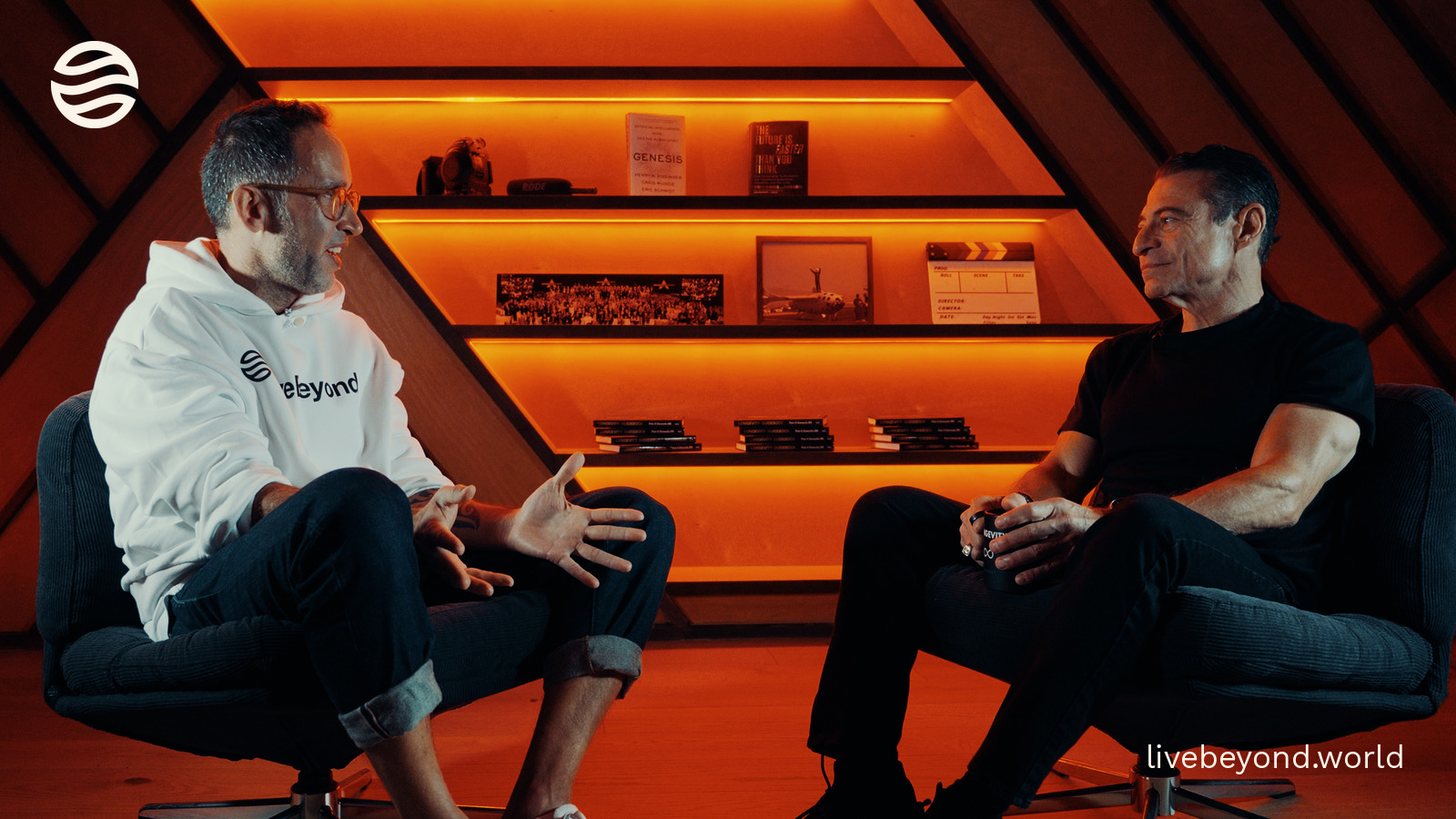
Marek Piotrowski and Peter Diamandis in his studio in Los Angeles, December 2025 — a Live Beyond interview on why optimists live longer.
Scientists measure optimism with a short questionnaire — for example, how strongly you agree that in uncertain times you usually expect the best. Then they follow people for years and see who stays healthy and who lives longer. In Los Angeles, Peter Diamandis, one of the first people who inspired me about longevity through his podcasts, told us about one of his favorite mindset hacks:
“One of my favorite mindset hacks, that I think everybody needs to know, and there was a study done at the National Academy of Sciences of 69,000 women and 1,500 guys, that showed optimists live 15% longer than pessimists. So just changing your mindset about being optimistic about the future can transform the length of your life.”
In plain words: Peter remembered it well. The study, published in the Proceedings of the National Academy of Sciences in 2019, followed 69,744 women for 10 years and 1,429 men for 30 years. The most optimistic women lived about 15% longer than the least optimistic, and the men about 11% longer. They also had 50 to 70% higher odds of reaching 85. [1]
Optimists live longer — in study after study
A review brought together 15 long-term studies with 229,391 people. Those who were more optimistic had about 35% lower risk of heart attacks, strokes and other heart problems, and about 14% lower risk of dying during the years they were followed.
Based on: Review of 15 studies · a link, not proof [2]
Women of every background
Among 159,255 American women followed for up to 26 years, the most optimistic quarter lived about 5.4% longer and were about 10% more likely to live past 90. The link held for women of different racial and ethnic backgrounds. Healthy habits like exercise and good food explained less than a quarter of it — so optimism seems to help in other ways too.
Based on: One large long-term study · a link, not proof [5]
How you see your own aging
In Ohio, 660 people aged 50 and older were asked how they felt about getting older. Those with the most positive views lived about 7.5 years longer — even after the scientists took account of age, gender, income, loneliness and health. Part of the difference was their will to live.
Based on: One long-term study · a link, not proof [4]
Words worth knowing
Three words behind a hopeful mind
From our glossary. Tap a card to turn it over: the science on the back, and the people we met who explained it to us.
No. 08 / 66Everyday word
Psychoneuroimmunology
The science of how your thoughts and feelings talk to your nerves, hormones and immune system.
No. 08 / 66Everyday word
Psychoneuroimmunology
Mind and body are one conversation: change one, and you change the others. Long stress, fear and loneliness keep inflammation running, and chronic inflammation is one of the twelve hallmarks of ageing. So longevity is not only your habits: what you think and feel is a power in your own hands. Read more →
“I love psychoneuroimmunology … that’s that intersection point between psychology, behavioral sciences, the nervous system, immunology, and endocrinology, i.e., funny enough, everything affects everything.”
Stress, cortisol and the alarm that never switches off
The sound is not the problem. Not being able to switch it off is.
What helps
Sleep is both a cause and a cure, and it is the first thing to fix. Exercise raises cortisol briefly and lowers the baseline. Connection matters more than most people expect — loneliness is a chronic stressor with its own mortality signal. Read more →
Robert Waldinger with Marek Piotrowski and Alek Piotrowski in Boston, November 2024 — a Live Beyond conversation about happiness, the mind and health.
How can a thought change how long you live? Olivia explained it to us in Singapore, on the day we met:
“I love psychoneuroimmunology, and as we were discussing before, that's that intersection point between psychology, behavioral sciences, the nervous system, immunology, and endocrinology, i.e., funny enough, everything affects everything. And we have so many more levers to pull when it comes to optimizing health, happiness, physical health as well because of the fact that everything is connected to everything. And I think that the mind aspect and the heart aspect tends to be a little bit overlooked because it's harder to quantify, harder to qualify.”
In plain words: Your mind, your nerves, your hormones and your immune system talk to each other all the time. A worry, a joy or a lonely evening is never only in your head.
Olivia told us about the work of the psychologist Alia Crum in Singapore, and again when we met in Formentera. Two of her experiments show it beautifully.
The same milkshake, two different bodies
46 young adults drank the same 380-calorie milkshake twice, a week apart. Once it was labeled as a 620-calorie indulgent treat, once as a 140-calorie sensible shake. After the indulgent label, their hunger hormone ghrelin dropped much more steeply; after the sensible label it stayed about flat. Same drink — the body followed the belief.
In seven hotels, 84 room attendants were told that their daily work counts as good exercise. Four weeks later, without changing what they did, they had lower weight, blood pressure, body fat and waist-to-hip ratio than colleagues who hadn’t been told.
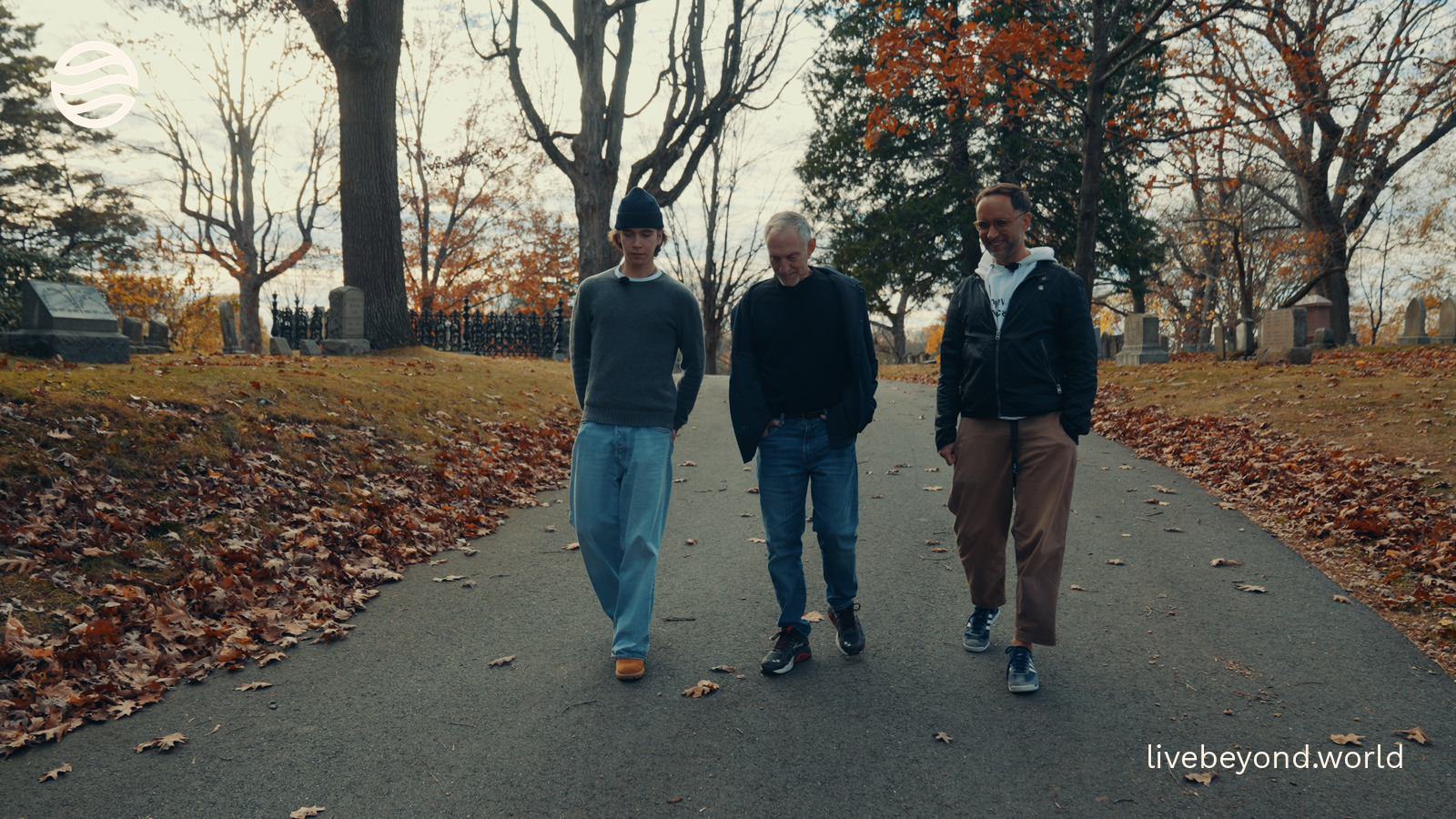
In Boston, Robert Waldinger, who directs the Harvard Study of Adult Development, chose to meet Alek and me in a cemetery with a beautiful park in it. From the first minute he felt like family, a very positive man. He told us why he became a psychiatrist:
“It's one of the reasons why mental health care is so useful for physical health, not just for emotional wellbeing. That people get better physically when they're happier, when they're less stressed. […] It's one of the reasons why I became a psychiatrist, because I thought it was the most fundamental part of medicine, that if you were desperately unhappy and struggling with mental illness, it was very hard to be physically healthy.”
In plain words: When people feel happier and less stressed, their bodies often get better too. Looking after your mind is part of looking after your body.
Heartset: what the heart adds
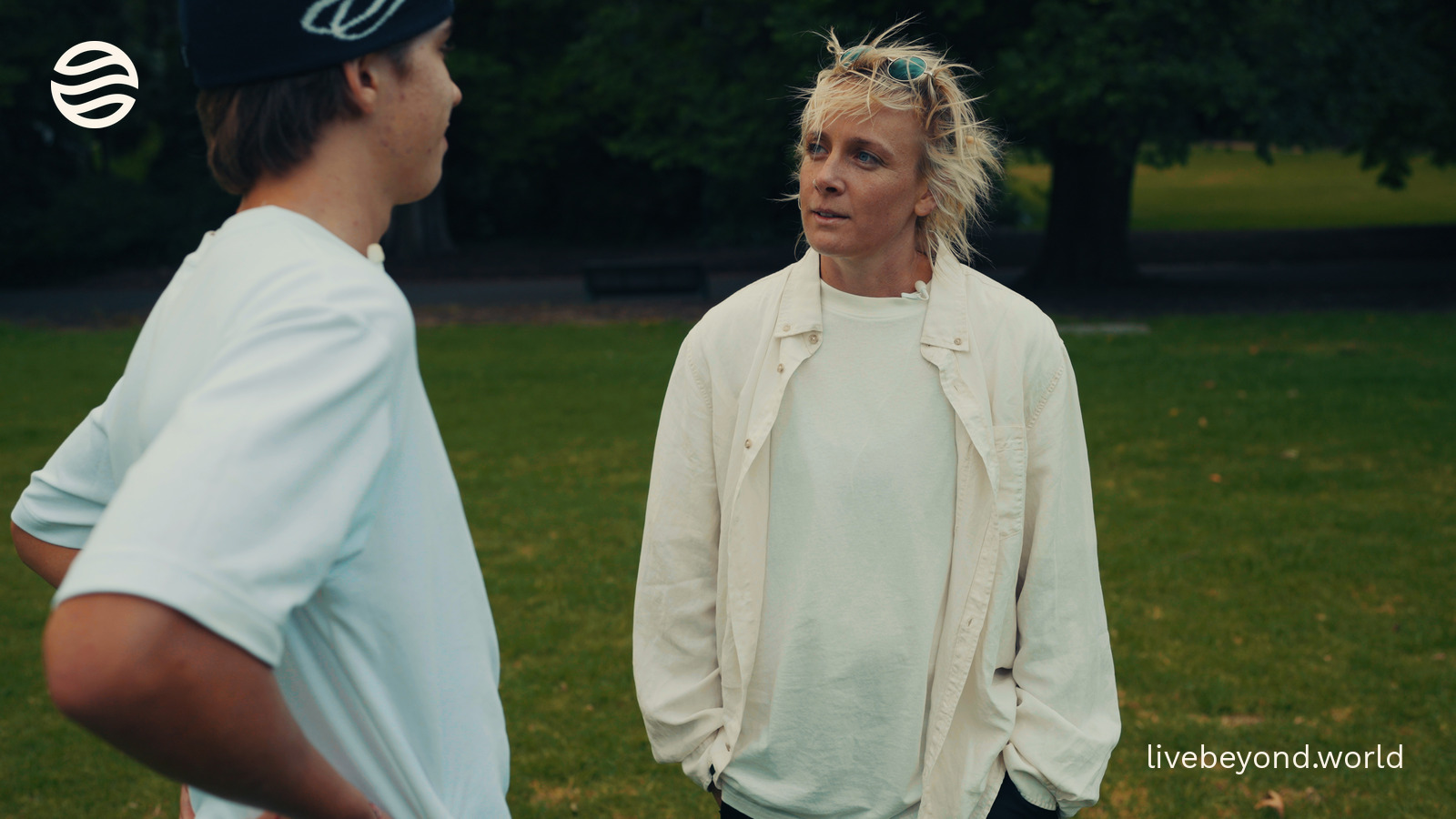
Nicole Gibson and Alek Piotrowski in Melbourne, January 2024 — a Live Beyond conversation about love of life and the will to live.
I like to say mindset and heartset. The mind is what you think; the heart is what you feel — love, gratitude, joy, and also fear and anger. When I introduce Olivia to friends, I call her the mind, heart and body doctor. In Singapore I asked her what our emotions do to us. She was honest that this part of the science is new, and then she said:
“I do know that we all have a sense that certain emotions and certain thoughts and ideas carry certain energy to it, right? Fear, anger, shame, guilt, there's a heaviness to it. Joy, compassion, forgiveness, there's a lightness to it.”
In plain words: Some feelings weigh you down and some lift you up. You can’t always choose what you feel, but you can choose what you feed: the people you spend time with, what you watch, how you spend your evenings.
In Melbourne we recorded two conversations with Nicole Gibson, who founded Love Out Loud, on one day — one with Alek and one with me. When I told her that I saw the right mindset as the basis for all longevity, she answered:
“I really believe that. […] I think we're still defining what longevity means. And when I contemplate it, I think of vitality, the vital force within us, the life force, and being able to extend that. And a lot of people, as we were just mentioning, have this kind of repressed life force. And so what does it really take to activate that? And once you do, I think you start to realize that there's this will to live, and that starts to kind of permeate and translate into the right mindset, the right behaviors, looking after yourself, not wanting to do harm to yourself.”
In plain words: When you love your life, you want more of it — and then looking after yourself stops feeling like a duty. That’s heartset. The heart also lives in other people: read Do good relationships help you live longer?
A mindset can be trained
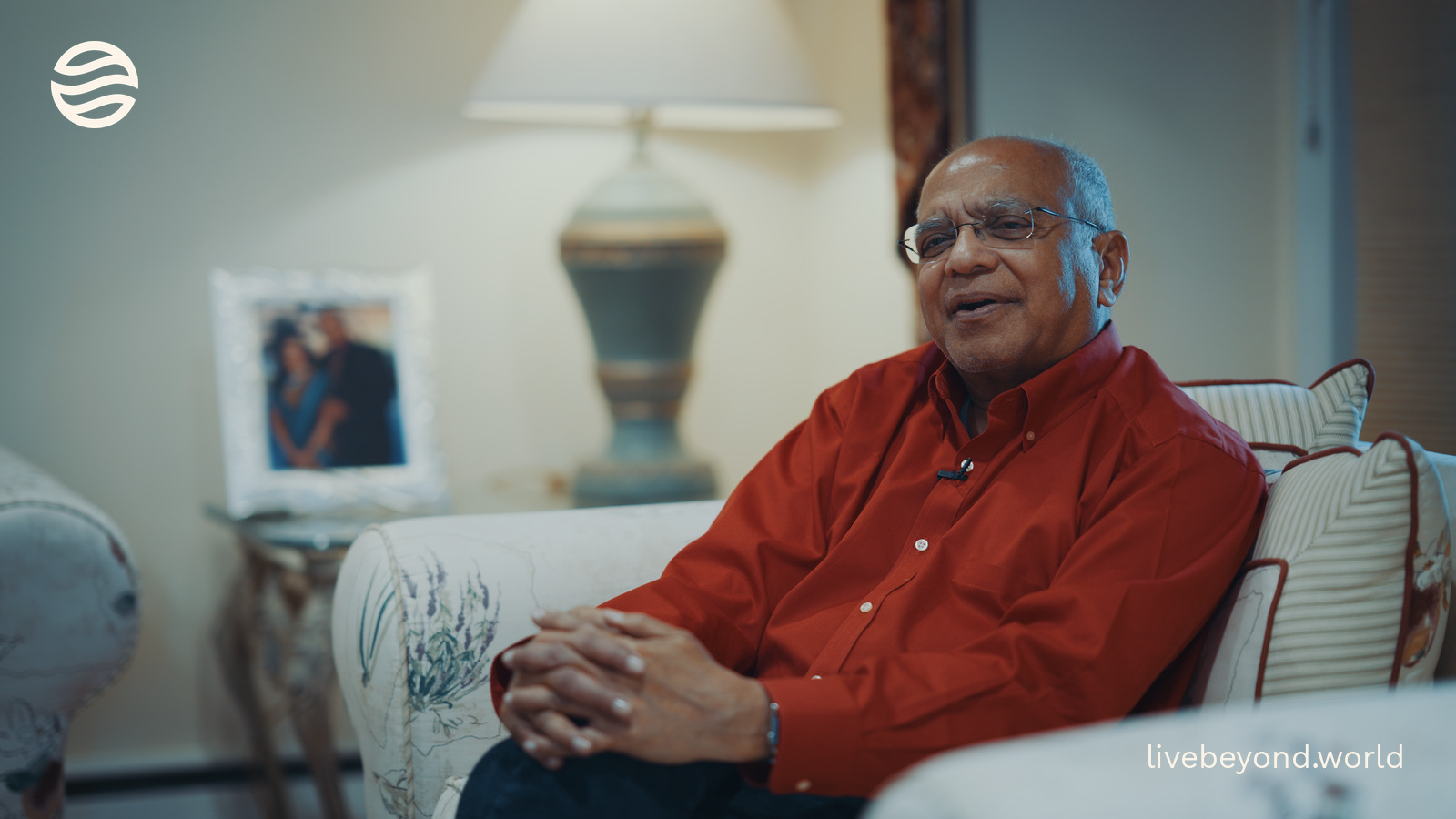
Srikumar Rao at his home on Long Island, New York, June 2024 — a Live Beyond interview with Marek Piotrowski on the stories we tell ourselves.
Here’s the best news on this page: optimism isn’t only a gift you’re born with. The experts we met train their minds every day, the way athletes train their bodies — and studies show that it works.
Optimism can be learned
A review of 29 randomized studies with 3,319 people found that short psychological exercises really did make people more optimistic. Among the most helpful was the Best Possible Self: imagining, and writing about, your life in the future when everything has gone as well as it could.
In New York, Srikumar Rao welcomed us to his house on Long Island. He teaches people to change the world around them by changing the way they look at it. He told us he wasn’t a longevity expert. I told him he was the longevity master. Here is one of his teachings:
“We're always telling ourselves stories. Anything happens and we instantly tell a story about it and spin it out far into the future, and sometimes we take the story into the past. […] There's no problem with telling stories to yourself. There is a problem with telling stories to yourself without recognizing that you're telling stories to yourself. […] What happens in your life is important, but much more important is the story you tell yourself about what happened in your life. And if you recognize that you're always telling stories, and some of these stories are very dysfunctional, they don't serve you well, that is the first step towards reclaiming your wellbeing, your happiness.”
In plain words: Things happen to all of us. Whether they become a disaster or a lesson depends a lot on the story we tell ourselves about them — and we can learn to notice that story and tell it differently.
His teaching became our rule for the rest of the quest. Whenever something went wrong or got lost, Alek and I asked each other: what good will come out of this bad thing, and how will it help us grow?
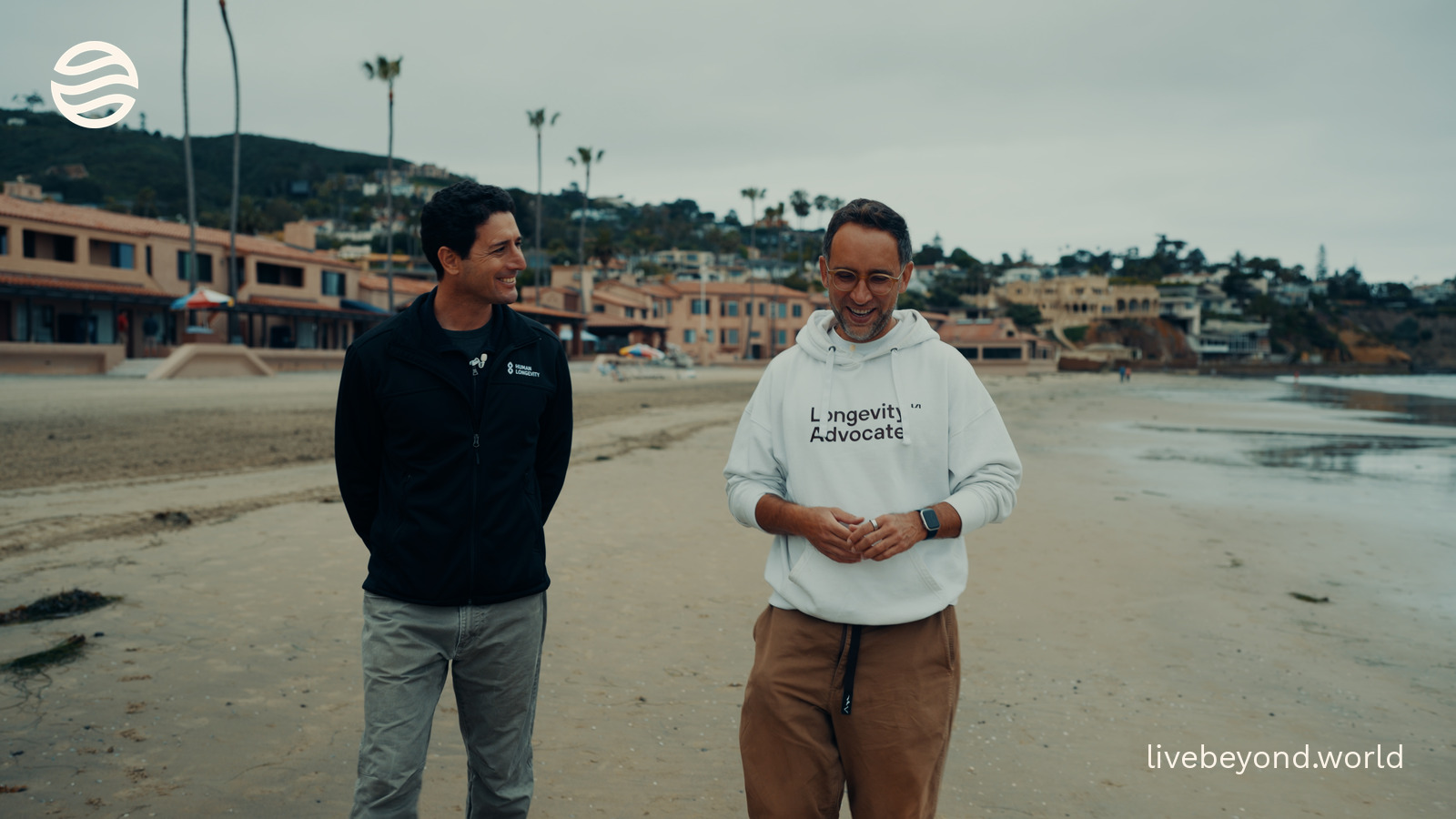
In San Diego, Eric Dinenberg, a mindset doctor we met at Human Longevity, took us to the beach where he grew up and where he now walks with his clients. His own path into mindfulness began with a hard time of his own, after an accident in medical school. He gave us the simplest exercise on this page:
“It's helpful to know that we are wired to hold onto negatives as they come in. That's just how we evolved, and we're also wired to push away positives. And so knowing that is helpful because then we can tell ourselves: I know that I'm wired to push away these positives, wired to hold onto these negatives, but I could then institute a practice to address that. Something like a very simple thing like journaling three good things before you go to bed. You just journal three good things from your day, and all of a sudden your mind the next day starts looking for good things.”
In plain words: Our brains hold on to bad news more easily than to good news. Writing down three good things each night trains your attention to notice the good.
Three good things
In an online study, people were randomly given one of six short exercises. Those who wrote down, every night for one week, three things that went well and why they went well were happier and less depressed six months later. 411 people completed the study.
Three good things. Tonight, before bed, write down three things that went well today, and why.
Your best possible self. Spend ten minutes imagining your life when everything has gone well, and write it down.
Catch the story. When something goes wrong, notice the story you’re telling yourself. Then ask: what good could come of this?
Choose what you feed your mind. The people you spend time with, what you read, watch and listen to — they all shape how you see the future.
Ten seconds of now. Before a meeting or while you wash your hands, notice your breath for ten seconds.
What people doubt
Eric Dinenberg and Marek Piotrowski on the beach in San Diego, May 2024 — a Live Beyond conversation about training the mind.
We want to be honest about where the science stops.
Cause or link? Almost every number on this page comes from long-term studies. Scientists take account of health, money, habits and low mood, but a link is still a link.
Which comes first? Healthy people may find it easier to be hopeful, and illness can take hope away. Probably both are true.
Not forced cheerfulness. Optimism here means expecting good things and working toward them — not pretending everything is fine. Feeling sad, angry or afraid is human.
Small steps, not miracles. The exercises help, but the changes are moderate, and they last when you keep practicing.
The mind isn’t everything. A good mindset doesn’t replace sleep, movement, good food, check-ups or your doctor. It helps you do them.
And when life is really hard, nobody should feel they failed at optimism. Eric put it beautifully:
“It's very helpful to understand that during some parts of our life, some times in our life, we don't really have a choice. We're just feeding that wolf. Maybe we're in depression or maybe we're in anxiety. […] And it's wolf time. And so that's where these modalities and practices can help people come out of their suffering enough to understand that they have a choice. I can choose to feed not the wolf, but the dog. And then that makes all the difference.”
In plain words: When you’re depressed or very anxious, you can’t simply think yourself happy — and that isn’t your fault. That’s the time to ask for help, and to lean on practices and people that lift you enough to choose again.
Where the joy is
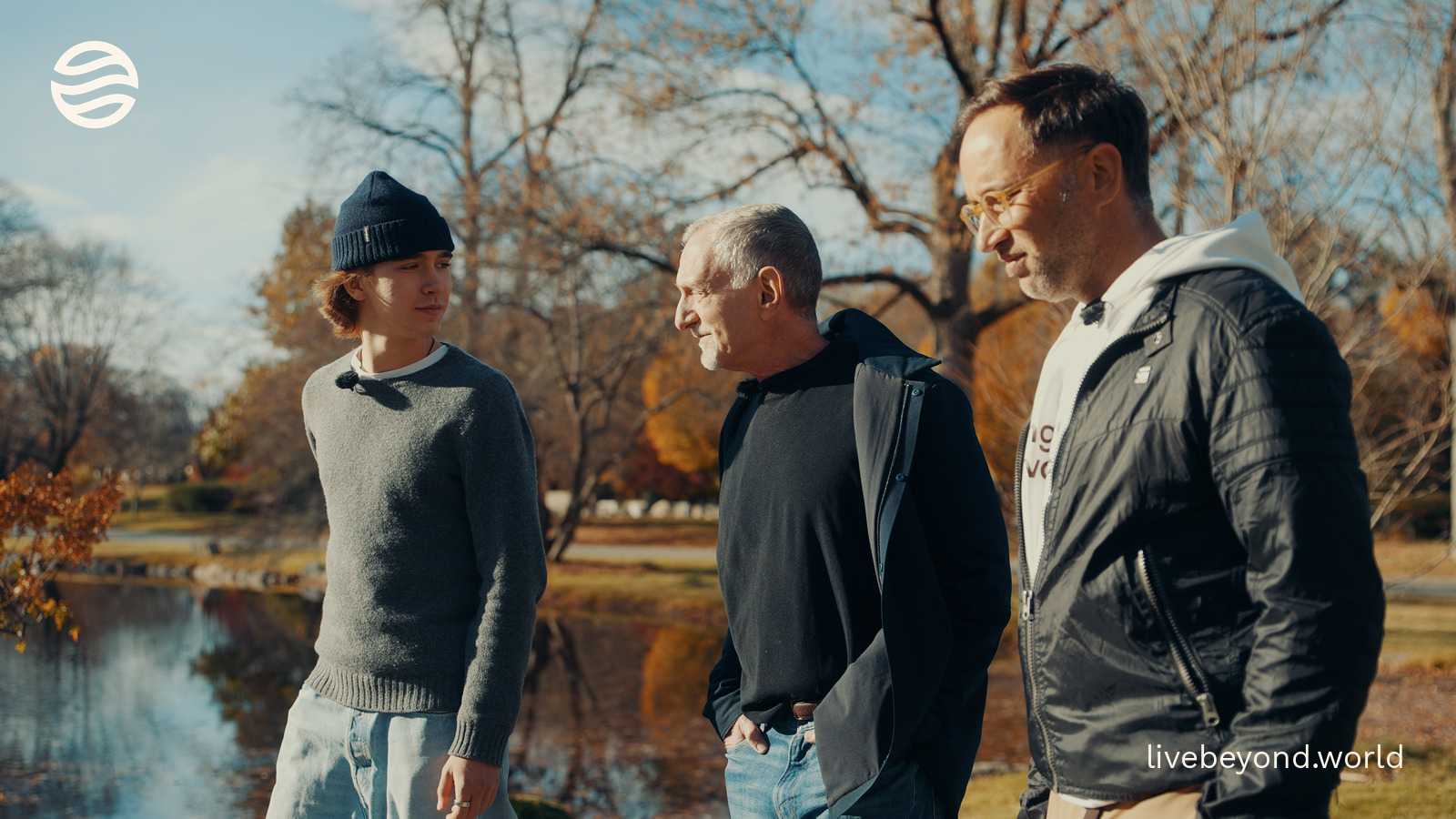
Alek Piotrowski, Robert Waldinger and Marek Piotrowski walking in Boston, November 2024 — Live Beyond, on what a long life is for.
In Boston, Alek told Robert Waldinger that many of his friends don’t want a long life, because they imagine it poor and unhappy. Robert answered:
“The other thing is that changing mindsets may not require a lot of money, and it may not require a lot of technology. It may require helping people to understand more about lifestyle changes and dealing with stress and being more socially connected, that those are not expensive solutions. And they're very powerful solutions compared with a lot of the high tech things that cost a lot of money.”
In plain words: Some of the most powerful longevity tools for the mind are almost free: learning to deal with stress, people you love, and small daily habits.
That’s the joy for me. I learned that problems will always be there, and I can still be happy every day. Optimism isn’t pretending life is easy. It’s loving life so much that you want more of it. Longevity isn’t a fear of dying — it’s that I love every day, and I want it to last. Start tonight: three good things, a call to someone you love, a story told a little more kindly. And if you want to go further, read what we learned about having a purpose.
Every number on this page, by the number in square brackets. Quotations come from Live Beyond’s own recorded interviews, cleaned only of “um” and “uh”. Not medical advice. Talk to your doctor before you change anything.
Lee LO, James P, Zevon ES, Kim ES, Trudel-Fitzgerald C, Spiro A III, Grodstein F, Kubzansky LD. Optimism is associated with exceptional longevity in 2 epidemiologic cohorts of men and women. Proc Natl Acad Sci USA. 2019;116(37):18357-18362. doi:10.1073/pnas.1900712116
Rozanski A, Bavishi C, Kubzansky LD, Cohen R. Association of optimism with cardiovascular events and all-cause mortality: a systematic review and meta-analysis. JAMA Netw Open. 2019;2(9):e1912200. doi:10.1001/jamanetworkopen.2019.12200
Malouff JM, Schutte NS. Can psychological interventions increase optimism? A meta-analysis. J Posit Psychol. 2017;12(6):594-604. doi:10.1080/17439760.2016.1221122
Levy BR, Slade MD, Kunkel SR, Kasl SV. Longevity increased by positive self-perceptions of aging. J Pers Soc Psychol. 2002;83(2):261-270. doi:10.1037/0022-3514.83.2.261
Koga HK, Trudel-Fitzgerald C, Lee LO, et al. Optimism, lifestyle, and longevity in a racially diverse cohort of women. J Am Geriatr Soc. 2022;70(10):2793-2804. doi:10.1111/jgs.17897
Crum AJ, Corbin WR, Brownell KD, Salovey P. Mind over milkshakes: mindsets, not just nutrients, determine ghrelin response. Health Psychol. 2011;30(4):424-429. doi:10.1037/a0023467
Crum AJ, Langer EJ. Mind-set matters: exercise and the placebo effect. Psychol Sci. 2007;18(2):165-171. doi:10.1111/j.1467-9280.2007.01867.x
Seligman MEP, Steen TA, Park N, Peterson C. Positive psychology progress: empirical validation of interventions. Am Psychol. 2005;60(5):410-421. doi:10.1037/0003-066X.60.5.410