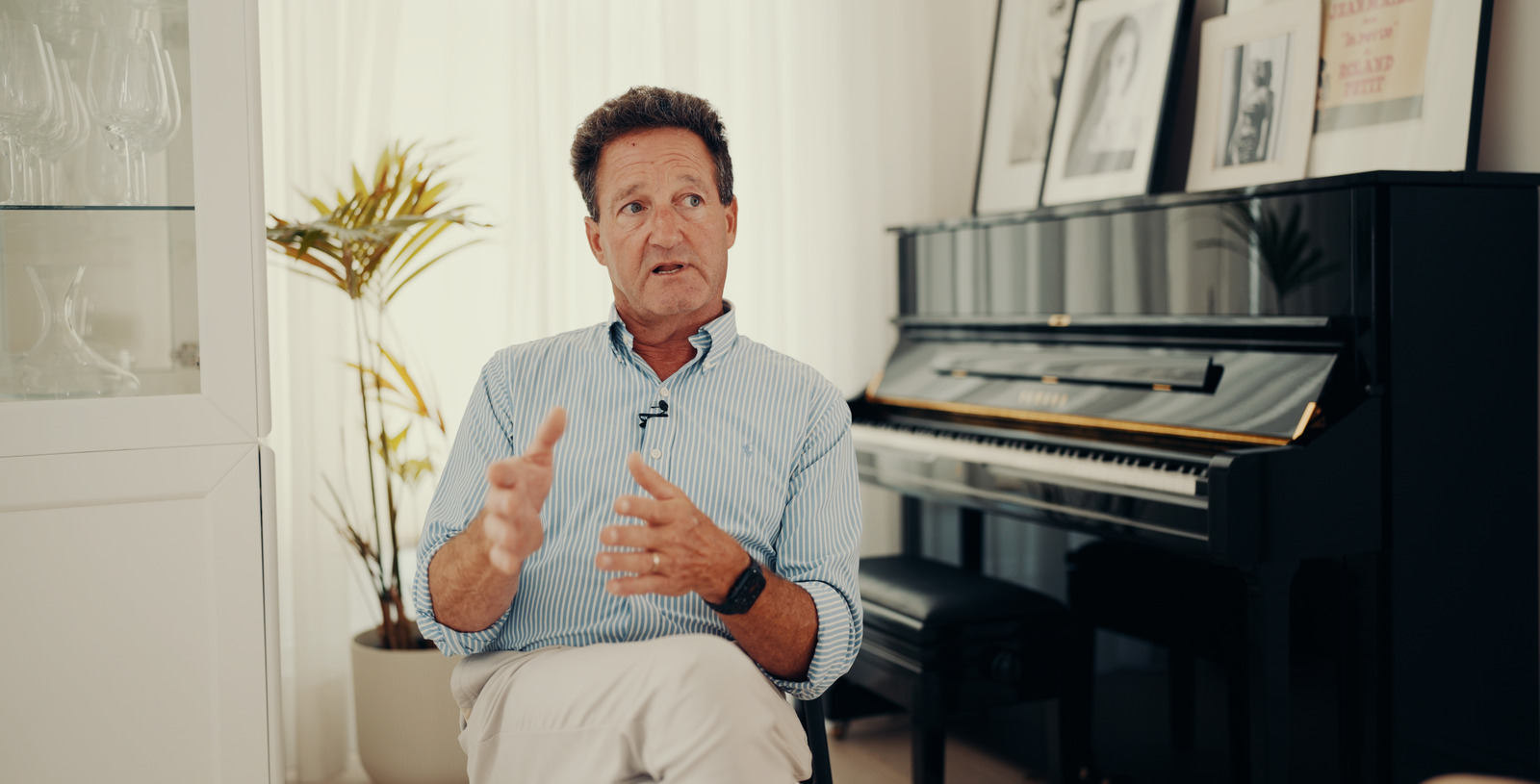
Marek Piotrowski and Liz Parrish on a forest walk near Seattle, June 2024 — a Live Beyond conversation about gene therapy.
On our quest, my son Alek and I met more than a hundred longevity experts in 39 countries and states. Gene therapy came up again and again — the idea that adding a gene could keep us younger. I wanted to try it myself. So I asked the scientists I trust most: would you do it? This page explains what gene therapy is, what has been shown and what hasn’t, and what they answered. It still needs to be proven, but the pioneers are already on their way.
Promising — and the first results are already here. For us, longevity is much more than the length of life: it’s more healthy, strong, clear-minded and joyful years. Gene therapies aim at exactly that. In animals they bring lives that are both longer and healthier, and the pioneers who took them report more muscle, longer telomeres, a sharper mind and no serious side effects. The big human trials are just starting — and that’s where most of the scientists we asked would begin. [1][2][3]
Longevity, as we mean it: more healthy, joyful years. What we mean →
24%longer typical life in mice given a telomerase gene therapy at one year of age — and healthier, with no rise in cancer.[1]
6.71 → 8.12kb: the telomeres in Liz Parrish’s white blood cells before her 2015 gene therapies and in 2018, by her own measurements.[4][5]
26+people Dr Patrick Sewell told us he has treated with follistatin gene therapy, with zero negative changes.
Before you change anything
This page shares what research and the experts we met say. It is not medical advice, and it does not recommend any medicine, supplement or treatment. It knows nothing about you. Before you start, stop or change anything — especially if you are pregnant, live with a health condition or take any medication — please talk to your doctor. In an emergency, call your local emergency number.
What gene therapy is
Liz Parrish and Marek Piotrowski walking through a hotel in Shanghai, 2023 — Live Beyond, talking about the four gene therapies she took.
Your genes are instructions. A gene therapy adds a new copy of one instruction to your cells, so they make more of a protein the body makes less of as it ages. The gene usually travels inside a harmless, emptied-out virus, called a vector, that carries it into the cells and leaves it there.
Four genes come up again and again in longevity: follistatin (helps keep muscle), klotho (linked to healthy kidneys, brain and blood vessels), telomerase (protects the ends of our chromosomes) and PGC-1α (helps the energy factories in our cells). Liz Parrish took all four herself: follistatin and telomerase in 2015, then all four together in 2020.
Gene therapy is not gene editing
Gene editing, like CRISPR, changes the letters of a gene that is already there. The gene therapies discussed for aging don't change your own genes. They add an extra working copy that makes more of a helpful protein.
Based on: How the treatments work
Longer life — and a better one
Matt Kaeberlein in Seattle, June 2024 — a Live Beyond interview with Marek Piotrowski on lifespan and healthspan.
When I say longevity, I don’t mean only the length of life. In my definition, it’s every span of a good life: healthspan, joyspan, cognitive span, beauty span, fitness span. Years when you’re strong, sharp and happy. What longevity means to us.
People sometimes worry that science will give us extra years of frailty. Matt Kaeberlein, who has studied aging for decades, told me in Seattle why that isn’t what he sees in the lab:
“Nobody wants an extra 20 years of disability and frailty. I think it’s important to reassure people that, first of all, that’s not the goal, and secondly, […] there is not a single case that I have seen in laboratory animals where lifespan has been extended and healthspan wasn’t extended. If anything, the interventions like rapamycin disproportionately extend healthspan, meaning the animals are living longer, but they’re healthier for an even greater proportion of their lifespan.”
In plain words: In the animal studies, living longer and staying healthy go together. That’s why a therapy that targets aging itself is so exciting: it’s about more good years, not just more years.
What has been shown
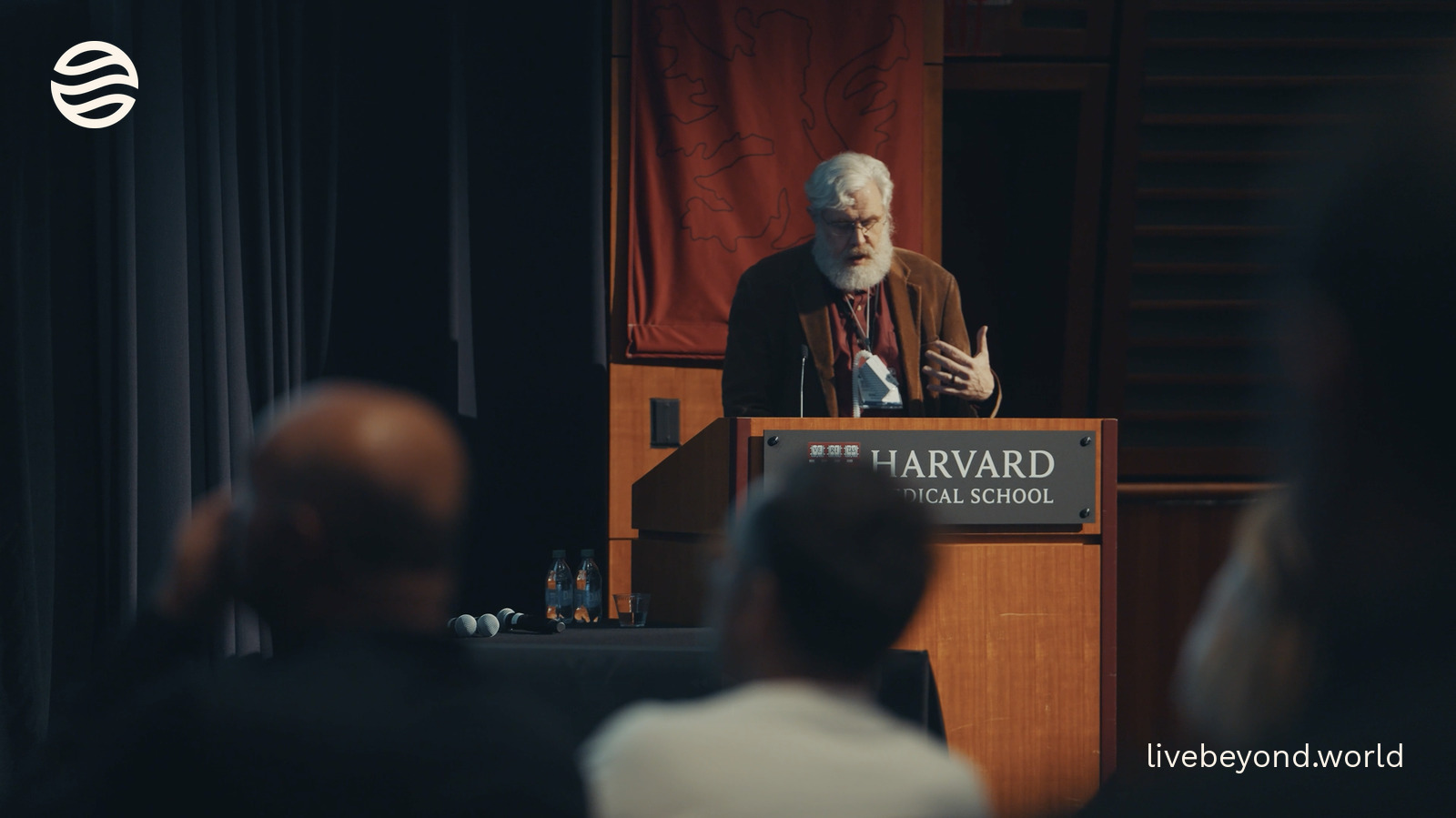
George Church speaking at Harvard Medical School, Boston, November 2024 — filmed by Live Beyond at the Biomarkers of Aging conference.
In mice, it can extend life
Mice given a telomerase gene therapy at one year of age — middle age for a mouse — lived about 24% longer on average, and were healthier, without more cancer. Mice that make extra klotho live longer too.
In George Church’s lab, a single combination of three genes treated several age-related diseases in mice at the same time: overweight, type 2 diabetes, heart failure and kidney failure.
Gene therapy is already approved medicine for some rare inherited diseases, starting in 2017 with an inherited form of blindness. For aging, the human trials are only beginning.
Patrick Sewell in London, July 2024 — a Live Beyond interview with Marek Piotrowski on follistatin and klotho gene therapy.
We don’t have the big human trials yet — but we already have results. The first people who took these gene therapies have been measuring themselves, and their doctors have been watching closely.
Liz Parrish: longer telomeres, more muscle, a sharper mind
In September 2015, before her first gene therapies, the telomeres in Liz Parrish’s white blood cells measured 6.71 kb — short for her age. By March 2016 they measured 7.33 kb, and by 2018 8.12 kb; by 2024, BioViva reports, they were longer than a healthy 25-year-old’s. She also reported more muscle mass, still there years later, less fat inside her muscles, excellent blood sugar control, very low inflammation and no side effects. And after klotho, she reports her IQ went up by 10 points.
Based on: Her own measurements, published by BioViva [4][5][3]
“My IQ increased by 10 points after taking Klotho.”
In London, Dr Patrick Sewell told us about the people he has treated with follistatin gene therapy:
“I personally have treated around 26 patients […] with follistatin, and maybe over 30. […] Zero negative changes, and that was amazing. No allergy reaction, no deaths, no sickness, no illness.”
And for him, the bigger muscles are only the beginning:
“It lowers your hemoglobin A1C, which is related to obesity, type 2 diabetes. […] It also facilitates and often causes resorption of atherosclerotic plaque. So plaque in your coronary arteries, plaque in your cerebral arteries, which are related to heart attack and stroke. […] The early data shows that it does. The plaque does regress after follistatin.”
He is just as excited about klotho, a gene whose levels in the brain fall as we age, along with small memory slips and fuzzy thinking:
“If you reintroduce klotho, raise klotho levels in the brain, those symptoms reverse back in time to 10 years ago or 20 years ago. So klotho therapy as an anti-aging therapy can give you clarity of mind by raising the klotho levels through, say, gene therapy.”
In plain words: Early results from a small number of people, and they look really good. The trials now starting will show how well these therapies work, and for whom.
What still needs proving
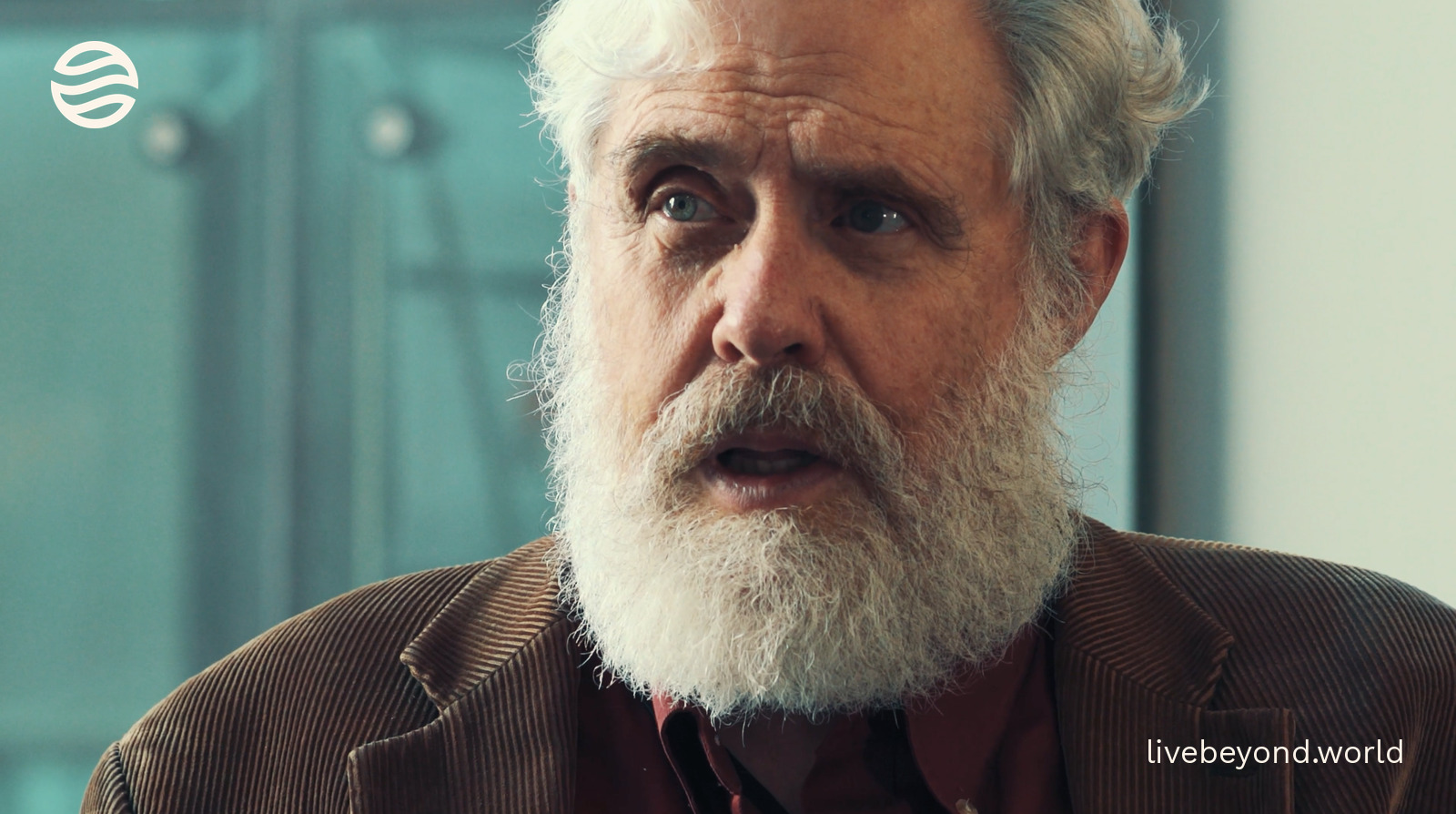
George Church at Harvard Medical School, Boston, November 2024 — a Live Beyond interview with Marek Piotrowski on why trials come first.
How well it works for everyone
The results so far come from animal studies and a small number of pioneers. Large clinical trials are what will show how much these therapies help, and for whom.
Based on: Where the science is today
That one person trying it tells us much
George Church told us why he isn’t in a rush. If one person tries a therapy with no comparison and no blinding, we learn very little — not even whether it helped that person — unless the effect is dramatic.
Based on: Interview, Boston, November 2024
“There are many cases where something that looks really good on paper kills people. For example, the first two gene therapies killed a few people and the first monoclonal antibodies almost killed four people on the first day.”
In plain words: Something can look perfect in the lab and still go wrong in a human body. That is why trials start small, go slowly and watch closely.
Words worth knowing
Three words behind the genes
From our glossary. Tap a card to turn it over: the science on the back, and the people we met who explained it to us.
No. 33 / 66Therapy
Gene therapy
Giving cells a new or corrected instruction, delivered into their DNA.
No. 33 / 66Therapy
Gene therapy
Already used for some rare inherited diseases caused by one faulty gene. Against ageing itself it is still experimental: a few people, Liz Parrish first among them, have tried it on themselves, and the large trials have not been done. It may take us past today’s limits, and it is the one to watch most carefully for safety. Read more →
“I do believe that it will be the gene therapies that bust the bottleneck of the 120 years.”
Scientists first listed them in 2013 and brought the list to twelve in 2023; Guido Kroemer, whom we filmed, is one of the authors. Every process further down this page belongs to one of the twelve.
George Church and Marek Piotrowski at Harvard Medical School, Boston, November 2024 — the Live Beyond interview where Marek asked: would you do it?
I wanted to try one of these gene therapies myself, to show people that the future is coming. So on the road I asked the scientists I trust most the same question: would you do it? Their answers were a real spread, and every one of them was honest.
George Church, whose lab has worked on the gene combinations many of these therapies come from, gave me the answer I keep coming back to:
“I'm in between. I would say that I'll do it in the context of a clinical trial that's well thought through and the pre-clinical phase has been quite clear. If you're gonna do a combination, you have to do that combination ideally in primates or in human organoids or some other thing, ideally in both, so you really get it.”
In plain words: Yes — but only in a proper clinical trial, built on clear results in animals, and testing the exact combination you would take.
And then he explained why being careful matters even if you are not the first person to try something:
“Yes, you may not be the first, but you may be the first that has something about you, right? Like, you could be taking another drug that interacts with it, or you could have a genetic predisposition for a particular problem, or you could have an infectious disease you do or don't know about. […] We plan for the worst and hope for the best rather than just, do I feel lucky and do Russian roulette?”
In plain words: Each body is different. A therapy that was fine for others can still meet something unique in you.
Aubrey de Grey, who has spent his life arguing that aging can be defeated, surprised me:
“No, I wouldn't do it yet. But that's not to say much. […] I'm not much of a risk-taker at heart in the first place. But I think we need to applaud people like Liz for going out on a limb and doing what she thought was best for herself, and we need to encourage people like Liz and empower people like Liz to gather data on themselves and to allow us to analyze that data so that discoveries can be made.”
In plain words: Not yet for him. But the people who go first and share their data help everyone else.
Vittorio Sebastiano, who has become a friend, didn’t hesitate:
“Since, I mean, you said we're friends, right? So as a friend, I'm gonna tell you that I would like you not to do that, very frankly. At least not now with the information that we have at the moment, right? […] As a part of a clinical trial done in the right way, why not?”
In plain words: Not now, not alone — but in a trial done the right way, why not.
Andrea Maier, a doctor who also runs a longevity clinic, was clear about when she would say yes:
“Sure. Let's do it. Absolutely. Life is too short to die. I fully agree with you. We just have to then define what kind of efforts do you have, and is it worthwhile, for whom it's worthwhile to go to this radical. But if it would be available for a mass of individuals, absolutely. Let's go for it. Because this is medicine. I studied medicine to prevent people to die.”
In plain words: Once it is proven and available to many people, not only to a few.
Would Peter Diamandis do it? He’s close:
“We consider ourselves the chief guinea pigs. So we'll try these therapies early on. I'm very close to wanting to do both Klotho and follistatin. I feel like I'm willing to wait another year or two, and then take it on.”
Liz Parrish didn’t need to be asked twice. In 2015 she became one of the first people to take a gene therapy for aging herself. She explained why:
“I did not come into this industry to live a long time. I came here because my son was diagnosed. […] I didn't come to live forever. I came to see if we could. […] I'm a doer, and if I die doing, that's my business, not theirs.”
“This year, 36 million people minimally will die of biological aging associated diseases. And so this is a case where we can take out new medicine, and we can say it's safe enough to use now.”
In plain words: For Liz, waiting has a cost too. Every year, millions of people die of diseases that come with aging.
Would Dane Gobel do it? Yes, probably:
“I got invited to participate in a clinical trial for follistatin, and I've actually been talking with some folks about doing a Klotho trial. […] Personally, I think it's very interesting, and I'd probably do it. I'd wanna dig into it.”
Oz Garcia didn’t wait either. When we walked through Central Park together, he had just done it:
“At my age, given the fact that I’m concerned with muscle wasting, sarcopenia, which is a sign of aging, premature aging, once I knew that I could do follistatin gene therapy, I just went and did it. And like that, I’m willing to consider myself somebody who is willing to experiment.”
“Number one, I would say as a hedge against aging. […] As I’ve gotten older, I want to be careful in terms of how much exercise I do and the kind of exercise that I do. […] And the follistatin gene therapy is an extremely promising approach to building a substantial amount of extremely healthy muscle without, in a way, putting in the effort.”
Eric Verdin, who runs the Buck Institute for Research on Aging, isn’t in a hurry. He worries for the whole field:
“There's a part of me that's afraid because we are an emerging field. The last thing we need is to kill someone young. And I'm concerned about some of the high-risk interventions that are being made. So not to say that what Liz did is dangerous, I do not know the full technical details, but I do worry.”
So, would you do it? When I asked Brian Kennedy what people should do about gene therapies like these, he handed the question back to each of us:
“I don't like to tell people what to do. I think an individual watching this, if they wanna try to extend their healthspan, they should match their approach to their personality. Do they wanna only do validated interventions, which is gonna be mostly lifestyle, or do they wanna be on the cutting edge and try stem cell therapy or gene therapy? […] You have to decide where you wanna be in it.”
Where the joy is
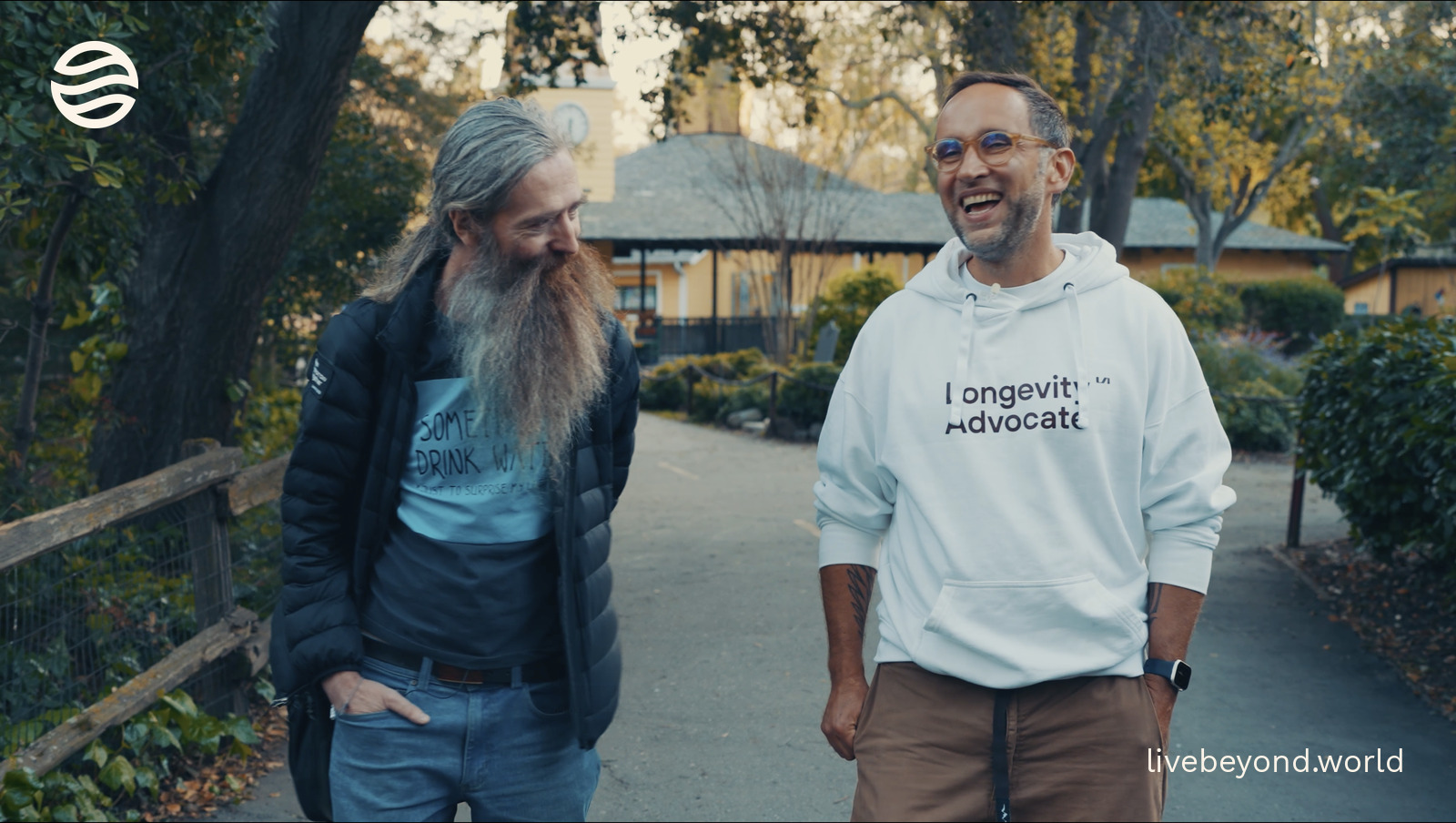
Aubrey de Grey and Marek Piotrowski laughing on a walk in Los Gatos, California — Live Beyond.
I still haven’t decided. Here is what I told George in Boston:
“I like to do it, just to show people that the future is coming.”
That is the joy for me: these scientists are real people working on something that may change how long we all live — and they answered me as friends, honestly, even when the answer was “not yet”. Meanwhile the things that are proven are free: moving every day, sleeping well, real food and time with the people you love. Those keep you healthy enough to be there when the science arrives.
Who should be careful
Only inside a trial
Gene therapies for aging are not approved anywhere for healthy people. Some clinics abroad offer them for money, outside any trial. You can’t take a gene therapy back once it is in your cells. If you are interested, look for a registered clinical trial and talk to your doctor first.
Your own situation
Other medicines you take, a hidden infection or your genes can change how a therapy works in you — exactly the point George Church made.
Based on: Interview, Boston, November 2024
What to ask before joining a trial
Is the trial registered? Look for its number on a public registry, such as ClinicalTrials.gov.
What happened in animals? Ask for the results that made the team confident enough to try it in people.
Is there a comparison group? A trial with blinding and a comparison is how we learn whether something works.
Who looks after me, and for how long? Gene therapies can act for years, so the follow-up should be long too.
Not medical advice, and not a recommendation for or against gene therapy. We describe what the studies say and what the scientists told us.
Every number on this page, by the number in square brackets. Quotations come from Live Beyond’s own recorded interviews, cleaned only of “um” and “uh”. Not medical advice. Talk to your doctor before you change anything.
Bernardes de Jesus B, Vera E, Schneeberger K, Tejera AM, Ayuso E, Bosch F, Blasco MA. Telomerase gene therapy in adult and old mice delays aging and increases longevity without increasing cancer. EMBO Mol Med. 2012;4(8):691-704. doi:10.1002/emmm.201200245
Davidsohn N, Pezone M, Vernet A, et al., Church GM. A single combination gene therapy treats multiple age-related diseases. Proc Natl Acad Sci USA. 2019;116(47):23505-23511. doi:10.1073/pnas.1910073116
Alonzi A, Hall R. The World’s Most Genetically Modified Person. BioViva Science, 2024. bioviva-science.medium.com/the-worlds-most-genetically-modified-person-dcc342b93d3e (BioViva’s own report.)
The Scientist. First data from anti-aging gene therapy. April 2016. (Telomere results reported by BioViva; not peer-reviewed.)
Parrish E. Update on her 2015 telomerase and follistatin gene therapies, BioViva, 2018. Reported in Fight Aging!: An update on a human telomerase and follistatin gene therapy, August 2018.
Kurosu H, Yamamoto M, Clark JD, et al. Suppression of aging in mice by the hormone Klotho. Science. 2005;309(5742):1829-1833. doi:10.1126/science.1112766
U.S. Food and Drug Administration. FDA approves novel gene therapy to treat patients with a rare form of inherited vision loss. News release, 19 December 2017.