Longevity escape velocity: can science outrun aging?
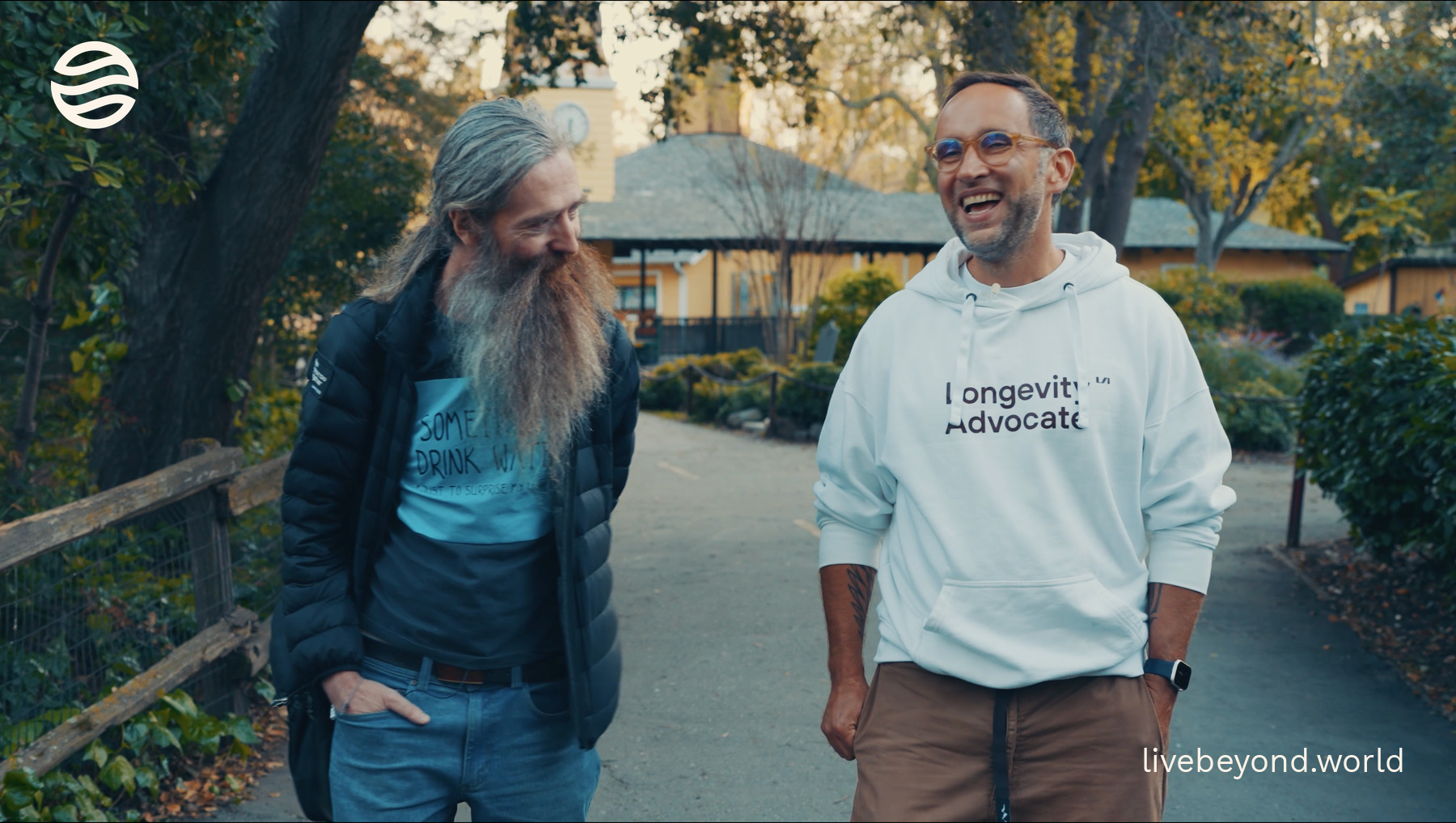
Marek Piotrowski and Aubrey de Grey laughing on a walk in Los Gatos, California, April 2024 — a Live Beyond interview on longevity escape velocity.
Our quest began in Dublin, in August 2023, at Aubrey de Grey’s Longevity Summit. Aubrey is the man who started the whole wonderful craziness around longevity, and he gave its biggest dream a name: longevity escape velocity. The next spring he invited my son Alek and me to Los Gatos, California, and we filmed a walking interview with him in a park. This page explains in plain words what escape velocity is, when it could happen, what it needs — science, money and the will of all of us — what other scientists think, the honest doubts, and what it means for you and me today.
Longevity escape velocity is the moment science starts giving us back more than a year of healthy life for every year we live — so, for as long as it keeps up, aging can no longer catch up with us. Aubrey de Grey, who coined the term, gave it a 50/50 chance within about 12 to 15 years when we asked him in 2023, and again in 2024. Some scientists we met share his hope, others think it will take much longer — and every step on the way means more healthy, strong and joyful years. The best way to be there when it comes is the same for all of us: stay healthy now. [1]
Longevity, as we mean it: more healthy, joyful years. What we mean →
1 yearof healthier life added for every year that passes — that is escape velocity, in the words Aubrey de Grey used with us in Los Gatos.
3 monthsis about how much life expectancy has risen every year, for 160 years, in the country with the longest lives. Escape velocity needs all twelve.[2]
$38 trillionthe value of slowing aging just enough to add one year to life expectancy in the United States, one study estimates.[3]
What longevity escape velocity is
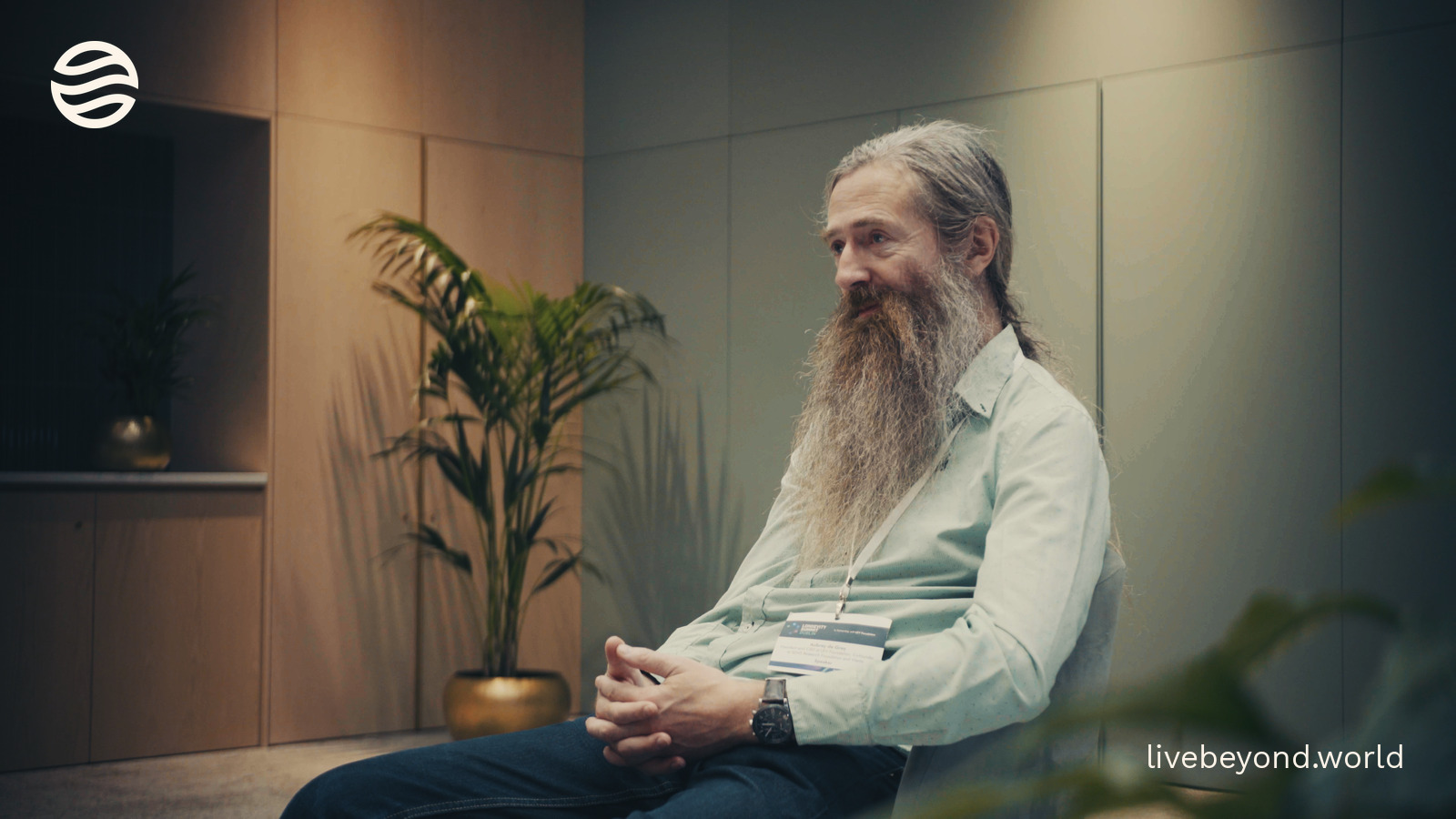
Aubrey de Grey in Dublin, August 2023 — a Live Beyond interview with Marek Piotrowski on what longevity escape velocity means.
Think of a rocket. To leave the Earth for good, it has to fly so fast that gravity can never pull it back. That speed is called escape velocity. Aubrey de Grey borrowed the idea for aging.
Today, medicine and good habits already give us extra years. But every year we live, we also get a year older. Escape velocity is the moment science gives back more than time takes away: every year, the treatments get good enough to push the problems of old age further off than the year we just lived. From then on, as long as science keeps improving, aging can’t catch us. This is how Aubrey put it to us in Los Gatos:
“That means getting to the point where not only are we trying really hard as a species, humanity overall is trying really hard to fix aging, but actually we've succeeded to the point of postponing the health problems of late life by one year for every year that passes.”
In plain words: Every year, science pushes the illnesses of old age back by at least a year. If it keeps doing that, you never reach them.
Where the name comes from
In 2004, Aubrey set out the idea in a scientific paper called “Escape velocity”. His point: we don’t need a cure for all of aging at once. If the treatments improve fast enough, people who are alive when the first ones arrive can stay ahead of aging. He called that rate “actuarial escape velocity”; the world came to know it as longevity escape velocity. The first spark came from David Gobel of the Methuselah Foundation, whom Aubrey later introduced us to; Aubrey gave it its name in science.
And the first step is the hardest. In Dublin, Aubrey told us why:
“I think that once we get those first 20 years or so, we will have done the hard part. I think that will actually get us to longevity escape velocity because 20 years is a long time in medical research, and I think that it's pretty much certain that 20 years will be long enough for researchers to figure out improvements so that damage repair 2.0 gets the next 20 years.”
In plain words: The first treatments could buy us about 20 healthy years. In those years, scientists build better ones — version 2.0 — and then 3.0. Nobody has to solve everything at once. On our graph of every span of a good life, this is the far end: the point where the whole curve keeps moving forward.
Aubrey de Grey: the man who started it
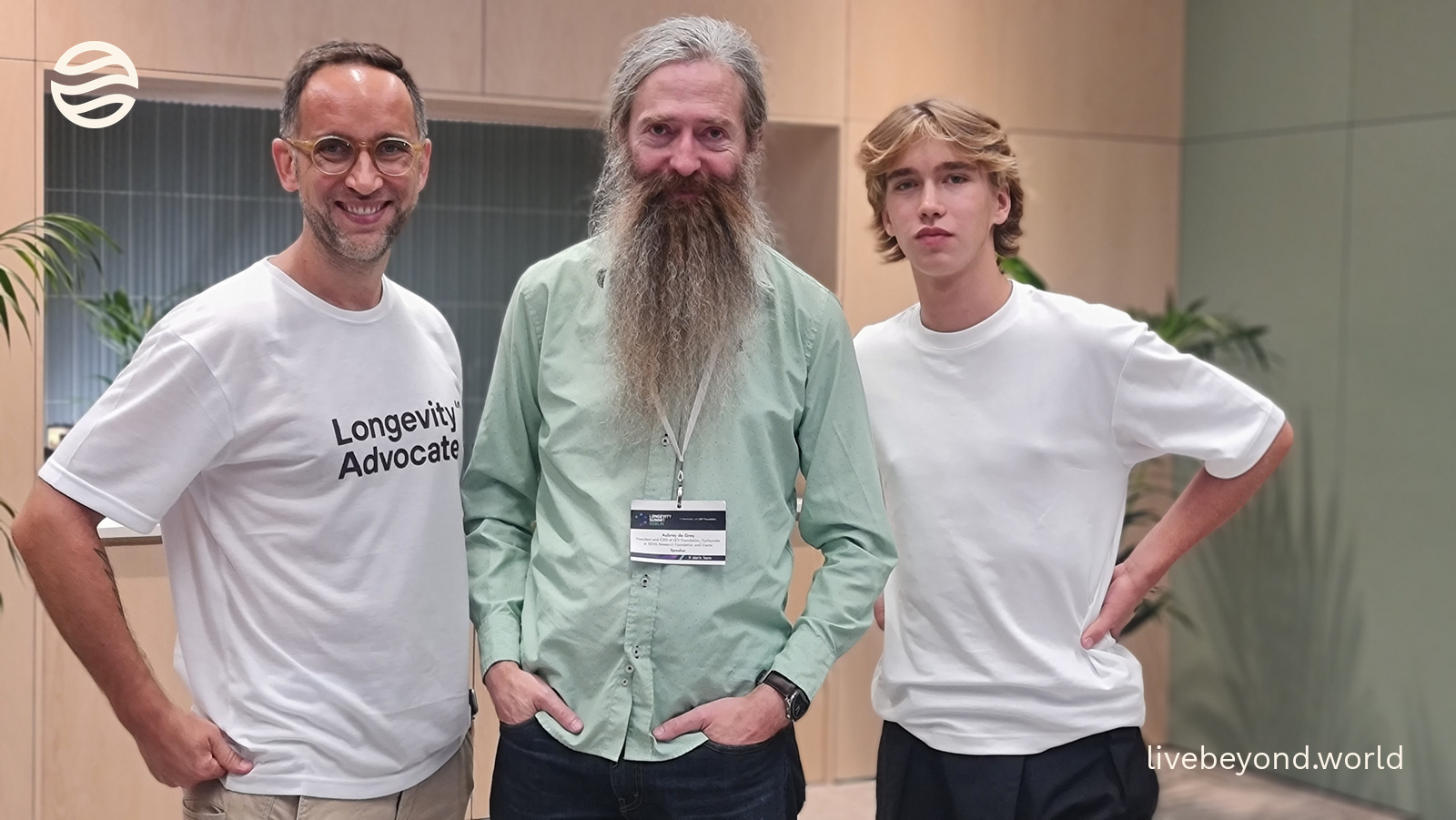
Marek Piotrowski, Aubrey de Grey and Alek Piotrowski at Longevity Summit Dublin, August 2023 — where the Live Beyond quest began.
When I say Aubrey started the whole craziness around longevity, I say it with love. Again and again on the quest, scientists and doctors told us that he was the one who inspired them — first with his book, then with years of tireless advocacy. Avi Roy told us in London that it was meeting Aubrey that set him on his path. Oliver Zolman told us the same about his first years in medical school.
Our quest began at Aubrey’s conference, Longevity Summit Dublin, in August 2023. With his very long beard he looks like a sage, and he is a true character — Alek’s word as much as mine. What surprised me most: even though he’s something of a celebrity in this world, he stays warm and open, answers every message, and helped us all year long, writing the introductions that opened the doors of other labs. The next spring he invited us to Los Gatos, California, and we filmed a walking interview with him in a park.
I asked him why a computer scientist had switched to aging. The answer: as a young man, he discovered that most biologists simply weren’t working on it.
“I was completely astonished and horrified that this would be the case. I had gone through the whole of my life until that point knowing perfectly well that aging was by far the most important problem for humanity, the thing that causes by far the most suffering.”
In plain words: Aubrey saw aging as the biggest cause of suffering in the world, and almost nobody was trying to fix it. So he changed fields and took it on himself.
When could it happen?
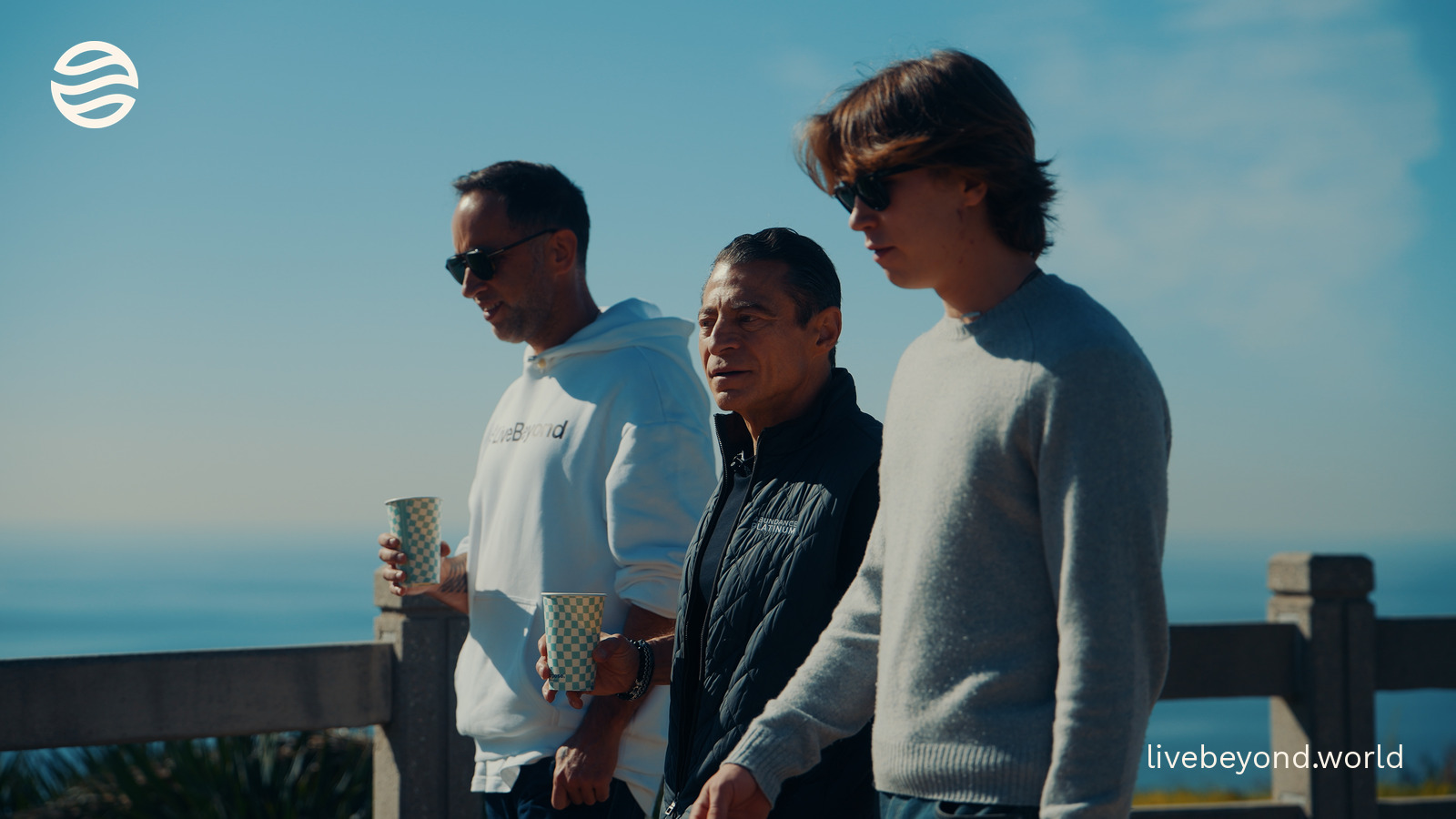
Marek Piotrowski, Peter Diamandis and Alek Piotrowski on a walk in Los Angeles, December 2025 — a Live Beyond conversation about how soon science could outrun aging.
That was my very first question to him in Dublin: does he still believe we’ll get there so soon?
“I do. I think that we have to always be careful to emphasize how speculative these predictions are. So whenever I give a prediction of timeframes for anything that's gonna happen more than a few years from now, I always make sure that people understand that it's a 50/50 probability. There's certainly at least a 10% chance that we won't get to longevity escape velocity for 100 years. But I think, yes, I think we have a 50/50 chance of getting there within the next, I'd say, 12 to 15 years from now.”
In plain words: Think of a coin toss: half a chance within about 12 to 15 years, and a small chance it takes a century. Aubrey is always honest that these are educated guesses about the future, not promises.
When we met again in Los Gatos the next spring, his answer was the same: 50/50 within 12 to 15 years. And he added something I love. Ten years from now, he said, there is a very good chance (he put it at 80%) that the world will at least be fighting a full-blown war on aging, treating it as the medical problem it is.
Some see it coming even faster. Peter Diamandis told us in Los Angeles that he believes science will get us to escape velocity over the next ten years — and that for the last decade, his life’s purpose has been to inspire and support the scientists and entrepreneurs who can get us there. Liz Parrish, the first person to take a gene therapy for aging herself, told us in Dublin that it will come very fast once people can picture what they would do with their extra healthy years, and start asking for it.
What it needs: science, money and all of us
Max Unfried and Marek Piotrowski in Dublin, August 2023 — a Live Beyond interview on the bold science escape velocity needs.
Escape velocity won’t arrive by itself. On the quest, three things came up again and again.
Science. No single pill will do it. Aging is the slow build-up of many kinds of damage in our cells and tissues, and each kind needs its own repair. That’s why Aubrey’s foundation is testing several treatments together in mice — not only drugs, but gene therapies and cell therapies too. When we met him in Los Gatos, he told us the first results were looking very promising. And the field needs more bold ideas. Max Unfried, one of the first scientists we met in Dublin, said it plainly:
“Sure, we all know live healthy, have a good diet, exercise, don't drink too much alcohol, have like a good social network, right? Enjoy life. That's all important, but that won't give us like to longevity escape velocity or like anywhere close to, right? […] I think it would be more exciting if we would have way more scientists from different field trying crazy experiments, and I would still claim the amount of crazy experiments that people are trying is like still very low.”
In plain words: Healthy habits keep us well, and they matter a lot. But to reach escape velocity, we also need many more brave experiments in the lab.
Money. Research on aging is still small next to everything aging costs us. In Los Gatos, Aubrey told us:
“What's not nice is that these are expensive experiments. A large part of why other people are not doing these things is because of the sheer cost. […] It's terrible how little funding there is in this field. […] We're ready to start our next experiment in this area and we can't do it because we've got no money.”
In plain words: Some of the experiments that could matter most are ready — and waiting for funding.
Why it would pay off for everyone
Economists from Oxford, London Business School and Harvard calculated that slowing aging just enough to add one year to life expectancy would be worth about $38 trillion to the United States alone, because people stay healthy, active and working for longer. Liz Parrish told us in Seattle that this is exactly why governments have every reason to want it too.
All of us. This is the part I find most exciting, because it’s ours. Aubrey believes the money and the progress will follow the moment enough people believe it’s possible:
“There's no one magic funding bullet. We are just going to have to carry on doing what we've been doing for the past 20 years. You could call it repeat advertising, just basically telling the same story increasingly strongly, because every incremental step forward makes the story more persuasive, more compelling, and makes it less possible for people to say that the whole thing is science fiction and will never work. […] There will come a point, a kind of tipping point, where people kind of feel that they know enough, and it will be a really sudden tipping point because of the whole herd mentality phenomenon, the fact that when a critical mass of opinion formers say something, then everybody follows. I think that may be only a couple of years away, but I've been saying that for a while. […] I don't do hope. I just plug away, and it takes as long as it takes.”
In plain words: Every new result makes the story harder to ignore. One day enough people will be convinced at once, and everything will move fast. Aubrey doesn’t wait for that day. He just keeps working.
When Alek asked him what young people can do, Aubrey told him you don’t need to be a billionaire to help: changing the minds of decision makers starts with the public, and young people are the public of the future. He also told us that one of the things that bothers him most is how science-fiction films show a world after aging, and that something has to be done about it. We are making a film. We took that to heart.
What other scientists think
Steve Horvath in Dublin, August 2023 — a Live Beyond interview with Marek Piotrowski on whether escape velocity is coming.
On the quest I asked almost everyone the same question: do you believe in longevity escape velocity? The answers were a beautiful spread. Steve Horvath, whose clocks measure how fast we age, is careful by nature — and that’s exactly why his answer stayed with me:
“Let me be a bit cautious but also optimistic. […] First of all, I believe in the concept of this escape velocity. Why? Because it's math. You can't argue with it. When it comes to the timeline, this could be really too optimistic. But I will say one thing. Like, a year ago, I was really surprised by the artificial intelligence revolution. […] And that gives me hope that maybe there will be this breakthrough, and we are much closer to these radical enhancements of really health span, really preventative medicine. So maybe we are much closer than we think we are.”
In plain words: If treatments improve faster than we age, escape velocity follows — that part is simple math. The question is when. And the sudden leap in AI showed him that breakthroughs can come sooner than experts expect.
Avi Roy, who has studied aging cells for many years, sees it as a goal worth aiming for:
“Our goal as the people in this industry should be very clear. We want to get to maximizing human lifespan, which comes with healthspan. […] Longevity Escape Velocity is a very good kind of like a heuristic, as real as made-up graphs can be. It's a nice heuristic. It's a nice goalpost to kind of aim for. So I love that, and the debate is kind of moot. We are all trying to really do the same thing.”
In plain words: Nobody knows the date. But a clear goal helps everyone pull in the same direction.
Tina Woods, who works with governments to bring longevity to everyone, told us in Dublin that she is fascinated by the idea that it is possible, and that big goals and stretch targets are what drive progress. And Phil Newman, who follows every longevity company in the world, was certain: it is going to happen — the only question is when, with bumps in the road along the way, scientific and commercial.
Words worth knowing
Three words behind the future
From our glossary. Tap a card to turn it over: the science on the back, and the people we met who explained it to us.
No. 21 / 66Everyday word
Longevity escape velocity
The point at which science adds more than a year of life for every year that passes.
No. 21 / 66Everyday word
Longevity escape velocity
Reach it, and ageing stops being a countdown. It is the idea most closely tied to Aubrey de Grey, whom we met on the quest. Nobody knows yet when, or whether, we will get there. Read more →
“So longevity escape velocity is gonna happen. The question is when.”
Not keeping you well for longer, but raising the ceiling itself.
No. 18 / 66Everyday word
Radical life extension
Not 85 good years, but 120, 150 or more. Gene and cell therapy, partial reprogramming, new organs and, as a backup plan, cryonics: the furthest-out part of the field, and further along than most people think. Many of the people we met are working on it. Read more →
“So are we closer? Yes. Yes. We’re definitely closer … But are we close? I think we’re incredibly close.”
Scientists first listed them in 2013 and brought the list to twelve in 2023; Guido Kroemer, whom we filmed, is one of the authors. Every process further down this page belongs to one of the twelve.
Marek Piotrowski and Eric Verdin at the Buck Institute, California, May 2024 — a Live Beyond interview on the dreamers and the pragmatists of the field.
Not everyone is convinced, and some of the people I respect most are among them. Their doubts make the dream more honest.
We are already moving — at about a quarter of the speed
In the country with the longest lives, life expectancy has risen by almost three months every year for 160 years, as medicine and our lives got better. That is a huge achievement. Escape velocity would need twelve months, every year.
Based on: Study of record life expectancy, 1840–2000 [2]
Eric Verdin, who welcomed us at the Buck Institute for Research on Aging, reminded us how far we’ve come and that the curve is still rising. But for him, escape velocity is a dream — and he said so with real respect:
“Getting to what Aubrey de Grey calls longevity escape velocity is a dream. But again, Aubrey is entitled to his dream, like I'm entitled to mine. […] And I think the field, in some way, accommodates itself from a whole variety of opinion. The pure dreamers and the pure pragmatic, and I think I'm sort of like right in the middle.”
In plain words: For Eric, escape velocity is a dream, not a plan. And there is room in the field for dreamers and pragmatists alike.
Andrea Maier, a doctor and scientist who became a friend over the quest, answered me in Dublin when I confessed I’m a huge fan of radical life extension and escape velocity:
“My mission is to optimize health to be longer on Earth in a much, much better physical state. I'm not going for any radical strategies. It's about optimization and a good return of the investment of something which is feasible for the broader population.”
In plain words: For Andrea, the goal is many more years in great shape for as many people as possible — and that is something we can start on now.
Others were somewhere in between. Amy Killen told us she doesn’t know if it will happen, but she wants to believe it; she thinks we’ll be able to slow aging enough to live to 120 or 130, and isn’t so sure about 200 or 300. Richard Barker would be very happy if most of the world could live to 120 without chronic disease. Leslie Kenny, in Oxford, doesn’t know if it will come in her lifetime — so she does everything she can to stay as healthy as possible, ready to take advantage of it if it does. And Evelyne Bischof told us in Dublin that she doesn’t spend much time thinking about it: her work is health span.
In plain words: The honest answer is that nobody knows the date. The good news: what helps you get there is the same, whoever turns out to be right.
What it means for you today
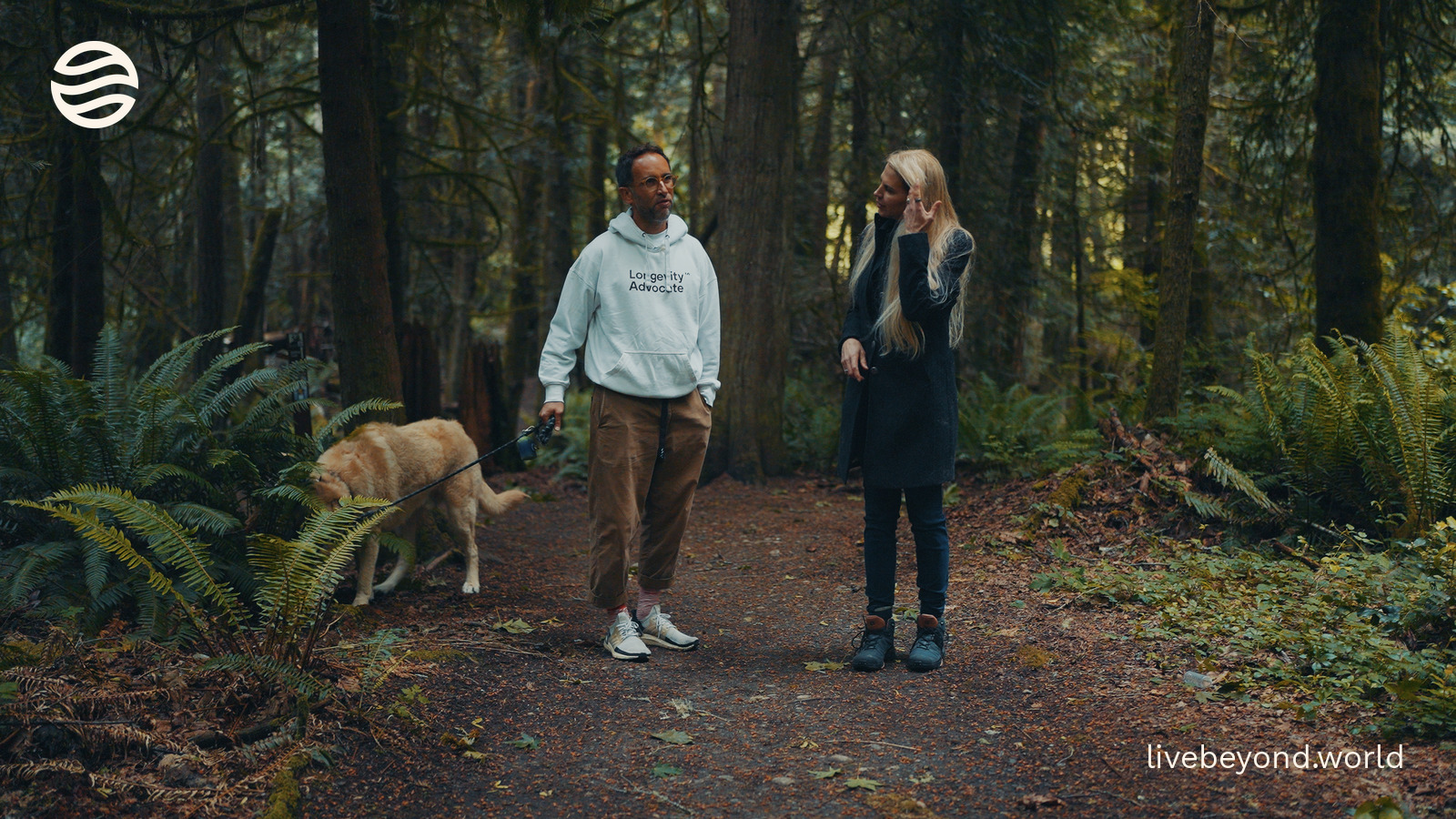
Marek Piotrowski and Liz Parrish on a forest walk near Seattle, June 2024 — a Live Beyond conversation about staying healthy for the next breakthroughs.
So what do we do with a dream that may come in 12 years, or in 50? This is where the believers and the doubters meet. Aubrey himself puts health first:
“Remember that the right way to think about it and to talk about it is not about lifespan, it's about healthspan. We have to always say that, we have to always remember and emphasize that lifespan is a side effect of healthspan. You stay alive by staying healthy. […] I certainly care about lifespan. I celebrate the fact that there is this side effect, but it's still a side effect. […] Nobody wants to be sick. Nobody wants to get sick.”
In plain words: A long life comes from staying healthy. Nobody wants more years of being ill. We want more good years — and then more of them.
Eric Verdin told us in Warsaw that he can guarantee we won’t see escape velocity in the next 20 years — and that’s exactly why he wants people to put all their energy into the here and now, into how they live every day, while the scientists do the work. Peter Diamandis, a believer, says the same from the other side. He calls it the longevity mindset: believing science will get us to escape velocity, and doing the basics now — getting out of bed and to the gym in the morning, skipping that piece of cake after dessert, getting to bed in time for a great night’s sleep. And Liz Parrish summed it up in Seattle: we don’t need a cure for aging right now; we need bodies healthy enough to be there for the next boom in breakthroughs.
Look after the basics. Move every day, sleep well, eat real food and spend time with the people you love. They are your bridge to the future. Start with a walk.
Stay curious. Follow the science and the people doing it. Knowing what’s coming makes the road more exciting.
Add your voice. Escape velocity needs public will. Talking about it, supporting research and joining the movement all count.
Don’t look for it in a shop. Nothing you can buy today gets you to escape velocity. It will come from science, tested in trials — that’s what makes it real.
Where the joy is
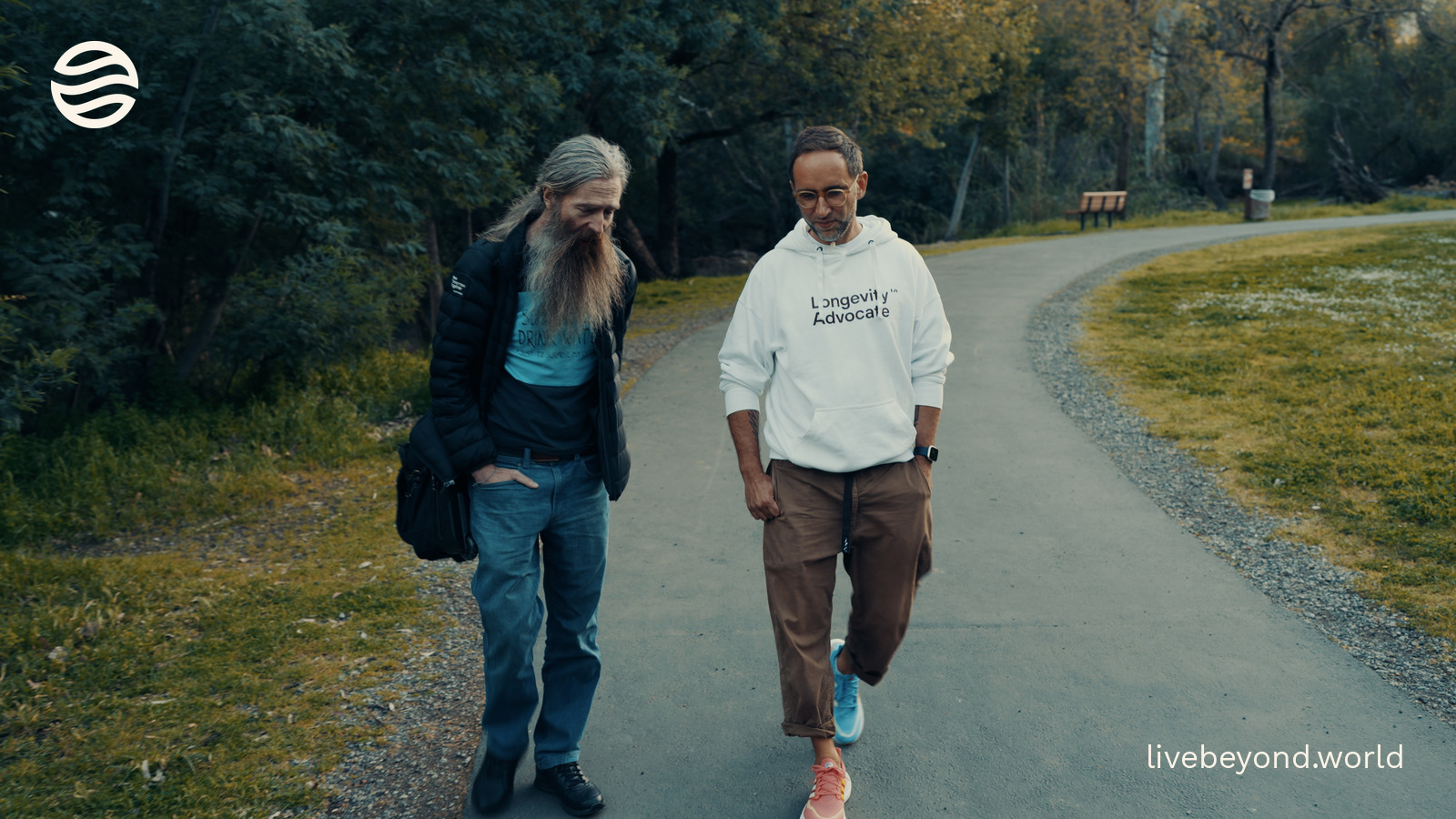
Aubrey de Grey and Marek Piotrowski walking in a park in Los Gatos, California, April 2024 — our Live Beyond walk and talk.
For me, longevity was never a fear of dying. I love every day, and I want it to last. In Dublin I told Aubrey what I tell all my friends:
“I'm always telling my friends that I have to live at least 500 years or more to experience it all because every day is amazing.”
On the quest I once asked a 92-year-old man, sitting by a church, if he would like to live another hundred years. He answered with a question: if he could be as strong as he was that day? Then, of course. That is the spirit of escape velocity: not more old age, but more life.
At the end of our walk in Los Gatos, I thanked Aubrey for supporting us and for introducing us to scientists all around the world. And he thanked us — for making the documentary. That’s the joy for me: the man who gave the dream its name, saying thank you to a father and his son on a quest.
“I hope that we will meet again and again. And also thank you for introducing us to different scientists all around the world that we can visit and talk to. And yeah, let's change the world for better together.”
My wish is simple: that we reach escape velocity together — Alek and I, and Aubrey with us, for hundreds of years to come. Until then, we’ll enjoy every single day of the road.
Every number on this page, by the number in square brackets. Quotations come from Live Beyond’s own recorded interviews, cleaned only of “um” and “uh”. Not medical advice. Talk to your doctor before you change anything.
de Grey ADNJ. Escape velocity: why the prospect of extreme human life extension matters now. PLoS Biol. 2004;2(6):e187. doi:10.1371/journal.pbio.0020187
Oeppen J, Vaupel JW. Broken limits to life expectancy. Science. 2002;296(5570):1029-1031. doi:10.1126/science.1069675
Scott AJ, Ellison M, Sinclair DA. The economic value of targeting aging. Nat Aging. 2021;1(7):616-623. doi:10.1038/s43587-021-00080-0