Skin longevity: the organ that shields all the others, and how to keep it young
Carolina Reis Oliveira, Alessandra Zonari Scheel and Marek Piotrowski before paddling in Sausalito, California, May 2024, on a Live Beyond day about skin longevity.
For years I thought skin was mostly about beauty. On our quest, Alek and I heard the same thing again and again, from a lab in California to a clinic in Zurich: skin is an organ, the shield in front of every other organ, and caring for it is part of longevity. Here is what the people who taught us that told us, and what the studies say.
Your skin can stay healthier and younger for longer, and the most powerful tools are simple and cheap.
In a real trial, people who put on sunscreen every morning showed less skin aging over the years than people who used it only now and then. Sun is behind most of the visible aging of the face, and good sleepers have younger-looking skin that repairs itself faster.
Lab research on senescent, “zombie” cells in skin is exciting, but it has not yet been proven in people. Caring for your skin is caring for an organ, and that is longevity. [1][2][3][4]
Longevity, as we mean it: more healthy, joyful years. What we mean →
Skin is an organ, not a surface
“The main thing that was repeated in my conversations about skin is that skin is our shield, and actually it’s the biggest organ, as they say, but it’s also the organ that is protecting everything that’s inside.”
In Zurich, in July 2025, near the end of our quest, Alek and I met Liv Kraemer, a skin-longevity doctor who began as a model, became a physician and did stem cell research at Columbia University before she turned to skin. She calls herself a personal skin trainer:
“You can train your skin as you can train your organ. And as you mentioned, the skin is an organ, so as your muscles are.”
In plain words: Like a muscle, skin answers to how you treat it, day after day. Its top layer is a wall: it keeps water in and sun, germs and dirt out. The stronger that wall stays, the better it protects everything underneath.
She never liked the word “aesthetic” for her work:
“I didn’t like the word aesthetic because it’s more prevention. It’s taking care about your skin. […] It’s not about beauty. It’s about taking care.”
In plain words: Looking after your skin is prevention: keeping an organ healthy. Looking good is the bonus.
That is why skin has its own place in our definition of longevity. Longevity is not only how long you live but every span of life, and your skin carries one of them, the beauty span: how long you look as young and as well as you feel inside. Keeping it longer is longevity too.
How skin ages
In Kuala Lumpur, in March 2024, we spent a day inside the clinic of Kathryn Koh, a dermatologist. I asked her what actually makes skin look older:
Kathryn Koh and Marek Piotrowski at her clinic in Kuala Lumpur, March 2024, a Live Beyond interview on skin and aging.
“So as you grow older, as you age, you lose collagen fibers, you lose elastic fibers, and you lose hyaluronic acid as well. […] That results in wrinkles, fine lines, and open pores in your skin.”
In plain words: Deep in your skin sit three things that keep it firm and smooth: collagen, a protein that gives it strength; elastic fibers, which let it spring back; and hyaluronic acid, which holds water. With the years we make less of all three, and the skin gets thinner and looser.
Skin ages in two ways. One comes from time and from your genes. The other, called photoaging, comes from outside, mostly from the sun. The second is the one you can do the most about.
Most visible aging of the face comes from the sun
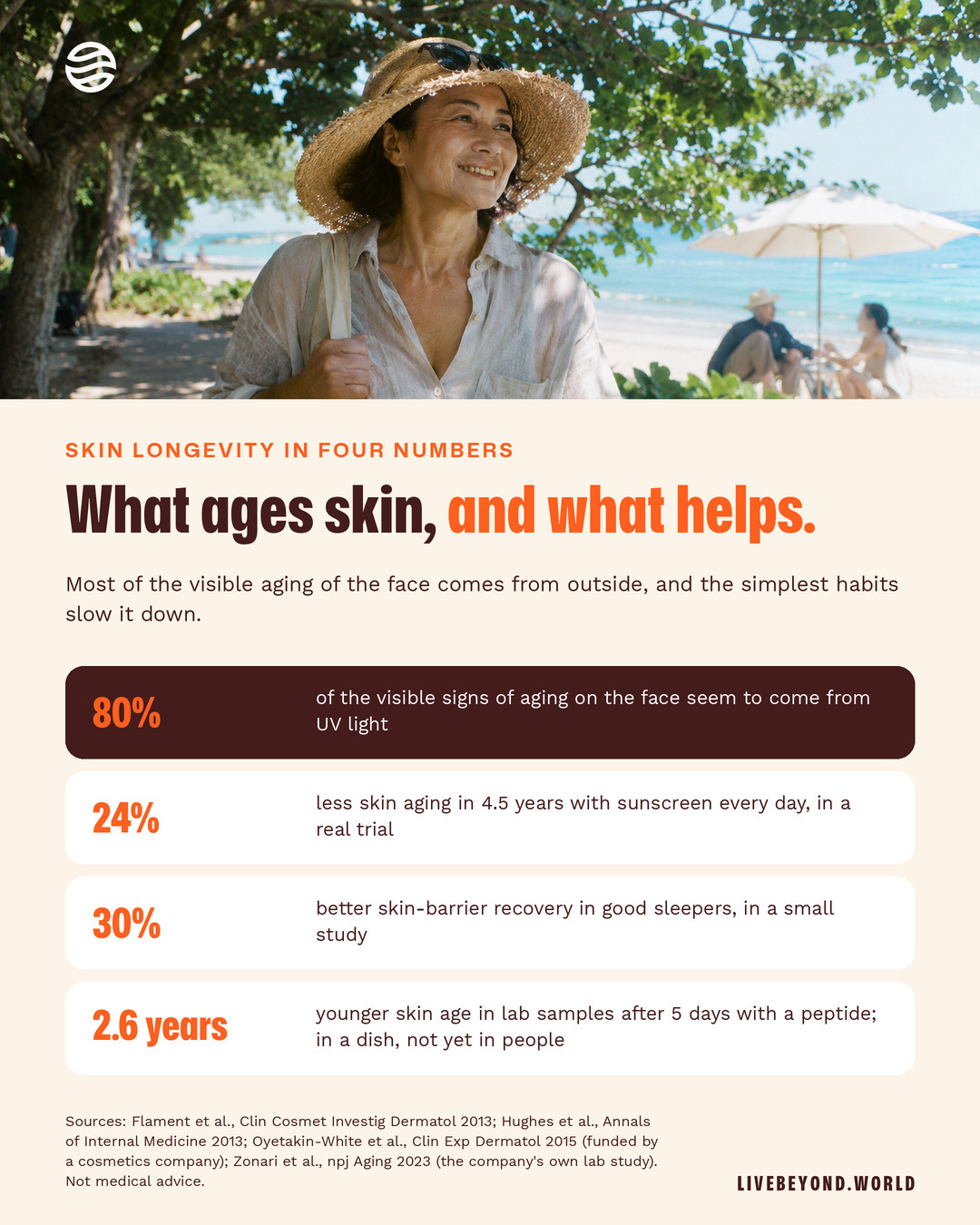
Scientists in France studied the faces of 298 white women aged 30 to 78. They concluded that UV light seems to be responsible for about 80% of the visible signs of aging on the face.
Skin longevity in four numbers, a Live Beyond infographic.
Daily sunscreen slowed skin aging
In Nambour, Australia, 903 adults younger than 55 were split into two groups by chance. One group put on a broad-spectrum sunscreen (SPF 15 or more) every day; the other used it only when they chose to. After four and a half years, skin aging had progressed 24% less in the daily group. It is a rare real experiment on skin aging in people.
Our quest began on Okinawa, one of the world’s Blue Zones, where people live long and well. In October 2023, in Nanjo, I expected to see old people out walking and exercising. The village was empty. My son Alek asked our host, Mikiko Kumagai, why:
“Yeah, I think one reason is because sunshine is very strong. So they avoid sunshine.”
“So you want to protect your skin,” Alek said. “Yeah,” she answered. Later we heard the other half of it: people there go out to move and exercise in winter, when the sun is gentle.
In plain words: Even in a place famous for long lives, nobody walks in the strong midday sun. They protect their skin, and they don’t stop moving: they choose the hour and the season. Shade and movement go together.
On a hill above the bay in Sausalito, California, in May 2024, my son Alek asked Carolina Reis Oliveira, the co-founder of OneSkin, what she would tell his generation about skin:
“And then also for your skin, I think is another important area that it’s never too young, too early, or too late to take care of your skin. And I think nowadays we are much more aware of the importance of sun protection.”
In plain words: You can start at any age. Protecting your skin from strong sun is the first step, and it is never too late to begin.
Liv keeps daily care just as simple. Her basics:
“So fruit acids, AHAs, and retinols are the basic. This is what my core level is. […] And a sunscreen. This is the main thing.”
In plain words: Fruit acids (AHAs) gently clear away old cells on the surface, retinols (forms of vitamin A) help the skin renew itself, and sunscreen protects it from the sun. Liv’s point is that you need a few things that work, not a shelf full of jars. Which ones suit your skin is a question for a dermatologist.
Before you try retinol or acids
They can irritate the skin, and retinoids are usually avoided in pregnancy. If you are pregnant or breastfeeding, have a skin condition or take medicines, ask a dermatologist first.
Skin starts inside
Every expert we met said the same thing: what you do for your whole body shows on your skin. Kathryn put it like this:
“First things I think we need to reduce inflammation. So that can be done through all sorts of ways, like eating a healthy diet, not getting exposed to strong sun, getting enough sleep, not drinking alcohol, not eating processed food.”
In plain words: Inflammation is the body’s alarm system. When it stays switched on, it slowly damages tissues, skin included. Good food, shade from strong sun, enough sleep, little alcohol and less processed food all help to keep it calm. More on chronic inflammation.
In Phuket, in December 2023, Dr Joy, a dermatologist at the Laguna Clinic, said the same in her own words:
“I need you to understand that our skin represents just one part of our body. If the skin looks unhealthy, it can be from inside, internal factors, and from outside factors.”
Good sleepers had younger skin
In a study of 60 women in Cleveland, Ohio, those who slept well had fewer signs of aging from within, and three days after their skin barrier was stressed in a test, it had recovered about 30% better than in women who slept poorly. A small study, funded by a cosmetics company, so read it as a link, not proof.
“It’s like a Swiss watch. A couple of wheels have to move because the big hand is moving. […] You never know which wheel is the one who will move the big hand.”
In plain words: Your skin is one wheel in a watch. Sleep, food, movement, stress and the gut all turn together, and you never know which one is holding the others back. Liv also sees the skin and the gut as one system. More on sleep, the gut microbiome and what the longest-living people eat.
Carolina told Alek why it is worth starting young:
“When we are young we just think, “Oh, I have all the time of my life, so I can do whatever with my health.” […] And I think you realize that all of those actions are building up like small damages in your body that you are not feeling at your age, but in 10, 20 years, that will start to affect you.”
In plain words: Junk food, alcohol, smoking and too much sun leave small marks you cannot feel at twenty. They add up, and they show years later. The good news runs the same way: what you start today keeps paying back.
Can skin be made younger?
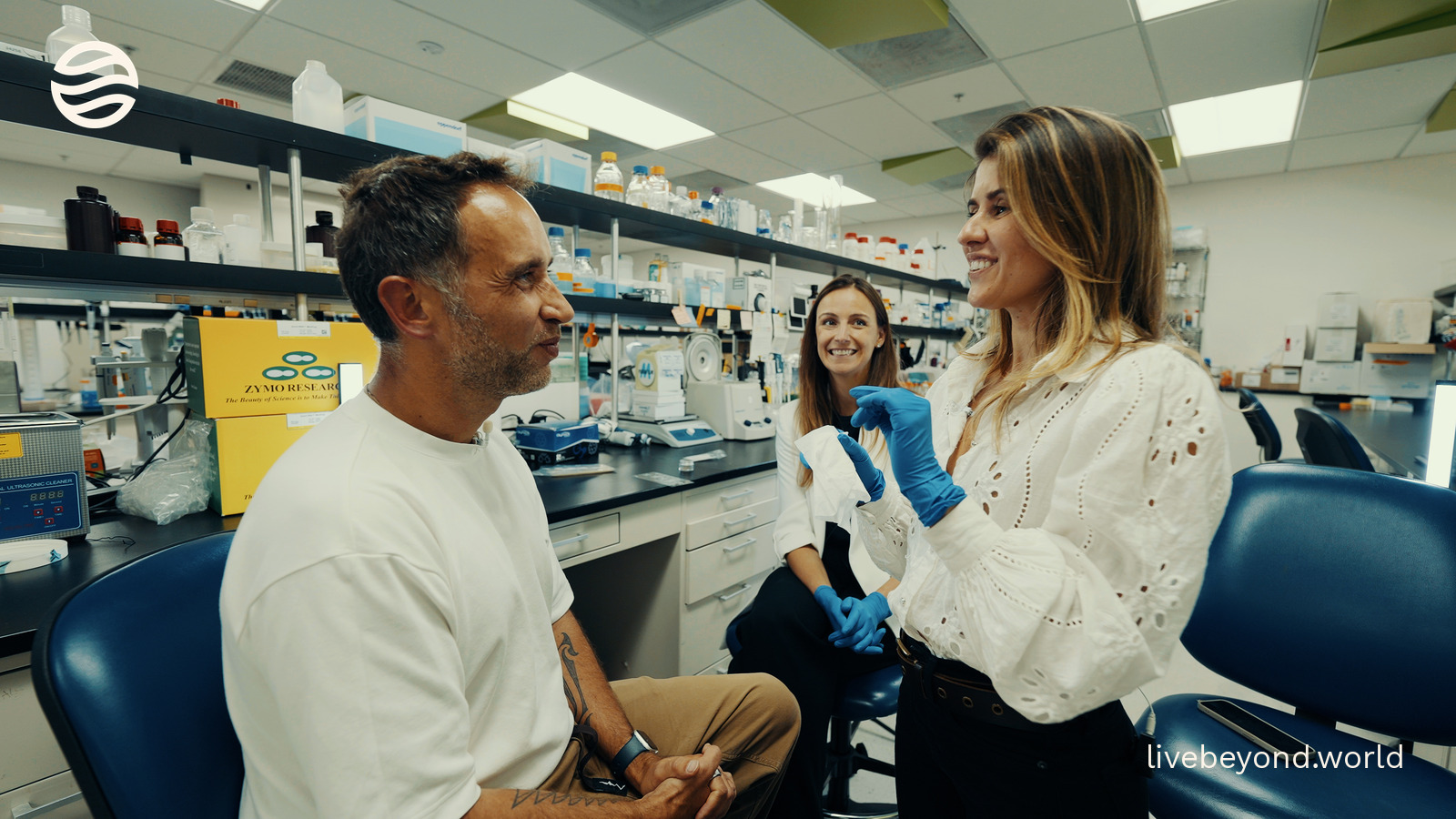
Marek Piotrowski with Carolina Reis Oliveira and Alessandra Zonari Scheel in the OneSkin lab, California, May 2024, taking a skin sample to measure his skin age, a Live Beyond visit.
A few days before Sausalito, Carolina and Alessandra Zonari Scheel showed Alek and me their lab in the Bay Area. They grow real human skin there and use it to test whether a product does anything to skin aging at all. They told us that most of what they tested worked on how skin looks, not on how it ages, so they went looking for something that would.
A peptide that made old skin samples younger, in the lab
In their own published study, the OneSkin team screened almost 1,000 peptides, small pieces of protein, and found one that reduced the number of senescent, “zombie” cells in human skin models. In skin samples from a 79-year-old donor, five days of treatment lowered the skin’s DNA methylation age, a measure of biological age, by about 2.6 years on average. This was skin in a dish, not people, and the study comes from the company’s own scientists.
Senescent cells have stopped dividing but do not die, and they send out signals that inflame the tissue around them. Clearing them is one of the big ideas in longevity science: see senolytics and cellular senescence in plain words. The age measure used here is one of the aging clocks.
A few days after the OneSkin lab, in Salt Lake City, Amy Killen, a doctor of regenerative medicine, told us why her patients kept asking her about skin:
“When people ask me what I do, I say I do sex and skin. […] Of course, we can use stem cells and regenerative medicine for skin health […] But there are also all these topical peptides that are great. Topical rapamycin seems to be effective. […] There’s a lot of crossover between sexual health, skin health, longevity. It’s all very important.”
In plain words: Skin, sexual health and longevity share the same roots, so what helps one often helps the others. Peptides and rapamycin creams are early ideas, not standard care yet. Read more on rapamycin.
What gave Alessandra hope was not only the lab, but what it taught her about her own family. She grew up expecting the illnesses her grandparents had:
“And one thing that for me was a game changer after I got into this longevity field was realizing that the way we age is not conditioned by our genetics, that genetics is just a small part of it. […] So it’s more my actions, my lifestyle.”
In plain words: Your genes are only part of the story of how you age. Much of it is in what you do every day, and that is in your hands.
Words worth knowing
Three words behind younger skin
From our glossary. Tap a card to turn it over: the science on the back, and the people we met who explained it to us.
No. 59 / 66Inside the body
Cellular senescence
Cells that retired but stayed in the building, complaining loudly enough to make everyone else worse at their jobs.
Clearing them extends healthy life in mice, which is why senolytics attracted so much attention. Human trials so far have been small and the results mixed. This is a genuinely promising area that is not yet a thing you should be dosing yourself for.
Reduce the load rather than chase the repair: sun sensibly, do not smoke, keep alcohol modest, sleep. The single most useful thing here is not a supplement but screening, finding what went wrong early, which is the whole point of the Bridge of Prevention.
Sleep, weight, muscle, oral health, and treating the obvious sources. Omega-3s have decent evidence. This is also one of the few processes where a simple blood test, high-sensitivity CRP, tells you something useful and cheap.
For most of my life, I didn’t look after my skin at all. In Phuket, in December 2023, I told Dr Joy how I used to think, and why that changed:
Kathryn Koh with Marek Piotrowski during a laser skin treatment at her clinic in Kuala Lumpur, March 2024, filmed for Live Beyond.
“Let’s take me as an example. I’m a guy, and usually guys don’t care about their skin. I was always, ‘I’m a tough guy. I don’t need any cream on my face. I don’t even need to protect it from the sun.’ And now the years passed by, now I’m this longevity advocate, and I want to look younger also on my skin.”
Clinics offer much more: lasers, microneedling, radio frequency, injections. Kathryn’s list for her patients starts with the same basics as everyone else’s:
“So number one, a healthy diet. Number two, regular exercise. Number three, your sunscreen. Number four, a good sleep.”
In plain words: Food, movement, sunscreen and sleep come first. After those, Kathryn listed skin-care ingredients such as vitamin C and retinol, then devices such as radio frequency, ultrasound and lasers, then injections. Those are medical treatments, and a decision to make with a doctor.
And collagen pills, the most popular skin supplement of all? Amy Killen changed her mind about them. On a podcast in December 2025 she said:
“I have changed my opinions about collagen for skin health […] All the studies essentially that had good results were industry funded. And if you took those off the table, then collagen did not seem to really improve skin health.”
Collagen pills: no proven benefit for skin in independent trials
In 2025, two researchers pooled 23 randomized trials with 1,474 people. Taken together, the trials looked positive. But the good results came from trials paid for by companies that make or sell the supplements. In the trials without that funding, and in the best-designed ones, collagen made no difference to skin hydration, elasticity or wrinkles. The authors concluded that there is no clinical evidence that collagen supplements prevent or treat skin aging. Supplement makers dispute the analysis.
Based on: A review of 23 trials · the independent trials found no effect [5]
In plain words: When you swallow collagen, your body digests it like any other protein. For your skin, the money is better spent on good food, sunscreen and sleep.
Liv uses some of those devices herself, and warned us about overdoing them:
“So again, know the anatomy, know the skin, know the laser, know the purpose, know the point of action. And in a good hand, it does fantastic. Less is more.”
In plain words: A good treatment, done by someone who knows the skin, can help. Done too often or too deep, it can harm. More is not better. If you are thinking about a clinic, read how to choose a longevity clinic first.
Where the joy is
Carolina Reis Oliveira and Alessandra Zonari Scheel with Alek and Marek Piotrowski on the hill above the bay in Sausalito, California, May 2024, a Live Beyond conversation on skin and a good life.
My favorite part of all this happened on the water. After the lab, Carolina and Alessandra took Alek and me paddleboarding and kayaking on the bay in Sausalito, windy, with seals in the water, and then we sat on the grass and talked. They moved out of the city for a life closer to nature and to people, and both see it as a longevity choice in itself: neighbors they actually know, volleyball on Sunday afternoons, a run at sunrise.
And when I asked Liv for her message to young people like my son, she did not start with skin at all:
“Don’t think about skin. Think about overall health. Think about what you eat. Think about your sleep. […] Get your friends. Get a good network. Get healthy relationships. […] If it comes to super basic, wash your face in the morning and evening with a cleanser with fruit acid. Put a sunscreen on. That’s it.”
In plain words: Good skin follows a good life: food, sleep, friends. Then a cleanser and a sunscreen, and that is it. Glowing skin is a happy side effect of looking after yourself and of the people around you. More on friendship and longevity.
Not medical advice, and not a recommendation for or against any product, ingredient or treatment. We describe what the studies say and what the people we met told us.
Before you change anything
This page shares what research and the experts we met say. It is not medical advice, and it does not recommend any medicine, supplement or treatment. It knows nothing about you. Before you start, stop or change anything, especially if you are pregnant, live with a health condition or take any medication, please talk to your doctor. In an emergency, call your local emergency number.
Sources
Every number on this page, by the number in square brackets. Quotations come from Live Beyond’s own recorded interviews, cleaned only of “um” and “uh”. Not medical advice. Talk to your doctor before you change anything.
Hughes MCB, Williams GM, Baker P, Green AC. Sunscreen and prevention of skin aging: a randomized trial. Ann Intern Med. 2013;158(11):781-790. doi:10.7326/0003-4819-158-11-201306040-00002
Flament F, Bazin R, Laquieze S, Rubert V, Simonpietri E, Piot B. Effect of the sun on visible clinical signs of aging in Caucasian skin. Clin Cosmet Investig Dermatol. 2013;6:221-232. doi:10.2147/CCID.S44686
Oyetakin-White P, Suggs A, Koo B, Matsui MS, Yarosh D, Cooper KD, Baron ED. Does poor sleep quality affect skin ageing? Clin Exp Dermatol. 2015;40(1):17-22. doi:10.1111/ced.12455
Zonari A, Brace LE, Al-Katib K, et al. Senotherapeutic peptide treatment reduces biological age and senescence burden in human skin models. npj Aging. 2023;9:10. doi:10.1038/s41514-023-00109-1
Myung SK, Park Y. Effects of collagen supplements on skin aging: a systematic review and meta-analysis of randomized controlled trials. Am J Med. 2025. doi:10.1016/j.amjmed.2025.04.034