Stress can make you stronger, if you let yourself recover
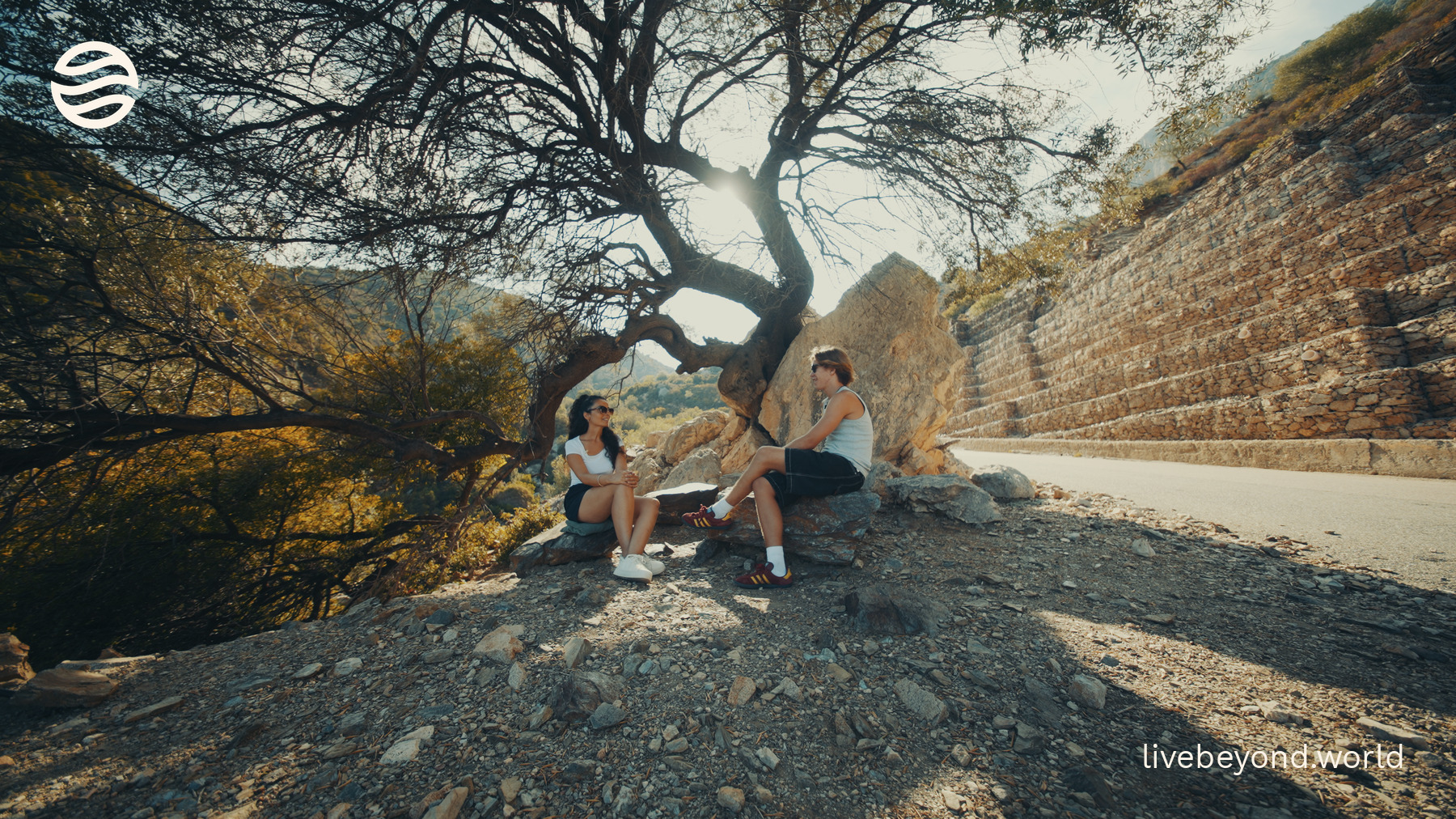
Paola Demurtas and Alek Piotrowski under a tree in Sardinia, August 2024 — a Live Beyond interview on the centenarians and a calmer life.
On our quest, my son Alek and I met more than a hundred scientists, doctors, healers and experts in 39 countries and states. Stress came up again and again: in labs and clinics, on a beach in San Diego, under a tree in Sardinia. What surprised me most is that stress itself isn’t the problem. Short stress, followed by rest, makes us stronger. It’s the stress that never switches off that wears the body down. This page explains both, and how to come back to calm, in the words of the people who taught us, with all our gratitude.
Good news first: calming stress is one of the kindest things you can do for a long, healthy and joyful life. Short stress that you recover from trains the body, the way exercise, a sauna or a cold plunge do. Stress that never switches off is a different story: it keeps the alarm on, feeds inflammation, steals sleep and is linked with about twice the odds of a heart attack. And the best ways to recover cost nothing: sleep, movement, time in nature, slower breathing, a few minutes of mindfulness, and the people and the purpose you love. [1][2][3]
Longevity, as we mean it: more healthy, joyful years. What we mean →
120 mina week in nature: people who spent at least two hours a week in parks, woods or by the water were more likely to feel healthy and well. One long visit or a few short ones, it didn’t matter.[4]
47studies of meditation programs, with 3,515 people. Together they show small to moderate drops in anxiety, low mood and pain, from practice anyone can learn.[3]
~2×the odds of a heart attack for people who felt stressed all the time, at work or at home, in a study of 24,767 people in 52 countries. Stress that comes and goes is a different story.[1]
Stress is not the enemy. It’s the body’s alarm, and it saved our ancestors’ lives. The trouble starts when the alarm never switches off. This page is about both sides: what long-lasting stress does to the body, why short stress can make you stronger, and how to come back to calm, in the words of the people who taught us.
What chronic stress does to your body
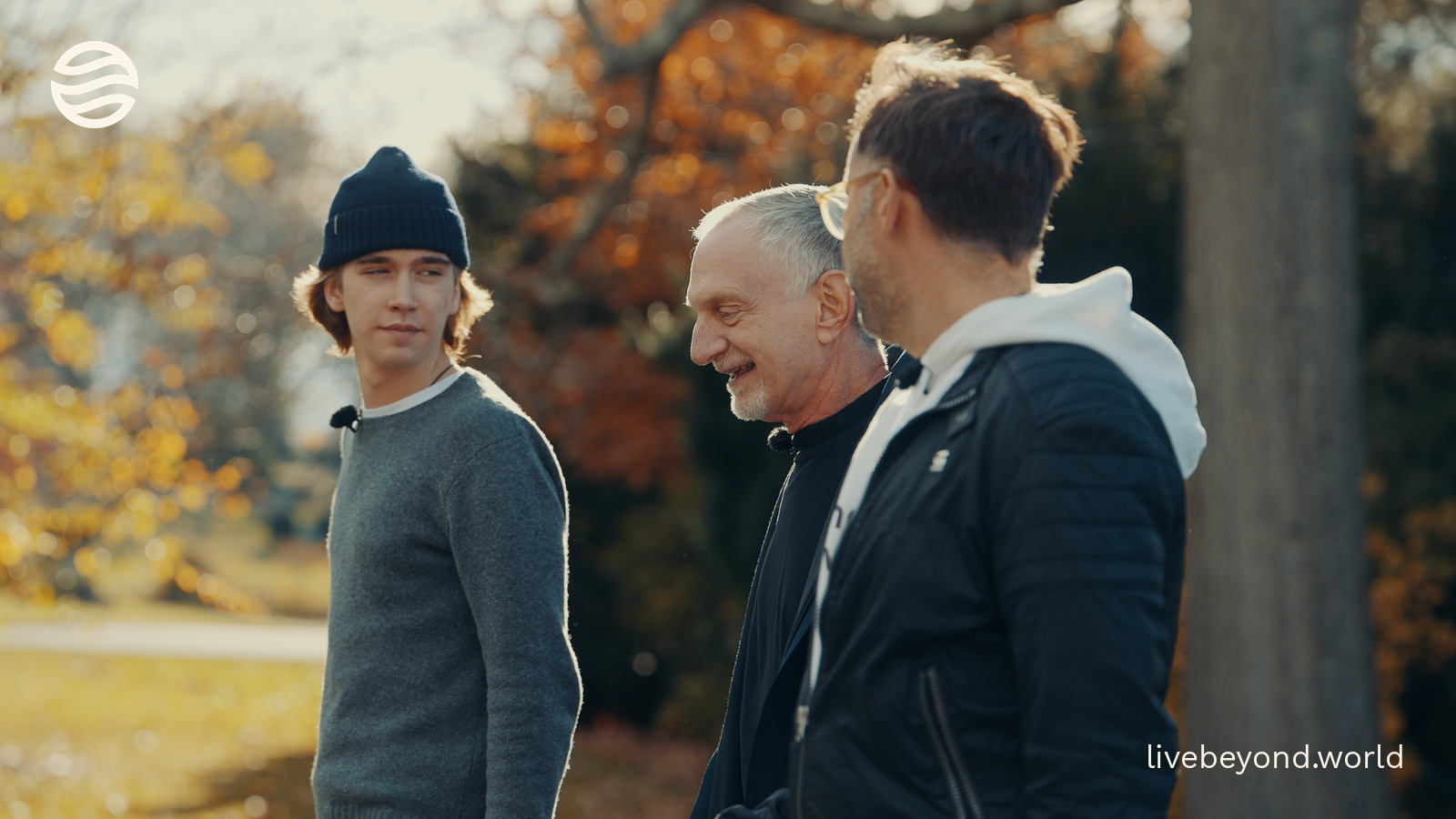
Robert Waldinger with Marek Piotrowski and Alek Piotrowski in Boston, November 2024 — a Live Beyond conversation on stress, happiness and a long life.
When something scares you, your body releases adrenaline and cortisol, the main stress hormones. Your heart beats faster, your breathing speeds up, sugar pours into your blood, and everything that can wait is put on hold. That’s perfect for running away from danger. In London, Nikolina Lauc, who opened the doors for us to Human Longevity in San Diego and to Staša Stanković in Cambridge, explained what happens when the danger never goes away:
“Our mind has such a huge effect to our immune system. And it's something that we're just beginning to understand, but it's kind of the strongest element of our health that we can control by our mind because of this state of, in a way, chronic stress. Because if you are running from a lion, you don't need your immune system for those few moments. You don't need your reproductive system, you don't need your digestive system. So all of these systems suffer […]. And the other impact of it is regular stress that can be from work to divorce to God knows, everything else in life.”
In plain words: Stress is built for a few minutes of danger. When it lasts for months, the body keeps putting its repair work on hold: fighting germs, digesting, even having children.
In Boston, Robert Waldinger, who directs the Harvard Study of Adult Development, chose to walk with Alek and me through a cemetery with a beautiful park in it. He felt like family from the first minute. When Alek asked him whether a happier life is a longer one, he answered:
“Being happier means you're likely to be less stressed, and being less stressed means that you're likely to have fewer of the breakdowns in the body that stress causes, right? So the stress breaks down many body systems, like chronic inflammation […]. And so you're likely to be healthier if you are happier.”
In plain words: Long-lasting stress slowly wears the body down, and one of the main ways is chronic inflammation: a small fire inside that never quite goes out.
At the Buck Institute in California, David Furman, who studies how the immune system ages, told us where that fire comes from:
“I've been studying the social lifestyle determinants of inflammation for 15 years. So there are different layers, right? The first layer is the one size fits all. Move more, eat well. […] But there's other things in the environment that many people don't know are exposed to, and they cannot control very well. Social stress is a biggie, causes inflammation. We know that. Many pathways are affecting inflammation in chronic stress, social stress. Quality of sleep, right?”
In plain words: Food and movement matter. But stress from other people, from feeling alone or under pressure, and poor sleep light the same fire.
When stress never lets up, the heart feels it
In a study of 11,119 people who’d had a heart attack and 13,648 people who hadn’t, in 52 countries, those who said they felt stressed all the time at work or at home had about twice the odds of a heart attack. Stress that came only now and then was linked with a much smaller rise.
Based on: Study in 52 countries · a link, not proof [1]
Stress reaches the hallmarks of aging
Scientists list twelve hallmarks of aging, the main ways our bodies wear out over time. Two of them show up again and again in stress research. One is chronic inflammation: in Sheldon Cohen’s experiments, adults who’d lived through a long, stressful time had immune cells that listened less to cortisol, the hormone that normally calms inflammation, and people whose cells listened less were more likely to catch a cold when they were given the virus. The other is telomeres, the protective caps on our chromosomes: among 58 mothers, the most stressed had telomeres shorter by the equivalent of about ten extra years of aging, compared with the least stressed.
Based on: Experiments and studies in people · links, not yet proof that stress causes aging [5][6][7]
And stress steals sleep, the time when the body does its deepest repair work. A busy mind at night and a tired body in the morning feed each other. We wrote a whole page on sleep for longevity.
Why some stress is good for you
Dr Tamsin Lewis in Formentera, August 2024 — a Live Beyond interview with Marek Piotrowski on training, stress and recovery.
Here’s the surprise: a little stress, followed by rest, makes the body stronger. Scientists call it hormesis. A hard workout, the heat of a sauna, a cold plunge, a short fast: each one is a small, safe shock, and the body answers by repairing itself and getting tougher. We explain how it works on the sauna and cold plunge pages.
A small dose, then rest
Hormesis means that a small amount of something stressful, like exercise or a short fast, switches on the body’s own protection and repair, while a large amount, or one that never stops, does harm. It’s the difference between a training session and an injury.
Based on: Review of studies in cells, animals and people [2]
On Formentera, in August 2024, Dr Tamsin Lewis, a longevity doctor who comes from endurance sport herself, explained the catch:
“We know that the repeated oxidative stress one gets from doing extreme endurance really does add up on the body, and that's what I saw when I started testing people, is that less in professional athletes because they spend half of their time recovering, whereas people of our demographic like to do a half Ironman or a marathon and then at the same time they're getting up at 5:00 a.m. to fit the training in. They're going to work. They're dealing with kids. Their stress bucket is huge, and so the exercise they're doing is adding to that, and the body is not given enough time to repair, so over time that creates damage within the body. […] And also your repair process from exercise and the strengthening is the adaptation that you need to strengthen and improve performance, not the actual exercise, which is merely the stressor. It's the adaptation that makes you stronger, fitter, and better endurance.”
In plain words: Training is a stress. You get stronger while you rest afterwards, not during the workout. If your life is already full of stress, add exercise gently and give your body time to recover.
How you see stress changes how you feel it
In a set of experiments, short films changed what people believed about stress. And in a stressful test, people who saw stress as something that can help them had a more moderate rise in cortisol, and were more open to feedback.
Good stress is short, chosen, and followed by rest: a run, a sauna, a speech you prepared for. Harmful stress is long, out of your control, and never ends. The same body can handle a lot of the first kind, as long as it gets time to come back to calm. [2]
Words worth knowing
Three words behind the calm
From our glossary. Tap a card to turn it over: the science on the back, and the people we met who explained it to us.
No. 64 / 66Inside the body
Stress, cortisol and the alarm that never switches off
An alarm built to ring for a minute, ringing all night.
Stress, cortisol and the alarm that never switches off
The sound is not the problem. Not being able to switch it off is.
What helps
Sleep is both a cause and a cure, and it is the first thing to fix. Exercise raises cortisol briefly and lowers the baseline. Connection matters more than most people expect — loneliness is a chronic stressor with its own mortality signal. Read more →
Sleep, weight, muscle, oral health, and treating the obvious sources. Omega-3s have decent evidence. This is also one of the few processes where a simple blood test — high-sensitivity CRP — tells you something useful and cheap.
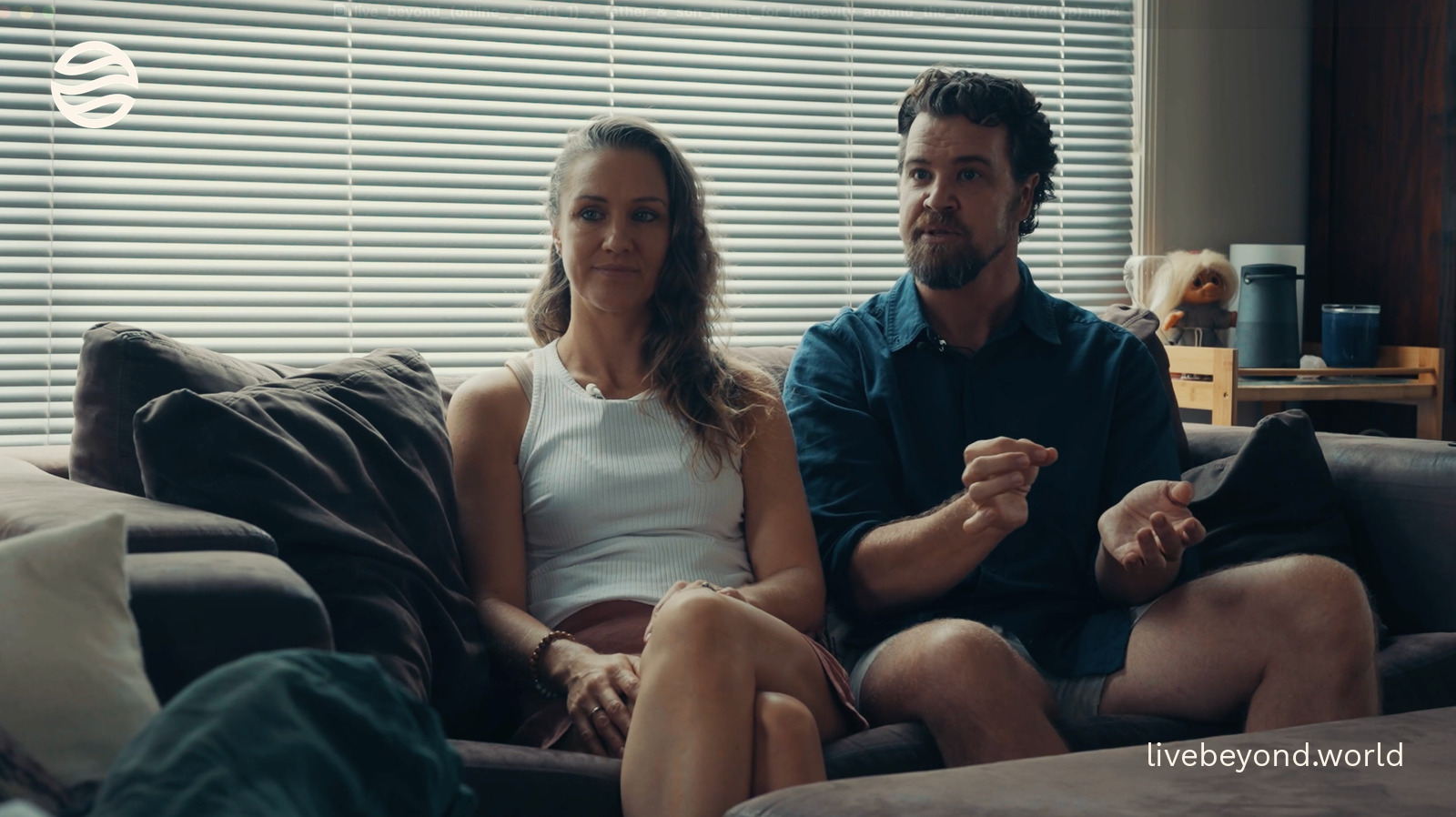
Angelina and Shane Saunders on the Gold Coast, Australia, January 2024 — a Live Beyond interview with Marek Piotrowski on breathing and stress.
The good news is that the body has its own calm button, and you can press it. Sleep, movement, nature and breathing all tell the body that the danger is over. Walking is the easiest way to start; it’s on our walking page.
Paola Demurtas found us on Instagram and offered to guide us to the centenarians of Sardinia, and she did exactly what she promised. Alek interviewed her under a tree above a little bay:
“I feel very different when I live abroad or when I go outside to work. And when I come back here, I feel another person. Much less stress. And of course, the environment helps a lot, because I can stay here half an hour just doing nothing, and it's the best therapy for my mind, I think. So I don't need to go somewhere else to distract myself. I just stay here. That's so natural.”
In plain words: She doesn’t need a program to calm down. Half an hour of sitting outside, doing nothing, is enough.
Two hours a week in nature
Among 19,806 people in England, those who spent at least 120 minutes a week in nature, in parks, woods or on the beach, were more likely to say they were healthy and felt well. It didn’t matter whether it was one long walk or several short ones. The benefit leveled off at about three to five hours.
On the Gold Coast in Australia, we met the breathwork teachers Angelina and Shane Saunders. Angelina showed us how stress shows up in the breath first:
“We have a natural inbuilt ability to cope with stress, like a coping mechanism, right? And what happens is when we have stress, stressful factors, could be external or could be internal factors, our breathing will start picking up because it starts responding or reacting to the stressful situation. It's that fight or flight response where it's like, 'All right, I'm getting ready to do something here.' […] But what really got me is that by becoming aware of what the breathing is doing, […] and then finding that reflex or allowing that pause or giving yourself a way to go out of this environment and just pause for a moment, reset that breathing mechanism, […] then you can start thinking clearly. And then you make very different decisions moving forward when you're in the middle of a stressful situation.”
In plain words: Stress makes you breathe faster without noticing. If you catch it and slow down for a moment, your head clears and you choose better.
Breathing to calm down
A review of 12 randomized trials with 785 adults found that people who practiced breathwork felt less stressed than people who didn’t, with small to medium effects. Most studies were small, so the authors ask for more research.
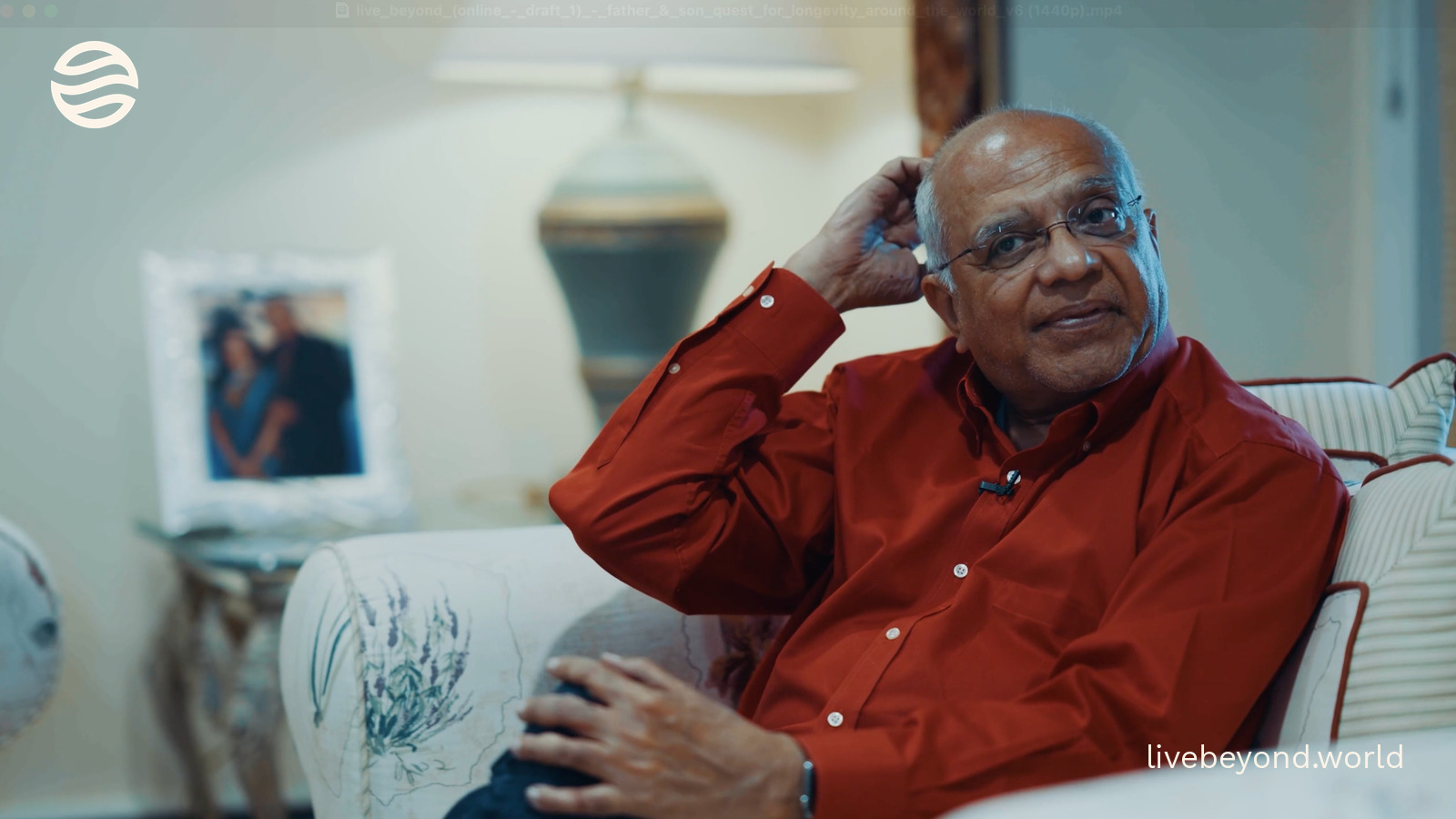
Srikumar Rao at his home on Long Island, New York, June 2024 — a Live Beyond interview with Marek Piotrowski on stress and what we can't control.
For me, mindset is the basis of everything in longevity, and most of the scientists and doctors we met agreed. Problems will always be there. Money, work, worries about the people we love. And still you can be happy every day. The mind and the heart have a huge influence on our health, and on how stress lands in the body. I don’t want this to sound like magic, so we wrote a whole page on the science: do optimists live longer?
In New York, Srikumar Rao welcomed us to his house on Long Island. When I asked him how to inspire people to stress less, he listed what thousands of people on six continents had told him: money, relationships, children, careers, health, the big troubles of the world, and too much to do. Then he said:
“These are the reasons why people think they feel stress. But actually, Marek, that's not true. The only reason you feel stress is because you have a rigid idea of this is the way the universe should be, and the universe pays no attention to you and goes its own merry way. […] What is the solution to that? The solution to that is to learn to accept that you do not have control. […] If you accept the fact that you do not have control, you never had control, you never will have control, and you don't just accept it, but you accept it gratefully, you embrace it, then you will find that stress leaves your life. This is a learnable skill, but you have to work to truly learn it.”
In plain words: Much of our stress comes from fighting what we can’t change. Accepting it, even being grateful for it, is a skill you can practice.
In San Diego, Eric Dinenberg, a mindset doctor we met at Human Longevity, takes his clients for walks on the beach where he grew up. His advice was the simplest on this page:
“The message is simplicity, and the way I talk about it, the simplicity is find a formal practice and an informal practice. And the formal practice could be as easy as five minutes sometime in your day, and that's the simplicity of getting a formal practice. And what you do in that formal practice is just cultivate present moment attention. So if you're gonna do this before bed, for example. Right before bed, just simply notice what it feels like to breathe and let go of everything else, just for five minutes. That would be formal practice. And then the informal practice is what we talked about earlier, where you let these cues throughout your day cue you to just 10 seconds of that present moment attention.”
In plain words: Five minutes a day of just noticing your breath, and a few 10-second pauses during the day. That’s a mindfulness practice.
What meditation can and can’t do
Across 47 trials with 3,515 people, mindfulness programs led to small to moderate improvements in anxiety, low mood and pain. The evidence for lowering stress itself was weaker, and meditation was not better than other good options like exercise.
Dr Olivia Lesslar in Singapore, February 2024 — a Live Beyond interview with Marek Piotrowski on the mind, the heart and the body.
We met Dr Olivia Lesslar on the first day of a conference in Singapore in February 2024, and afterwards we talked for two or three hours by the hotel pool. I call her the mind, heart and body doctor. After we became friends and saw how our missions align, she decided to join Live Beyond as its Medical Director. She told us what she sees in her patients:
“I knew that being centered and calm within myself in a happy relationship made a huge difference. And I see that with my patients, too. Because my eyes are open, I'm now looking for that with my patients, and I see it all the time. I have seen patients do really well not changing what they eat, so they're still eating rubbish, but changing how they eat. With gratitude, saying grace, taking the time, smelling the food, eating with friends. And I have seen patients do very poorly despite going to the best food, whole foods, organic, eating the right macros and micros, because they're eating in a sympathetic state, right?”
In plain words: A sympathetic state is the body’s fight-or-flight mode. Calm, gratitude and good company switch the body into rest-and-repair mode, even at the dinner table.
The people around us are one of the strongest calm buttons there are. We wrote about it on friendship and longevity. And a reason to get up in the morning, something bigger than our own worries, makes the hard days lighter: that’s our page on purpose.
Small ways to start
No pressure and no rules. Pick the one that feels easiest, and try it this week.
Pause for a moment
Before and after a meeting, notice your feet on the ground and your breath for about 10 seconds.
Eric Dinenberg’s everyday practice
Slow your breath
When you feel rushed, notice your breathing and let it slow down for a few breaths.
Just notice what it feels like to breathe, and let go of everything else.
Eric Dinenberg’s everyday practice
Call someone you love
Or eat together, without phones. Good company calms the body.
Live Beyond interviews
Let go of one worry
Notice something you can’t control, and let it go a little.
Srikumar Rao’s teaching
What’s proven, and what’s only popular
Nikolina Lauc and Marek Piotrowski in London, July 2024 — a Live Beyond interview on stress and inflammation.
We want to be honest about where the science stops. Olivia told us what she has made her mission:
“I feel that my mission is to put the hard science into the soft science. […] Why does helping someone with stress resilience improve their disease state? We know these things to be true. But people wanna hear receptors and ion channels, transmitters, metabolites. Okay, let's do that then. And that's when we're going to have doctors, scientists, and patients on board with the fact that this is another tool in our toolbox, a very important tool that's been ignored a little bit, but an important tool, and it's there for us to use, for us to leverage.”
In plain words: Olivia sees in her patients that helping people handle stress helps them get better. Now she wants science to show exactly how, so that everybody can trust it.
Nikolina was just as honest:
“So I believe, we don't have the evidence for it, but that psychology could be the main driver of actually lowering this inflammation-related aging, and that that's something that feeds into so many diseases that we can have maybe the most amount of effect compared to diet, exercise, and all these other things. 'Cause you can find people who have the perfect diet and lifestyle but have incredibly high levels of inflammation, at least through what we measure.”
In plain words: She believes the mind may matter even more than food and exercise for inflammation. She says clearly that it’s her belief, and that the evidence isn’t there yet.
Proven: Stress that never switches off is linked with heart disease, poor sleep and inflammation in large studies.
Proven: Breathing, mindfulness and time in nature help many people feel calmer, in trials and big surveys.
Not yet proven: That calming stress slows aging itself or adds years. The telomere and inflammation findings are links, not proof.
Popular, not proven: “Adrenal fatigue.” A big review found no proof that it exists as an illness (see below). If you feel exhausted all the time, see a doctor.
Popular, not proven: That a gadget’s stress score tells you exactly how stressed you are. It’s an estimate, mostly from your heart rhythm: useful for spotting trends, not a diagnosis.
Remember: Not all stress is bad. Short stress you recover from is part of how we get stronger.
Adrenal fatigue: a review
A systematic review of 58 studies found no evidence that “adrenal fatigue” exists as a medical condition. Feeling tired all the time is real, and it deserves a proper check with a doctor.
Eric Dinenberg and Marek Piotrowski on the beach in San Diego, May 2024 — a Live Beyond conversation on mindfulness and joy.
When I asked Eric how mindfulness and longevity belong together, his first answer was joy:
“For me, there's two answers. One is to enjoy your life, to savor this long life that you've earned through all these longevity practices. The mindfulness helps you really savor that long, healthy life. We have many, many clients that tell us, 'I don't want just a long life. I want to enjoy my long life.' And I think the mindfulness brings that piece of savoring. And being present with your loved ones in a deep way for a long, long time for longevity means even more with the mindfulness.”
In plain words: A long life is worth more when you are really there for it: present with the people you love.
That’s where the joy is for me. Recovering from stress is not one more task on a long list. It’s a walk with a friend, a slow breakfast, half an hour by the sea, a breath before you answer. I want to live a very long life, and I want to be there for every day of it. Calm is how we get to enjoy the years we are working so hard to add.
We wrote this page from Live Beyond’s own recorded interviews and the published studies listed below, with gratitude to everyone who took the time to teach us.
Before you change anything
This page shares what research and the experts we met say. It is not medical advice, and it does not recommend any medicine, supplement or treatment. It knows nothing about you. Before you start, stop or change anything — especially if you are pregnant, live with a health condition or take any medication — please talk to your doctor. In an emergency, call your local emergency number.
Sources
Every number on this page, by the number in square brackets. Quotations come from Live Beyond’s own recorded interviews, cleaned only of “um” and “uh”. Not medical advice. Talk to your doctor before you change anything.
Rosengren A, Hawken S, Ôunpuu S, et al. Association of psychosocial risk factors with risk of acute myocardial infarction in 11119 cases and 13648 controls from 52 countries (the INTERHEART study): case-control study. Lancet. 2004;364(9438):953-962. doi:10.1016/S0140-6736(04)17019-0
Mattson MP. Hormesis defined. Ageing Res Rev. 2008;7(1):1-7. doi:10.1016/j.arr.2007.08.007
Goyal M, Singh S, Sibinga EMS, et al. Meditation programs for psychological stress and well-being: a systematic review and meta-analysis. JAMA Intern Med. 2014;174(3):357-368. doi:10.1001/jamainternmed.2013.13018
White MP, Alcock I, Grellier J, et al. Spending at least 120 minutes a week in nature is associated with good health and wellbeing. Sci Rep. 2019;9(1):7730. doi:10.1038/s41598-019-44097-3
López-Otín C, Blasco MA, Partridge L, Serrano M, Kroemer G. Hallmarks of aging: an expanding universe. Cell. 2023;186(2):243-278. doi:10.1016/j.cell.2022.11.001
Cohen S, Janicki-Deverts D, Doyle WJ, et al. Chronic stress, glucocorticoid receptor resistance, inflammation, and disease risk. Proc Natl Acad Sci USA. 2012;109(16):5995-5999. doi:10.1073/pnas.1118355109
Epel ES, Blackburn EH, Lin J, et al. Accelerated telomere shortening in response to life stress. Proc Natl Acad Sci USA. 2004;101(49):17312-17315. doi:10.1073/pnas.0407162101
Crum AJ, Salovey P, Achor S. Rethinking stress: the role of mindsets in determining the stress response. J Pers Soc Psychol. 2013;104(4):716-733. doi:10.1037/a0031201
Fincham GW, Strauss C, Montero-Marin J, Cavanagh K. Effect of breathwork on stress and mental health: a meta-analysis of randomised-controlled trials. Sci Rep. 2023;13(1):432. doi:10.1038/s41598-022-27247-y
Cadegiani FA, Kater CE. Adrenal fatigue does not exist: a systematic review. BMC Endocr Disord. 2016;16(1):48. doi:10.1186/s12902-016-0128-4