The best exercise for longevity: strong muscles, steady balance, a big engine and a habit you love
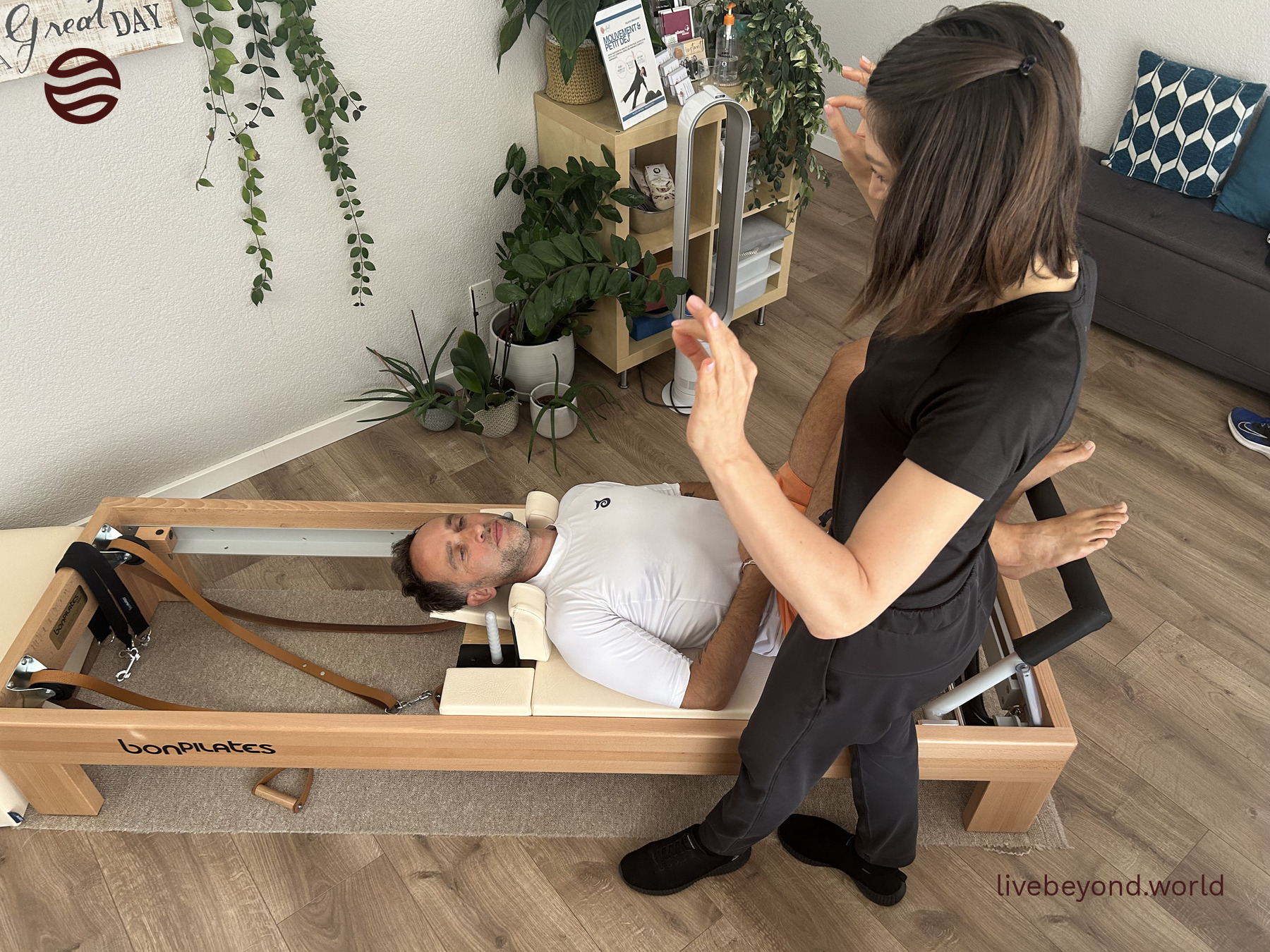
Iva Mazzoleni guiding Marek Piotrowski on the Pilates reformer in Lausanne, Switzerland, July 2025, on a Live Beyond day about Pilates and longevity.
Ask ten experts what the best exercise for a long life is, and you may get ten answers. On our quest, my son Alek and I trained with coaches, a Pilates teacher, biohackers and scientists, from a park in Warsaw to a studio in Lausanne. Here is what I took home: start with strength, protect your balance, build your engine with zone 2 and intervals, and above all, keep showing up. Your body answers at any age.
Exercise is the closest thing we have to a medicine for a long and healthy life. Strong muscles protect your bones, your blood sugar and your independence, good balance keeps you on your feet, and a fit heart and lungs go with a longer life.
The best plan starts with strength, adds balance, and then builds your VO2 max: zone 2 for a wide base, and intervals for the peak on top of it.
If you could choose only one kind of training, choose Pilates: it trains strength, balance and the mind together. Feed your muscles with enough protein, breathe well while you move, and keep the cold plunge away from your strength sessions. Most of all, keep showing up, even on the days you only stretch. Your body answers at any age. [1][2][3]
Longevity, as we mean it: more healthy, joyful years. What we mean →
Strength first: muscle is an organ
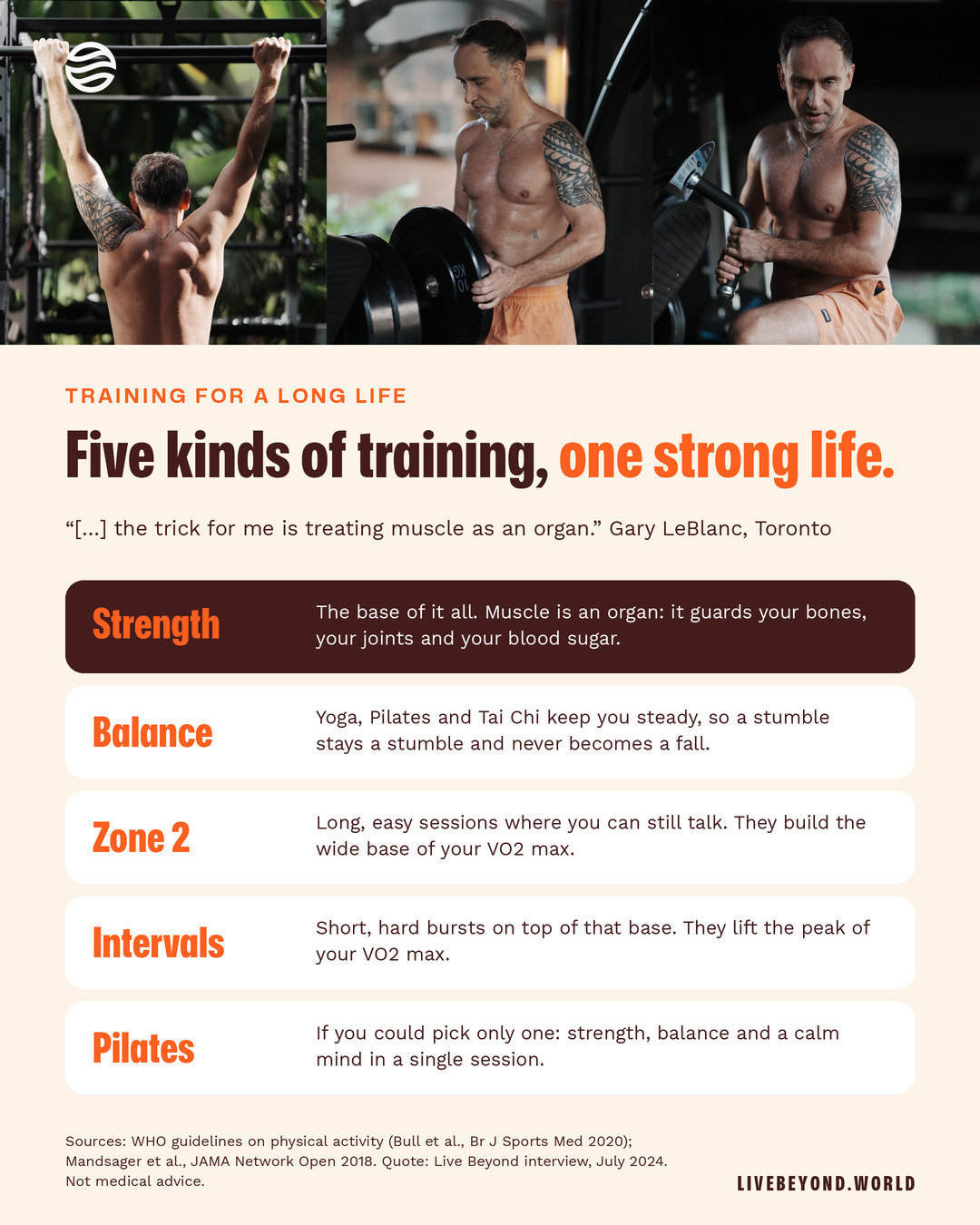
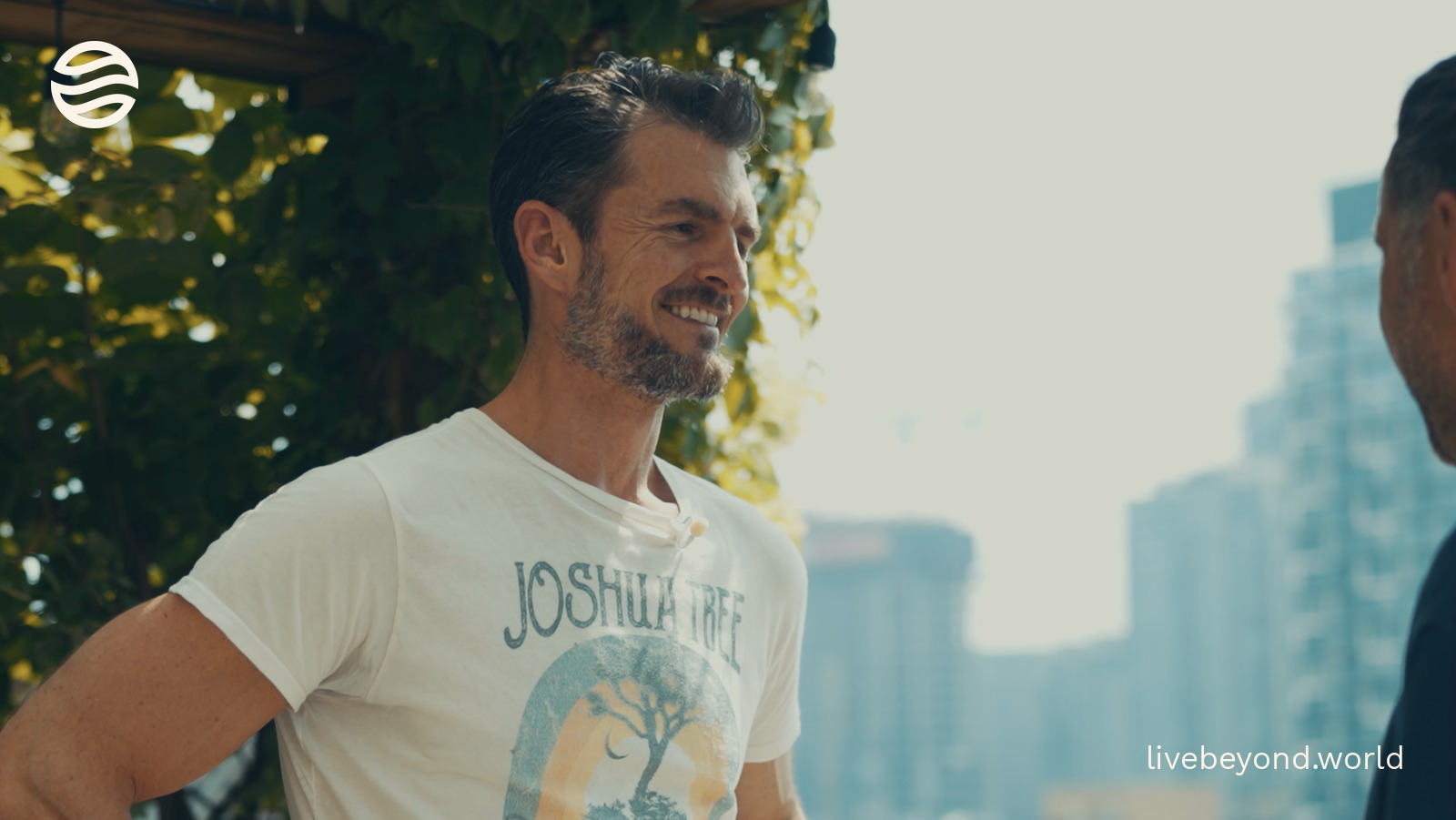
Five kinds of training for a long life, a Live Beyond infographic, with Gary LeBlanc's words from our interview in Toronto, July 2024.Gary LeBlanc in Toronto, July 2024, a Live Beyond interview on muscle as an organ.
When I ask myself what the base of my own training is, the answer is always the same: strength. It is the floor everything else stands on. My own week looks like this: three days in the gym, each one for a different group of muscles, then one day of cardio and flow, then another three days of strength. Every session starts with a long warm-up of about 50 minutes, then 30 to 40 minutes of strength work, short but intense. When I have time, I do the sauna and the cold plunge before training, never right after. And whenever I can, I add something wild and fun: rock climbing, swimming, surfing or windsurfing. In Toronto, in July 2024, I met Gary LeBlanc for the first time. He is a well-known name among biohackers there, though he calls himself a life engineer, and he looked the part. Our interview was one of the most interesting of the whole quest. He told me why he treats muscle as an organ, not as decoration:
“We have a hard time keeping muscle on as we age. We can put it on. We have a hard time keeping it. So really, the trick for me is treating muscle as an organ, finding out what my functional weight is, carrying a bit more muscle than the average person, and that becomes a place where you store sugar, so obviously, your insulin sensitivity goes up. Your blood sugar gets regulated better. Your amino acid stores are there. You can get injured. You can take a hit and still bounce back from it.”
In plain words: Muscle is alive and busy. It stores the sugar from your meals and keeps your blood sugar steady, it holds a reserve of protein for hard times, and it helps you bounce back when life knocks you over. We can build it at any age. The hard part is keeping it, so keep using it.
Strong muscles, a longer life
Adults who train their muscles are 10 to 17% less likely to die early, from any cause. Those who also do exercise that gets them out of breath are about 40% less likely. The biggest gain came at around 30 to 60 minutes of strength training a week.
Based on: Many long-term studies combined · a link, not proof [1]
If we stop, muscle quietly leaves: sarcopenia
From around the age of 30, a body that is not trained loses about 3 to 8% of its muscle every ten years, and the loss speeds up after 60. Doctors call it sarcopenia. Less muscle means weaker legs, more falls, harder stairs, less room to store sugar and a slower comeback after an illness. It is one of the most frightening things that can happen to our fitness, our health and our longevity, and the best news is that strength training slows it down and can win muscle back at any age.
Based on: Review of many studies on muscle and aging [4]
In plain words: Muscle is not something you have, it is something you keep. Every week you train, you tell your body to hold on to it. Every year you don't, it lets a little go.
In plain words: The official guidelines start at two days a week of training for all the big muscles: legs, hips, back, chest, shoulders and arms. Your own body, elastic bands, a backpack or weights all count. Our page on strength training for longevity shows how to begin, at any age. [5]
Words worth knowing
Three words behind exercise
From our glossary. Tap a card to turn it over: the science on the back, and the people we met who explained it to us.
It starts in your thirties, and almost nobody notices until it costs them something, a fall, a stair, an independence.
What helps
Resistance training at least twice a week, enough protein, and vitamin D if you are low. Grip strength and how fast you can stand up from a chair predict how the rest of your life goes better than most blood tests. Read more →
It came up most in our conversations with: Liz Parrish, David Karow, Avi Roy
Zone 2 endurance work builds new ones; high-intensity intervals improve the ones you have. Doing both beats doing either. Supplement evidence here is modest next to the training effect.
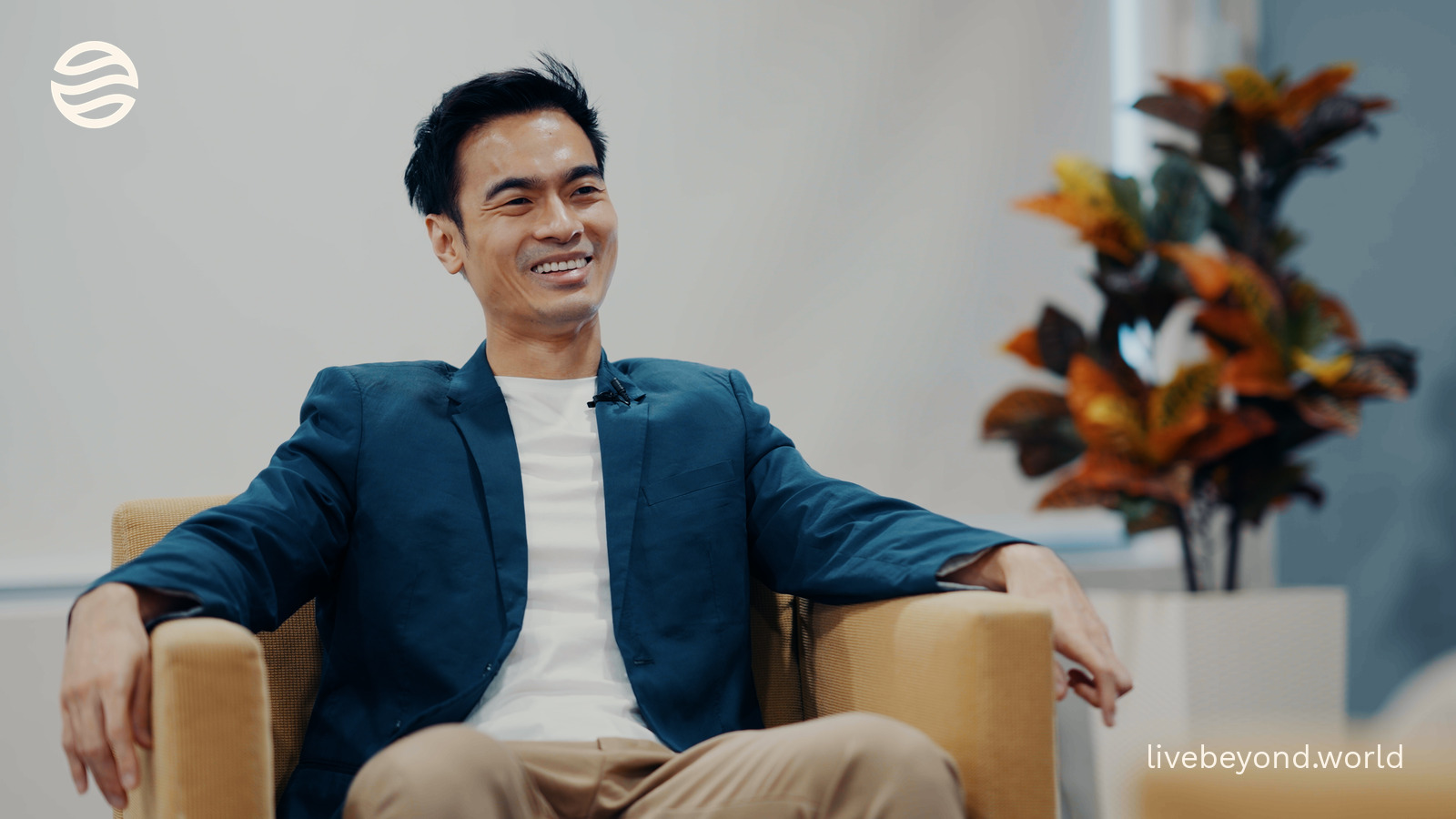
Kit Mah in Singapore, February 2024, a Live Beyond interview on training the whole body.
Second on my list is balance. A fall is one of the things that changes an older life the most. Strong legs help, but balance is a skill of its own. Like every skill, it fades when we stop practicing it, and it comes back when we train it.
Balance and strength together prevent falls
When older people living at home train their balance and everyday movements, they fall about a quarter less often. When they combine balance with strength training, they fall about a third less.
Based on: Many fair tests combined (Cochrane review) · shows cause [3]
In plain words: In the US alone, more than one in four people aged 65 and over falls every year. That is why balance is one of the most useful things you can train, at any age. [6]
Balance also lives inside the body. In Warsaw, in September 2024, I trained with Pawel Rzepecki, a movement and mobility coach at the Longevity Center, who was also one of the coaches of a Polish tennis star. He was kind, patient and very knowledgeable, and he showed Alek and me how muscles that are trained unevenly pull the body out of its natural position. His rule was short: first balance, then load. In Singapore, in February 2024, at a longevity conference, we met the biohacker Kit Mah, a man so fit he has been on the covers of fitness magazines. He told us how he learned the same lesson the hard way:
“Training-wise as well, I do tend to focus specifically just for the whole entire midsection because I once had a lower back injury from squatting, and that was many years ago when I was doing a lot of squats and I was lacking in the deadlift. So there is some imbalance there, which causes the lower back to be injured. And ever since then, I make it a priority to strengthen the midsection. So it’s not just about training […] the anterior part, which is a lot of leg raise, sit-ups or planks, but also strengthening the lower back and also the obliques and all. So it’s an overall strengthening, and adding resistance to it, very important.”
In plain words: Train the whole body, front and back, left and right. Muscles that are strong on one side and weak on the other pull you out of line, and that is often where injuries start. Balance first, then add weight.
In plain words: Yoga, Pilates, Tai Chi, dancing, or simply standing on one leg while you brush your teeth: all of them train balance. After 65, the World Health Organization advises balance and strength training on three or more days a week. [5]
Zone 2 and intervals: the pyramid of your VO2 max
Marek Piotrowski and his son Alek running between Boston and New York, on the Live Beyond quest.
Third comes the engine: your heart, your lungs and your blood vessels. Scientists measure it as VO2 max, the most oxygen your body can use when you work as hard as you can. It is one of the strongest signs of how long, and how well, you will live.
Fitness and a longer life
Doctors at the Cleveland Clinic in the US followed 122,007 adults who did a treadmill test. The fittest, the top 2.5% for their age and sex, had about 80% lower risk of dying during the study than the least fit. Low fitness carried a risk as big as, or bigger than, smoking or diabetes.
Based on: One very large long-term study · a link, not proof [2]
I picture VO2 max as a pyramid. The wide base is zone 2: long, easy sessions of brisk walking uphill, cycling, swimming or jogging, at a pace where you can still talk in full sentences, but you would rather not sing. The base makes your heart stronger and teaches your cells to burn fuel well. On top of the base sits the peak: intervals, short bursts of hard work with easy minutes in between. Intervals push the peak higher, but only on top of a good base. Without the base, the peak has nothing to stand on.
Easy most of the time, hard some of the time
When scientists looked at how the world’s best endurance athletes train, they found the same pattern again and again: about four in five sessions are easy, and about one in five are hard, mostly intervals.
In controlled trials with healthy young and middle-aged adults, both steady endurance training and interval training gave large gains in VO2 max. Intervals gave a little more.
Based on: Many controlled trials combined · shows cause [8]
The engine stays strong only if you keep using it. The goal is simple: keep your VO2 max as high as you can for as long as you can, and the way to keep it is to keep improving it, a little, all the time. Walking counts too: our page on walking for longevity shows how much.
If you could do only one: Pilates
Marek Piotrowski and Iva Mazzoleni after a Pilates session in Lausanne, Switzerland, July 2025, a Live Beyond day.
People often ask me: if I had time for only one kind of training, what should it be? My answer is Pilates. It builds strength, it trains balance and mobility, and it asks for your full attention, so it trains the mind too. In Lausanne, Switzerland, in July 2025, I trained on the reformer with Iva Mazzoleni, whom I met through Margot Hiller. Iva is a family woman in wonderful shape and a true ambassador of Pilates. After our session, I asked her why so many people would pick Pilates as their one exercise for life:
“To the general public, Pilates is known as strength and stretch with control. Therefore, there are two main components, functionally speaking, that are being taken care of. And from the creator’s point of view, the Pilates method is based on a principle of trinity, which is that we address the body, we address the mind, and we address the spirit. […] Now, biomechanically, it stretches you, it makes you more agile, it makes you more mobile, it makes you stronger, it makes you denser, it maintains your muscle mass.”
In plain words: Pilates is strength and stretching done slowly and with control, with your mind fully in the movement. That is why it covers so much at once: muscles, bones, mobility, balance and focus.
Iva is honest about its limits. For people who want to build more muscle, she suggests adding one or two short weight sessions a week. That is my view too: Pilates as the one thing, and weights when you have time for a second.
Pilates in older adults
Pooling 39 studies in older adults, scientists found that Pilates improved balance, strength, flexibility and everyday movement, and lowered the risk of falls. They concluded that it may help older people stay independent in daily life.
Based on: Many studies combined · many of them small [9]
Yoga: balance, flexibility and calm
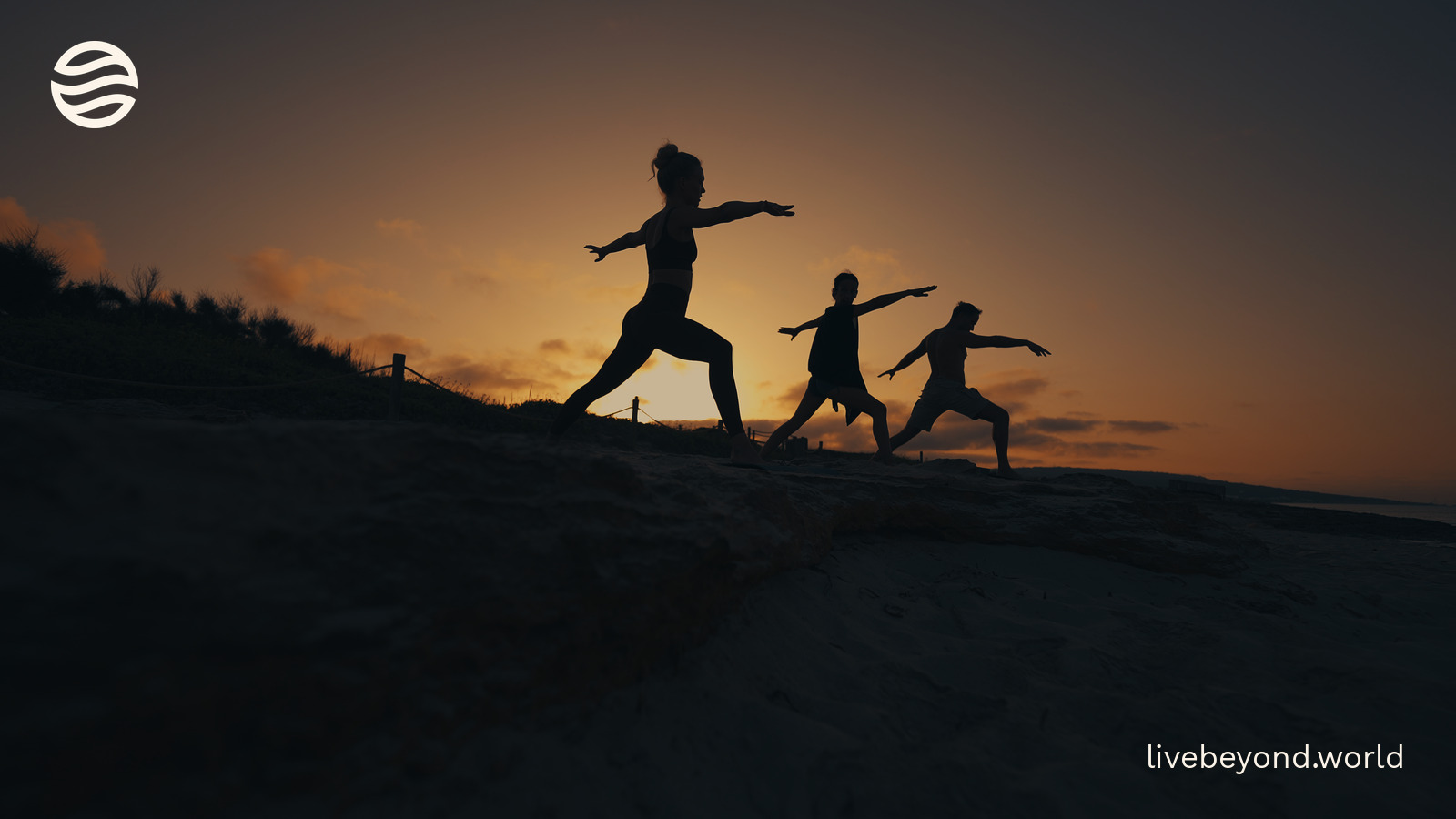
Yoga at sunset on Formentera, July 2024, with Marek Piotrowski, a still from the Live Beyond film.
Yoga is amazingly important to me. It loosens what strength training tightens, it trains balance in every standing pose, and it calms the mind through the breath. On our quest, Alek and I did Yoga wherever we could: on the rocks above the sea in Hong Kong, and on a beach in New York with a teacher who led the two of us through a class at sunset.
Better balance after 60
In people aged 60 and over, Yoga improved balance a little, and everyday movement a bit more. Whether that also means fewer falls has not been tested yet.
Based on: Many fair tests combined · shows cause [10]
In plain words: Yoga is a gentle way to train balance and flexibility for decades. Pair it with strength and with something that gets you out of breath, and you have a beautiful mix. Our page on Yoga and breathwork tells what is proven and what is not yet.
Breathe while you move
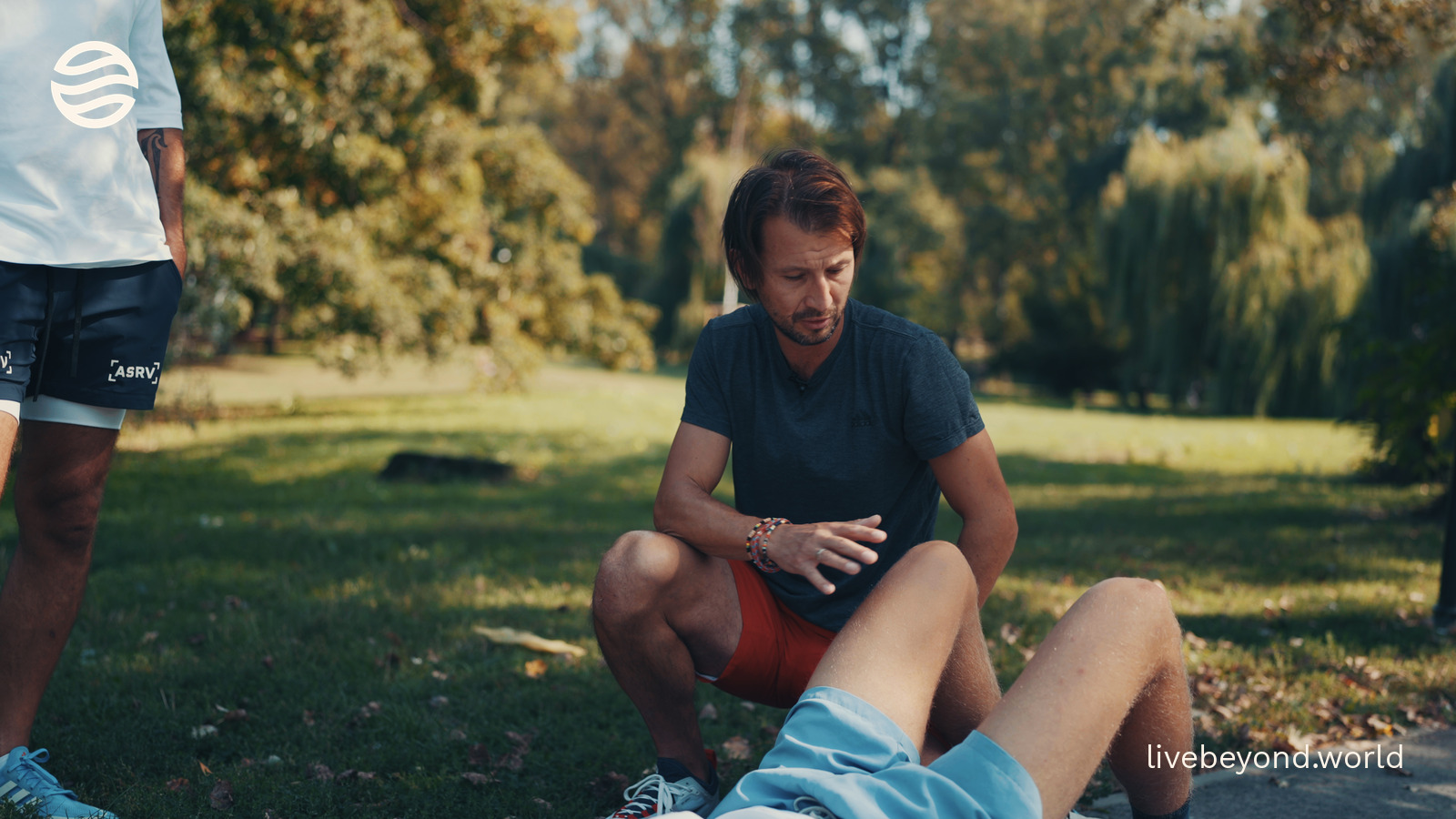
Pawel Rzepecki during a training session in a park in Warsaw, September 2024, filmed for Live Beyond.
Breathing is the part of training almost nobody teaches. In Warsaw, Pawel tested my strength: I held my arm out to the side and he pushed it down. When I took a big breath into my chest, I was weaker. When I breathed in through my nose and let my belly expand, I was stronger. Then he explained what breathing does:
“It brings stability to your body. And let’s compare your body to a car. It’s like a traction control. If there’s no traction, there’s no power, no stability, no strength. […] Core is a lot of muscles working together. It’s coordination, and it’s combined with breathing. So you cannot work with core if you don’t do the proper breathing pattern.”
In plain words: Your breath is part of your strength. Breathing low, into the belly and through the nose, steadies the middle of your body, the core, so your arms and legs push from a stable base. Before a hard lift, take one slow breath into your belly.
Iva puts breath first too. When I asked her how to look after the body, the first thing on her list was simply to be aware of every breath you take. In Yoga, breath is the center of everything: our page on Yoga and breathwork explains the simple techniques with the best evidence.
Fuel for the muscles: protein and real food
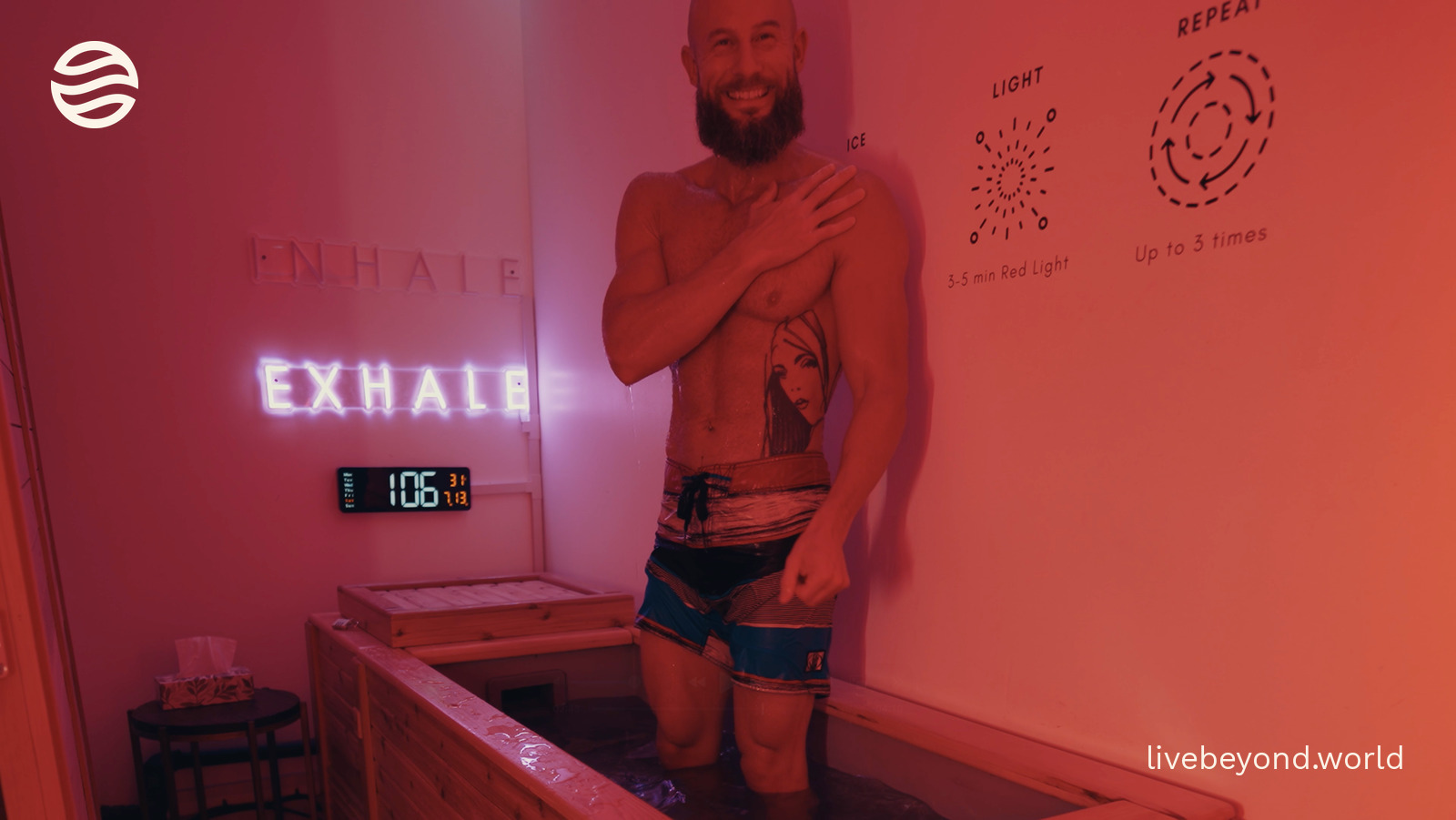
Brendan Coates in his cold plunge in Toronto, July 2024, a still from the Live Beyond film.
Training sends the signal, and food brings the building material. Muscle needs protein to grow, and as we get older the body uses protein less well, so older adults need a little more of it, always together with training. Our page on protein and longevity explains how much, at every age.
In Toronto, in July 2024, I asked Brendan Coates, a clinical nutritionist known as the Gut Whisperer, how people turn fat into muscle. He corrected me straight away:
“You don’t convert fat into muscle. You lose fat, you build muscle at the same time, provided that you’re working out and you’re eating the right foods.”
In plain words: Fat does not turn into muscle. You lose fat and build muscle at the same time, and you need both halves: the training and the good food.
And what is good food? The people who live longest in the world mostly eat simple, real food: lots of vegetables, beans and whole grains, cooked at home and shared. Read what the longest-living people eat. In New York, my friend Oz Garcia, one of the city’s top nutritionists, told us the same in his own way: eat real food that feeds you, not engineered products that don’t.
Train the body and the brain together
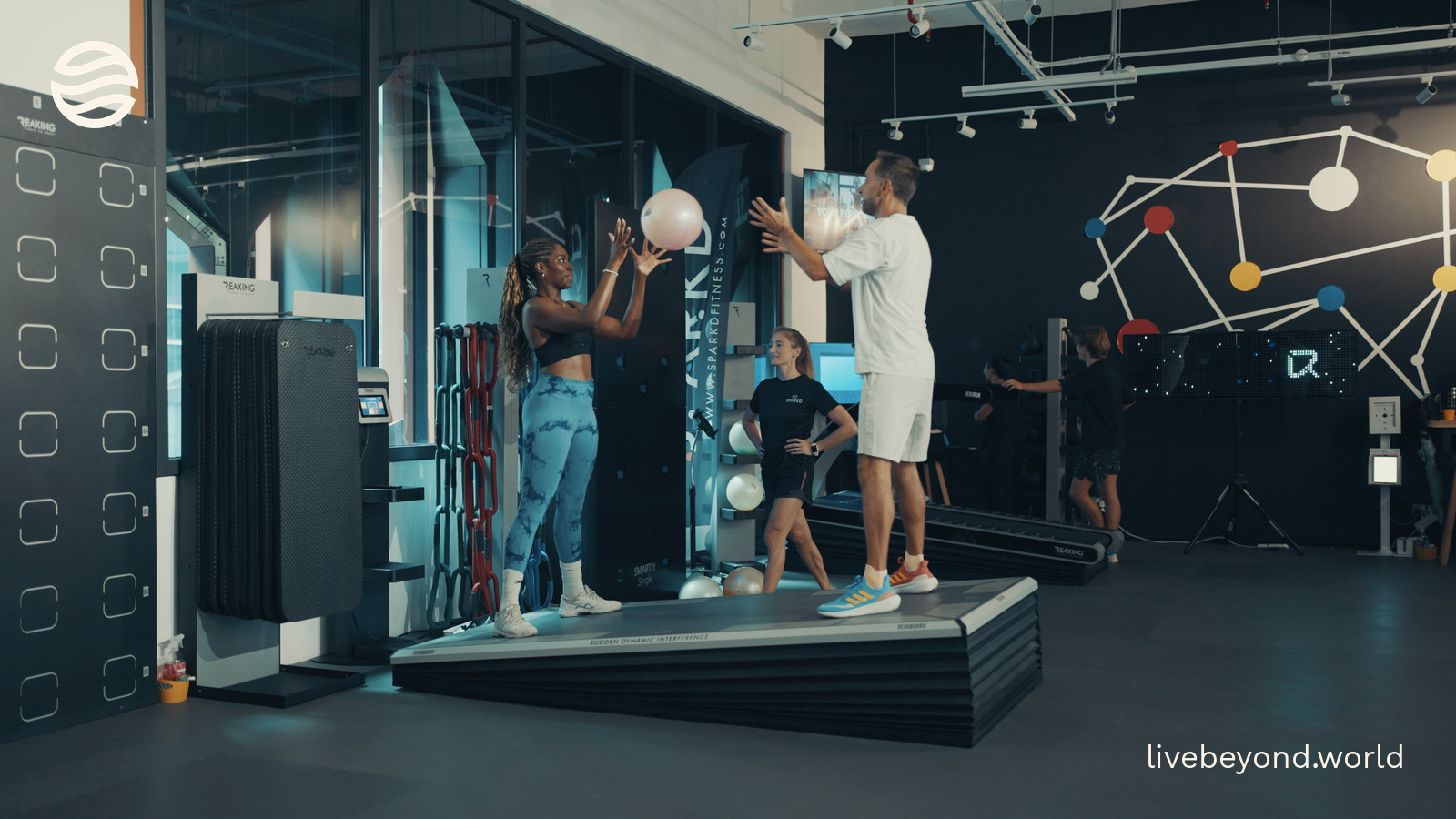
Marek Piotrowski and Simisola Oke training on the moving platform at SparkD, with Anna Milani, Singapore, February 2024, filmed for Live Beyond.
In Singapore, in February 2024, Alek and I spoke at our first conference there, and part of the program was a visit to SparkD, the gym Anna Milani created to train the brain and the body together. On a platform whose floor never stops moving, Simisola Oke and I did squats side by side and threw a ball filled with water to each other. The water shifts inside, so the ball never lands the same way twice. Every exercise there asks two things of you at once: move, and pay attention.
That afternoon I told Anna that a studio like hers should be at every gym, and I still think so. When your muscles and your attention work together, you train balance, reaction and focus in one go, and that also protects you from falls. You can start at home: stand on one leg while you count backwards, or play catch with a friend while you walk. The whole story is on our page about keeping the brain young.
Sauna and cold plunge: the right order
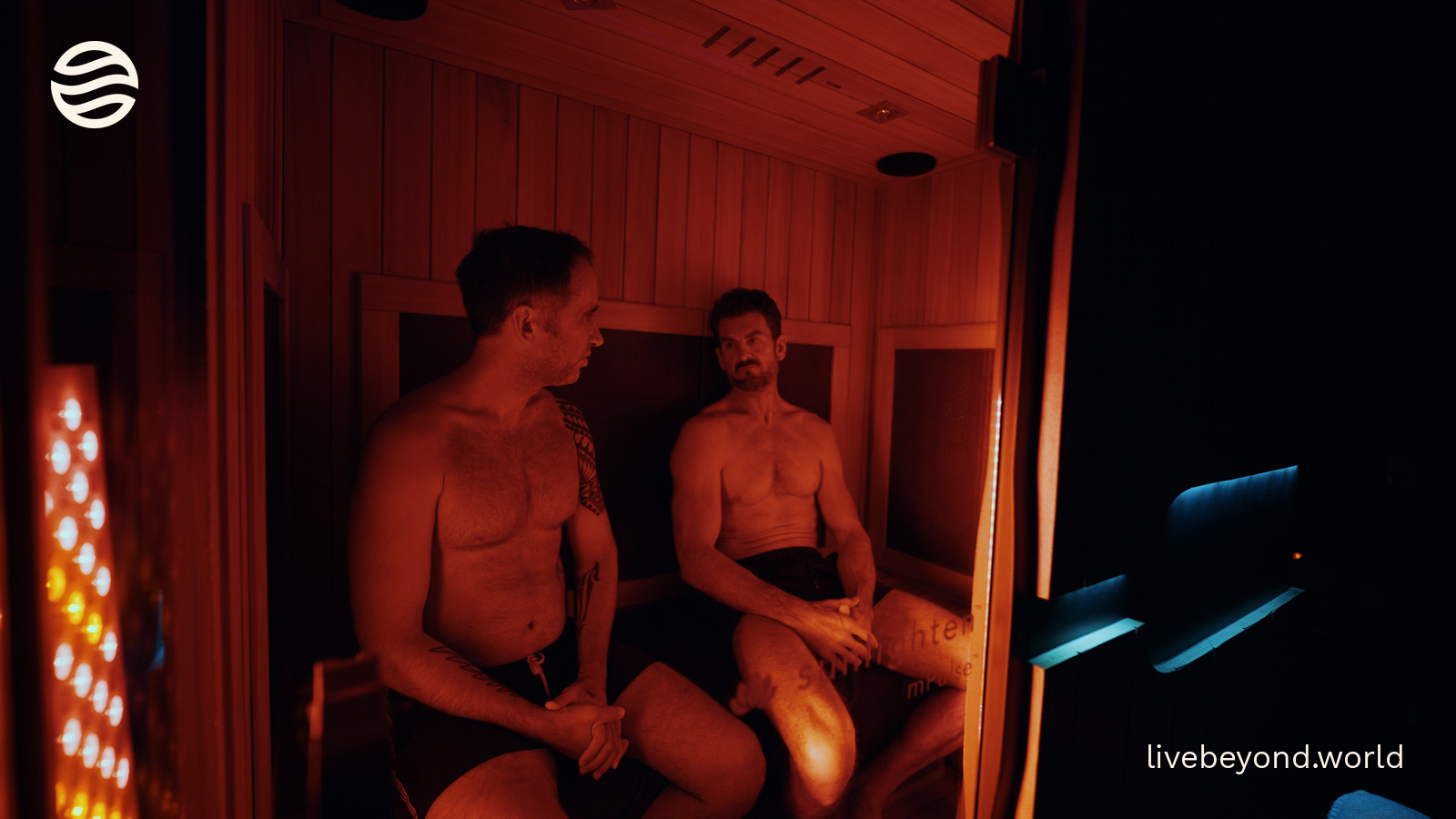
Marek Piotrowski and Gary LeBlanc in a sauna in Toronto, July 2024, filmed for Live Beyond.
I love contrast therapy: the heat of a sauna, then cold water, then rest. Sauna is good for the heart and blood pressure, and after cold water many people feel calmer and more awake. In Toronto, Gary LeBlanc told us how saunas and cold plunges have become a new way for people to meet and connect, instead of bars. Read more about sauna and cold plunge.
But if you train for muscle, the timing of the cold matters.
Cold water right after lifting slowed muscle growth
21 active men did strength training twice a week for 12 weeks. After every session, half of them sat in cold water at 10 °C for 10 minutes, and the other half cooled down on an easy bike. The men who took the cold bath gained less muscle and less strength. In a second study, the same team saw the cold blunt the muscle’s repair and growth signals for up to two days after one workout.
In plain words: Cold water straight after lifting seems to quiet the very signals that tell muscle to grow. The studies tested the cold right after training, so nobody knows the exact number of hours that is safe. Many coaches suggest a cold plunge before your workout, on a rest day, or several hours after training. A sauna after a workout is a different story: in one experiment it added to what the exercise did for fitness and blood pressure. [12]
What science is working on: keeping muscle for life
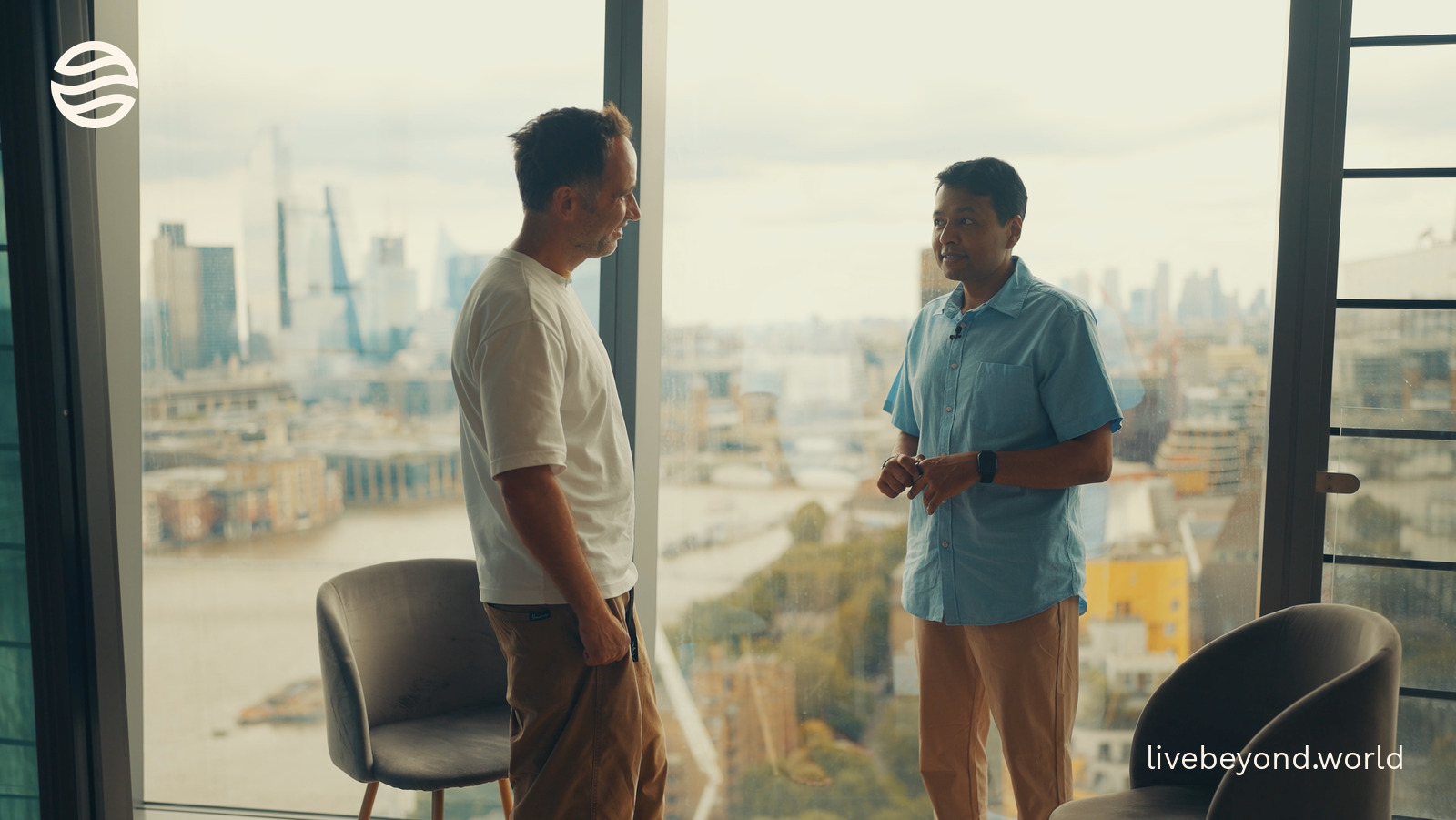
Marek Piotrowski and Avi Roy in London, July 2024, a Live Beyond interview on the science of aging.
Today, the only proven way to build muscle is to use it, with enough protein. But scientists are working on new helpers, and some of them may one day matter most for people who cannot train hard, or who lose muscle fast. Avi Roy, a cell biologist who studies aging, is one of my closest friends from the quest. We first met in Shanghai through Liz Parrish, and in London we have met at least a dozen times since, talking about science, longevity and AI. Every one of those talks taught me something. In London, in July 2024, he told me what is coming after today’s weight-loss medicines:
“And then there are other drugs that are coming down the pipeline, which is actually trying to preserve muscle, and then some are actually trying to activate so that you can actually gain muscle faster, like the follistatin therapies and things like that.”
In plain words: GLP-1 medicines help people lose weight, but part of what they lose is muscle. The next medicines try to protect muscle, or even help it grow, while the fat goes.
Keeping muscle while losing fat, in a trial
In a trial of 507 adults with obesity, published in 2026, people who took semaglutide, a GLP-1 medicine, together with bimagrumab, an experimental medicine that blocks signals telling muscle to stop growing, lost more weight than on semaglutide alone. About 92% of what they lost was fat, compared with about 76% on semaglutide alone.
Based on: One mid-stage randomized trial · not an approved treatment [13]
Today’s GLP-1 and GIP medicines already let you build muscle while you lose fat, as long as you train and eat enough protein. My dream is the next step: medicines that help you lose fat and at the same time actively help you grow your muscle mass, so it is faster and easier for everyone, even for people who cannot train hard. Read our page on GLP-1 drugs and longevity.
Follistatin gene therapy, so far in monkeys
Follistatin is a protein that releases one of the body’s natural brakes on muscle growth. In monkeys, giving leg muscles an extra copy of the follistatin gene made them bigger and stronger. A few pioneers have tried follistatin gene therapy on themselves, but it is not an approved treatment, and large trials in healthy people have not been done.
Based on: Laboratory study in monkeys · early [14]
In plain words: These are research and the future, not something to try on your own. Our page on gene therapy for longevity tells the pioneers’ stories. And the muscle you build with your own training is still the best muscle there is.
Show up, even on a low day
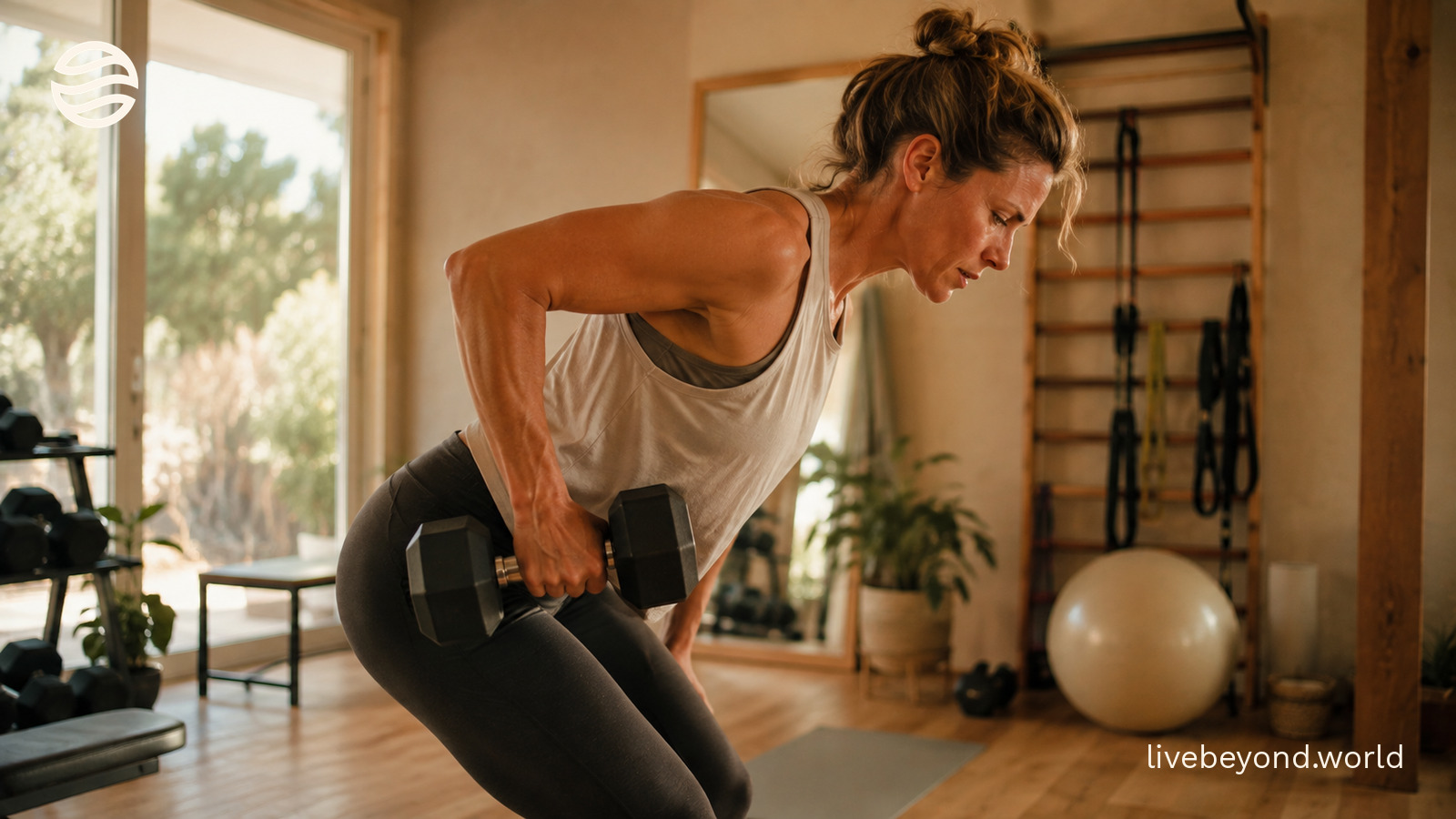
Show up, even for a short session: strength at home, any age.
Of everything on this page, this matters most: consistency. The best training plan is the one you still follow next year. And there will be days when you don’t feel like it at all. On those days, I go anyway. I do a little, sometimes I only stretch, and I go home. That still counts, because what I protect is the habit: the place, the time, and the feeling of showing up for myself.
Iva said it beautifully, in a few words she recorded for us after our talk:
“One of the beliefs we have in the method is that the body never lies, and the body forgives. And that is why less is more works if it’s done with intention and with quality, which means with awareness. So just one exercise for your body every day, just one, will remind your body that you’re there for it, and therefore, it will hold no grudge. It will not send you an invoice years or months later because it knows you will always come back.”
In plain words: A little, every day, is worth more than a lot once in a while. Your body learns that you keep coming back.
How long a habit takes
In a study in London, volunteers chose one healthy thing to eat, drink or do every day. It took 66 days in the middle, and anywhere from 18 to 254 days, before it felt automatic. Missing a single day did not really change how automatic it became.
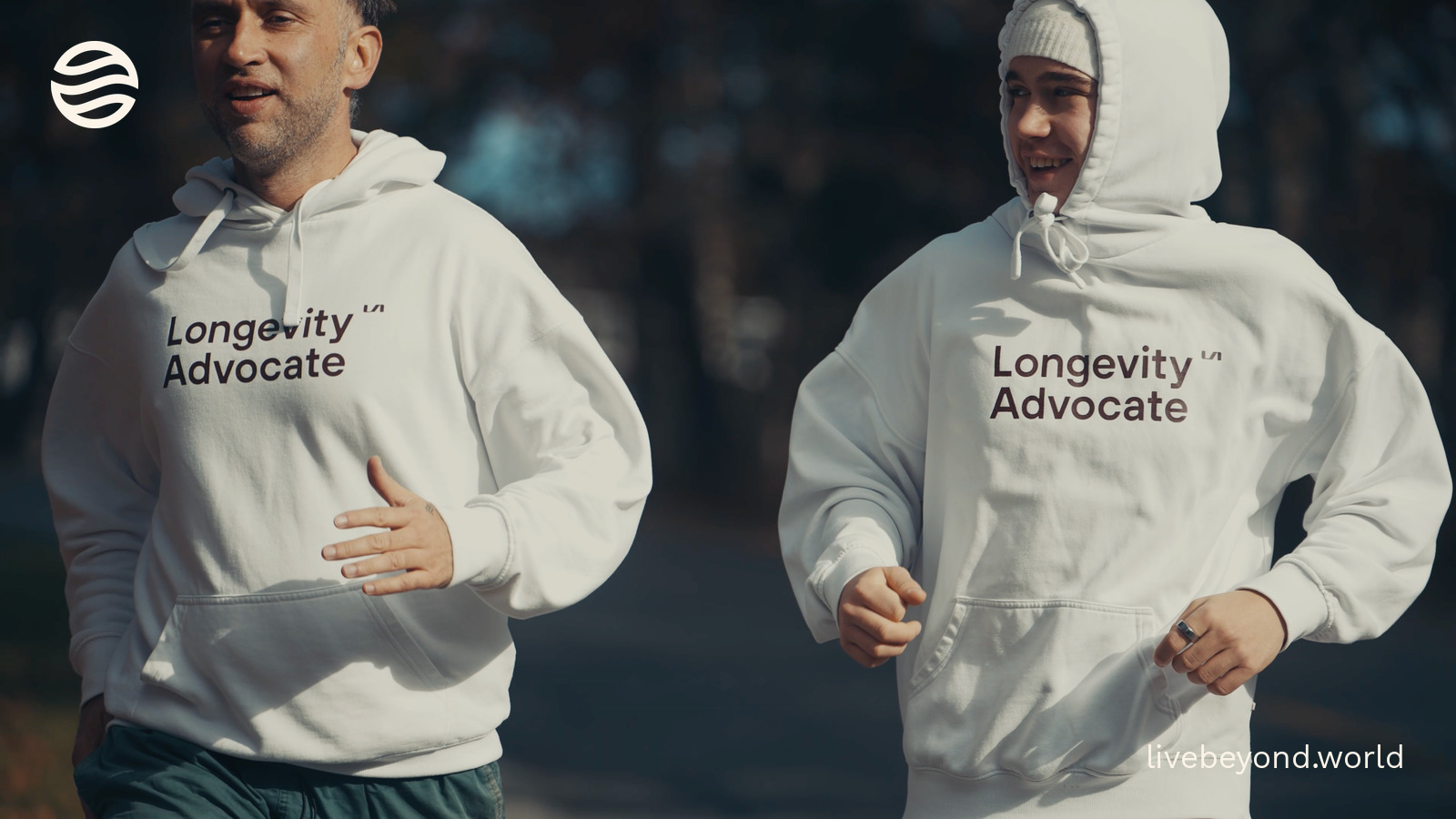
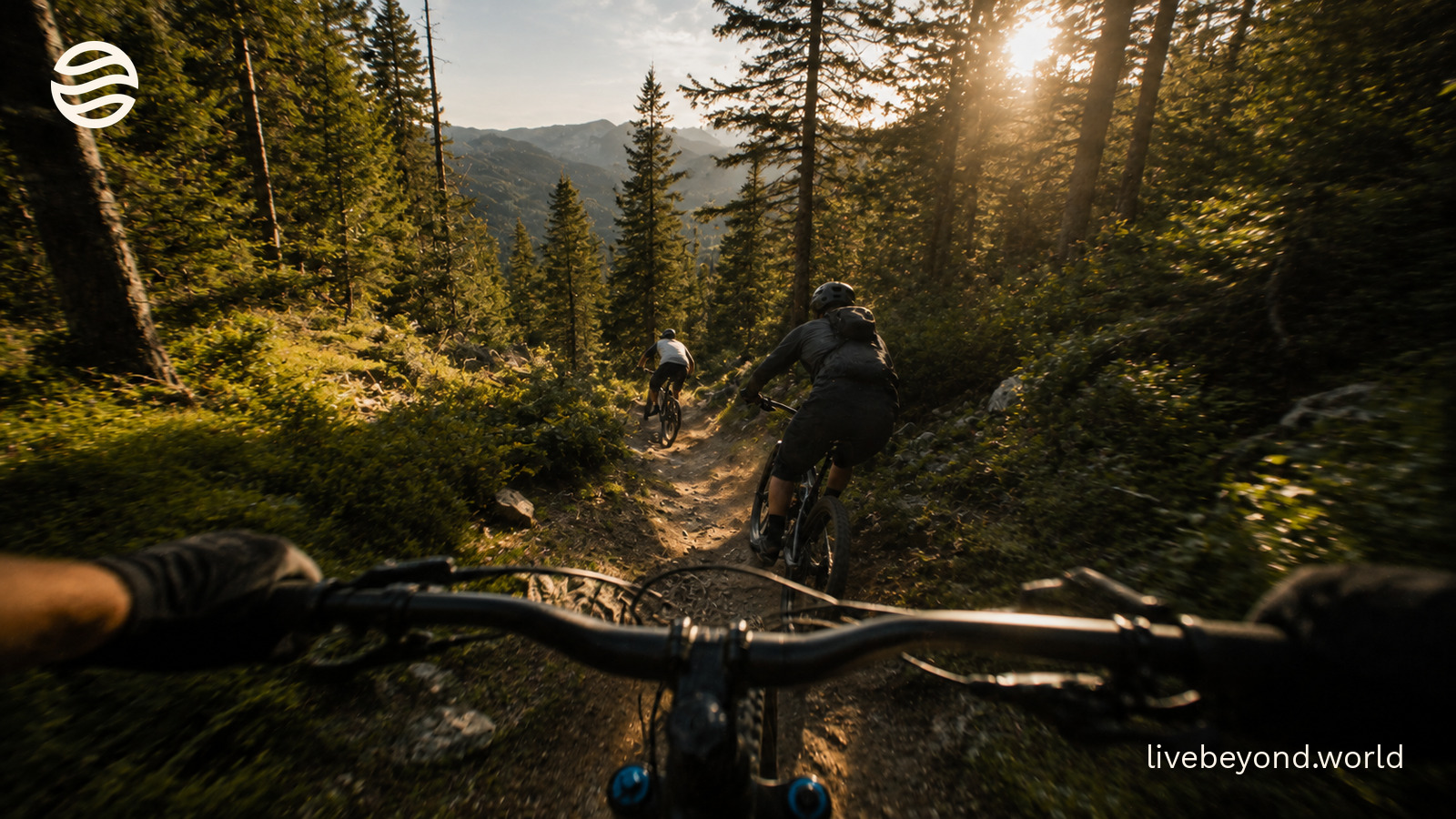
Friends on a forest trail: the joy of a body that does what you ask of it.
Training is not a punishment, and it is not only about adding years. It is the joy of a body that does what you ask of it: carrying the bags up the stairs, playing with children, hiking up a hill for the view, dancing at a wedding until late. Some of my happiest hours on the quest were in motion: Yoga with Alek on the rocks in Hong Kong, the moving floor at SparkD in Singapore, and a Pilates session with Iva in Lausanne.
Iva had a beautiful idea for families: before the bedtime story, do one exercise together, the whole family. Children learn by watching us, and a parent who moves with joy is the best coach a child can have.
Find the movement you love, and bring people into it: a friend who expects you at the gym, a walking group, a class where everyone knows your name. Then exercise stops being a task and becomes a part of your life you look forward to.
We wrote this page from Live Beyond’s own recorded interviews and the published studies listed below, with gratitude to everyone who taught us. If you have a health condition, talk to your doctor before you start a new kind of training. Hey, and one question at the end: if you could keep only one kind of training for the rest of your life, which would it be? Just tell me in one line. On Instagram or LinkedIn, wherever you are.
Before you change anything
This page shares what research and the experts we met say. It is not medical advice, and it does not recommend any medicine, supplement or treatment. It knows nothing about you. Before you start, stop or change anything, especially if you are pregnant, live with a health condition or take any medication, please talk to your doctor. In an emergency, call your local emergency number.
Sources
Every number on this page, by the number in square brackets. Quotations come from Live Beyond’s own recorded interviews, cleaned only of “um” and “uh”. Not medical advice. Talk to your doctor before you change anything.
Momma H, Kawakami R, Honda T, Sawada SS. Muscle-strengthening activities are associated with lower risk and mortality in major non-communicable diseases: a systematic review and meta-analysis of cohort studies. Br J Sports Med. 2022;56(13):755-763. doi:10.1136/bjsports-2021-105061
Mandsager K, Harb S, Cremer P, Phelan D, Nissen SE, Jaber W. Association of cardiorespiratory fitness with long-term mortality among adults undergoing exercise treadmill testing. JAMA Netw Open. 2018;1(6):e183605. doi:10.1001/jamanetworkopen.2018.3605
Sherrington C, Fairhall NJ, Wallbank GK, et al. Exercise for preventing falls in older people living in the community. Cochrane Database Syst Rev. 2019;1:CD012424. doi:10.1002/14651858.CD012424.pub2
Volpi E, Nazemi R, Fujita S. Muscle tissue changes with aging. Curr Opin Clin Nutr Metab Care. 2004;7(4):405-410. doi:10.1097/01.mco.0000134362.76653.b2
Bull FC, Al-Ansari SS, Biddle S, et al. World Health Organization 2020 guidelines on physical activity and sedentary behaviour. Br J Sports Med. 2020;54(24):1451-1462. doi:10.1136/bjsports-2020-102955
Centers for Disease Control and Prevention. Older adult falls: facts and stats. cdc.gov/falls/data-research/facts-stats (accessed November 2026)
Seiler S. What is best practice for training intensity and duration distribution in endurance athletes? Int J Sports Physiol Perform. 2010;5(3):276-291. doi:10.1123/ijspp.5.3.276
Milanović Z, Sporiš G, Weston M. Effectiveness of high-intensity interval training (HIT) and continuous endurance training for VO2max improvements: a systematic review and meta-analysis of controlled trials. Sports Med. 2015;45(10):1469-1481. doi:10.1007/s40279-015-0365-0
Fernández-Rodríguez R, Álvarez-Bueno C, Ferri-Morales A, Torres-Costoso A, Pozuelo-Carrascosa DP, Martínez-Vizcaíno V. Pilates improves physical performance and decreases risk of falls in older adults: a systematic review and meta-analysis. Physiotherapy. 2021;112:163-177. doi:10.1016/j.physio.2021.05.008
Youkhana S, Dean CM, Wolff M, Sherrington C, Tiedemann A. Yoga-based exercise improves balance and mobility in people aged 60 and over: a systematic review and meta-analysis. Age Ageing. 2016;45(1):21-29. doi:10.1093/ageing/afv175
Roberts LA, Raastad T, Markworth JF, et al. Post-exercise cold water immersion attenuates acute anabolic signalling and long-term adaptations in muscle to strength training. Journal of Physiology. 2015;593(18):4285-4301. doi:10.1113/JP270570
Lee E, Kolunsarka I, Kostensalo J, et al. Effects of regular sauna bathing in conjunction with exercise on cardiovascular function: a multi-arm, randomized controlled trial. Am J Physiol Regul Integr Comp Physiol. 2022;323(3):R289-R299. doi:10.1152/ajpregu.00076.2022
Heymsfield SB, Aronne LJ, Montgomery P, et al. Bimagrumab plus semaglutide alone or in combination for the treatment of obesity: a randomized phase 2 trial (BELIEVE). Nat Med. 2026. doi:10.1038/s41591-026-04204-0
Kota J, Handy CR, Haidet AM, et al. Follistatin gene delivery enhances muscle growth and strength in nonhuman primates. Sci Transl Med. 2009;1(6):6ra15. doi:10.1126/scitranslmed.3000112
Lally P, van Jaarsveld CHM, Potts HWW, Wardle J. How are habits formed: modelling habit formation in the real world. European Journal of Social Psychology 2010;40(6):998–1009.